Search This Blog

CCE in brief

My photo
Recovering backpacker, Cornwallite at heart, political enthusiast, catalyst, writer, husband, father, community volunteer, unabashedly proud Canadian. Every hyperlink connects to something related directly or thematically to that which is highlighted.
Showing posts with label Positive Psychology. Show all posts

Friday, 25 April 2014

Consciously Succeeding: Open, Responsible and Empowered


KPI being "key performance indicator."

To be brief:

- This is what smart business are exploring now
- This is what successful political parties/government are going to start doing, too

It's all about maximizing personal potentials - strong individuals for a strong society.

How do we get there?

- Understand behavioural economics and the science of empowerment/resiliency 
- Redesign work and workspaces with a focus on cognitive labour
- Open Data, Open Government, Responsible society.

It's about empowerment.  Leadership always is.

Looking forward to meeting the leaders out there ready to pave the way forward; we've got a lot of work ahead of us.

It's gonna be fun.


Thursday, 17 April 2014

Can You Vaccinate Against Fear?


There's a fascinating psychology behind this.  Yes, it's true that Big Pharma is interested in making money and yes, it is in their interest to have more of their product bought.


It's also true that incidences of fatalities from communicable diseases like measles, mumps and rubella have gone down thanks to the introduction of inoculations.  In fact, the increase in healthcare, social infrastructure and social services demonstrably improves quality of life across the board.  


There have been complaints, however, about inoculations causing autism.  This has been refuted; there has also been evidence that an increase in autism diagnoses has nothing to do with vaccination changes, but diagnosis changes.  Recently Aspergers was rolled up into the Autism spectrum, giving a whole group of people a new label.


It doesn't matter how much evidence is brought forward against this complaint, however, because all this evidence is trying to solve the wrong problem.  The issue was never specifically that inoculations cause autism, but that some people were fundamentally uncomfortable with the concept of inoculation itself.  Irrifutably demonstrate that there is no causal correlation between autism and inoculation and you'll still have doubters; others will simply find another straw illness to tilt at.


The problem isn't the risk - it's the fear of risk.  It's the same with wind farms - having recently come back from Germany, I met and talked with a number of youth who grew up next to wind farms and are no physically worse off than someone who grew up next to a subway, or a freeway, or a road, period.  


In the past, each of these innovations and environmental changes have provoked fear and, in each case, those fears have been associated with health risks.  

In truth, people are right in all cases, not just in the way they think they are; the health issue is not one of what we traditionally identify as physical illness, but one of anxiety.  All these things are out of the individual's control and change the individual's physical and mental landscape.  Change is an uncomfortable process that we are inclined to fear, because on some level, we're not sure if we are able to adapt.  

Therefore, we resist.


Phobias are most often irrational; fear of open spaces, fear of spiders whether they're harmful of not, fear of gay people, of black people, fear of all kinds of things that aren't actual threats.  Phobias are like allergies - overreactions to physical stiumlus that really aren't trying to hurt us.

This doesn't make them any less real or crippling - as is the case with any mental illness, phobia can get in the way of normal individual functioning and social cohesion.

Which takes us back to vaccinations - a densely packed society like ours can't function without vaccinations.  That's a ticket to plague, exacerbated by a lack of coordinated (and enforced) social rules around cleanliness, transit, dispute resolution, etc.  We aren't physically designed to live in such crowded environments; society can't function without collaboration and a certain amount of central coordination.  That's why we invented government.

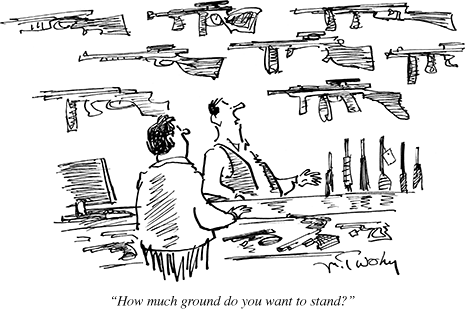
What does being anti-vaccine have to do with being pro-gun?  The gun industry is massively wealthy and spends a large amount of coin promoting gun culture, why aren't they traditionally lumped in with Big Pharma?


It's because a gun in the hand is, theoretically, about giving you power over others.  A vaccine, however, is about defending your immune system as well as that of your neighbours'.  A gun is aggressive, reactive and individual; a vaccine is strategic, passive and collective.

By and large people are reactive and individual; what pushes us to be aggressive, is we're not sales-oriented hunters, is a response to fear.

This is why the politics of fear is so widely practiced and why it allows for otherwise sane people to do pretty insane things.  It's not logical, it's emotional - when you appeal to emotions first, an individual can find all sorts of ways to validate their opinion, including through the use of micro-targeted arguments and full-on attacks.


Sadly, we're seeing an increased use of fear, isolation and idolatry in our political systems these days, catalyzing a solidifying oppositional movement.  Hate, we're told, is a purifying force - and hate is on the rise.  This is not a good thing.  There's precedent and current examples of where hate leads us.

Fear and hatred aren't the solution - they catalyze immediate, reactive action against something, but to the detriment of broader social sustainability.  If you're not killing your opponent off, you have to live with them, something hate and fear don't allow.

Hate is a purifying force, after all - it allows for no diversity, no debate.  Like fear, hate is a mind-killer.

Society is at a tipping point with a new revolution required to help us break through to a more sustainable model.  As the old system fractures, people are becoming increasingly anxious, a fact being exploited by populists doing far more long-term harm than they probably care to realize.  We are looking for names to blame for our anxiety, subconsciously trying to isolate ourselves from an increasingly invasive world.  

This isolation from the global picture and rejection of everything from inoculations to fluoride in the water to social services to immigration aren't the fire-walling solution, they're part of the structural problem.

So, what do we do?  How do address the deep-rooted reality of strong, reactive emotions like fear and hate?


There's a fascinating article on the rational choices of crack addicts that offers an interesting window into the nature of behaviour; it throws the assumption that an addict is an addict by demonstrating how crack addicts, removed from negative environments, can make more rational, sustainable choices.

This suggests that even the most negative of behaviours can change, which we should already know.  It also implies that perception isn't as functionally fixed as we like to think it is.

I recently met a 90 year-old Holocaust survivor who tells an amazing story about laughing in the face of an SS firing squad.  Chat Bowen made them deeply uncomfortable - it didn't matter that they were in complete control of the situation, they had no ability to influence Chat.  He had no fear, no anger; he simply accepted that death had arrived and their was no point fretting it.


For 70 years, Chat has lived his life with an acceptance of death and a rejection of fear and hatred. He's healthy, happy and deeply in love with his wife, his life, and at peace with the world.

The lesson here is that, even under the worst conditions imaginable, it's possible to control one's responses to external stimulus with the right perspective.  This is incredibly difficult and, like running a marathon, not an option for everyone, but it's still one option on the table.


It's important not to make the mistake of assuming fear is not real and merely a product of the thoughts you create - that's not the case.  Fear is an emotion; it precedes and informs thought, just as hatred, hopefulness and love do.

Like all emotions - like most physical processes, really - fear can be controlled.  People with anxiety disorders control fear through the use of medications and practices like Cognitive Behavioural Therapy.  Activities like yoga or simple breathing exercises also help to re-balance a body's neurochemistry (out with the bad, in with the good, oxygenate the blood).


The growing field of Positive Psychology as well as fields like Social Emotional Learning and Self Regulation are increasingly looking at fear, depression, hatred, excitement and all of our emotions as things that can be regulated.  


These regulatory processes are being introduced to our school systems, empowering our youth with the ability to recognize and up/down regulate their emotions as necessary.  Encouraged in this process is critical thinking; the ability to look beyond one's own emotions and view a situation, a person or an object in a more objective capacity (something that, despite what Ayn Rand may have thought, doesn't just happen naturally).

As with any exercise, the more you do it, the stronger you become.  Athletes train, writers write, innovators never stop iterating.  When it comes to emotional regulation, practice is a constant but the result is an increasing amount of conscious awareness and control of both one's own emotional state, but of those around you as well. 

It's impossible to really understand somebody, what they want, what they believe, and not love them the way they love themselves.


Wednesday, 22 May 2013

Mental Fitness (Brain can be trained in compassion, study shows)

 
An article that is, essentially, embracing the concept of mental fitness.  Gordon, I'd say you owe me a beer.
 
 
MA Counselling Psychology - Become A Professional Counselor W/ Our Online Masters Program. Join Us - YorkvilleU.ca/Psychology
Sylvan Learning Centers - Help Your Child in Math Sylvan Has A Tutor For You - www.Sylvanlearning.info
Enter Your Subconscious - Develop Your Subconscious Mind Download Free Training Today... - www.SilvaIntuitionSystem.com


Until now, little was scientifically known about the human potential to cultivate compassion—the emotional state of caring for people who are suffering in a way that motivates altruistic behavior.
A new study by researchers at the Center for Investigating Healthy Minds at the Waisman Center of the University of Wisconsin-Madison shows that adults can be trained to be more compassionate. The report, published Psychological Science, a journal of the Association for , investigates whether training adults in can result in greater and related changes in underlying compassion.

"Our fundamental question was, 'Can compassion be trained and learned in adults? Can we become more caring if we practice that ?'" says Helen Weng, lead author of the study and a graduate student in . "Our evidence points to yes."

In the study, the investigators trained to engage in compassion meditation, an ancient Buddhist technique to increase caring feelings for people who are suffering. In the meditation, participants envisioned a time when someone has suffered and then practiced wishing that his or her suffering was relieved. They repeated phrases to help them focus on compassion such as, "May you be free from suffering. May you have joy and ease."

Participants practiced with different categories of people, first starting with a loved one, someone whom they easily felt compassion for like a friend or family member. Then, they practiced compassion for themselves and, then, a stranger. Finally, they practiced compassion for someone they actively had conflict with called the "difficult person," such as a troublesome coworker or roommate.

"It's kind of like ," Weng says. "Using this systematic approach, we found that people can actually build up their compassion 'muscle' and respond to others' suffering with care and a desire to help."

Compassion training was compared to a control group that learned cognitive reappraisal, a technique where people learn to reframe their thoughts to feel less negative. Both groups listened to guided audio instructions over the Internet for 30 minutes per day for two weeks. "We wanted to investigate whether people could begin to change their emotional habits in a relatively short period of time," says Weng.

The real test of whether compassion could be trained was to see if people would be willing to be more altruistic—even helping people they had never met. The research tested this by asking the participants to play a game in which they were given the opportunity to spend their own money to respond to someone in need (called the "Redistribution Game"). They played the game over the Internet with two anonymous players, the "Dictator" and the "Victim." They watched as the Dictator shared an unfair amount of money (only $1 out of $10) with the Victim. They then decided how much of their own money to spend (out of $5) in order to equalize the unfair split and redistribute funds from the Dictator to the Victim.

"We found that people trained in compassion were more likely to spend their own money altruistically to help someone who was treated unfairly than those who were trained in cognitive reappraisal," Weng says.

"We wanted to see what changed inside the brains of people who gave more to someone in need. How are they responding to suffering differently now?" asks Weng. The study measured changes in brain responses using functional magnetic resonance imaging (fMRI) before and after training. In the MRI scanner, participants viewed images depicting human suffering, such as a crying child or a burn victim, and generated feelings of compassion towards the people using their practiced skills. The control group was exposed to the same images, and asked to recast them in a more positive light as in reappraisal.

The researchers measured how much brain activity had changed from the beginning to the end of the training, and found that the people who were the most altruistic after compassion training were the ones who showed the most brain changes when viewing human suffering. They found that activity was increased in the inferior parietal cortex, a region involved in empathy and understanding others.

Compassion training also increased activity in the dorsolateral prefrontal cortex and the extent to which it communicated with the nucleus accumbens, brain regions involved in emotion regulation and positive emotions.

"People seem to become more sensitive to other people's suffering, but this is challenging emotionally. They learn to regulate their emotions so that they approach people's suffering with caring and wanting to help rather than turning away," explains Weng.

Compassion, like physical and academic skills, appears to be something that is not fixed, but rather can be enhanced with training and practice. "The fact that alterations in brain function were observed after just a total of seven hours of training is remarkable," explains UW-Madison psychology and psychiatry professor Richard J. Davidson, founder and chair of the Center for Investigating Healthy Minds and senior author of the article.

"There are many possible applications of this type of training," Davidson says. "Compassion and kindness training in schools can help children learn to be attuned to their own emotions as well as those of others, which may decrease bullying. Compassion training also may benefit people who have social challenges such as social anxiety or antisocial behavior."

Weng is also excited about how compassion training can help the general population. "We studied the effects of this training with healthy participants, which demonstrated that this can help the average person. I would love for more people to access the and try it for a week or two—what changes do they see in their own lives?"

Both compassion and reappraisal trainings are available on the Center for Investigating Healthy Minds' website. "I think we are only scratching the surface of how compassion can transform people's lives," says Weng. Provided by Association for Psychological Science

Thursday, 18 April 2013

Homework for the CPC


You're a Member of Canada's governing Party. 
 
You may even be a frickin' Minister with power and budgets and stuff, yet still you have all these opposition people, science-y people and various combinations of socialist, separatist, environmentalist, communist, thug-huggers, comedians and latte-drinking liberals asking you to provide information you don't want to, tell the truth when you do speak and while you're at it, speak to the big issues that are plaguing the Canadian people and the health of our democracy.
 
It can be very taxing trying to rule a democracy.  When you don't always get your way, when people question you and when you're supposed to admit when you're wrong, it's not surprising you occasionally get angry.  Just from time to time.
 
I empathize with you.  Honest, I do - anger isn't good for your health and limits your efficacy.  We want everyone to reach their personal maximum potential so they can dedicate same to the strength of our society, don't we?  We move forward together and that includes you.  :o)
 
So, here's some homework for ya.  It's not very taxing at all - you just need to dedicate a bit of time to a social medium.  Be prepared to work some muscles you don't generally use, though, but believe me, you'll be happy you did.
 
 
Then, for bonus points, look at these, too.
 
Doesn't that feel better?
 
It's amazing how a bit of shared sunshine can turn your world around, isn't it?

Hugs and kittens,

Me


Sunday, 14 April 2013

Is it Possible to View Mental Illness Positively? (Natalie Jeanne Champagne)


You can't live life from the margins, looking in.  That's why they call it lived experience.
 
This topic came to me at a rather ridiculous time—though this is often the case and I am usually somewhere without a pen!—when putting on mascara. Ah, yes. The best ideas plant themselves in my often scattered brain when I am doing anything other than wondering what I might write about.
That being said, with mascara wand in hand, I ran into my office, grabbed a pen, and scribbled it down. And then I thought: “Can we actually view our mental illness positively?” At this moment, as I write these words, I have no idea. But I want to give it a shot. After all, what’s the worst that could happen (cue somber music)?

Connecting Mental Illness to Positivity

OK. I like things organized. My damn closet is color coordinated and separated by season. If I am really bored, or anxious, by the length of each shirt. I have a closet relegated to pants. Which I also hang. Perhaps I should write a post on being exceedingly anal? That aside, this is why I like lists: they make tough subjects easier to first break down and second digest. They remind me of my closet: simple enough to avoid being overly complicated.
A few examples which I hope will connect to our mental health/illness and positivity:
  • When we are first diagnosed we suddenly have to focus primarily on our health; physical and mental health. We practice self-care and, in doing so, learn about ourselves. It is a time that allows us, as we work toward recovery, to get to know ourselves. That is positive! Right? Right!
  • We learn to embrace change. Or, to be honest here, we don’t have much of a choice. The diagnosis of mental illness forces change upon us and in doing so we learn to adapt to life.
  • We understand empathy on a deeper level—the ability to put oneself in another’s shoes. Pain is part of recovering from mental illness and, having experienced this, we are often more understanding of other people. We know that life isn’t always fair and everyone needs a helping hand. Sorry for the cliche.
  • We learn to trust. It can be hard letting people into your life but once we do, once we learn to trust, our relationships are enhanced. In turn, our ability to communicate with people.
  • We appreciate life on a different level. When you have fallen so far from grace and climbed your way back into life, life itself means more. Waking up and feeling okay, like you can get through each day, is now special. We value life more.
  • We have perspective! Perspective is an invaluable tool that allows us to think about things, about our recovery, in a new way.
Reading this over, I sort of smile. We can find things that are positive when connected to mental illness, and I think that in doing so we can recover in a more positive way.
Maybe it’s worth it to take a few minutes, reflect on life, and ask yourself the question: “What has been a positive change in my life after the diagnosis?” It’s worth a shot. Reflecting on life is positive in itself.

Tuesday, 12 March 2013

If Confidence is King, then Humility is Queen


If you want to be a master of confidence (without falling into the trap of delusion) you gotta understand the psychology behind it.  Balance confidence with a bit of humility and you can put perfection, not yourself, at the top of the pedestal.


James Caan

James Caan

CEO of Hamilton Bradshaw

 
Ask any businessman or woman and they will tell you the same thing – confidence is a vital ingredient in the recipe for success. In other words, if you want to be really good at anything - no matter what walk of life you are involved in - you need to have belief in yourself and your abilities.
Not all of us are blessed with self-confidence. When I was starting out in business it was something that I personally had to work on to improve. I can still remember turning up for important meetings and interviews feeling incredibly nervous before walking into the room.
 
Of course, confidence improves with success and experience but there are various steps and measures you can take to make sure you are not put at a disadvantage by a lack of self-belief.
 
Preparation is everything. If you go into a meeting or interview not fully prepared then you are going to be on the back foot from the very outset. There is nothing worse than getting off to a bad start in an important meeting by not knowing that simple yet vital little detail.
 
To be honest, in these days of the internet and instant access to information there really is no excuse for being unprepared. It can make all the difference between a successful meeting and something which is a waste of time and effort. But more importantly, you will go into the meeting knowing that you personally have left no stone unturned. This is an excellent way of removing self-doubt.
 
Another good method is to think about positive outcomes you have achieved in the past. You may want to look back at case studies of clients you have worked with successfully, or sales that you have managed to close in the past. It does not even have to be business related – maybe you once gave a great speech in front of hundreds of people at a wedding! What you are doing is visualising past successes and this will put you in the right frame of mind for what is about to come.
 
Also, make sure you are resilient to criticism you get along the way. Rather than taking it as a negative, use it as a springboard for improvement. I have always said that it is the mistakes I’ve made which have given me the biggest lessons.
 
All of this has to come with a word of warning, because there can be a very thin line between confidence and arrogance. That is a characteristic that can very quickly get in the way of doing business.
 
It is a fact of life that we all prefer to work and deal with people we like and get on with. Just as importantly though, we also want to work with people that have total belief in what they are doing.

Sunday, 21 October 2012

PTSD a very real — but mysterious — problem for soldiers (by Peter Worthington)

 
The Harper Conservatives are all about fighting, dominance, etc.  They don't seem to care about the individual or social psychological consequences of their aggressive approach to politics.  Our democracy is suffering.  Our soldiers are suffering.  It's not too late, though - they can turn the ship around.  If they won't, then perhaps it's time for a new captain.

PTSD a very real — but mysterious — problem for soldiers


TORONTO - In recent years, it’s become generally accepted that post-traumatic stress disorder (PTSD) is a genuine affliction that can affect those in high-tension, physically and emotionally charged jobs: Military, police, fire-fighters, emergency medical people.
Soldiers, especially, are prone to PTSD. In fact, the greatest threat to Canadian soldiers on dangerous missions (like Afghanistan) is not roadside bombs, ambushes or enemy fire, but PTSD.
It’s estimated that up to 25% of soldiers in danger zones come down with some degree of PTSD. And symptoms can occur years after the experience, and/or be manifested in alcoholism, severe depression, aberrant behaviour, even suicide.
PTSD is an invisible war wound that can be as devastating as a missing limb. Or more so. Often unrecognized, there is also stigma attached — though not as much as in the past when PTSD was variously labeled as shell shock, lack of moral fibre (LMF), battle fatigue, even cowardice.
These days PTSD is accepted for what it is. Soldiers basically feel relieved if they don’t come down with it – or don’t think they are afflicted. Often they just don’t know. Research is never-ending about the causes and incidents of PTSD.
In the U.S., it’s estimated that PTSD afflicted up to 20% of those who served in the second Iraq war; 10% who were in the brief Desert Storm campaign; 30% who served in the Vietnam war.
When undiagnosed and untreated, PTSD sometimes leads to suicide.
A recent news item that caused concern was 38 U.S. Army soldiers committing suicide last July — a grisly record, considering that in a volunteer army, all applicants are supposedly screened for emotional and physiological stability and such.
Since the beginning of the war in Afghanistan, over 2,600 American soldiers have committed suicide — compared to 2,000 who died fighting. That’s a horrendous statistic.
Of 187 U.S. military personnel who committed suicide up to August this year, 116 were on active service, 71 in reserves. It’s probable they all suffered from PTSD.
In the Canadian military, 20 soldiers committed suicide in 2011—up from 12 in 2010. While not on the scale of the U.S. military, it’s still a concern because volunteers in our military are also screened for emotional stability.
While there is research to determine types who might be susceptible to PTSD — and even more research on how best to treat the ailment — there is virtually no research underway on personalities unlikely to succumb to PTSD.
And there are such types who seem immune to stress disorder.
The Bellwood Health Clinic in Toronto specializes in treating those afflicted with PTSD. And it’s not just soldiers. Police, firefighters, individuals in hazardous jobs are all susceptible courtesy of their occupations, though for obvious reasons they get far less attention than the military.
(As an aside, it has always puzzled me that a young nurse in an emergency ward can be exposed to horrendous injuries yet not come down with PTSD, while a soldier who is trained to expect the worst, may find it traumatizing).
At Toronto’s Bellwood Health Clinic, Michael Hartmann, clinical manager of the PTSD/trauma program, and Dr. Simone Arbour, research coordinator, suggest that what may tip the balance with a soldier, say, in Afghanistan, is not what he endures but the horrors he sees others subjected to. This seems a valid observation, since being in the eye of a hurricane is often easier than being on the fringes.
One of the problems of soldiers returning home with undiagnosed PTSD, is that they often have no outlet for their feelings. Family members and friends can’t fully understand what they’ve been through, thus they turn inward and emotionally further isolate themselves.
Bellwood staff find families can be vital for helping veterans readjust. The longer PTSD is dormant and untreated, the more rigid and obsessive it can get.
Some soldiers have done several missions in Afghanistan while being afflicted throughout with varying degrees of PTSD, that steadily intensify.
What makes Afghanistan so prone to cause PTSD is that every time a soldier left the base for any reason, he/she was constantly aware that a they could run into a roadside bomb could at any time. In some cases, a soldier in Afghanistan might never have been shot at, never engaged the Taliban in a fire-fight, yet came down with PTSD from simply driving in streets or the countryside.
Every soldier was always aware that someday the law of averages was likely to catch up with him. Every trip outside the wire increased the odds for an incident.
In that sense, Afghanistan was more nerve-wracking than a conventional shooting war like WWII or Korea, or even Vietnam.
When asked if there’s any way to detect those likely to be susceptible to PTSD, the answer from Michael Hartmann was a blunt: “That’s the million-dollar question.”
It’s an answer the army would like to know. Training, morale, discipline, understanding, all help to prepare an individual, but there are no guarantees. Lt.-Gen. Romeo Dallaire coming down with PTSD after commanding UN Forces in Rwanda during the time of genocidal slaughter, brought acceptance and respectability to the ailment, but did little to lessen its prevalence.
U.S. and Canadian statistics alone indicate need for research into personality types resistant to PTSD. As far as one can determine, those who have the ability to put events behind them and move on without looking back, seem less prone to come down with PTSD. But the human psyche can take only so much.
In World War II, Field Marshal William Slim remarked of the Burma campaign that “the British soldier is not braver than other soldiers, he is just braver longer.”
That assessment could apply to those who don’t come down with PTSD. It just takes longer to get them. No normal person can endure horrors indefinitely without cracking.
Now that Afghanistan is kaput for Canadians, the task of dealing with PTSD “victims” (if that’s the right word) is the responsibility of Veterans Affairs, which these days has to deal with a different sort of wounded soldier than in past wars.
Not all PTSD is the same, but all types can be crippling and all deserve the support that is given to those who have visible, life-altering wounds.
In many case, PTSD is a war wound — and soldiers who are wounded for their country have earned and deserve everything the country can do to repair the damage.
Most would agree with this, but words and deeds don’t always coincide.
Too many of Canada’s wounded feel now that the shooting is over, they are being abandoned. Sometimes, their only protector is media publicity, because that’s what grabs the attention of politicians who make the decisions.


Presence, Bullying, PTSD and the Resiliency Solution


Look at Dianna Booher's list of traits common to people who "lack presence":
 
  1. Others often interrupt you as you speak.
  2. Your recommendations carry little weight with decision makers—or even your friends.
  3. You often hear, “I’m not following your point. Would you repeat that.”
  4. Your stories seem to “fall flat” and have no impact during formal presentations.
  5. You often lose emotional control during meetings, either displaying anger or withdrawing.
  6. You have difficulty facilitating discussions among strong personalities.
  7. In a group, you feel more comfortable standing off to the side than in the center of activities.
  8. Team members often make decisions on important issues without asking for your input.
  9. When others ask questions or seek your opinion, you have difficulty thinking on your feet to respond clearly, concisely, and completely. You typically feel that you need a “re-do.”
  10. Others point out inconsistencies in your behavior. What you say you value and believe doesn’t match what you actually do. You don’t demonstrate the “courage of your convictions” to act. Consequently, you seem irresponsible or unpredictable to others.
Then, ask yourself what kinds of people tend to be targeted for bullying and ask yourself, why?
 
Then, look at the sorts of behaviours that stem from Post Traumatic Stress Disorder and the consequences that stem from it.
 
Lastly, dig into Positive Psychology and the Resiliency Solution.  If the sorts of behaviour that encourage bullying can be overcome and if the inclination to bully those who "lack presence" can be trained against, what kind of difference would it make to include educaiton that covers this kind of thing in our schools?
 
We're already starting to do it through Social Emotional Learning and programs like Ontario Shores' mental health curriculum.
 
We can make the difference - not be reacting to bullying, but proactively educating and training individuals against it, like a bullying innoculation. 
 
It's a social win, a political win and a fiscal win, just waiting for someone to take the lead.