Search This Blog

CCE in brief

My photo
Recovering backpacker, Cornwallite at heart, political enthusiast, catalyst, writer, husband, father, community volunteer, unabashedly proud Canadian. Every hyperlink connects to something related directly or thematically to that which is highlighted.
Showing posts with label Liberal Party of Canada. Show all posts

Thursday, 20 February 2014

Roots and Umbrellas: Weathering the Canadian Spring


Justin Trudeau has positioned himself as the voice of change in Canadian politics.  His team has come to the conclusion that a coalition of middle class, youth, and a few other key demographics can buy this message and vault him to the PMO.
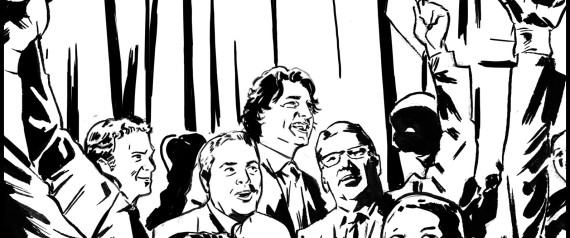

To distinguish himself as different from what came before, he has strategically distanced himself from some established political staples.  In times of old, it was common wisdom to surround yourself at big conventions with the winningest faces in your Party's history, hoping some of their shine will rub off on you.  

Not ironically, there are more than a few would-be Liberal candidates out there who spent more time selling their tenuous links to Trudeau than trying to define their own vision and brand.

There's no question that something has to change in Canadian politics; our system has gone off the rails, with partisan convention trumping the actual constitutional functioning of Parliament and government.  


The system as-is offers little shelter to every-day Canadians.  Even MPs don't know what they're supposed to stand for or who they're answerable to these days; on paper it's their constituents, but everyone knows the balance of power lies in the hands of the Party, not the People.


What good is a strong hand at the till if not everyone is allowed on the boat?

Which is why I think disbanding the Liberal caucus was a good thing, in principle (which isn't the same thing as smart politics, but I digress).  There have been disparaging words thrown his way for dismissing loyal Party stalwarts and "kicking them to the curb."  While I can understand the sentiment behind that feeling, I think it's really a symptom of the culture of entitlement that pervades our politics.

The once-Liberal Senators haven't been kicked out of the Liberal house so much as they've been set free to follow their conscience instead of partisanship interests.  And that's what the Senate is supposed to do.  In fact, partisanship on the whole is more convention than the law of the land - it has its value but often becomes a thick lens that obscures our politicians' ability to see and hear Canadians.

But I don't think it's smart to completely distance oneself from the past, good or bad.  

Here's why.

1) Canada is a temporal creature that must be understood in the context of where we've come from to properly determine the right course forward.  Engaging with leaders of old is about more than just borrowing their brand; it's about receiving their counsel.  What's been tried before, what didn't work?  What meta-trends have they seen form over time that younger people might be able to read about, but not feel and understand in their bones?

2) Today's seniors were yesterday's youth.  If you turn your back on the past, you are choosing not to represent those who shaped today's present.  It's bad for policy, bad for image and equally as important, it sets a precedent you might not like.  History shows us how this works.

3) Those who fail to understand history...  I have been involved in a few leadership campaigns where relative Party "outsiders" decided they were going to change the system that they felt was flawed and exclusionary.  They were determined to "do politics differently."  

Once they won, that is.  When it came down to the brass tacks of political logistics, I saw nothing different between their operation and the operation of the establishment.  Top-down hierarchies, closed-door meetings of insiders, divide-and-conquer strategies, so on and so forth became the fire in which this opportunity to do things differently would be forged.  

You cannot do politics differently by simply switching the paradigm and leaving those in the ivory towers and skyscrapers to rot.


4) Canada's future must be built on common ground.  

We cannot talk about big tents or moving forward together if we are consciously leaving people behind.  It's as simple as that.  This isn't cheap rhetoric or an idealistic fantasy - it's fact.  The greater the collaborative diversity, the stronger our chance of successful adaptation.  


From severe weather to increased political unrest in places that have been stable for generations, things are changing out there.  We need all hands on deck to weather the coming storms.

So yes to sunny ways, to the essence of good leadership - which is persuasion, not force, and setting the example, not micro-managing from afar.

But a tree without roots cannot hope to grow far and it never hurts to carry an umbrella.  That's the sort of experienced wisdom our elders have to share.

Friday, 1 November 2013

Putting a Polish on True Grit


Everything about the Conservative approach to politics fits within their emotional pitch to Canadians; sound-bite, reactive, targeted.  The whole operation is designed to make people feel reactive - to crime, to corruption, to anything that makes them feel like someone else has an unfair advantage.  That includes social services and education.  The Tory narrative also encourages voters to think strictly about their immediate issues, which don't include the environment or lateral, structural thinking.

When the Liberals try to ape the Conservative approach, they help grow more conservatives as surely as if they were to talk strictly about conservative issues like crime and punishment.  Even when the Liberals gain votes from this approach, it comes at the expense of realigning Party interests to lighter shade of blue.  The results are the same.

Liberals need to be Liberals in how they operate, which means exploring the tools that engender proactive, patient, pro-social and long-term thinking.  We're finally seeing a move in that direction now through the way email blasts are framed, an emphasis on listening over messaging and the kinds of positions that are being taken and through big picture moves like open data, open government and crowd-sourced policy ideas.

The trick for Liberals at all levels now is to rediscover their sense of purpose and optimism and to have the courage to keep building what they believe in - which, at it's core, is a stronger Canada for all.

Tuesday, 27 August 2013

Team Sonny Cho: What Leading By Example Looks Like


We've all heard the line: "I can work all kinds of miracles for the Riding/City/Province/Country, but only if you elect me.  You need to vote for me to make change happen."

You get the job you audition for - when you're an Opposition Leader who does nothing but oppose, you might as well get comfortable being in Opposition.  Even should you form Government, you're still gonna end up opposing things, not accomplishing them.  When a politician says "I'll do stuff if you support me," they're asking for a mandate to get support - if they were serious about effecting change, they wouldn't wait.  They'd be doing it already.

There are some great politicians out there who have walked the walk since day one.  They aren't as populous as you'd think, sadly.

Which is why I love Team Sonny Cho's idea of a community care box.  Campaigns build profile and engage citizens - why not use that focus for the betterment of your community?  There's no reason you can't chew gum and walk at the same time.  If you truly want to be a leader, lead by example - that's what will win the people and set the standard.

Full confession - I served as Sonny's Campaign Manager prior to the amazing Patrick Smith.  The Team they have assembled include some of the smartest, most creative, most dedicated and fun people I've had the pleasure to work with (and I've worked with quite a few).

I encourage the community to support the Care Box and would encourage all political candidates and sitting politicians to follow this example.  This is the kind of leadership the people of Canada deserve.
 
UPDATE: Not sure if any of the people who joined this campaign with the intent of walking the walk are still there.  Not sure if the community box initiative is still happening. 
 
Leading by example is hard, and it requires a leap of faith - but if that's what you're asking of others, surely it's worth the effort?

Monday, 8 April 2013

Apparently Martin Goldfarb Reads WAKATA, Too


Canadians aren't technocrats and political theatre (clearly) isn't a scientific exercise.  We want narratives.  We want destinations and journeys that we can see ourselves participating in.  Political visions need to be about what our country can look like - not as a fire-walled lock-box of nationalism, but as a whole that's greater than the sum of its parts.
 
A while ago, I proposed The Conscious Society as a working title for a Liberal vision for Canada.  Bob Rae one-upped me with The Successful Society.  Team Trudeau doesn't have to rely on one of these brands; they're smart people, they can craft a narrative of their own. 
 
It's the message, not the metaphor, that matters.


Wednesday, 3 April 2013

Canadian Liberalism and The Successful Society

It's not hard to see why I love this Bob Rae post (reproduced in full below).
 
The values he expresses are the same ones I believe in.  They are not the exclusive property of any one Party; they are a common expression of society shared by most Canadians and open to all.  The Liberal Party, at its best, doesn't see itself as the only legitimate voice for this shared worldview; instead it strives to be a prism for the voices of everyone.
 
Without question, the Liberal Party lost its way for a while; to paraphrase Gerry Butts, it wasn't that Canadians had lost faith in liberalism so much as the Liberal Party seemed to have.  It might just be finding its way again.
 
I tend not to get hung up branding; it's the concept, not the wording, that matters.  Having said that, I understand the need for terminology to communicate concepts; I liked the nuance of The Conscious Society, but if Bob Rae's The Successful Society sticks I'm good with that, too.  It's the shared destination that matters; no matter where we come from we all end up in the same place.  We all gain from the journey when we travel together.
 
Of the Political Parties in Canada, it's the Liberal one that is seen as the least rigid, the most inclusive and yes, the most resilient.  When liberals hold true to what they believe in, Liberals are empowered to do what they do best - listen to Canadians, communicate with our partners and create shared solutions that move everyone forward.


What follows in the first in a three-part series by Liberal leader Bob Rae on the resilience of liberalism.
 
I am a Liberal because I believe in the dignity and equality of every human being and I believe in a democracy where we care about what happens to each other.

I believe that the pursuit of prosperity, social justice and sustainability can best be achieved together, and that bringing them together is the job of an accountable and democratic government.

I want the policies to achieve these goals to be based on evidence, on what works, and not on ideology.

I am a Liberal because I believe that love is better than hate, because I believe in celebrating success and never resenting it, and because I do not mock failure.

I believe in enough government to help us all achieve success, but not too much government to stifle initiative and creativity. I understand that markets are the best way to create prosperity, that a progressive tax system is necessary to pay for programmes, and that all of us -- individuals, families, businesses and governments -- have to live within our means.

I want every child to have the love, support and education they need, and everyone to have a job that reinforces dignity and security. I want those who are less able, to receive the support they need, and to allow those who are older to continue to live in dignity.

I believe that access to good health care, education and housing are fundamental attributes of a good society, and well within our means as a successful society. I believe in the Charter of Rights and Freedoms and the independence of judges. I believe that punishment should fit the crime, that public security needs to be protected, and that a good and strong society will encourage rehabilitation and change. I would rather build a school than a prison, and believe that it is important to be as tough on the conditions that give rise to crime as we are on crime itself.

I am a Liberal in Canada because I want us to build a better world based on the rule of law, where we celebrate and share our values.
I believe that while charity and justice begin at home, their pursuit does not end there. The reduction of violence, the protection of rights, the closing of the gap between rich and poor, the greening of the planet are all best achieved with an approach that starts at home but embraces the world.

I am a Liberal and a proud Canadian. I am proud to be a member of a party that has consistently supported an ever expanding sense of citizenship based on our inherent rights as free women and men, of our two official languages, French and English, a distinct Canadian flag. This is a federalism that celebrates the unique identities and rights of Canadian provinces and territories, and understands the need for a deeper reconciliation between aboriginal Canadians and all those who have, through the centuries chosen to make Canada home. I am proud of a country that celebrates free expression, diversity and pluralism, and the right of everyone to be themselves without fear of discrimination.

We came here in many boats. We're in the same boat now.

The resilience of the liberal idea gives us hope and strength. Our task is to keep building a country and a party worthy of the idea itself.


Liberalism: A resilient idea, a resilient movement

It all starts with an idea and a feeling -- about individual conscience, freedom, and dignity. All else flows from that.

The idea of liberalism in history is connected with powerful changes -- from economies and societies based on hierarchy and conformity to those based on people demanding to be heard, insisting that authority be made accountable and transparent.

It is an idea whose power is felt today -- in societies around the world that fail to respect the rule of law, that disregard diversity, that insist that the power of the party or class or privilege is more important than the primacy of freedom.

Liberalism's journey has been about understanding the key role of economic freedom, and government's role in ensuring a strong capacity for regulation and the rule of law, to make sure that someone's freedom does not become a licence to abuse power.

Liberalism understands that for each person to achieve their freedom, society needs to help break down the barriers to human potential. Liberalism understands the dilemma that it is not enough to say that the rich and poor are equally able to sleep under bridges.

In the great movement for democracy that has marked the last 200 years, liberals have been at the forefront of expanding the franchise and expanding rights -- to go beyond a world determined by wealth and colour to a world determined by equal rights and a sense that a good country is one where people care about what happens to one another.

In the last half century we've become more aware that the great British liberal Edmund Burke was right when he talked about society being a contract with those yet unborn, or to borrow a phrase from our aboriginal tradition, that we borrow the Earth from our children and our responsibilities have to last as long as the wind blows and the rivers run.

Samuel de Champlain came to Canada in the early 17th century formed by the experiences of a Europe literally torn apart by religious and ethnic conflict. The "great and good place" he saw in Canada was to be marked by a spirit of reconciliation and a recognition of the rights and traditions of all -- Catholics, Protestants, non-believers, and the aboriginal people he encountered as he travelled eastern and central Canada.

The people and institutions he left behind did not always live up to his hopes and expectations. Violent conflict, death by disease and neglect, conflict between English and French -- our early history was not often marked by civility.

But as the refugees flowed north from the United States after the revolutionary war, and immigration continued from Europe, liberal ideas began to take hold in the provinces of British North America. While the supporters of the Family Compact wanted a government that would insist more on order than on liberty, the irresistible arguments for freedom and for responsible government began to win out. Joseph Howe in Nova Scotia, followed by Baldwin and Lafontaine in "United Canada" -- we can trace the organized origins of the liberal movement in Canada (and indeed the modern Liberal Party) to elections where those fighting for responsibility, accountability, the separation of church and state and a universal right to public education won out over those who simply preferred the status quo, or worse, who rioted against policies of social progress and change. The Reform government of 1848 took office at a time of great democratic turbulence in the world.

Liberals should take great pride in these governments, and in the remarkable fact that Lafontaine sought election in York and Baldwin in Rimouski -- a symbol of partnership that would carry on through strong Liberal Cabinets that through three centuries have emphasized how liberalism transcends the ties of religion and race.

Liberals -- prominent names like Brown, Mowat and Taché -- became proud partners in the governments that led to Confederation, but except for the Alexander Mackenzie administration in the 1870s, with its important contributions including the secret ballot, did not take national office until Laurier's great win in 1896.

Laurier had won pre-eminence as a Liberal in the 1880s, when as a young parliamentarian he stirred the deepest emotions in his speeches on the crisis created at the heart of the federation by John A.Macdonald's decision to hang Louis Riel for his role in the Red River rebellion and the death of Thomas Scott, "executed" by the Riel government. Laurier eloquently eviscerated the Macdonald government for its mishandling of affairs in the Northwest and the national ramifications it had wrought saying of his fellow French Canadians, "We do not want any more privileges, we are strong enough, but what we want is justice for all."

It became clear that Laurier would in fact be the man to replace Macdonald when as Opposition Leader he eulogized Sir John A. in the House of Commons with greater eloquence than any of his fellow Conservatives, saying that the old chieftain was "endowed with those inner, subtle indefinable graces of the soul which win and keep the hearts of men."
 
Laurier would become one of Canada's greatest Prime Ministers. Possessed of great charm, wit, and eloquence, his "sunny ways" endeared him to Canadians. The first French speaking Quebecker to take office as Prime Minister, he will long be remembered for building strong bridges between French and English, his determination to give Canada its place on the world stage, and opening up the country to widespread immigration to Western Canada from many parts of Europe. He resisted calls for imperial union, and was a determined proponent of a "new nationality" that would allow Canada to stand stronger on its own.

Laurier's belief in more open markets, and a strong desire among Western farmers to be able to get cheaper manufactured goods from the United States led to the free trade election of 1911, which Laurier lost to Borden, the Conservative.

Sir Wilfrid stayed on as Opposition leader until his death in 1919. The First World War produced a crisis for Canada and for the Liberal Party, as, following the British example, Borden offered Laurier and his fellow Liberals seats in a coalition government. Laurier resisted the appeal, arguing that Quebeckers needed to be understood and listened to in their resistance to conscription. But many other Liberals felt it was their patriotic duty to join the government in a moment of non-partisanship.

Laurier's decision, born of deep conviction, left him alone and isolated, and the Party was devastated in the election of 1917. Many then predicted the demise of Liberalism, as a new mood of radicalism took hold in the West and a nascent labour movement seemed ready to join with farmers to take the country in a different direction. Even Laurier himself in an uncharacteristic moment of despair, bemoaned the growing political polarization saying, "I have lived too long. I have outlived Liberalism."
 
Laurier's death in 1919 could have marked the end of the Liberal party, but the party's choice of Mackenzie King as its leader proved wiser than many pundits realised at the time. Certainly there was none of the charisma, the charm, or the deep good humour of Laurier. But King was astute, savvy, and a masterful politician. He formed a minority government in 1921 with the support of the Progressives, and outmanoeuvred Arthur Meighen in the "King-Byng" crisis of 1925-26. He brought in Old Age Pensions with the support of the Ginger Group led by J.S. Woodsworth in 1927, and after being defeated by R.B. Bennett in 1930 came back to lead the Liberals with a majority in 1935, a position the Liberals held until 1957.
 
TOMORROW:From Mackenzie King to Chrétien

Thursday, 14 March 2013

E-Government: Progressively Winning Canada


Consider:


Like it or not, a growing chunk of our lives are lived remotely, through keyboards and touchscreens.  Progressive thinkers like Don Tapscott look at the failings of our current service delivery models and the usage trends of youth and see opportunity.  Conservative thinkers like Andrew Keen fear an erosion of self and society. 
 
Those who see opportunity march forward to seize it.  Those who fear change put up walls and cling fast to the fading reality of yesterday.  If you were to chart this trend out, it would look like this:
 
Now, look at this trend through the lens of politics. 
 
The people on the far left - the innovators - are ahead of the curve, literally. If it's new, they're not only on it - they're trying to do one better.  Their hypomanic edge gives them the drive, the fearlessness and the sheer creative potential to build things that have never existed before.  These are the Mark Zuckerbergs, the Steve Jobs' and yes, the Chris Mazzas of the world, roman candles burning in the void, lighting the way forward.  These people chafe under restraint, rules, red tape, the yoke of consequence.  They want the freedom to do and if they vote, it's likely to be for whoever gives them space to build their legacy.
 
These are also the folk that produce dotcom bubble bursts and ORNGE.  Left completely to their own devices, they will fail the marshmellow test time and again, then use charm, deceit or threats to avoid accountability.
 
The people on the far right - the conservatives - are at the tail end of the curve, trying to wag the dog with their pleas for stasis.  They decry change as an erosion of the good world that has been and view Progress as synonymous with the Fall of Man.  There is no system to these social laggards, no evolution - just individuals in competition.  They want freedom to be, as they are, and if they vote, it'll be for whoever validates their silo-based world view and leaves them alone.
 
These are the people who fear not just change, but also difference.  Right off the bat, they will view the unfamiliar as threatening; their instinctive reaction to these perceived threats will  be to flee or fight.  If it comes to a fight, it'll be one to the finish - when you see the world as silos, you see others as alien, justifying whatever action is required to get the job done.  The marshmallow test?  Fear will almost always keep them from temptation.
 
Everyone between these poles, the so-called political mushy middle, are social consumers.  Depending on their genetics and life history, they can vacillate between the two extremes, generally looking to strike a balance between the bold, new and risky and the safe, static status quo. They won't want to be left behind, but they won't want to be first out the gate, either. They simply want the chance to participate in a meaningful, rewarding way.
 
 As they get on in life, these political centrists will become increasingly comfortable with the system they have grown up with, or fearful that change might bring uncomfortable uncertainty.  Unless, of course, that system is one prone to improvements, upgrades and a continuous series of status gold-stars that come with being an early adopter.
 
So what does this have to do with e-Government?
 
The Harper Government is emblematic of Canadian democratic institutions - it rests in the Late Majority phase of the spectrum, increasingly shifting from anything resembling bold towards shoring up its holdings.  An exanding amount of public resources are being allocated for that purpose, in fact. 
 
The same holds true of the Private Sector in Canada - hiring is decent on front-line service and widget-building positions but innovation - and as a result, productivity - is lagging.  Our social infrastructure is outdated, underfunded and unaccommodating.  Canada is becoming more conservative, which is why we are starting to fall behind other jurisdictions in terms of new potential.  As the world changes, it's becoming clear that the all-eggs-in-one-basket approach is going to fail, yet again, as it always does.
 
On the other end of the spectrum are the social entrepreneurs, the engineers of tomorrow's online infrastructure - they are pushing envelopes, diversifying, expanding, churning out new code for consumption.  When these folk get the financial traction to turn ideas into products, the people, also known as the voters, are buying it up.
 
They like the Internet.  They like new technology.  Increasingly, they want to use new technology and the Internet to access public services, with two caveats - they want it to be efficient and they want ownership of their own content.
 
At the front-end of this wave are the traditional early adapters, youth - people who aren't voting so much these days in no small part because they don't see their world reflected in the white-wig reality of our outdated political institutions.
 
How do progressives earn, entice, woo these youth votes?  How to they inspire the early and late majorities to hop on the progressive bandwagon?  Not by appealing to the laggards with the tribal approach and go-for-the-gut tactics that have fueled the conservative movement federally and in jurisdictions like Toronto - you don't win races by running backwards to the starting gate.
 
You do it by leading from the front.
 
So yeah - e-Government. 
 
Progressives need to stop seeing themselves as competing tribes and instead recognize progress itself as a movement that, when they push forward at just the right pace (but not so hard as to burn themselves out), they can lead.  This means offering competing visions of what Canada's Digital Future will look like and developing/beta-testing that future with their own internal infrastructure.  Online, map-based social service platforms are a good way to go.  So too is the Hub World model frequently found in video games.
 
These sorts of innovative approaches are fun, bold and by their very nature, require the support of innovators - who are looking to create new things, anyway.  That's the first slice of the market covered.  Then, start discussing how these online models can actually support and enhance private-sector innovation; like a garden, the role of government is to create the right infrastructure to allow sustainable growth, not to impede it.  Smart business folk understand this concept already and will be supportive of initiatives that demonstrably allow them to flourish.  Now, you're into the magic zone where a trickle of an idea becomes the tidal wave of a movement - the mushy middle will want to be part of the change, too - they'll be afraid not to. 
 
Those that are afraid of change in the first place?  Well, they're not progressives in the first place, are they?  Done correctly, e-government will benefit the laggards despite making them uncomfortable.  That's certainly better than what we have now, where the laggards lead and the majority get left behind.
 
For anyone reading the tea leaves, the emerging trend lines are clear, as are the causes behind them.  If progressives are really looking for a win, they have to get passed the queasiness they're feeling about the massive changes required of them in how they operate - not by breaking laws and spreading themselves out flat, but by breaking their self-imposed glass ceilings and reaching higher.
 
It's risky.  It's unprecedented.  It's uncomfortable.  But progress always is.
 
The question for progressive players in Canada, then, is who's content to be a RIM - and who wants to be the Apple?


Wednesday, 6 March 2013

Political Sales - Know Your Audience


You can see politics as competition - destroying your opposition - or you can see it as sales.  You can agitate voters into voting against, but only in the absence of meaning.  What earns the people's trust, though, isn't knowing what you stand against, but what you stand for
 
Naturally, people want to know you stand for them.  Voters are always more likely to buy from and come back to the Party that listens to and empathizes with them.

Friday, 18 January 2013

Mike Del Grande and A Lesson For Liberals


"Believe it or not I listen to what the lefties have to say."

- outgoing Budget Chief Mike Del Grande

I have no doubt that Del Grande did listen to them lefties, in the sense that he put himself in a place where their voices were picked up by his ear drums.

The fact that he refers to them by the stigmatic brand "lefties" suggests that while he might have listened, he didn't take those voices seriously. 

Del Grande can't be individually blamed for this oversight - we all live in glass houses when it comes to active listening. The average person will listen to conflicting positions strictly to develop counter arguments, instead of seeking clarity.

Rob Ford did the same thing. Stephen Harper does the same thing. Tim Hudak has never demonstrated the ability to actively listen.

The constituencies each of these leaders represent are fractured - a direct result of the divide-and-conquer approach they take to their politics. Their primary goal is to win, individually, meaning they automatically see other viewpoints as threats to success instead of opportunities for improvement.

When it becomes about winning, not achieving, you're lost.  Which, of course, is a big part of how we've gotten into our big social/democratic/fiscal mess in the first place.

Something for the Ontario and Federal Liberal Parties to think about as they pick their new leaders:

What do Liberals stand for? Partisan success and imposition of interest or active listening and shared solutions for all people, wherever they rest on the political spectrum?

Questions worth considering if we want to keep moving forward

Wednesday, 14 November 2012

Canada's Opportunity: Collaborative Politics, Shared Success


Of course not.  Nobody does - that's why we work together.  Including with Opposition Parties in Parliament.

See, when all of your energy and resources are being spent on partisan wins rather than social issues, everyone loses.  Live together, die alone, etc.  You gotta have a little faith in your fellows.

So, now that you're asking, here are some ideas that need to be moved on:


- increased support for life-long learning that makes it easier to foster flexible workers and innovative thinkers

- a centrally coordinated mental health strategy that takes a serious look at the impacts of mental health on work - we are moving in to a knowledge economy, after all

- redefine Canada's international role to be what we have always been the best at - the world's diplomat

- oh, and diversify the economic portfolio by drilling more into innovation, not just oil - the former will have a much healthier life span.

That's a start.  I'm always happy to chat more and make connections with some of the Islands of Excellence developing tomorrow's solutions; nothing makes me happier than being the stone in the soup.

Monday, 5 November 2012

(CFN) The Politics of Opposition


November 6, 2012

“We can be in total disagreement with someone without denigrating them as a consequence.”
-       Pierre Elliot Trudeau 
                                                                                                                                                                                                                                                  
CFN – Liberal Leadership season is settling in across Canada with races underway federally, in Québec and in Ontario.  Political people are lining up behind their preferred candidates and trying to convince others to join them.  Standard wisdom tells us that part and parcel of the running for game is running against.  As candidates actually declare, supporters are starting to ask themselves – if I stand for candidate A, why do I stand against Candidate B?  As with all political races, when the lines are drawn and the water hole of undeclared voters begins to shrink the contest inevitably turns into a competition not just of policy, but of personality.  But does it have to be this way?
 
Yes, it does – because when we vote, we’re not just selecting ideas we prefer, but trusting a leader to implement them.  Rob Ford’s win in Toronto was due at least as much to his perceived commitment to keeping his word as it was to his actual policies.  More than that, we pick leaders based on our perception of their ability to play politics successfully.  Part of Michael Ignatieff’s perceived appeal was that he would be the second coming of Pierre Trudeau.  A well-spoken intellectual with a bit of international seasoning would surely have the moxie needed to woo the masses and take on a rather bland Stephen Harper.  That didn’t work out so well because Ignatieff fell victim to the truest of political truisms – define or be defined.
 
Now, Justin Trudeau has ascended into the public spotlight in a fashion most candidates can only dream of, partly because he is the literal next-gen Trudeau, but also because he looks and sounds the part of a successful politician.  In the absence of specific policy, pundits have focused on how fresh and energized Trudeau will look squaring off against the two angry old men that are Stephen Harper and Thomas Mulcair.  Justin Trudeau’s hair has gotten more press coverage than Mulcair’s stance on just about anything.  According to some polls (always to be taken with a grain of salt), Trudeau’s image alone could be enough to return the Liberal Party to government.  Potential leadership opponents have been gun-shy to enter the race, faced with the prospect of out-charming a political superstar.
 
This reality presents a bit of a conundrum for the Conservative Party, too; the personalized line of attack that worked so well against Ignatieff and his predecessor, Stéphane Dion, will bounce off Trudeau’s flowing locks harmlessly.  Canadians already feel they know Justin and like what they see.  The Tories face the much more daunting challenge of attacking Trudeau’s eventual policies as harmful to our nation’s security and economy.  That will be a tough card to play, as it can cut both ways.  Count on Stephen Harper to buffer attacks with an attempt to soften his own image; we might soon be seeing more of the infamous sweater vest.  Given that his entire political narrative has been built on an arc of opportunistic cynicism, it’s doubtful any such attempt will be taken seriously by anyone other than Harper’s most die-hard supporters.
 
It would be silly to deny the importance of personal brand in shaping political success – but what of personal attacks on competitors?  Is it possible to do politics without denigrating one’s opponents?  The evidence isn’t promising.  Political attack ads are nothing new – they’ve been around, in fact, as long as politics itself.  As the best policy choices tend to hover around the middle, personal attacks present clear opportunities for candidates to establish why their political brand is a safer, stronger one than that of their opponents.  Survival of the fittest, after all, isn’t about being the strongest but being the last candidate standing. 
 
There’s an unfortunate sidebar to this, though – when would-be leaders or Parties focus so intently on shoring up their own political brand and relentlessly attacking their competitors, politics becomes more about attack and defend rather than working together to create the best policy. This is when mistakes happen, as they did with the Walkerton tragedy in Ontario or as they’re happening right now with Harper’s mismanaged trade deal with China.  These sorts of mistakes foster disillusionment in the voting public, leading to lower turnouts at the polls and a weakening of our democratic system.  Is this an inevitable political paradox?  Is the politics of opposition necessary to win, but unavoidably damaging over the long run?
 
Not, I would argue, if one’s political brand is designed to be supportive (dare I say, leader-like) from the get-go.  One of my favourite campaign moments came in the 2003 Ontario general election when then-Official Opposition Leader Dalton McGuinty came to the defense of Premier Ernie Eves.  Eves had been rattling off the nonsensical insults that frequently crop up in the waning days of campaigns, calling McGuinty a pointy-headed reptilian kitten eater.  When asked about this by the press, McGuinty’s reply was political gold; “I know Ernie, and this kind of thing isn’t him.”  With one sympathetic phrase, McGuinty showed the class and empathy most of us want from our leaders and undercut his opponent without resorting to personal attacks himself.  McGuinty walked away from that election Premier of a majority government.
 
One of my favourite Ministers in the McGuinty government is Kathleen Wynne, one of the two declared candidates hoping to become the next Leader of the Ontario Liberal Party.  The reason that I and many Ontarians of all or even no political stripes like Wynne so much is because she is sincere, dedicated and positive.  
 
In addition to this, she is consistent in both her thoughtfulness and in her personal integrity.  When she expressed discomfort with the recent prorogation to the Queen’s Park Press Gallery, there were few who assumed Wynne was strategically distancing herself from her Party for personal gain.  
 
Why?  Because the Wynne we heard that day was the exact same woman that expressed dismay when her Party backed down on increased sex education in Ontario’s public schools
 
Wynne remained consistent to her brand when she sent out a tweet Monday morning, congratulating her leadership opponent Glen Murray on a media interview:
 
Just heard @Glen4TC on @metromorning Great job articulating your experience and ideas!
 
Now, I’m sure the people who actually get paid to do political punditry would disagree with me, but I’d argue that little line scored Kathleen Wynne the first point in Ontario’s leadership race.  She has demonstrated that the person who’s running for leader is the same one who was much respected as a Cabinet Minister, reaffirming her integrity and credibility.  She has complimented one of her opponents, setting the campaign respectability bar high and making it harder for anyone to use personal attacks down the line.  At the same time, she has set a positive tone for the race that will help avoid the fractious politics that often come with leadership races and could weaken the Liberal Party leading in to a likely spring election.  Not bad for a kick-off, I’d say.
 
Politics is perceived as a blood sport because it’s always been that way; this doesn’t mean it can’t change.  Just as there were days where it was unthinkable that a woman would have a vote, much less lead a Party or a province, there’s no particularly valid reason why we can’t put the politics of denigration behind us and move on with more respectful competition; such mindful contests could even be of strategic benefit, as I think Kathleen Wynne is teaching us.
 
Yes, politics is about fighting to the finish, but leadership is about setting the example.  It’s time for Liberals to show everyone just how progressive they’re willing to be.


Sunday, 21 October 2012

PTSD a very real — but mysterious — problem for soldiers (by Peter Worthington)

 
The Harper Conservatives are all about fighting, dominance, etc.  They don't seem to care about the individual or social psychological consequences of their aggressive approach to politics.  Our democracy is suffering.  Our soldiers are suffering.  It's not too late, though - they can turn the ship around.  If they won't, then perhaps it's time for a new captain.

PTSD a very real — but mysterious — problem for soldiers


TORONTO - In recent years, it’s become generally accepted that post-traumatic stress disorder (PTSD) is a genuine affliction that can affect those in high-tension, physically and emotionally charged jobs: Military, police, fire-fighters, emergency medical people.
Soldiers, especially, are prone to PTSD. In fact, the greatest threat to Canadian soldiers on dangerous missions (like Afghanistan) is not roadside bombs, ambushes or enemy fire, but PTSD.
It’s estimated that up to 25% of soldiers in danger zones come down with some degree of PTSD. And symptoms can occur years after the experience, and/or be manifested in alcoholism, severe depression, aberrant behaviour, even suicide.
PTSD is an invisible war wound that can be as devastating as a missing limb. Or more so. Often unrecognized, there is also stigma attached — though not as much as in the past when PTSD was variously labeled as shell shock, lack of moral fibre (LMF), battle fatigue, even cowardice.
These days PTSD is accepted for what it is. Soldiers basically feel relieved if they don’t come down with it – or don’t think they are afflicted. Often they just don’t know. Research is never-ending about the causes and incidents of PTSD.
In the U.S., it’s estimated that PTSD afflicted up to 20% of those who served in the second Iraq war; 10% who were in the brief Desert Storm campaign; 30% who served in the Vietnam war.
When undiagnosed and untreated, PTSD sometimes leads to suicide.
A recent news item that caused concern was 38 U.S. Army soldiers committing suicide last July — a grisly record, considering that in a volunteer army, all applicants are supposedly screened for emotional and physiological stability and such.
Since the beginning of the war in Afghanistan, over 2,600 American soldiers have committed suicide — compared to 2,000 who died fighting. That’s a horrendous statistic.
Of 187 U.S. military personnel who committed suicide up to August this year, 116 were on active service, 71 in reserves. It’s probable they all suffered from PTSD.
In the Canadian military, 20 soldiers committed suicide in 2011—up from 12 in 2010. While not on the scale of the U.S. military, it’s still a concern because volunteers in our military are also screened for emotional stability.
While there is research to determine types who might be susceptible to PTSD — and even more research on how best to treat the ailment — there is virtually no research underway on personalities unlikely to succumb to PTSD.
And there are such types who seem immune to stress disorder.
The Bellwood Health Clinic in Toronto specializes in treating those afflicted with PTSD. And it’s not just soldiers. Police, firefighters, individuals in hazardous jobs are all susceptible courtesy of their occupations, though for obvious reasons they get far less attention than the military.
(As an aside, it has always puzzled me that a young nurse in an emergency ward can be exposed to horrendous injuries yet not come down with PTSD, while a soldier who is trained to expect the worst, may find it traumatizing).
At Toronto’s Bellwood Health Clinic, Michael Hartmann, clinical manager of the PTSD/trauma program, and Dr. Simone Arbour, research coordinator, suggest that what may tip the balance with a soldier, say, in Afghanistan, is not what he endures but the horrors he sees others subjected to. This seems a valid observation, since being in the eye of a hurricane is often easier than being on the fringes.
One of the problems of soldiers returning home with undiagnosed PTSD, is that they often have no outlet for their feelings. Family members and friends can’t fully understand what they’ve been through, thus they turn inward and emotionally further isolate themselves.
Bellwood staff find families can be vital for helping veterans readjust. The longer PTSD is dormant and untreated, the more rigid and obsessive it can get.
Some soldiers have done several missions in Afghanistan while being afflicted throughout with varying degrees of PTSD, that steadily intensify.
What makes Afghanistan so prone to cause PTSD is that every time a soldier left the base for any reason, he/she was constantly aware that a they could run into a roadside bomb could at any time. In some cases, a soldier in Afghanistan might never have been shot at, never engaged the Taliban in a fire-fight, yet came down with PTSD from simply driving in streets or the countryside.
Every soldier was always aware that someday the law of averages was likely to catch up with him. Every trip outside the wire increased the odds for an incident.
In that sense, Afghanistan was more nerve-wracking than a conventional shooting war like WWII or Korea, or even Vietnam.
When asked if there’s any way to detect those likely to be susceptible to PTSD, the answer from Michael Hartmann was a blunt: “That’s the million-dollar question.”
It’s an answer the army would like to know. Training, morale, discipline, understanding, all help to prepare an individual, but there are no guarantees. Lt.-Gen. Romeo Dallaire coming down with PTSD after commanding UN Forces in Rwanda during the time of genocidal slaughter, brought acceptance and respectability to the ailment, but did little to lessen its prevalence.
U.S. and Canadian statistics alone indicate need for research into personality types resistant to PTSD. As far as one can determine, those who have the ability to put events behind them and move on without looking back, seem less prone to come down with PTSD. But the human psyche can take only so much.
In World War II, Field Marshal William Slim remarked of the Burma campaign that “the British soldier is not braver than other soldiers, he is just braver longer.”
That assessment could apply to those who don’t come down with PTSD. It just takes longer to get them. No normal person can endure horrors indefinitely without cracking.
Now that Afghanistan is kaput for Canadians, the task of dealing with PTSD “victims” (if that’s the right word) is the responsibility of Veterans Affairs, which these days has to deal with a different sort of wounded soldier than in past wars.
Not all PTSD is the same, but all types can be crippling and all deserve the support that is given to those who have visible, life-altering wounds.
In many case, PTSD is a war wound — and soldiers who are wounded for their country have earned and deserve everything the country can do to repair the damage.
Most would agree with this, but words and deeds don’t always coincide.
Too many of Canada’s wounded feel now that the shooting is over, they are being abandoned. Sometimes, their only protector is media publicity, because that’s what grabs the attention of politicians who make the decisions.