Search This Blog

CCE in brief

My photo
Recovering backpacker, Cornwallite at heart, political enthusiast, catalyst, writer, husband, father, community volunteer, unabashedly proud Canadian. Every hyperlink connects to something related directly or thematically to that which is highlighted.
Showing posts with label Ontario Politics. Show all posts

Thursday, 28 May 2015

Banned by the Ombudsman


You are blocked from following @Ont_Ombudsman and viewing @Ont_Ombudsman's Tweets. 

So, I've been banned by the Office of th4 Ombudsman of Ontario.

Not by the person who occupies the position, mind you - the office account itself.  

For having the temerity to say this:

Rather disappointed to see Andre Marin campaigning + pitching for his job like a politician. Unbecoming of @Ont_Ombudsman post. #onpoli

Now, this is all just on Twitter - and it's not like "blocking" actually stops people from seeing content.  I can use one of the other accounts I manage, or look up the ombudsman account without being logged in (though whether that's known to the person managing the account, I don't know).

The issue here is that an officer of the Legislature - a position that is supposed to have an open ear to public concerns - is blocking people left, right and centre without just cause.  

What impression does that send?  How comfortable should we now feel, contacting that office with concerns?  How seriously should we feel our concerns will be taken by that office?

You can see where the problem lies.  There's enough public mistrust of government; the last thing we need is to feel even our ombudsmen are running their own agenda and dismissing complaints and people they don't like.

Worse, as I mentioned yesterday, Andre Marin has organized an active campaign to lobby for his job - an appointment by the Legislature.  He's not a lobby group, lobbying government; he's supposed to be a watchdog.  Yet now he's trying to demonstrate to the Legislature that he's got a constituency of his own and that therefore, has personal legitimacy in the way a politician might.

It's an uncomfortable precedent to set.  The ombudsman has a broad range of powers, a significant budget and easy access to the media; if the person who holds that office starts putting themselves and their interests above the neutrality of the office, we have a big problem.

It's what happens to governments at around the 10 year mark - they begin to think they are the office, rather than have the privilege and duty of occupying it for a time.

For the integrity of the office, out of respect for the public servants in that office who simply want to do their job, it's time for a change.

If Marin truly likes the idea of having a constituency to represent, there are actual elected offices he can run for.

Post Script:
  and 3 others retweeted a Tweet you were mentioned in
9h
well u are in the minority, facts don't enter ur equation, I'll stop trying to entertain educate u

"I'll stop trying to entertain /educate you" retweets the Ombudsman. The latter is his job, so perhaps not the smartest retweet on record.

Andre Marin and the Role of Ombudsman


Please, keep in your thoughts and prayers at this most difficult time.
12 retweets3 favorites


Choose language/Choisir langue
Most people have no clue who Andre Marin is, nor what the role of the Ombudsman is.  Of the public, those who recognize his name and his post view him as a hard-hitting government watchdog, protecting the realm from government misanthropes.  


Like them or not, under Marin's watch the Office of the Ombudsman has produced hard-hitting reports presented with the flair of an advocacy group; he knows how to work a headline, he knows how to get attention.  You can see some of these reports here.

Of course, his performance has not been without criticism.  Some of it has stemmed from the content of his reports; that's expected.  When people are attacked, especially if there's justification, the instinct tends to be "fight back"  Kill or be killed, etc.  No one wants to lose face, or privilege, or face consequences.

It makes sense that the Ombudsman has to be someone ready and willing to be tough - but also fair. Especially when the person filling that role is responsible for surfacing misconduct, their own actions must be beyond reproach.  


There have been a whole host of complaints over the years that put Marin well within the realm of reproach.  It's certainly possible to dismiss all the complaints filed and the high rates of staff turnover as sour grapes or team members who "didn't make the cut", but this raises questions about HR practice, expectations set, etc.  It's certainly not common for an office to develop a support group (CADOO Coalition Against Discrimination at Ombudsman Ontario).  

There are expense questions as well, though it must be said this is a bit of a political culture thing we're noticing at all levels rather than a story unique to one office.

Which is why the Open Movement is so promising - public servants working to put the public good first, promoting transparency in government, collaboration on policy with citizens (like the Open Data Directive), etc.  There's a slow culture shift away from the old-school frame of power broker or information gate keeper.  

It's a difficult transition, especially in a work culture where employees are often afraid of being "public servant zero" - the epicentre for a scandal, whether of their making or not.  Outreach is sometimes discouraged, innovation stifled - the silo effect is a big part of government's structural problem.  The Virtuous Schemers working quietly behind the scenes to open the silos of government are courageous and inspiring.

These Virtuous Schemers strike a careful balance between respecting the constraints of their position and their commitment to public, rather than partisan, service.  Not a one of them puts self before service.

Which, to me, is the most troubling part of Marin's active and aggressive campaign for the job.  That kind of hard-sell might be how sales works - it might be the kind of approach politicians take in "reapplying" for their job (seeking a new mandate from their constituents).

Yet the office of Ombudsman is an appointment.  More than that, it's one that comes with a great deal of power.  To be appointed is an honour that comes with a duty.  It's not, by design, a gig you mount public campaigns for.  

In so doing, Marin has created a constituency and seeded with information that takes liberties with the facts.

3/3 Yep. In less than 48 hours, u have no Ombudsman. Time to make ur voice heard. Unfortunately it's come to this. MAKE SOME NOISE PLEASE!
136 retweets42 favorites


Consider - should Marin be reappointed, he could very well point to his "Marin Nation" of constituent support as justification and validation for his business-as-usual.  He could continue to block out voices he doesn't care to hear from (happened to me tonight - not from Marin's personal account, but the office's account).  What impact will that have on his capacity to shed light where it's most needed?

Consider - he's been in the role for a decade; that's about a good time for anyone in positions of power to step down, before they confuse their position with themselves.  

The Office of the Ombudsman is not facing a "difficult time" - it's in the middle of a defined administrative process that will carry on long after Marin is gone.  I doubt Marin himself is facing a "difficult time;" he's a man with a long career and  list of accomplishments he can point to.  Plus, he's that bulldog, right?  That's the sort of ABC mentality that's doing well in sales these days.

I think that, after ten years and some questions raised over his tenure, now's a great opportunity for Andre Marin to try out some new opportunities and for Ontario to have a new, hard-hitting Ombudsman who brings new energy and is a little less comfortable with the massive leeway and power that comes with the role.

If anything, it was his partisan-esque Twitter campaign that solidified that.  A leadership quote to end with I hope Marin takes to heart:


Most people will never know who Marin is, but it would be a shame if they come to view the office of the ombudsman itself with suspicion or derision.  Let's avoid that.

Wednesday, 28 January 2015

Man, does Warmington Miss the Point!


Here's Warmington's frame: Wynne, that dastardly woman Premier, is manipulating children (little non-sentient creatures who are supposed to be protected from the world by their parents until a ritualistic coming-of-age) as political pawns.  Shameful.

Here's Vety's frame: this ungodly lesbian woman is trying to teach children to accept sex, because to even talk about sex is to suggest getting to yes is the objective.  Sex, after all, is sinful, unless it's procreative and within the context of holy matrimony.

There are audiences who will jump on such frames.  Clearly, their are politicians who will seek advantage in pushing those frames, possibly including Monte McNaughton.  He can differentiate himself from Christine Elliot by owning the issue and set himself up as the only one who can protect youth from evil Liberal attempts to sexualize children.

That's their frame.  Now here are a couple of factoids reflective of actual reality.

Millenials are a growing force to be contended with - they make up a full half of the workforce and, as baby boomers fade off into a retirement sunset many Millenials fear will be denied them, they recognize that the 20th Century social model is failing them.

Still on Millenials - they aren't motivated by the same aspirations that drove their parents; they're more interested in social ownership than just property.  They want to engage grow, build communities, put people and the planet before profit, etc.  This can be interpreted as lefty socialism or more right-leaning entrepreneurialism and direct participation in the nation-builder sense.

Now, on to religion.  Believe it or not, religious inclinations and the buying-in to complete religious ideologies is decreasing.  Youth don't see organized religion as representative of their reality or embodying of their values any more than they feel government has their long-term interests at heart.  If anything, youth feel that traditional institutions have played a massive role in mucking up the world previous generations borrowed from them.

This applies equally to second-gen Canadians as to those whose families have been here for ages.  "We're not married to your past," they say. "We have to protect our future by building a world that can sustain it."

Then, there's the reality of Gomeshi, the Parliament Hill assault scandals and the overarchinig and incredibly uncomfortable public conversation around unspoken sexual abuse that largely involves powerful older men targeting younger women.

Now let's add this all up:

On the one hand, you have the Warmingtons and Vetys of the world, aghast at the idea of kids learning about sex, being indoctrinated into an adult world before their time and in a way that subverts traditional sexual enculturation (talk birds and bees, ignore sex entirely until the kids get married).  They see youth as pawns, ie without ownership, without will, without any ability or right to speak for themselves or make decisions about their own self-interest.

On the other hand, there are youth who see the Warmingtons and Vetys of the world as poster-boys for everything that's wrong with the world; chauvinist, borderline imperialist with their sense of cultural superiority, instigators of social disorder and apologists for every male who has abused power so they can abuse young women.  

Remember - Tessa Hill and Lia Valente started a petition; they did indeed lobby the government and were successful at it, too.  If the tables were turned and it was Warmington and Vety at the podium, talking with the Premier about the need to keep kids in the dark about rules of engagement around sex and just hoping predators would leave them alone, the Warmingtons and Vetys of the world would be congratulating themselves on their win.  It's patronizing, hypocritical, domineering.

That a Conservative leadership hopeful would miss the demographic reality behind this scenario suggests they're either super short-sighted or hopelessly cynical.

Meanwhile, there's Kathleen Wynne, right in the middle.  She's not using the youth as pawns - they came to her.  The Premier is serving as a conduit for their message, their initiative and their taking ownership of their own future.

Hill and Valente are stepping up in the same vein as Morgan Baskin and Munira Abukar; don't judge us by our age or our gender, they're telling us:

- this is our time, folks; we hope you'll be with us, but we're moving forward regardless

That's their frame.  They feel that the educational status-quo is putting them at risk.  They feel the institutional status quo is impeding their opportunities.  They feel that the old boys' network is intentionally keeping them down so that the Warmingtons and Vetys can continue to reap more than their fair share of society's benefits.

With Premier Kathleen Wynne, however, they see someone who listens, who treats them seriously and understands their perspective.  They see Wynne as their advocate.

Wynne knows exactly what she's doing.  The game is changing, and she's adapting in ways that are both strategically beneficial and better for Ontario in the long term.

If there is a fight brewing, it isn't between the left and right; it's between the past and the future. 

Wynne knows which side she's on.  Her opponents are making it pretty clear which side they're on, too.


Friday, 7 November 2014

Ghomeshi Comes to Queen's Park: Harassment, HR and Leading By Example


Premier Kathleen Wynne is a woman of unquestionable integrity.  She's a strong leader in every sense of the word - she's mission-focused, but understands the importance of morale.  She's empathic, a strong communicator and a natural facilitator.
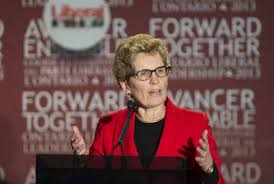
 
Ask anyone who works (or has worked) with her - Premier Wynne creates strong workplace cultures that empower employees to do well and find fulfilment in their work.  The why behind this is easy - Wynne realizes people aren't office infrastructure; they're the architects for her and her party's success.
 
Such is not the case for all employers, at Queen's Park or otherwise.  All too often, staff are viewed as tools, not individuals.  Workplace culture is not seen as a consideration, any more than you might care about how much dust collects on your computer; you can always get another one.
 
This heavy-handed, boss-centred approach to HR has proven to have a negative impact on bottom lines, on productivity, on innovation; demoralized staff aren't scared into doing better work, they're instead focused on not messing up or redirecting blame. 
 
Which, of course, is a self-fulfilling prophecy; when tough bosses practice the mantra "we are smart, they are dumb" - they in reference to staff - talent isn't nurtured, it's suppressed.  Those who rise to the top may be good at what they do, but it's the ability to curry favour with the boss that determines career growth.
 
But is a business - especially when it's government - supposed to be structured in a way that places ultimate power in the hands of bosses who, often as not, don't know and don't care about professional HR practices or basic leadership skills?  Do we want workplace cultures where it's the ability to curry favour with bosses that determines success, especially in light of the emerging conversation around bosses that abuse their positions of power in relation to their staff?
 
What are the consequences of poor leadership and a lack of training for employees and employers on morale, productivity, innovation and that other emerging biggie, mental wellness?


So it's interesting to hear Premier Wynne discuss harassment and HR concerns within her party.
 
The Liberal Caucus Service Bureau (Leg-funded internal support organization for the Ontario Liberal Party) has a Policy for a Harassment/Violence-Free Workplace that is to be made available to all employers and staff and posted in prominent locations in each workspace.  This document is intended to serve as a framework to prevent the sorts of entitled boss behaviour that can happen in situations where accountabilities aren't clear, training isn't provided and power imbalance is prominent.
 
Some highlights from this policy:
 
Members of the Ontario Liberal Caucus (“Member(s)”) are committed to providing a work environment which is conducive to both positive morale and productivity - a work environment free of harassment and violence to both women and men.  Behaviour, comments, or display of materials that could reasonably be perceived to be offensive, humiliating or demeaning are not acceptable in the workplace. 
 
-- one would assume the whip that is, for historical reasons, displayed on the wall of the Whip's office is an exception to this "display of materials" rule.  In fact, the very notion of a Whip is contrary to the intention of this policy and empowered workforces in general, but the outdated conventions of our centuries-old model Westminster Parliamentary system is a whole other topic.
 
Members, as employers, have an important role to play in promoting awareness and setting standards.  Harassment, in any form, undermines an employee’s work performance and the goals of the office.  All concerns of harassment will be taken seriously and handled in a professional, impartial and confidential manner in accordance with the provisions set out in this Policy. 
 
-- In other words, it's the responsibility of Members to lead by example when it comes to a harassment-free and empowering work culture.  The corporate structure at Queen's Park is a somewhat unique one, where MPP staff are the employees of Members, paid by the Legislature, but are equally answerable to their political party, who has no legal authority over said staff, but again, politics isn't a "normal" working environment.
 
It might seem counter-intuitive to have those with the most power and freedom to exercise it be responsible for self-regulation and empowering of staff to question their authority, but there's an answer to that, too.
 
Under the Liberal policy, it's not the party's HR person (paid through the Legislature) that is responsible for addressing harassment issues, but the party Whip, who is another elected official and therefore a peer to Members..  As such, it's to the Whip (or designate), a party-determined role, who is responsible for ensuring MPPs and staff are familiar with the contents of the policy and administering it when issues of harassment arise:
 
1) Responsibilities of the Whip 
The Whip is responsible for informing the Members and employees of the Policy and its contents.  Where employees bring forward concerns of harassment against Members, the Whip will take immediate and appropriate action as follows: 

a) respond promptly to all enquiries regarding harassment concerns involving Members; 
b) advise the Member that a concern of harassment has been brought forward against him or her; 
c) provide assistance, clarification and guidance with respect to situations involving harassment; 
d) work with all parties involved to try to resolve the situation fairly, and in a manner that preserves the dignity of the parties concerned; 
e) resolve situations of harassment through dispute resolution methods, in a non-adversarial, rehabilitative manner, and take the necessary steps to achieve a resolution.  If the Whip determines that an investigation is necessary, the investigation will be handled promptly in an impartial and confidential manner with due respect for the rights of the parties concerned
 
One would assume there is an internal training session for all Members and new staff that makes the contents and intent of this policy clear so that there is no confusion about responsibilities and processes that lead to resolution.
 
Key to this process, as we are learning through #ghomeshi, are the great obstacles employees can face in bringing forward allegations of harassment.  In politics, Members are all-powerful; they are the elected voice of the people, after all.  If they answer to anyone, it's the Premier and designated party officials who, naturally, are tasked with winning elections, not fostering strong workplace cultures.  It's just the nature of the beast.
 
It can be career suicide to bring forward allegations against an abusive boss, whether the abuse is sexual harassment, aggressive behaviour, passive-aggressive behaviour, etc.  Much as we have seen through #ghomeshi, under circumstances like this staff will often "suck it up", complain about bad bosses with other staff and suffer silently with the consequences of poor leadership. 
 
Or, they will raise concerns and be marginalized or discover that they have "burned bridges" by trying to defend themselves, and end up unemployed and shut out. 
 
This sort of toxic environment can lead to accrued depression and anxiety, kill workplace morale and ultimately result in poor functionality, which leads to unhappy constituents, poor decisions made, etc.  There's a reason why occupational mental health is becoming a thing these days.
 
To avoid unjust consequences to what would essentially be whistleblowers, the Liberals have included a NO REPRISAL clause in their policy:
 
a) Employees who bring forward harassment concerns shall not be subjected to any form of reprisal. 
b) For the purposes fop this policy, retaliation against an individual i) for making a complaint under this policy (whether on behalf of oneself or another individual); or ii) for having participated or co-operated in any investigation under this policy; or iii) for having been associated with a person who has made a complaint under this policy or participated in these procedures, will be treated as harassment
 
So, there would be no tolerance for cultures of fear within the liberal family at Queen's Park.  No person of authority would ever say something like "He's never going to change, you're a malleable person, let's talk about how you can make this a less toxic work environment for you" to staff who bring forward concerns about abusive employers.
 
Staff would never be re-victimized for bringing forward concerns; that would go directly against the beliefs of the party and the content of their policy.  Moving forward together, after all, doesn't involve dumping those who raise valid concerns by the wayside, or publicly shaming them, etc.
 
As harassment without definitions is largely in the eye of the beholder, it helps to provide some clarification on what, exactly, constitutes harassment in this context.  Again, the Liberal's harassment policy provides a framework to help Members and staff alike, when they're trained on the contents of the policy, to know what to look for:
 
To assist in ensuring that our workplace is harassment-free, the following are examples of harassment.  Please note that this is not a complete list and that each situation will have to be considered individually. 

- Jokes causing embarrassment or offence, told or carried out after the joker has been advised that they are embarrassing or offensive or that they are by nature clearly embarrassing or offensive
Example: Telling sexually explicit jokes or suggestive stories may be offensive to some and not to others.  They can have the effect of making someone feel uncomfortable and interfere with their ability to participate in work-related group activities. 
- The display of offensive material
Example: Posters placed on the office bulletin board depicting members of a particular racial minority group in a derogatory manner.  Even though an employee belonging to that racial minority group complains, the Manager says there is nothing he/she can do 
- Verbal and physical abuse or threats
Example: a supervisor constantly asks a subordinate out and is continually rebuffed.  The supervisor subsequently begins to criticize the subordinate’s work in front of co-workers and eventually threatens to fire the employee. 
- Degrading or derogatory remarks
Example: A developmentally disabled employee is called names such as “dummy” by co-workers.  
 
Not an exhaustive list, but a helpful starting point and again this policy, which is to be provided to all MPPs and staff and posted in prominent locations, gives some guidance on what constitutes harassment and where to go for furtuer clarification in less-clear circumstances.
 
I would assume that party HR is fully aware of this process and actively re-directs concerns raised to the party Whip/Whip's designate, who will be fully trained on how to mediate with empathy and an eye towards resolution for all parties.
 
Hopefully, they will borrow from the approach recently taken by federal Liberal leader Justin Trudeau:
 
 
Kathleen Wynne is the best kind of leader - one who recognizes that the people she leads are the architects of her vision, not infrastructure for her success.  She is a skilled facilitator who genuinely cares about people and their well-being.  She understands the importance of morale, empowering workplace culture and respecting the dignity of the people on the front lines.
 
A big part of why people don't trust politicians and feel their policy decisions aren't in the public's interest is because of our perception of internal political culture as corrupt, self-serving, feudal in nature.  Abuse of the public purse, abuse of position and abuse of human resources go hand-in-hand.
 
As #ghomeshi is forcing us to discuss such uncomfortable matters publicly, we're admitting publicly that this isn't something unique to politics - in all sectors, labour is done in a top-down, hierarchical way that empowers the aggressive, cunning and sales-oriented folk who also tend to be the ones most likely to abuse power in aggressive, cunning and team-harassing ways.
 
I think it would be great for the Liberals to provide a bit of inside-the-sausage Open Government of labour for the public on how they conduct their internal HR practices, especially as it comes to harassment/sensitivity training for MPPs and staff. 
 
It would set the right tone in a proactive fashion, provide some best-practices for others to learn from and make it clear that unlike some other employers out there, they have nothing to hide.
 
'Cause if there's one thing Premier Wynne excels at, it's leading by example.  We desperately need more of that kind of example right now.

Sunday, 19 October 2014

Conserving Progress - Leadership Advice for the PCPO


This isn't the first time I offer some leadership and engagement advice to the PCPO.  Unfortunately, I expect these words of suggestion to be ignored in similar fashion.
 
Here goes anyway.
 
There are two things happening within the PC Party right now; a leadership race, in which contenders want to portray themselves as the best bet to lead the Party to victory and a broader bit of soul-searching as, if they're wise, PC partisans are asking why they've lost traction and what exactly it is they stand for.
If they study the failings of their past two leaders (which I'm sure they're doing) they may have noted that both John Tory and Tim Hudak had a particular fixation with winning.  With winning being the primary objective, everything else was stacked up to deliver a win.
 
Theoretically, this makes sense - it's about the system is supposed to work, right?  Give the people what they want, with a bit of strategically picking fights to mobilize action - that's how winning is done, n'est ce pas?
 
John Tory tried the shiny baubles and put slightly new quotes of paint on old ideas (coal plants).  Tim Hudak picked fights and positioned himself as the voice of righteous anger.  We know how well these approaches worked out, don't we?
 
On the other hand, I imagine they'll be taking a gander at Kathleen Wynne's massive victory, even if secretively, and trying to reverse-engineer her success.
Kathleen Wynne's greatest strength is that she is a facilitator.  She's incredibly engaging - not just charming, but when you speak with her, she listens.  She takes notes.  She follows up - and when she acts, the people know that their ideas and concerns were part of what fed that process.
 
I'd argue Wynne and the Liberals need to do more of this in rural Ontario; I'd argue the reverse for the PCs in urban Ontario.
 
With the process in place right now, contenders for the PC leadership need to sell memberships and have more people to vote them in as leader.  As always, it's a race to the finish line - no time to engage, the rush is to close the deal, period.  When winning is done, consequences can be dealt with later.
 
The problem is, filling bums in leadership convention doesn't necessarily translate into seats in the Legislature.  If the ranks of the PC Party are filled with angry landowners who dislike the notion of culture change, will the Party and leader be beholden to their ideology?  How well will that sort of message resonate in increasingly diverse urban Ontario, especially must-win places like the 905?
 
On Monday, Why Should I Care is having a discussion about Healing Ontario's Rural/Urban divide.  It's a topic that should be incredibly relevant to the PCPO, given that they desperately need inroads into the GTA.  It was in recognition of this twinning of culture challenges (the renewal of the PC Party and the need for renewal in Ontario) that we decided to invite PCPO leadership candidates to attend.
 
WSIC is a well-respected forum that continual draws "top-drawer" speakers while staying true to its purpose of helping everyone, regardless of rank or wealth, to get informed, get engaged and make a difference.  The likes of Art Aggleton and Alan Fotheringham have been known to pop by and listen to the insightful conversations that happen at WSIC.
 
It's also worth noting that WSIC's founder, Terri Chu, is running for Toronto Council in Ward 20, and has a serious chance of winning.  Terri has a strong reputation as a balanced, non-partisan voice that puts evidence over ideology.  From a political positioning angle, it makes good sense to be seen engaging with her.
 
I can only assume the teams of the PC leadership candidates either didn't do their homework or simply couldn't connect why being WSIC speakers would be beneficial for them.
 
One never bothered to answer.  Two agreed to participate quite some time ago, but backed out at the last second (yesterday, in fact) because of concerns they might appear as "lesser-thans" if the star candidate wasn't there.  This may have been the strategic reason why the star's team never made any efforts to participate, either.
While efforts are being made even now to find replacements for the backed-out speakers, the message provided is clear: the Party is saying "civic engagement in the GTA isn't a priority for us" as individual leaders and their teams are saying "our commitments are only so valid as we see their value to our strategic branding, which is focused on headline-status, not grassroots engagement."
 
So here's my word of advice - don't do that.  Don't play the game that has caused so many Ontarians to disengage from politics and with the PCPO in particular.  Things have changed, and this "control the message" model is no longer viable. 
 
Leaders engage; they go among the people, listen to the people and then bring them and their ideas together into a broader framework.  They recognize diversity of ideas and of people as a strength, and nurture them.
 
Going back to the same well of depleted soil that has been homeground for the PCs since the days of Mike Harris is not a great strategy for growth.
 
There may be no immediate wins to be had at urban engagement forums like WSIC, but as with all gardening, you've got to nurture the soil before you can plant seeds, and seeds need to be tended to with care over time.
 
Forget the focus on own land, folks.  It's time to be gardeners.