Search This Blog

CCE in brief

My photo
Recovering backpacker, Cornwallite at heart, political enthusiast, catalyst, writer, husband, father, community volunteer, unabashedly proud Canadian. Every hyperlink connects to something related directly or thematically to that which is highlighted.
Showing posts with label Responsible Society. Show all posts

Wednesday, 7 October 2015

Nation Building


Why are the NDP bleeding support?  They've strayed from where they were in the quest to solidify centrists votes; their base feels uprooted and everyone else sees the NDP as a policy tumble weed.

Why have the Harper Conservatives been able to grow?  For starters, they have never abandoned their base, which means their floor has never lowered.  Their roots are deep and the party ain't shifting ground.  

More than a couple positions that keep their base rock-solid, however, are anathema to voters on the other end of the spectrum.  You can't be all things to all people, but you can't win majorities off of your base alone.

So Team Harper has perfected the art of the wedge-issue, essentially side-stepping substantial policy challenges and appealing to people's baser instincts.  You can be a left-leaning, pro-separation Quebecer but hey, if the niqab/scary Muslim things makes you skittish, you might just base your vote on that alone.

That's what modern politics is about, after all - adding just the right pieces to your narrative to expand your coalition into the small percent of non-locked voters to form a majority.

While Team Harper is mighty effective at this, the consequence of their wedge-issue mentality is an increasingly divided, embittered and angry country.   Anger is better than confusion for gaining support - it's so clear, so motivational! - but it's a dangerous state to keep a nation in for long periods of time.

If not anger and wedge-issues, though, how do you add enough support to  your coalition to win? More to the point - how do you not push the short-term effective, long-term destabilizing anger-button when the other guys are doing so and clearly benefiting?

Is it possible for a party to win a big enough coalition with aspiration instead of instigation?  How could you effectively communicate such a message to the niche groups you need to win?

There is a massive difference between winning power and nation-building and increasingly, it's hard for Canada's political parties to play that role - a role they were never intended to play, anyway.

Perhaps the question needs to change.  Instead of parties asking what does it take to win, we should all be asking where do we go from here?

Thursday, 1 October 2015

What Canada Should Be Ready For:


Look at this picture - what do you see?

I'll tell you what I see:

A wicked-smart, no-nonsense municipal policy advisor (and the genius mind behind CSLabs) elegantly raising points about the functioning of Westminster Parliamentary democracies and how we don't elect governments.

She's raising that point with an intelligent, informed panel put together by a remarkable think/do tank that is leading the way on two of Canada's current hot-button issues.

And all of this happening in a well-recognized Canadian institution - note the Sears name on the wall.

Smart people who understand how the system works and how the game is played dedicating themselves to positive solutions, and with the support of "old stock" Canada.

This election has largely been about emotions and emotional story-telling.  This picture mobilized the country (for a time) over an issue that has been going on for ages and shows no signs of stopping.

Scratch the surface, though, and a different picture emerges - the war room folk are no longer the only ones framing the narrative using data and behavioural economics.

The face of Canadian politics is changing; the power is shifting.

It is a revolution, of sorts, happening right out in the open.

So have hope, folks - winter is around the corner, but spring isn't far off either.

Tuesday, 15 September 2015

The Political Free Market: Bringing Down Under to the Great North (and some fresh air at the end)


"They" being select members of the B.C. business community, the kind of folk that Lynton Crosby wants to find a relevant message for.

Expect more of this ABC-style approach to political campaigning as the season-long #elxn42 lumbers forward into fall. Identify your target market - only your target market, not (pejorative minority group) - they aren't your people anyway - and then close that deal.  If you keep hammering at them, hitting the key emotional triggers and all that jazz, you'll push them into making a choice, and that choice will be in your favour.

Pretty simple, right?

You'd think so, at any rate.  Apparently not, though.  Despite having aggressive sales folk like Nick Kouvalis and comms whizes like Kory Teneycke at his service and despite having long-term loyalists like Jenni Byrne and, um, Chris Woodcock in his circle, Harper has decided to look further afield for the talent he needs to win this election.

It's not that, you know, he's ungrateful to his own people.  He simply realizes it's a tough election and he could very well lose, especially if his campaign can't get on the right course.  Staying the course isn't an option, because too much is not going his way.  If they're too risky to guarantee a win, you have to look at other options.

Which is what a lot of Canadians, including traditional Tory supporters, are doing.

Harper's people, meanwhile - they're all about the free market and against national protectionism. 

They won't be the slightest bit wounded or embittered about Harper's clear indication that he doesn't feel they're up to the job and preference for bringing in an Australian to do the job they are having trouble with.


Which is why Harper's whole team is surely embracing the simple message frame and proven track record of that Voldemort from Down Under, Lynton Crosby.

It doesn't matter whether he comes from up above or from Down Under, or how much skin he has in Canada's election.  It makes no difference whether the policies and messages he picks as winners for the target he identifies create headaches for non-Con market voters.  All that matters is that he can deliver the goods.

This got me thinking.

Harper's message is that the other guys - Trudeau and Mulcair, because he is loathe to mention Elizabeth May's name - are too risky.  You can't be sure they'll do a good job, and if they don't, fire and brimstone will ensure from the ruptures that will form in the earth, sucking all that is good and traditional down the drain (like manufacturing jobs and the forest industry).

Thing is, though, Harper hasn't done so hot himself.  He's continued and exacerbated the trend of poisoning the democratic well for partisan gain; he's made a mess of relations with provinces, the media and countless stakeholder groups; un- and under-employment are on the rise, aboriginal women are still going missing, pipelines are still pipe dreams, etc.  

Can we really count on Harper to do anything other than what he's been doing already?  That's what his campaign seems to suggest - more of the same, when that simple hasn't been good enough.

It's a bit risky, isn't it?

Maybe Harper has provided us with the extra option we needed.  Perhaps we don't need to limit ourselves to the risky choices before us - Harper didn't, and as leader he sets the example, doesn't he?

There's no rule that says Canada's Prime Minister has to be an elected official.  To be honest, the office of PM is one of convention, not one of legislation, so we have all kinds of flexibility on how to fill the role.

To keep things moderately in-house, though, what we could do is look at honourary Canadian citizens to fill this honourable role.

Here are some options:
   Karim Aga Khan IV

   Malala Yousafzai

  Aung San Suu Kyi

 and my personal choice:

   The Dalai Lama


Of course, we don't have to look abroad to find the best fighters to conquer electorates, or to fight off our political representatives. That's another thing that's become convention, but is not and does not have to be the rule.

Perhaps instead of looking abroad for people to fight his battles for him, Harper should look to the past for some advice on what it means to be Public Servant #1, as the Prime Minister should be:

- the Honourable Jim Flaherty, 2011

As for the rest of us - maybe we have to stop waiting for someone to solve our social ailments. Maybe we have always had the ability ourselves, and just needed the opportunity and encouragement.

Now's the time for something different.


Wednesday, 2 September 2015

Human Starfish: "'Everyone is the media'


"I pretended not to have seen, I pretended not to have heard because I didn't want to be responsible."

- Adalbert Lallier

The picture above came to mind as I read this article on the controversy caused by viral pictures of a drowned Syrian child, barely more than a baby.

It's a picture of Buchenwald Concentration Camp post-liberation; the well-dressed folk walking by the stacks of dead bodies are residents of Weimar, the centre of culture for Germany where Goethe and Schiller worked and lived.  

Weimar is a short drive down the hill from Buchenwald.  The smoke from the crematorium chimneys would have been visible from town.  The gunshots would have been heard.  More than that, inmates were transported through town.  There was no way the people of civilized Weimar could not have known something inhuman  was happening on the hill where Goethe took walks and thought.

Yet clearly, these people were disturbed and horrified by what they saw in Buchenwald, when it was right in front of them and impossible to avoid.

They couldn't pretend they didn't know something was going on next door to them, hidden behind the birches.  

"I can recall back in the '60s and '70s when we would see photos like this posted in newspapers regarding the Vietnam War," he says.


"We simply now have media that can reach more people and it's becoming more difficult for people to avoid seeing them."


The most famous example of these Vietnam War pics is at right.  The girl in the picture, Kim Phuc, is now a Canadian Citizen.  Her napalm scars remain.

Pictures like that have an impact that statistics or sound bites can't.  We're looking at real people, moms and dads, sisters and brothers, seniors, children - like anyone's family.  And the people in these pictures are enduring horrors that are uncomfortable to see.

We don't like pictures like this.  They make us feel despondent, or angry; they may even give us cause to worry about what the future holds for our own children.

Isn't it great that we can make that unease go away by reminding ourselves we have our own problems and our own solutions?  Or by making a donation to a cause and then comfortably changing the channel knowing we've done our part?

Thing is, there should be save venues, known venues for this kind of gruesome communication to happen; the news, which can be avoided, or magazines with marked pages that can be skipped over. Other people's tragedies have no place in the Facebook pages or Twitter feeds of the nation - that's a bit too much like suggesting that world and our world are one and the same.

That really makes us feel uncomfortable.

I've been to some corners of the world where bad things happen on a regular basis, where poverty and the consequences of poverty are dire.  Of course, being a Canadian, I don't need to travel far - there are First Nation reservations where conditions are pretty bad.  There are even communities and buildings in our big, civilized urban centres that reflect conditions that would make us feel uncomfortable to see in a magazine.

The truth is, we are as wilfully blind in our own way as the people of Weimar were in theirs.  We can tout the wonders of free market capitalism and talk about how it's improved the whole world, skirting over marginalized workers in places like Bangladesh that hold the free market pyramid up.

We can point to federal missions or donations or the loss of Canadian soldiers in places like Afghanistan and say "we've done our part, the rest is up to someone else."

Embedded image permalinkThis dead kid?  Honestly, it sucks to be him, but it's his parents' fault he's dead, no one else's - right?  Or bad luck to be born into a war-ravaged region of the world, but that's their own problem to solve - isn't it?  


As Westerners, we have a ridiculous amount of power that we neglect to use.  We can shape the policy of our governments - not resort to picking platforms and pitches sold to us.  We can stop buying products from companies who's practices overseas we dislike, and encourage good corporate ethics as a result.

We can decide to be allies to peoples in need in various capacities, and we can accept the risk that comes with such actions as taking on a small portion of the burden they should not have to carry alone.

But no one can force us to do these things.  No one has the power to persuade us, if we choose not to be persuaded.

At present, we lean towards laissez-faire engagement as a global citizen, despite holding the power to change everything by the choices we make.

Online, in person, through our efforts, our conversations and our consciousness, we are the message.

Right now, the message isn't particularly comforting.

If pictures of dead children bother you, great - that means you're human.

When the medium is everyone and what we choose becomes the message, all of these seas of troubling issues will eventually wash up against your shores.

What are you prepared to do to help keep future children from suffering the fate of starfish?

Saturday, 29 August 2015

#CCETakeover Day 6: CSI and the Spirit of Change


If you've come along for the whole #CCETakeover ride, you'll probably have noticed some consistent themes: 

- the desire to contribute more to society; 
- the search for community; 
- the emergence of a movement that is, depending on your point of view, either disrupting the status quo or in timely fashion trying to steer our civilization through a tectonic shift of cultural change.

Our journey began with the idea of DECAs as value-adding community animators, but as a counterpoint the reality that many people both members and DECAs alike have gravitated towards CSI looking for community. They are living through self-defined "periods of transition" and have come together because they feel that CSI is a place they can belong in, be part of.

This bears repeating - they're not coming to CSI looking for profit, a new market, or to get an in with a growing organization. They're not coming (at least not primarily) for the basics of space and desks and administrative assistance. These are all things that can be found elsewhere.

Entrepreneurs, Not-For-Profits, even corporations and public servants are migrating to CSI in search of something deeper than the material - something that isn't so easy to find in their normal lives and spaces of engagement.

They come to CSI looking to find themselves. They come to belong. They come to be part of something greater than themselves.

Pause on that for a second.

In Marxism, religion is labelled as the opiate of the masses - something that oppressive rulers use to keep lower classes in line. The implication in this is that the community existed first, and that religion was essentially a con created by elites that allowed them to rise to the top and ensure the common folk carried the labour burden.

Archaeological sites like Gobekli Tepe paint a different picture. They suggest that religion may have come first and became a focal point around which community could form, like the stone in the soup.

Now, think about political parties, or comic-cons, or festivals like Burning Man. What are these except places where people go to discover, share, create and belong? An individual or group of individuals, motivated by the urge to see something in the world that they feel is lacking, or find an avenue for expressing something they feel can't be expressed in their normal lives create a space for new kinds of activity to occur. They may be seen as outliers as first, but others recognize something is happening that they want to be part of. That's how any movement begins.  

Think about User Generated Content as a concept - the idea of people creating their own tweets, sharing their own ideas, investing in costumes or solutions that someone else will benefit from. Is it really a clever scheme by corporate/partisan interests to get people to do their heavy lifting for them, or is it a natural human inclination these organizations are simply harnessing, like hydro-electric power?

If it is a human instinct, it's about more than aggregating in communities - it's about personal empowerment within that community. Like DECAs who design better processes or members who plant the seeds of a community garden.

Functionalism looks at religion as sort of a manifesto for society; a standardization of values to allow for smooth societal operation, flow. We know there's a lot more to society than symmetry, though, because the world is a complex system that is constantly in flux; society also needs to be in flux, which means standardization is actually long-term detrimental to the well-being of society.

It's the core principle of Darwinism; that which survives isn't the toughest/most stubborn and inflexible, but rather that which is best able to adapt to its environment. It just so happens that consensus is growing at all levels of society and around the world that we are in the first blush of a tectonic soci-economic shift.

Besides, the implication of functionalism is that the community existed first and that religion is the thing that evolves to allow societies to function cohesively.  

If that's the sum of what religion has to offer - in essence, rules - why has religion consistently been a catalyst for the creation of entirely value-add art?

Visit any continent, inhabit any society - the material culture of humanity is illuminated with value-added art, architecture and music created for the glory of (insert deity here). Throughout history, people have been inspired to create art and add value to their community because of religious fervour. It's not the only motive (love is another one), but it's a consistent one.

I'm sure by now you can see where we're headed.

There is evidence to support the notion that some form of religious instinct serves as a centre of gravity that pulls people together - call it the spirit of community. While organized religion (much like organized politics) can lean towards an insistence on rigid hierarchies, rituals and codes of surface societal conduct, the raw spirit of religion has been known to inspire people to create, experiment - be innovative. That, and of course, to be pro-social.

It used to be the case that religious institutions did the lion's share of charitable/social service activity.
 
As our society has expanded and older religious/social models have faced challenges in adapting to our shifting societal consciousness, we've seen a diversification of charitable/public service providers and solutions offered.


Less people make weekly visits to partake in religious services. Less people identify themselves as being part of one religion or another. Heck, less and less people believe in the concept of a divinity, period.

At the same time, there are a massive number of charitable organizations, not-for-profits, community groups and corporate social responsibility initiatives out there all seeking to do what used to be the purview of the church and, to some extent, the state.

In fact, there are so many funders, service providers, etc. out there now that we lack a comprehensive system to keep up with all of them. Our current model of service provision, including government, is plagued by duplication, gaps and overlaps. Humans do silos well, but systems - that's a work that has progressed in iterative fits and spurts throughout history.

The past two days of #CCETakeover have explored some of the work being done right now to facilitate this transition from silos to systems through open government and open data initiatives. Even media organizations like the Toronto Star are getting in on the game, asking #howmightwe provide access to our resources so as to empower others with them?

If wade into the conversations being had at forums ranging from Open Data Day to the Toronto Global Forum to countless chats in coffee shops across the land, there's growing buzz around the concept that all of this is leading somewhere, that there is a common ground in the middle of activity that we just need to discover.

Over the course of #CCETakeover, we've also looked at innovative programs like Techsdale and Community Solutions Labs that aim to empower traditionally marginalized people so that they can be equal partners at the social table.  Projects like these empower individuals within target communities. And they start by creating shared spaces and cultures that nurture belonging.

Initiatives like these aren't about service provision, capitalizing on an untapped market - in fact, the revenue-generation model is often the last bit of business to be tackled.  The key motivation isn't to reel people (and their pocketbooks) in, it's about growing strong communities.


Which leads us back to CSI.

What is CSI?  Is it a co-working space?  Is it an incubator?  Is it a unique environment that places coffee-making higher up on the to-do list than turning on the printer?  It's all of that, but from its inception, CSI has aimed to be something more.

"It's a place where I think you belong", Adil Dhalla has described it, perhaps prophetically.

CSI's membership continues to grow.  Its events attract more and more people, each one looking to find something - and each one ultimately finding both a community to belong in and an encouraged opportunity to be and do more within and beyond it.  It's not just the grassroots/Not-For-Profit community that has become a pillar of the CSI community - For-Profit entrepreneurs, corporations and even government is starting to put down roots in the centre.

My favourite examples of this are the weekly salad club which happens at each location and the community potluck with which CSI Regent Park is helping to animate not only their members, the broader neighbourhood around them.

The format of these events is pretty simple - CSI provides the pot (physical space) and a stone (the event), then inspires others to bring their own ingredients into the mix.  With a bit of intentional animation, what results is not only a meal as rich as its members, but a dynamic community of engagement.

CSI members are, by and large, change-makers.  They are part of a community that believes in community.  Members reflect the Grasssroots, For Profit and, increasingly, government agencies, partners and even public servants like Diana Thai.  The same holds true for those who are becoming part of the broader CSI community through events, programs and projects.

Wherever they have arrived from, these change-makers, virtuous schemers and community animators have three things in common:

- the desire to contribute more to society; 
- the search for community; 
- the belief that a movement for social change is emerging

These needs and beliefs have driven each one of them to the Centre for social innovation.

I don't think it was intentional.  If anything, the story to date seems to suggest that the catalysts of CSI were simply the first ones to put down a pot, toss in a stone and issue an invitation.

As things often happen, CSI just ended up being conceived and executed at the right point in time when an unnamed community of people were individually looking for an aspirational community to belong to that didn't seem to exist anywhere else.

Part by design, part by luck, but to a large extent simply because there is a need, CSI has come to represent the spirit of change that defines the age we live in.  Increasingly, CSI also embodies the spirit of community that people are seeking.

That's why it is becoming a centre of gravity for the change-making movement of our time.

Is the Centre for Social Innovation a modern-day Gobekli Tepe? If so, what are the broader implications of that?

I have no answers to share with you - only perspective.

After all, this takeover is a ride we're all taking together, as a community.

And where we go from here - that choice is up to us.


Friday, 14 August 2015

Spoils of War vs Fruits of Labour


Two lovely red tomatoes from my garden.


A healthy crop of fresh carrots from my garden.

There's nothing quite so rewarding as nurturing fertile ground, planting seeds and helping them to grow - providing each plant the infrastructure it needs to reach its full potential as its form emerges.

Embedded image permalink

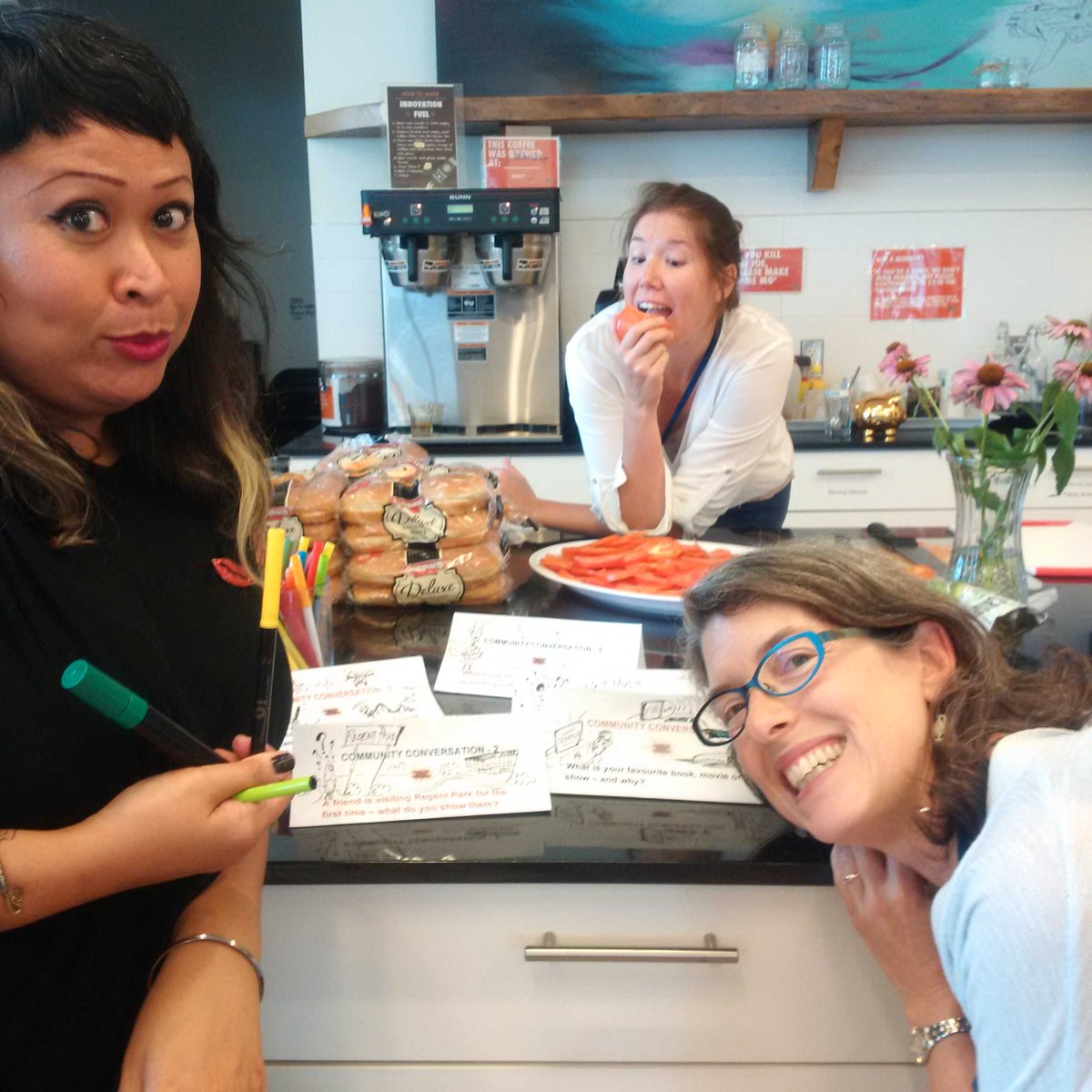
Tina and Barb, two CSI DECAs I'm training (foreground) with Regent Park superstar Tash (background) setting up for the monthly CSI RP potluck, where individual fruits of labour come together and become something more - community.

Political war rooms may compete for their share of the spoils of war.

I wonder - would they throw down their ads and join us to become gardeners of community?


Thursday, 18 June 2015

The Democratization of Power: You Can't Have #OpenGov Without #ResponsibleSociety


"We're in the age of the democratization of power.  Small actors can do big things.  The state no longer holds monopoly on the use of force," he said.

Whether Anonymous, whatever Anonymous is, committed the recent cyber attack that shut down several government websites yesterday remains to be seen.  That's part of the problem with collective anonymity; when no one knows who you are, anyone can pretend to be you.

We value anonymity for valid reasons; there can be very personal consequences for political actions, even when - especially when - the cause is just.  Equally, there is power in collective identity, a symbolic face that can be worn by legions.  This is true whether it's a Guy Fawkes mask, a uniform or a partisan t-shirt.


Yet with the power of anonymity comes great consequence, with mistrust and paranoia chief among them.  Human beings are hard-wired to identify threats before they do harm - it's a big neurological piece of why bigotry and especially violent bigotry exist.

Of course, you don't need to be anonymous or tribal to have powerful impact.  Ted Kaczynsk, among others, demonstrated that before the Internet and Social Media became a thing.

With the advent of the digital realm, it's continuously easier for a growing percentage of the populace to engaged directly with politicians, public information and even the policy-making process itself. Regular citizens can have Twitter conversations with Ministers of the Crown, post and vote directly on policy initiatives and even play a role in writing government directives.


This is happening at the same time as government power is increasingly consolidated in one person (the Prime Minister) and their unelected advisors (the real-world version of the Small Council).  Yes, we are seeing the collection of information reduced, those who speak truth to power silenced and decisions being made on poorly-conceived ideological grounds.  Opposition Parties vying for power are practising internally the exact same methodology.  These are very troubling truths.

Thing is, these truths are dependent on just one thing - public passivity.  

We have a representative democracy in Canada where Parliamentarians are meant to represent their constituents in holding government to account.  In reality, Parliament is now an arena for would-be governments to duke it out, with our representatives by default representing their Party more than their constituents.  It's not that our democratic representation has been taken away from us so much as we have failed to adapt engagement to the times.

Two teenagers can command media attention and even get face-time with a Premier.  It's a real thing. Facebook campaigns have stopped policy in its tracks.  We, as citizens, have more power to shape the policy agenda than ever before - we simply aren't exercising that power broadly, nor responsibly.

Politicians are only creatures of their Parties when their constituents allow them to be.  This happens because as citizens, we have fallen into price-matching political platforms and politicians instead of being active participants in shaping the direction of government.

Political parties have the power to fund or not fund local campaigns, promote or not promote their Members and, should they form government, deliver or not deliver on local projects.  That's a heck of a lot of influence over our representatives.

At the end of the day, though, it's our votes that Members of Parliament require most.  Between a promotion to Cabinet and simply holding their seat, which option do you think a politician would prioritize?


Citizens have the potential of enormous power to influence government - it's even more the case as Open Government becomes a thing.  If we choose not to exercise that power, we end up with the status quo.  If we choose to exercise that power irresponsibly, however - as I would argue this cyber attack was - government has plenty of cause to step back from openness and indeed start moving the other way.

There's an irony here which Anonymous should really pay attention to, given where they've borrowed their brand from.  But I guess some people like picking fights, regardless of collateral damage.

Open Government is not an inevitability - in fact, it's an impossibility without responsible society.

Responsible Government:
            - the powers of the governor general are limited - a fundamental concept which exists 
              nowhere in any legal document
            - based on the notion that the executive is accountable to the House of Commons
            - those who exercise executive power must obtain the support of the House for the use of 
              that power 

None of this happens, because with majority governments, Parliament is beholden to Government in the person of the Prime Minister and his backroom.  In short, the PM is the new King and his advisers are the new Privy Council; Parliament is more the King's court than the people's representatives.

The move to Open Government increases public access in much the way Magna Carta increased access for Parliament to government.  Combined with the increased consolidation of power in the office of the Prime Minister means the role of Parliament is changing.

Similarly, the role of citizen is changing, too.  We want more from government - we're not going to get it unless we're willing to step up as well.

Representative Democracy is failing; it's a model that simply can't be sustained with the demographic and access changes that have emerged.  The old model could never be equipped to tackle Wicked Problems anyway.

What's emerging now is Participatory Democracy - a model in which Parliamentarians will act more like facilitators between the people and the public service, with Cabinet acting as coordinators and project managers.

But it won't happen unless we all learn to exercise our powers responsibly.

That's the choice before us.  We can ignore the burning platform until we are all consumed.  We can light sparks ourselves.  Or we can learn to collaborate.

Its time we stop believing that he who has the gold or the crown makes the rules and start believing that with great power comes greater responsibility.

I have no qualms about being on record as having said so.

Monday, 26 January 2015

I Disagree with @stphnmaher


If the objective is to replace Harper, then yes - cut him off at the knees. 
 
In kindly, paternalistic fashion, lay out all his psychological foibles for public airing.  What leaving Toronto meant to him and why he wants so damned much to be seen as a Westerner.  Why he left the Liberals (which is why he hates the Liberals) and the things leaders he wanted to admire did that disappointed him that he himself is doing now.  The quiet things that torment him even now, driving him further and further away from the values and principles he thinks he holds dear.
 
If your sole focus is to destroy Stephen Harper, that's completely doable.  However, that shouldn't be the goal.
 
Canadians are cynical of their politicians in the same way young Stephen Harper was.  Any politician that focuses on destroying their opposition and portraying their own leader as an faultless demi-god aren't going to address our emerging democratic deficit and all the structural ills that come with it - they'll merely become the next party presiding over the demise.
 
Attacks of opposition and "framing" of your leader are all about messaging, attempting to build confidence through repetition.  Neither are about trust.
 
Our collective goal shouldn't be to get rid of Harper.  Harper is a symptom of broader societal malaise and civic rust.
 
When was the last time we had a leader that worked tirelessly to make us believe out democratic system was what mattered most?  That our voices mattered, when we raised them, and that policy was better when we engaged?
 
What we need now isn't a leader who can defeat the other guy.  What we need is leadership that brings us together with common cause and shows us that democracy works.
 
That's an even harder job - it means eschewing the quick wins and the low-hanging fruit and doing the more complex business of actually leading, and leading by example.
 
Whenever that happens, though, we'll all win.  And wouldn't that be a refreshing change?

Tuesday, 25 November 2014

Alexandra Constantinidis: Canary for Culture Change


A post I previously wrote about Constantinidis' encounter with Andrew Leslie is being much viewed today - probably due to the post above.  In my previous post, I framed that encounter as a positive thing, an example of agonoism - tough questions meant to further dialogue and explore all facets of an issue, ensuring robust conclusions and appropriate policy as a result.
 
I'm experienced and/or jaded enough to know that wasn't the intent, mind you - our politics is all about the gotcha moment where foes are concerned and circling the wagons in political omerta where our own tribe is concerned, throwing someone under the bus as a last ditch effort to maintain the status quo.
 
But that's not a frame that's sustainable and not one I want to reinforce.  Unlike some out there, I actively don't want to add fuel to our burning platform.  I'd like to think we can think far enough ahead, plan far enough ahead and be agile enough now to avoid the complete collapse of our system.
 
Then again, I'm no delusionally-confident partisan pitbull.  I'm the sort that fully expects aggressive tactics like the ones apparently employed by Constantinidis and built on by Kenney and co to blow up in everyone's face.
 
So let's step back a bit and look at this in context.
 
It looks like Constantinidis has intentionally gone in looking for "gotcha" moments to embarrass Liberals.  She's ready to record.  She's asking questions designed to solicit answers that can be positioned as negative and passed on to Sun News to trumpet to the world.
 
From one point of view, this is fine, as democracy should be - we theoretically want to be having an open conversation in which representatives and would-be representatives who impact policy decisions state their opinions so we can get a sense of who they are and how they think.
 
Of course, this frame of politics is naïve.  It implies that politicians want to be judged on their own merits and be chosen by the people only if they measure up.
 
That's nonsense.  Politicians want to win.  Political Parties want to be government.  They want to frame themselves for the win, not for public interest.  They want to control the narrative, not passively accept the public's choice.  There's nothing laissez-faire about politics.
 
Which leads to the other point of view - that the more we play gotcha politics, the more real opinions go underground.  We end up with carefully controlled messaging, spin and opaque policy conversations that lead to things like in camera committees and omnibus budget bills. 
 
These are all anti-democratic - but then, so is focusing on wins at all costs.
 
According to the version of the story now being circulated, Constantinidis lied to a public official so as to carry out her clandestine mission; she faked her name to get in and even said she was her look-alike cousin when called out.  It's not clear that Raynolds was the person who issued the "beer and popcorn" statement, but this fact has been ignored by the Brian Lilleys and Jason Kenneys of the world. 
 
From their perspective, it's not their job to tell the other side of the story - that's the Liberals' job.  Their job is to make their side stick, to frame the narrative, etc.  It's war-room politics, full stop.
 
Think about that for a second.  They don't feel responsible for the truth, only their version of it. 
 
I would argue that goes against the basic premise of individuals being self-contained rational actors, as it implies truth can only be achieved by collaborative action.  I'm fine with that.  But there's something else that I do find troubling.
 
How old is Constantinidis?  She looks like she's in her 20s.  Her LinkedIn profile suggests she's a student until at least 2017, provided it's a match.  Her Facebook, surprise surprise, isn't so accessible right now.
 
Are we to assume she acted entirely alone, lying, playing gotcha politics, etc?  If so, where did the idea of lying for a gotcha quote come from?
 
Are we to assume Michael Sona acted alone with the Robocall scam?  If so, where did he get the notion that such actions were acceptable?  Do we blame mommy and daddy, or is there a suggestion he's just a bad seed?
 
What of Sebastian Togneri?  I actually know his parents - they are kind, honest people who are active in their community.  They would never condone abuses of power, nor instil such values in their children. 
 
If we are to accept that these three young people were self-contained in their bad behaviour - or, better framed, bad behaviour they were caught out on - how did they get to positions of influence?  Where Constantinidis is concerned, why would she have assumed that acting in such a manner was a way to build her brand and get ahead?  Is she right on this?  If so, when did loyalty to Canada via a partisan party become more like Mafioso omerta?
 
Clearly, this has nothing to do with riots on the streets in Ferguson; what's happening there has nothing to do with a culture of entitled insiders playing the game for internal wins at the cost of social sustainability.  There's no need to ask hard questions about the failings of our culture; not when we don't believe in culture.
 
We keep hearing that politics is broken.  In fact, it's a line being parroted by tough political alphas to define themselves and hammer their opponents with (just don't look behind the curtain).  It's not their fault; nothing is their fault.  They're just playing the game as it's designed - and playing to win.
 
When we see youth pushing the envelope of political dark arts, it's time we step back and consider how we've gotten here, where it's going to lead, and if it's a place we're prepared to go.
 
Because, mark my words - this is no longer a "kick the ball down the field" to another generation thing; those leading the charge of our democratic decline are going to be alive and kicking when the consequences of their actions come home to roost.

History's actors, indeed.