Search This Blog

CCE in brief

My photo
Recovering backpacker, Cornwallite at heart, political enthusiast, catalyst, writer, husband, father, community volunteer, unabashedly proud Canadian. Every hyperlink connects to something related directly or thematically to that which is highlighted.
Showing posts with label Emotion. Show all posts

Thursday, 17 April 2014

Can You Vaccinate Against Fear?


There's a fascinating psychology behind this.  Yes, it's true that Big Pharma is interested in making money and yes, it is in their interest to have more of their product bought.


It's also true that incidences of fatalities from communicable diseases like measles, mumps and rubella have gone down thanks to the introduction of inoculations.  In fact, the increase in healthcare, social infrastructure and social services demonstrably improves quality of life across the board.  


There have been complaints, however, about inoculations causing autism.  This has been refuted; there has also been evidence that an increase in autism diagnoses has nothing to do with vaccination changes, but diagnosis changes.  Recently Aspergers was rolled up into the Autism spectrum, giving a whole group of people a new label.


It doesn't matter how much evidence is brought forward against this complaint, however, because all this evidence is trying to solve the wrong problem.  The issue was never specifically that inoculations cause autism, but that some people were fundamentally uncomfortable with the concept of inoculation itself.  Irrifutably demonstrate that there is no causal correlation between autism and inoculation and you'll still have doubters; others will simply find another straw illness to tilt at.


The problem isn't the risk - it's the fear of risk.  It's the same with wind farms - having recently come back from Germany, I met and talked with a number of youth who grew up next to wind farms and are no physically worse off than someone who grew up next to a subway, or a freeway, or a road, period.  


In the past, each of these innovations and environmental changes have provoked fear and, in each case, those fears have been associated with health risks.  

In truth, people are right in all cases, not just in the way they think they are; the health issue is not one of what we traditionally identify as physical illness, but one of anxiety.  All these things are out of the individual's control and change the individual's physical and mental landscape.  Change is an uncomfortable process that we are inclined to fear, because on some level, we're not sure if we are able to adapt.  

Therefore, we resist.


Phobias are most often irrational; fear of open spaces, fear of spiders whether they're harmful of not, fear of gay people, of black people, fear of all kinds of things that aren't actual threats.  Phobias are like allergies - overreactions to physical stiumlus that really aren't trying to hurt us.

This doesn't make them any less real or crippling - as is the case with any mental illness, phobia can get in the way of normal individual functioning and social cohesion.

Which takes us back to vaccinations - a densely packed society like ours can't function without vaccinations.  That's a ticket to plague, exacerbated by a lack of coordinated (and enforced) social rules around cleanliness, transit, dispute resolution, etc.  We aren't physically designed to live in such crowded environments; society can't function without collaboration and a certain amount of central coordination.  That's why we invented government.

What does being anti-vaccine have to do with being pro-gun?  The gun industry is massively wealthy and spends a large amount of coin promoting gun culture, why aren't they traditionally lumped in with Big Pharma?
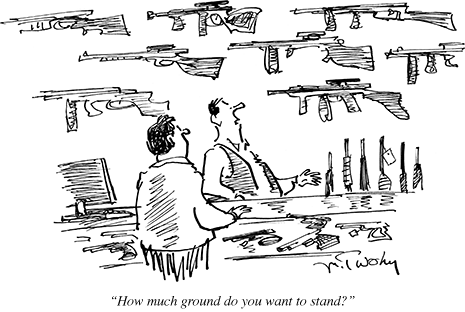

It's because a gun in the hand is, theoretically, about giving you power over others.  A vaccine, however, is about defending your immune system as well as that of your neighbours'.  A gun is aggressive, reactive and individual; a vaccine is strategic, passive and collective.

By and large people are reactive and individual; what pushes us to be aggressive, is we're not sales-oriented hunters, is a response to fear.

This is why the politics of fear is so widely practiced and why it allows for otherwise sane people to do pretty insane things.  It's not logical, it's emotional - when you appeal to emotions first, an individual can find all sorts of ways to validate their opinion, including through the use of micro-targeted arguments and full-on attacks.


Sadly, we're seeing an increased use of fear, isolation and idolatry in our political systems these days, catalyzing a solidifying oppositional movement.  Hate, we're told, is a purifying force - and hate is on the rise.  This is not a good thing.  There's precedent and current examples of where hate leads us.

Fear and hatred aren't the solution - they catalyze immediate, reactive action against something, but to the detriment of broader social sustainability.  If you're not killing your opponent off, you have to live with them, something hate and fear don't allow.

Hate is a purifying force, after all - it allows for no diversity, no debate.  Like fear, hate is a mind-killer.

Society is at a tipping point with a new revolution required to help us break through to a more sustainable model.  As the old system fractures, people are becoming increasingly anxious, a fact being exploited by populists doing far more long-term harm than they probably care to realize.  We are looking for names to blame for our anxiety, subconsciously trying to isolate ourselves from an increasingly invasive world.  

This isolation from the global picture and rejection of everything from inoculations to fluoride in the water to social services to immigration aren't the fire-walling solution, they're part of the structural problem.

So, what do we do?  How do address the deep-rooted reality of strong, reactive emotions like fear and hate?


There's a fascinating article on the rational choices of crack addicts that offers an interesting window into the nature of behaviour; it throws the assumption that an addict is an addict by demonstrating how crack addicts, removed from negative environments, can make more rational, sustainable choices.

This suggests that even the most negative of behaviours can change, which we should already know.  It also implies that perception isn't as functionally fixed as we like to think it is.

I recently met a 90 year-old Holocaust survivor who tells an amazing story about laughing in the face of an SS firing squad.  Chat Bowen made them deeply uncomfortable - it didn't matter that they were in complete control of the situation, they had no ability to influence Chat.  He had no fear, no anger; he simply accepted that death had arrived and their was no point fretting it.


For 70 years, Chat has lived his life with an acceptance of death and a rejection of fear and hatred. He's healthy, happy and deeply in love with his wife, his life, and at peace with the world.

The lesson here is that, even under the worst conditions imaginable, it's possible to control one's responses to external stimulus with the right perspective.  This is incredibly difficult and, like running a marathon, not an option for everyone, but it's still one option on the table.


It's important not to make the mistake of assuming fear is not real and merely a product of the thoughts you create - that's not the case.  Fear is an emotion; it precedes and informs thought, just as hatred, hopefulness and love do.

Like all emotions - like most physical processes, really - fear can be controlled.  People with anxiety disorders control fear through the use of medications and practices like Cognitive Behavioural Therapy.  Activities like yoga or simple breathing exercises also help to re-balance a body's neurochemistry (out with the bad, in with the good, oxygenate the blood).


The growing field of Positive Psychology as well as fields like Social Emotional Learning and Self Regulation are increasingly looking at fear, depression, hatred, excitement and all of our emotions as things that can be regulated.  


These regulatory processes are being introduced to our school systems, empowering our youth with the ability to recognize and up/down regulate their emotions as necessary.  Encouraged in this process is critical thinking; the ability to look beyond one's own emotions and view a situation, a person or an object in a more objective capacity (something that, despite what Ayn Rand may have thought, doesn't just happen naturally).

As with any exercise, the more you do it, the stronger you become.  Athletes train, writers write, innovators never stop iterating.  When it comes to emotional regulation, practice is a constant but the result is an increasing amount of conscious awareness and control of both one's own emotional state, but of those around you as well. 

It's impossible to really understand somebody, what they want, what they believe, and not love them the way they love themselves.


Wednesday, 22 August 2012

Be Conscious of Your Emotions At Work


Step 1: Awareness. Before you walk into work or a meeting, try to discern what you're feeling. It's not as obvious or simple as it sounds. The human mind is very good at burying in the subconscious what the conscious mind may not want to deal with. What you want to determine is if your mood is either significantly better or worse than usual.
 
Step 2: Understanding. Once you determine that you're feeling something unusual, whatever you do, don't try to ignore it or think it away. Emotions are critical signs of what's going on inside you. Instead, try to find some alone time and get to the bottom of what's really going on.
 
 
Step 3: Motivation. As we discussed in the first story above, sometimes emotions can be powerful motivators. They can drive you to do great things, perhaps to prove to yourself what you're capable of doing in spite of the obstacles. On the other hand, if you're not as self-aware, that's when you become your own worst enemy.
 
 
Step 4: Behavior. If you know you're dealing with some unusual emotions, try to be aware of your behavior. You might be more grandiose or short-tempered than usual, and that's important to know so you can give others a heads up and pay attention to feedback. If they see what you're not aware of, that's not a good sign. Don't just brush it off.

Whatever you do, don't use employees, coworkers or customers as either emotional punching bags or as personal confidants. Not only is that crossing a line, it's self-destructive behavior because, on some level, you know it's wrong and you're doing it anyway. And that means you're not as self-aware as you might think you are.

Saturday, 14 July 2012

Don't Hate Harper


"But in the anti-Conservative fever swamps, there’s no discussion. There is rage."


I've said it before and, sadly, I know I'm going to be saying it again - in his attempt to play the emotion card as a way to make Canada more conservative, Stephen Harper is only succeeding in making Canadians angrier. It should really come as no surprise - when you keep hitting the fear button, you make people more reactive. You tell them their resources are being taken away, you trigger a deep-rooted gut-reaction that rails against rather than stands for.


It's a disconcerting trend. People are beginning to feel that discussion can't work, that militancy is the only way to make things happen. Screw the other guy, we're going to fight for what we know is right. While the trend towards reactive, emotional behaviour society-wide is not all on Harper's shoulders - we've been witnessing the rise in violent division across the Western World - his approach is adding fuel to the fire.


This isn't good for Harper, nor is it good for the long-term prospects of his party. It certainly isn't good for Canada, or our position in the world. The solution, though, isn't to fight fire with fire, to become that which we might stand against. The answer, as always, is to drill down to the places where we agree and engage the Other in finding shared solutions.


Move Forward Together is not and cannot be the property of any one given group - it has to include everyone.


If we can't live together, we're going to die alone.

Tuesday, 17 April 2012

Between Rage and Serenity: X Marks the Spot


“I believe that true focus lies somewhere between rage and serenity.”

   - Professor Charles Xavier


We are dividing the political spectrum in lateral, convenient ways, but they’re not particularly accurate.  Communist regimes and dictatorships aren’t polar opposites – they’re equally oppressive and dominance-focused.  Thoughtful Conservatives, Liberals and NDP can come to the same, logical conclusions – it’s the emotional pieces that shaped their politically-oriented policies that polarize them.

By this light, fundamentalist Christian movements are exactly the same as fundamentalist Islamic movements; they use different language and are trying to protect different models, but their approaches are exactly the same.

It’s not left vs. right – it’s selection-of-the-fittest vs. strengthening the collective.  Put another way, it’s biological evolution vs. social evolution.

The X-Men franchise provides a great example.


“I will bring you hope, old friend – just don’t get in my way.”

Magneto believes in a coming, inevitable war between mutants and humans.  His focus is the differences; only one group can dominate.  Obviously, he feels his tribe is the natural party for this.  Magneto feels so strongly about his beliefs that he’s willing to sacrifice others – including his own kind – to achieve his goals.  For him, peace was never an option.

Magneto’s power?  The ability to manipulate the world (metal, but there’s metal in most of our social trappings) around him through sheer force of will.

“There’s good in you too, and you can harness all that.”

Then there’s Professor X.  He believes in a collaborative future between mutant and human, with a sidebar thought that, through evolution, mutants will likely overcome humanity through natural processes, just as homo sapiens did Neanderthals.  Xavier is a negotiator; he feels there is always room for dialogue and is willing to sacrifice himself to keep the conversation going.
Xavier’s powers are of the mind – control of self and, through that internal control, the ability to control others.  Like Loki, he’s a trickster, but unlike tricksters of old, the tricksters of today are seen as the heroes.  They want to solve through words, not violence.  Killing, says Xavier, won’t bring peace.

If we pay attention, there’s a trend, here – from reactive to proactive, from dominance to manipulation to collaboration.

When you look where we’re headed, it's not away from something, but rather towards a common centre.


Friday, 3 February 2012

UNDERSTANDING THE SOCIAL MATRIX: Stigma, Confabulation and the Power of Persuasion


CONTENTS:

As We Go Along
Prometheus
Going Down the Rabbit Hole 
The Immediacy of Competition 
Model Students
 Mind Over Matter 
Children Will Inherit the Earth 
Stigma
Why We Lie
Conclusion 
POST SCRIPT: Surfacing
 
-----

      -          Morpheus, The Matrix

DEFINITIONS

1.          A mark of disgrace or infamy; a stain or reproach, as on one’s reputation.
2. a)     medicine/medicinal – a mental or physical mark that is characteristic of a defect or disease
    b)      a place or point on the skin that bleeds during certain mental states, as in hysteria.

1.          To talk casually; to chat
2.          Psychology – To fill in gaps in one's memory with fabrications that one believes to be facts
 -----


“You don’t know what you’re talking about.”  We’ve all been there – getting or giving false directions; using terminology inaccurately; having the birds and the bees explained to us (through wringing hands) with a less than specific description of the biological process; being fed complete bullshit, wondering how the speaker thinks anyone’s going to believe them.


Sometimes, these are intentional falsehoods designed either to misdirect the person opposite or to mask our own ignorance (to make us sound more impressive or to mitigate the appearance of ignorance).  Guy I know who has been very successful in his career – made piles of money, advised leaders on the provincial and national stages – once gave me this nugget of advice: “You don’t have to know what you’re talking about, you just need to sound confident while you say it.  This approach has been proven to be a successful one on the individual level time and again; however, time and again it’s led to difficulties for society.

Sometimes our fabricated fictions are conscious products, but we also create these subconsciously – and do it far more often than we realize.  To understand why we intentionally fill in knowledge gaps or replace inconvenient sequences of fact with fabrications, we need to appreciate why we do this unconsciously.  This ability is not a parlour trick; our capacity to fill in knowledge sequences subconsciously – to confabulate – turns out to be a vital tool in our cognitive matrix.  It is also at the root of much of our social and internal conflict, facilitated through the lens of stigma.  We’ll get to stigma in a bit, but first, a quick example of how confabulation works in practice.


Ask yourself which you like better, a McIntosh apple bought at the store or a Granny Smith pulled fresh from the tree.


Then, ask yourself why you made that choice.


You might have picked the McIntosh; apart from the taste, it came from the store and was therefore easier to get.  You also knew that the apples in the store were likely more quality-controlled than a random pick from a tree.  On the other hand, you might have picked the Granny Smith because your grandmother used to keep a bowl of Granny Smiths at her home, so they bring up a positive childhood memory, or because you liked the idea that is was fresh.  Thinking about which apple you liked best in a given context – store or tree – might make you more inclined towards one brand or the other going forward.


Made your choice?  Good.  Odds are high that the answer you gave yourself was entirely confabulated.  You just subconsciously made it up, right here and now.  You could very well have no apple preference at all, nor any experitential connection between your Granny and a granny.  In this instance, if you played  long, your subconscious fabricated an answer because you were being pushed into addressing the question.  If I hadn’t asked, you might never have considered preference of one apple over the other.  It was the question that planted the notion of preference into your mind.


This concept of Inception – creating an idea or, in the movie, placing an idea into someone else’s mind – is well understood in our society at the surface level.  We see it when we look out the window, or when we turn on the television, or when we go to work.  When an ad associates manliness with a brand of Scotch, or when a waiter asks you “would you like red or white with your dinner?” or a politician tells you the ballot question is “us or people who want to undermine our country”, these folk are attempting to define your options for you in a way that is not necessarily reflective of reality.  By manipulating the choices before you and putting pressure on you to pick, they’re forcing you to not only make a choice but to develop a rationalization to explain that choice – a rationalization you may find yourself falling back on again and again in the future.    With an increase in our understanding of how the brain functions, that is starting to change.


The human animal is becoming increasingly wise to the trick of inception; more and more people are consciously aware that they won’t look like a TV commercial model if they consume the product he or she is shilling and that bar nuts are intentionally free because they make you thirsty and more likely to buy drinks.  As in sexual selection, we have socially-developed mechanisms to monitor for such deceptions; university papers require listed sources, job applicants must provide references and examples of their work.  The media shines light on the processes of government and business.  We don’t, in other words, accept things at face value – we are driven to understand them.  Director Christopher Nolan brilliantly captures this concept in his aptly-named film Inception; the various dream-hopping characters use personalized totems to help connect them to reality.
 

Going Down the Rabbit Hole

 
This leaves us with a conundrum, though; even when we understand the principles of marketing, they still, by and large, work.  We do buy the product; we do eat the nuts.  My favourite examples – everyone seems to agree that negative advertising in politics is deplorable, yet it continues to be used because attack ads work.  Politicians decry bullying, but continue to heckle in Legislatures.  It’s like dropping a hammer on your foot – knowing that it’s going to hurt doesn’t stop the pain.  Why do we allow ourselves to be manipulated?
 
To understand this paradox, we need to go down one layer further, past the thoughtful projections of consciousness into the mechanics of the projector – our brains.

If you close your eyes, you cannot see.  If you cover your ears, you can’t hear. In both cases, by blocking a sensory transducer, you are cutting off your brain’s access to a specific type of stimulus.  Under these circumstances, the brain isn’t creating the stimulus; it simply interprets the signals into a format you can understand, just as your computer turns a bunch of ones and zeros into content like pictures and words.  Shut down the input, you lose the signal.  The brain goes a bit further than that, though:
 
It determines the impact of external (or internal) stimulus on the body and suggests an appropriate response:
-        The eye sees and hears an attacking bear, the brain suggests the heart pump
         faster and the limbs get ready to attack, defend, or run
-        The nose and eyes perceive tasty food, the brain recognizes the food as
         desirable and informs the body to feel desire
-       A virus has gotten into the body, the brain reacts by adjusting body systems
         to attack it, redirecting energy to facilitate the response


It creates and stores mental copies of the things the sensory system has encountered for future reference
-          We call these memories.
 
If you close your eyes, you can still visualize representations of the things you have seen in the past.  If you block your ears, you can still recall the sounds that you have heard previously.  Unless, of course, you were born blind or deaf, in which case you have no recorded models to refer to.


Our mental reconstructions and projections of reality, then, are based on the sensory input and memories we collect over the course of our lives.  Does this mean we are born blank slates, then, with no input but that which we accumulate?  To me, this is a different way of asking the age-old question “if a tree falls in the forest and nobody hears it, did the fall make a sound?”


It doesn’t (mean we’re blank slates – the falling tree makes a signal of sound whether that signal is received or not).  We aren’t born clueless – we are born with built-in models that shape our reactive behaviour.  Two cases in point:


        Fear
                - If children have never had cause to fear the dark in their lifetimes,
                  why would fear of the dark be innate to, say urban kids?
                - If you have never been attacked by a bear, why would seeing one
                  be frightening?


        Beauty
                - If we have no inherent conception of beauty, why would we see anything as
                  beautiful at all?  Why would the basic aspects of beauty – healthiness and
                  symmetry – be universal?


If you think you have an answer – read to the bottom and see if you haven’t changed your mind by the time you get there.    :o)


The Immediacy of Competition

If you believe in evolution, you accept the premise that the purpose of life is to continue.  In an ecological system, there is constant symbiosis – one organism cannot succeed without interacting with another.  On an individual level, what that looks like is competition – the antelope kills the grass by eating it; the tiger returns the favour by eating the antelope.  When the tiger dies, its carcass deteriorates, nourishing the soil from which the grass grows.  If you take a macro look at the process, the circle of life is really just about regeneration – it happens on the level of the ecosystem or the organism in essentially the same manner on which it happens at the cellular level.


Individually, though, we aren’t interested in the circle of life – we’re interested in surviving long enough to pass our genes on, ideally as many times and in the strongest packages possible.  The better equipped our offspring are, the better their chances of survival and propagating our genetic lineage.


We try to achieve this by doing everything we can to select as mates those who appear to us to have the greatest indicators of health or success (beauty) and by avoiding (or eliminating) things which we perceive as threats to our own existence (fear).  Those individuals who are not only good potential mates and able to react successfully to threats but able to identify others who are good potential mates and able to avoid threats are the ones that keep their lineages thriving.


Through an evolutionary, selection-of-the-fittest process, the ability to identify and respond quickly to threats and opportunities has been encoded into our genes.
But how does this function, practically?  There is so much diversity in our global ecosystem, how are we to know a healthy person from an unhealthy person, or a dangerous animal from a harmless one?  The mechanism by which we identify the benign from the threatening from the good is the model.


Model Students


Picture a scene: 


You’re walking through a forest at night.  You can’t see too far through the trees – your sightlines are limited.  You hear unidentifiable noises all around you – your sense of hearing is ramped up, trying to identify which of those noises might present a threat.  You feel vulnerable; you’re heart is racing.  Suddenly, you see a snake in the path in front of you.  Your general level of anxiety bursts into fear and your body convulsively takes a jump back.  You’ve no idea if the snake is poisonous or not, but still you are afraid.  Until you notice the snake isn’t moving.  In fact, it’s got some rather sharp angles to its body.  As curiosity overwhelms your fear, you risk moving a step closer.  It’s then you realize it wasn’t a snake at all, but a stick.  You chide yourself, call yourself a fool for reacting so severely to nothing.

In recreating that scenario in your mind, you have fabricated a mental movie that relies on all the visual and auditory memories related to forests, snakes and night that you have collected in your life.  The concept of snake got your heart racing, just as it would if you had actually been in that scenario.  If I had said the object was a taipan, not a snake, you wouldn’t have reacted the same way – unless you already had a mental image of what a taipan is.  As soon as I indicated that the snake was a stick, you switched the mental model for the object – and your emotions adjusted accordingly.  Film makers intentionally manipulate this process to great effect, often using a beat of contrasting emotion to ramp up tension in a sequence.

What allowed you to conceptualize a snake in your head?  What, in the forest scenario, caused you to consider the stick to be a snake and respond to it instinctively?  Why is it that you didn’t feel the same way about the word taipan as you did about the word snake, unless you followed the hyperlink?  If you recognized the “ramp” clip from the first second, what made you tense up in anticipation? If not, what made you jump at the end? 

Coded into your genes are models of perception.  Thanks to these models, honed by generation after generation of selection-of-the-fittest evolution, you have the ability to react to potential threats in real-time – a good skill to have as it could save your life.  These models also nudge you towards things that are desirable; a beautiful sunset, for example, or a pretty girl or a tasty dessert, or cause you to try and appear desirable to others, as in the “save your life” clip at 0:41.  The various objects we see, or even sounds that we here, are in themselves symbols or totems – they represent meaning to us in ways that we are rarely conscious of.

To be widely applicable, though, these models need to be pretty general; a boa constrictor doesn’t look like a cobra which doesn’t look like a taipan.  What these snakes have in common is a general shape – long, straight, often found low-to-the ground.  Traits they have in common with sticks.  You wouldn’t fear a stick if you saw it in the day, in the open; you’d have enough context to know it was a stick.  It was the limited context of the woods at night that led you to fill in the gaps or confabulate the stick as a threat.  What is the autonomic mechanism that allows you to put two and two – context and content – together to determine what is a threat, what is benign, and what is desirable?


Mind Over Matter

 
Subconscious pattern recognition signals connect the models encoded in our brains directly into our body systems (motor, respiratory, etc.), inciting an almost instantaneous response.  More simply put – it’s our emotions that allow us to react almost instantly to the context and content of sensory stimuli.


We are all familiar with the idea of head and heart being in conflict.  The idea of “feeling your way” through a situation is a common one, as is the notion of “feeling out of control,” i.e. unable to consciously manage our physical responses.

This isn’t really a matter of emotion impeding conscious action; in terms of evolutionary development, emotion was there first.  The “reptilian” or “primitive” brain, as it is often called, is common to all animals in more or less the same degree.  As we have seen, it allows for instantaneous reaction to our environment.  What it doesn’t do is allow us to modify that environment, or control our behaviour.  Those abilities are permitted by the newer part of our brain, the “neo” or prefrontal-cortex.  Remember the snake in the woods?  It was the neo cortex that allowed you to create, or incept, a “mental movie” that was based on experience but original in and of itself.  The model of the snake – the file that the film was built around – came from deep within your limbic brain.

Our emotions are “original” and allow us to react to stimulus; our consciousness is new and allows us to manipulate the causes of stimuli through proactive innovation, planning and coordination.  For people, the challenge lies in bridging the gap – justifying our emotions in cognitively comprehensible ways.

With this in mind, ask yourself these questions:


                                               What is the meaning of life?
                                               What happens after we die?

You can see why this emotional/cognitive confabulatory conflict has broad ramifications and why it’s worth giving some consideration.  We’ll get into how that connects to stigma shortly.


As suggested through the example of fear and beauty, children have innate emotional responses – they know what they like and what they don’t like, what they should fear and what they should embrace.  My son, a Star Wars fan, needed nobody to tell him that the Emperor was evil (he looks sick and wears black) or that Princess Leia was good (empathetic, dressed in white, good skin).  His initial reaction to a toy of Luke Skywalker in black, though, was that Luke must be a bad guy.  Not ironically, that’s the subconscious impression the film makers were trying to achieve by dressing Luke in black in the first place.

Kids also have little self-control – everything from using a toilet to table manners has to be taught.  What kids do have, though, is an insatiable appetite for knowledge.  Language acquisition is a great example of this – kids will pick up a language whether given official language instruction or not.  It’s actually surprising how well kids pick up language regardless of said proper instruction or various language delay factors.  The same, incidentally, is true of deaf children; even without the ability to hear, they can absorb, model and innovate language.  The result might not be as clear or concise as that of a hearing child, but if there is intervention at an early enough stage, even deaf kids can adopt the fullness of language.

We all know that kids love to ask why about everything.  There is no detail that can’t be deconstructed further.  This is natural, expected, and desired – with every question they ask, the more information a child’s mental database is filled with.  The more knowledge he or she has, the more accurate models they have to work with.  This allows a child to better assess their world, interact with it meaningfully and develop realistic plans to further their interests.  Part of this process of establishing a cognitive framework of the world is connecting dots.  Back to my son; every now and then, he’ll come up with a syllogistic connection that he’s made.  These connections aren’t always right, but they are connections he has made, therefore they are real to him until proven otherwise in a way he can internalize.  It sometimes takes a bit of convincing to show him why his connection isn’t the right one.

A hypothetical yet reality-based example: my boy, now three, asks me a “why” question while I’m busy cooking dinner.  My attention is split, so I’m a bit tense from distraction, plus I don’t have an immediate answer.  Trying to think what to say while keeping dinner from burning, my body language expresses agitation and my brow is furled in concentration.  My boy connects that frown and my overall body posture with me being upset – this is, for him, an important emotional piece of information as, if I’m upset with something he has done, he could get a time out.  Those two factors cause an automatic emotional response and he asks me, hesitantly, if he is in trouble.

Why is he thinking this?  There is no apparent reason he should be in trouble.  This is the emotional, reactive piece: my body language matches a mental model in his memory bank of me upset; the recognition of that model has triggered an emotional response of discomfort.  In this case, the threat is the potential consequences of being in trouble; a time out or, as is more likely with me, a mini-lecture.

 
I ask him back, “why would you be in trouble?”  After a second’s thought, my son answers “because I said some bad words.”  That’s the cognitive, confabulatory piece.  He didn’t say any “bad words”, nor is he actually in trouble; the notion of being in trouble exists in his mind only.  This doesn’t matter – his feelings tell him there is a threat.  By giving him an opportunity to explain, under duress, why he is feeling that way, I’ve just incited my son to confabulate a cognitive justification for an emotional reaction.

Yes, kids do this intentionally; imaginary play is an important process by which they learn to interpret their world.  Adults do it too: we call it acting or role-playing, or in writing, euphemisms or allegory.  Broadly, we call this fiction, which we distinguish from non-fiction, or fact.

Of course, just as kids unconsciously confabulate all the time, so do adults.  These confabulations are more commonly thought of as biases or, more sinisterly, as stigma.

Stigma


From Inception:


As I have said, my son is a fan of Star Wars.  Periodically, when it’s not too over-the-top, we watch the exceptional computer animated Clone Wars cartoon series.  As the title implies, there are a lot of clones in the show – genetically identical troopers that look exactly the same except for hair styles and the odd tattoo.  In one episode, there is a “defective” clone that does not look like the others – he’s shorter, his face is asymmetrical and wrinkled, he has a limp and a hunched back.  While this was a fun episode, chock-full with all the stuff my boy likes – clone-on-droid action, big ships, cool sets – the appearance of that “defective” clone made him so uncomfortable that he insisted we turn the show off.  Why would that be?

All the clones are identical except for that one, who therefore stands out in stark contrast.  This drew my son’s focus to him, like a stick on an otherwise uninterrupted trail - or the word must caught your eye while we were considering Luke Skywalker a few paragraphs back.  The clone’s appearance suggests age and illness – two things which are detrimental to one’s long-term health.  The appearance of the “defective” clone (which stood out in sharp relief) triggered an emotional, reactive response of fear in my son, which itself incited a fight-or-flight response.  In short, my boy stigmatized the “defective” clone based on appearance alone.

 
With that in mind, take a quick look at these two videos:

            Jacqueline Saburido is a burn victim and a brave advocate against drunk driving.
            Leprosy is a medical illness with symptoms that manifests in a very visual way.

So – how did those two videos make you feel?  Uncomfortable?  Why might that be?


 I’m not going to be shy – seeing people with skin lesions brings out an emotional response in me, though less so as my understanding of the “why” behind them (both the lesions and my responses to them) grows.  Of course, you can’t catch burn and 95% of the human populace is immune to leprosy.  These facts do nothing to impede the isolation burn victims often feel or to change the long, sad history of stigma against lepers.

If you’ve read this article in its entirety, you now know why this is the case.  Hard-wired deep within our limbic system are mental models of what, in general, illness looks like.  Just as we automatically know that black hats indicate bad guys, we autonomically associate “defective” skin with unhealthiness and possibly contagion.  When presented with this potential threat we instinctively, emotionally lean towards avoidance or, when larger populations are concerned, containment.  To a much lesser extent this is true even of acne.  The reverse, of course, is true, too – we “stigmatize” that which we see as beautiful, equating beauty with good health, cleanliness, desirability (it’s easy to see why the cosmetic industry is always in good shape).  Remember Princess Leia dressed in virginal white and her clear complexion?

This, then, is the nature of stigma – it’s a hard-wired, model-based reaction to stimuli which trigger an emotional response.  These responses can be genetically-rooted (like the fear of snakes or the tendency to feel uncomfortable with people who look sick or somehow different or behaves erratically, especially if dressed poorly) or experientialy rooted (being abused by a relative with tattoos might prejudice one against anyone with tattoos).  When a stigmatic response is experientialy-derived, it’s easier for us to consciously trace the cause of experiential fear; with the right facts, we can properly begin to manage it.  When it’s a genetic response, particularly one that doesn’t lend itself to an obvious explanation, we subconsciously fill in the logic gap with pieces of other mental models; we confabulate.

Some examples:


Why homophobia?  Gays are unnatural (though they seem to appear in nature quite frequently, in a whole host of species), they disrespect the rules of society, they are social engineers, etc.  Gay/straight associations have no place in schools where our kids are supposed to learn important stuff - nor does sex ed, for that matter.

          Not, “I’m afraid I might catch gay or my kids might catch gay.”


Why sexism?  Women are inferior, too emotional, not tough, etc.  They therefore can’t be trusted to make the tough choices life gives us.  Or, men are brutish, overly competitive, they completely lack the ability to give in or find middle ground.  Women are better peace makers.
 
          Not, “I don’t rationally understand the motivations behind a man/woman’s
          behaviour because they’re different than my motivations and reactions; I
          therefore find them threatening/unreliable.”


Why racism?  Blacks/Jews/Indians/South Asians/Irish/British (or, for that matter, Muslims/Christians/Conservatives/Liberals) can’t be trusted, don’t think like you and me, are irrational, their motives are suspect.


          Not, “they are different than me, which makes me uncomfortable, particularly if

Poor people are lazy or stupid.  Rich people are ruthless or arrogant.  Urbanites have no morals; rural folk are bumpkins.  It goes on and on.  Of course, education has made progress in filling in the gaps in the cases of each one of these stigmas.  Knowledge and understanding are replacing the place-holder models with fact, allowing for conscious, considered responses over unconscious, reactive ones.

 
Why We Lie

We’ve all told lies; some big, some small.  The reason we do this is clear, when we stop to look at the facts – we tell lies when telling the truth is less advantageous to us.  You might lie on a date to make yourself sound more than you are; you may lie to your parents to avoid getting in trouble for something you have done.  In both cases, that’s your reactive, emotional brain egging you on with the self-preservation instinct.
The same holds true with self-deception; we have justified acts that we know to be wrong through confabulation.  There’s a cascade of consequence that happens when we do this; the confabulation becomes our reality and therefore becomes a model that we use to inform other aspects of our cognition.  If you have ever stewed about something a friend said that hurt your feelings, concluded that person wasn’t a good friend in the first place and turned your back on them, you’ll know what I mean.  If you’ve ever taken credit for a colleague’s work because they didn’t deserve it or it should have been your project in the first place, you’ll know what I mean.  If you ever justified short-changing the subway or a store teller because they/the chain had it coming, you’ll know what I mean.

Conclusion

This, then, is the whyfor behind how we think and why the rationales we give ourselves aren’t always accurate.  Of course, there’s always a chance that I don’t know what I’m talking about; I could very well be unconsciously shilling confabulation.  I’m confident I’m not.  Heliocentrism, after all, was accepted long before the balance of proof tipped in its favour; evolution and gravity are still theories, but very convincing ones.  Cleverly, humans have incepted a scientific model of inquiry to weed out the chance of emotional bias, so time will tell.


Our language (and therefore our thinking) is model-based; some of those models are inherited (nature) while some are based on learned experience (nurture).  Our first instinct is to respond to stimuli emotionally – this is an evolutionary adaptation honed over the history of life.  This is why there’s a strong correlation between emotion and gullibility or suspicion, an abilitiy that has itself only been stigmatized for a short period of history - for much of human existence, trickery that was seen as negative.  Humans have also developed the ability to extrapolate from existing models and build new ones, essentially mimicking the evolutionary process on a cognitive level.

Where these two tendencies (to rely on existing models and to create new ones from the pieces of old ones) collide, we either confabulate (if emotion is highly dominant), lie (if emotion is heavily present but manageable) or take the time to determine the facts (when emotion doesn’t hold sway). This is not to say that emotion is wrong – invariably, there is always truth in feeling, otherwise evolution would not have selected emotions as tools for responding to reality.  That truth in feeling, thanks to the generalized nature of models, isn’t always an accurate representation of a given set of circumstances.

If we’re to put some thought into it, then, our best bet is to temper our emotion with reason and to absorb as much varied knowledge as much as possible to inform both.  We’ve got a meaning-infused word for that, too – in English, this balance is known as mindfulness, or more commonly – wisdom.


POST SCRIPT: Surfacing


Our pursuit of an answer to “why” has taken us in two directions:

                - inward to the brain, the interaction of human systems and down to the
                  cellular level
                - outward to the level of the ecosystem

We’ve used computers and networks, cells and ecosystems  as examples.  Many of the hyperlinks are to Wikipedia entries, intentionally – Wikis are crowd-sourced pools of information that are modified to reflect user input, much like our sensory and nervous systems. 


Each hyperlink (and I know there are many) has been chosen for a specific reason; they might not speak directly to the word they link to, but hopefully, they get you thinking.  There’s many an Easter Egg for the patient peruser, like secrets in a video game.

I’ll close with two more questions to ask yourself:


                     How does the growth of human society/the advent of networked
                     intelligence parallel the growth of organisms and ecosystems?

                          If the cells in our bodies are collections that form an organism with
                          conscious thought, is it possible that we’re similarly cells in a larger,
                     conscious or consciousness-developing organism?

Something to think about.


From The Matrix:
Morpheus: I see it in your eyes. You have the look of a man who accepts what he sees because he is expecting to wake up. Ironically, that's not far from the truth. Do you believe in fate, Neo?
Neo: No.
Morpheus: Why not?
Neo: Because I don't like the idea that I'm not in control of my life.