Search This Blog

CCE in brief

My photo
Recovering backpacker, Cornwallite at heart, political enthusiast, catalyst, writer, husband, father, community volunteer, unabashedly proud Canadian. Every hyperlink connects to something related directly or thematically to that which is highlighted.
Showing posts with label The Peaceable Revolution. Show all posts

Monday, 8 September 2014

The Buring Platform: Culture Change in Canadian Politics


Very prescient statement from Den Tandt.  Does Harper think his approach is the right one for society on the whole?  Probably.  Is it?  No.  We're seeing a decline in civility, in our international reputation, in the cohesion of our union and the stability of our society as a result.

But none of that matters when you're putting the win before the big picture.

Meanwhile, how many MPs feel like they're not in control and don't even know who they work for?  The partisan culture inside our Legislatures is increasingly toxic, but that's nothing compared to the response politicians get from every-day citizens.

Which is why, from top to bottom, we have to stop looking for grievances, scapegoats or individual wins.

It's not any one man who's the problem .  It's our political culture that needs to change, and that can't happen from the inside alone.

You can't have Open Government without a Responsible Society.


Wednesday, 14 May 2014

In #cdnpoli, You Either Die a Hero...


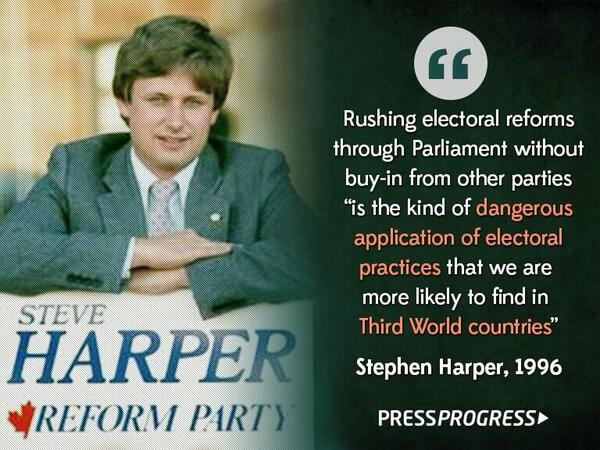
Embedded image permalink

... or pull a Stephen Harper.


Yeah, other Parties may not have bought in to the Fair Elections Act, but a majority of whipped Con MPs did, and that's most of Parliament, so that's what matters most, right?  Or at least, that seems good enough for the PM now.  Funny how perspectives change when you're holding the reigns, I guess.

Remember when Harper was all about reforming the system?  It looks like the system reformed him, for the worse.

Absolute power, absolute corruption, etc.  Unless your conviction is strong.  Looks like Harper's wasn't.


Wednesday, 7 May 2014

Bread and Circuses: Democracy at a Distance


Do campaigns matter?  Absolutely they do.  A well-funded campaign has the ability to puncture the data fog and place tailored, appealing messages in the inboxes of voters.  It can equally place tailored, opposition-undermining ads in front of massive audiences.

The in-person stuff is often designed just to fuel this sort of big-picture outreach.  A whistle-stop is no longer meant for the audience present, but the audience available through media.

Election campaigns are complex exercises that can demonstrate the discipline and fighting capability of a given Party's ground forces.  But that's largely what elections have become - the domestic equivalent to military exercises on the borders of the Ukraine.

We know that politics is a blood sport; like any engaged sport, it can be a lot of fun.  You get your elbows up, you feel the exhilaration of a race to the finish line, you have the chance to play, test yourself against opponents and invariably, get free food, booze and exposure to important people.  

Play your cards right, you can also get useful references for work - or maybe a job itself.


It's no wonder political strategists are so adamant that elections are crucial to democracy and bully those who suggest there may be more to democratic engagement than campaigns and a vote every four years.  They love the competition and make money doing so - elections are good for them.

But elections aren't supposed to be exercises in message superiority, job-hunt opportunities or profitable ventures.  They're not meant to be opportunities to beat down people you have grudges against, either.  

That is, however, what happens when we allow our democracy to turn into a blood sport.  It becomes bread and circuses, gladiatorial combat fought by aggressive War Roomers seeking to appeal to the lesser angels of the voting audience.

Lost in this process is healthy debate, an exploration of the issues and actual civic engagement.

If we're content to watch our democracy roll out from the cheap seats, I guess that's our choice - but this is a movie we've seen before.  We should know by now the ending sucks.


Monday, 7 April 2014

Canadian Spring in Bloom


Dobbin spares no rhetorical flourish in his piece and makes a point of tying "true democrats" with the NDP, but he also makes a lot of interesting points.  

Like the fact the Conservatives seem hell-bent on catalyzing a movement against them and spitting sparks on our convoluted electoral/democratic system.  All because they've gotten it into they're heads that they are an empire now and therefore entitled to a Divine Right of Government.

I find it interesting, though, that like most commentators Murray is focusing on the aggressive, noise-making critics like Idle No More.  There's copy in this because such groups already have traction, but there's a broader shift in public consciousness that, thanks to social media, is fundamentally changing the way the political game is played.

People who sell and those who profit by highlighting them are not paying attention to the emerging notion of UGC - User-Generated Content.  This is something businesses have started capitalizing on and bureaucracies are proactively starting to harness through the Open Data movement.

What's the opposite of a functionally-fixed government pushing policy that works for it, but nobody else?  A conscious and engaged public/public service collaboratively designing the policies they want and demanding government to implement them.

2014 is going to be an interesting year in terms of various threads weaving together - Open Data, Civic Disengagement, Social unrest and of course, elections.

Making this summer a perfect time for a Road Trip to explore and connect these various movements and populations through collaborative discussions and social media promotion of OpenGov.

Should the political big dogs be paying attention to this?  Probably not - they have bigger fish to fry.

But more on that later.

Thursday, 3 April 2014

Fair Elections Act, Fair Game: Reap What You Sow


Is the Fair Elections Act a sneaky, not-so-subtle ploy to rejig the way our electoral system works in their favour?  Or is it a misguided attempt to fix problems the Tories feel exists within our system and they're simply too stubborn to realize they're wrong?


Probably a bit of both, with heavy leanings on the former.  Remember - this is the Conservative Government whose leader misrepresent an opposition coalition as illegal and whose House Leader threatened to ignore the Constitutional process by "going over the heads of" Parliament, to whom Government is legally accountable.

Which is the underlying story in this.  Folk like Vic Toews, Dean del Mastro and Pierre Poilievre have a certain mindset which has made them valuable attack-dogs for Stephen Harper.  They all believe that strength and superiority are the only virtues that matter.  They could care less about Harper's former vision of a Conservative Canada with greater independence for all - they're all about Empire and the entitlement that comes with it.  

All else is justification.

The biggest failing of their perspective is that they've made the assumptions that all the Canadians who matter feel the same way as they do.  Del Mastro felt violated by Elections Canada because he got caught breaking the rules in the same way Rob Ford feels violated for the press exploring his law-breaking ways.  Poilievre has taken extreme relish in the message-focused, fact-ignoring riposte of Question Period and Press Scrums, assuming that the Canadians who matter like the fact that he's hard-nosed and admire him for it.


This is a Party that has fallen from grace.  It's strayed far from the path Preston Manning laid out not that long ago.  

The newer faces in the crowd, however, don't care.  They're no longer interested in shrinking government; they're focused on consolidating power and control.

Should we be concerned about this alarming trend?  Yes and no.  

Yes, in that all the critics are right; the Fair Elections Act, like closed committee meetings, withheld information, increased micro-management by government of the agencies meant to provide transparency and technical oversight of political decisions before it, are damaging to the well-being of our democracy and the sustainability of our country.  

But this is a trend that started before the Harper Tories took power and looks likely to continue after they're gone, too.  That's part of the structural problem no Political Party has yet addressed, because they have become the problem.  Parliament and Government are Church and State - they're meant to be separate entities.  How can Parliament hold Government to account when Government is dominated by Parliamentarians?  It can't work.

Which is why there is long-term promise in the way the Poilievres of the world are undermining the system we have.  They don't see it - they're not practicing the lessons of Sun-tzu - but they are actually helping to catalyze the replacement of this system with something else.


By making it harder for the average Canadian to even pretend they have a system that represent their best interests, the likes of Poilievre are simply encouraging more Canadians to decide the only way to protect their interests is to go over the heads of Parliament and Government itself.


Occupy was a lot of noise without action, but it rattled cages.  Idle No More had (has) some teeth.   Despite the fact it has been infiltrated by government agencies like the FBI, Anonymous is still keeping a watchful eye on miscarriages of justice.  And the Open Data movement is looking to open government from the inside out.

If control, dominance and fire superiority (costly attack ads) are the Conservative Government's priorities, they're going to find themselves stamping down harder on a growing number of foes, which is a slippery slope for any government to walk.  But the same will hold true for any other Party looking to wrest the reigns of power from the Tories.

If you're paying attention, things are looking worrisome right now as far as the health of our democracy goes.  They'll get downright frightening before enough people are motivated enough to do something about it.  When that happens, though, there is already a legitimate, democratic movement underway to replace our ancient system.  

Not everyone will want to take the slow road of structural change, though.  Some will just want to make someone pay for the injustices they feel.  


At that point, Government and Parliament both will have a choice - lump all the change-seekers together in one group and declare war on all of them (which would be a big mistake) or opt to work with those actually trying to help them.

You reap what you sow.  Right now, the Conservatives are clear-cutting democracy; fortunately, there are others who have already planted the seeds of a responsible society.

Spring is coming to Canada, and it's about time.


Wednesday, 2 April 2014

Do The Right Thing: Solving The Wrong Problem


There are so many smart, competent people on all sides of the political divide right now.  Most of them have no training to do the jobs they're technically tasked with doing (and receiving partisan pressure to do a different job besides) but the latent potential is staggering.  

Add to this an Ontario Public Service on the early edge of transformational change, with many of the functionally fixed players weaned on the ways of government during the tail end of the Industrial Age retiring and making way for a new generation that's grown up with social media and a whole new way of engaging.

Yet it all goes squirrely when it political sales and power comes into the question.  

We have budgets designed as campaign platforms being released in advance by political aides through one-off announcements, yet preemptively being leaked by disgruntled bureaucrats sending not-so-subtle signals that they're not willing to be treated like trained seals, as they have been under successive governments for decades.

I keep hearing from the smart people at the top of the political ladder "you have to identify the right problem if you want to find the correct solution," yet they keep ignoring their own advice.

Look, I get it - politics is about winning, power, the corner office, so on and so forth.  Yay, power.  

But the people in those corner offices have at least some inkling to how influenced they are by the people who put them in power - political organizers and funders in the private sector with their own agendas at play.  So, being in power isn't the be-all and end-all because you're still beholden to someone else.

And it's even messier - Parties are beholden to stakeholders, MPPs are beholden to Parties, but also constituents.  Often these interests don't add up.  When you have a Member (or candidate) forced to choose sides between Party platform (and Party support) or constituent concerns (and actual votes) you can't but end up with at least a partial analysis paralysis.

Look at the budget documents and platforms we're getting.  They are all check-lists of one-off projects or funding designed to appease a given stakeholder group.  There are no carefully-research structural reforms, cross-Ministerial service studies or revisions to internal operation with an eye towards making what exists now work better.

Political Parties are throwing starfish back in the ocean one at a time while tens of thousands of others are left to bake in the sun.

We have completely forgotten the whole point of Political Parties in the Legislature - it's not so that they can fight for power and dominate the agenda with one perspective or the other, it's so that they can find balanced solutions that represent the best interests of varied constituencies.  

That's been lost.  It's been lost largely because our system was never designed to have Parliamentarians in Cabinet in the first place.

We can keep at this merry-go-round of political-pendulum swinging, but the people are starting to get motion sick and want off the ride.  That includes the politicians themselves.

The problem we face isn't that one Party is more corrupt than the other, more beholden than the other.  It's that our entire system is antiquated and inadequate to meet the demands of today, from the political operation all the way down to how the front line of public service is supported.

Potential solutions exist.  Whole new processes are available.  Inside and outside government, there are good people who aren't entrenched in the system who are ready, willing and able to work with whoever to fix the real, structural problems that are gumming up our provincial works.

But they need people on the other side willing to work with them.  And that means recognizing that being in power isn't the solution - empowering the people is.

Not by handing them fish, not by throwing them in the deep-end, but by building trust, sharing information and re-designing the process with their input, every step of the way.

We've lost our responsible government.  It's time for a peaceful revolution paving the way for an Open Government serving as a social synapse for a responsible society.

Political Parties can continue to position each other as the problem, or they can collaborate with the rest of us on the solution.  

That's their ballot question to consider.  And they will be held to account for their choices.

Tuesday, 1 April 2014

Come Outside, Pierre Poilievre - Spring Is Coming!


Rules?  What rules?  The Globe and Mail has clearly missed that the only rule that matters when a Party feels they have an empire - they act, they create their own reality... they're history's actors.  All of us, we're just left to study what they do.  We commit sociology by studying, they just do.

Which, of course, is the ideology that's fueling Stephen Harper and his point men/women (but not, I would say, his whole Party).  Poilievre is poster boy for the smug entitlement that has corroded the institution Harper inherited from Preston Manning.

But there's something else going on here, something meta that the hyper-partisan and delusionally confident mud-slingers like Poilievre are missing (when you feel like you shape creation, you do tend to miss both the nuances and the bigger picture).

First - does no one else see the irony in any Members of Parliament (which serves the sole purpose of holding Government to account) serving as Government (so, holding themselves to account?) now reshaping the laws around democracy to better suit their interests?  It's like Magna Carta in reverse.


This is a key point I don't think enough people are paying attention to.  We've gotten so used to relying on Parliamentary traditions and conventions that we forget just how much of the current operation of Parliament is not reflected in our Constitution.  In fact, our Westminster Parliamentary system wasn't actually designed to have Political Parties duking it out over which gets to form the Monarch's government.  

It's no wonder our politics have gotten so squirrely and that Party Leaders now serve as partisan lords and stand-in monarchs both.  Political Parties evolved out of the Restoration, when the Horse Drivers (Whigs, now called Liberals) and Outlaws (Tories, now called Conservatives) were at odds over the religion of the King.

These were different perspectives that formed groups within Parliament, the body meant to hold Government to account.  It's by convention only (it being easier to tweak an existing system instead of implementing a new one) that we're now at a place where the politicians elected to hold Government to account on behalf of the people are now acting as Government and holding themselves to account.

Is it any surprise we now have Governments acting like Monarchs and focused on doing whatever it takes to win majorities so they can act, essentially, like empires?  When they are accountable to themselves only, who's to stop them?

Which brings us to point number two.


Given this reality of win-focused, self-serving partisan groups (largely directed by unelected, unaccountable to the people backroom operators) it's no wonder why there has been a notable shift in how civic protest against the closed-door, unrepresentative nature of our politics is manifesting itself. 

While the tough-minded alphas at the top insist that people are sheeple and that any changes they implement are etched in stone, discontent with the system entire (and the people nudging it away from true democratic operation) is swelling. 

Occupy was a lot of noise, little action and has been easily dismissed.  Idle No More brought more action to the table, but has not been seen as a wide-spread movement.  

It's really hard for people who don't believe in committing sociology to recognize emerging social trends until it's too late.

Both Occupy and Idle No More still exist, but more importantly they have fed into a longer-gestating Open Data movement that's started within bureaucracies and aims to completely transform how our government functions.  The partisans can bark orders, micro-manage and catalyze all the scandals they want; they come and go from government all the time.  The Public service has to take a longer-term view and, as such, is becoming much more strategic in how it both plans and positions policy for their "political masters." 


That's before you take into account Samara's almost ethnographic deconstruction of our system's failings, non-partisan GOTV training for less-likely-to-vote (and therefore, be engaged by partisans) communities and of course, the broader Open Data/Open Government movement.


Make no mistake - there is a movement out there, and it's growing stronger.  

You can call it the Canadian Spring (which, as a Game of Thrones fan, I enjoy) or, for historic relevance and bodacity, the Peaceable Revolution.  However you brand it, the direction is clear - change is on the horizon.  The further this or any government tries to tighten its grip, the more public trust - including that of their own partisans - will slip through their fingers.

In trying to recreate a mythical past, folk like Poilievre aren't further entrenching their power for perpetuity - they're merely expediting their fall from grace.

Which is why it pays to commit a little sociology every now and then; it actually helps overcome blindness.

If, that is, you're open to seeing.

Monday, 31 March 2014

The Zombie Shambles On


I'm not of the opinion that corporate executives (or conservative politicians) are consciously punishing, marginalizing and dehumanizing the front line as an excuse to make more profit.  Quite the reverse; I think a focus on profit is what's giving these folk cause to dehumanize the front line.
 
Apex predators, survival of the fittest and all that.
 
That's just one piece of the puzzle for me, though.  Looking at the big picture, I see wrong-headed focus, widening communication and social gaps and not a small bit of anger all emerging at the same time as the stagnancy of our political and social systems are causing public services to reach a breaking point. 
 
Then, there's a private-sector culture that was nurtured during the Industrial Age and is poorly-positioned to maximize their labour's full potential in a more knowledge (information, communication, advanced tech, social media) economy.
 
But we don't think about such things - not when we're worried about a zombie apocalypse shambling towards us.  It takes a monstrous catastrophe of class-shattering proportions to shatter us from this revere and realize that when we opt to react selfishly instead of planning ahead pro-socially, we are that zombie.
 
Of course, this has happened before, and it will happen again.
 
Time is mythical that way.

Political Credibility and the Peaceable Revolution


Really, Tim?  Do you feel the same way about Prime Minister Stephen Harper when he says he didn't know the details about the Duffy deal?  Remember that time you fired Peter Shurman after saying he followed the rules?  Or that time you embraced, then backed off of Doug Ford?  Or fired a locally-elected candidate for disagreeing with a policy position, then changed it anyway?
 
I'm sure you equally had no idea that, when you were Minister of Tourism way back when, bureaucrats actually feared your walk-abouts because they knew that while you'd play good cop, your hand-picked staffer would come around right behind you and bully everyone to tow the partisan line.
 
Oh, but there's so much more.
 
 
First off, love how you implicated your team, too - real leadership there, Tim.  Secondly - you have intentionally, proactively and by your own admission done everything in your power to grind the Legislature to a halt, refused to work with the other Parties to make government work and as a result, have pissed away precious tax dollars with ringing bells.
 
You've done all this because you want to be where Stephen Harper is, meaning a majority government where you, in turn, don't need to work with anyone but can force through whatever the hell you want.
 
But Hudak knows he's being a hypocrite.  He doesn't care.  It's both his personal inclination and the advice he's getting from his team (that he just put in the line of fire) to step on Wynne's throat and hold it there until she is gone, or at least reduced to a tertiary threat, at which point the foot will go on Horwath's throat.  Nowhere in here does the public interest play any role whatsoever.
 
Not that he's alone in this; as with his Federal counterpart, he's merely the worst provincial offender of the moment.  Team Harper continues to do the exact same thing, bullying (and there can be no other term for it) each and every opponent, attacking their character and dehumanizing or de-Canadianizing them to suit his partisan narrative.  Frankly, it's what McGuinty's team did towards the end of his term as Ontario's Premier, too. 
 
This is simply where our politics is at - unelected backroom partisans playing our democracy like it's a videogame, high-fiving each other for particularly devastating hits.  There's no focus on structural solutions or even properly identifying structural problems - the goal is to kill off one's opponent, full stop.
 
Backroom political operatives are punting for narrow-minded, aggressive political frontmen and in the process have turned our Legislatures into poorly-written courtroom dramas.
 
"I met with her on January 28 before these documents were destroyed in the premier's office.  I expected I was talking to the premier of the province at this time."
 
 
You could be specifically asking about the nature of the transition and seeking clarity.  You could be probing with Leg Services as to when Team Wynne actually took residency in the Premier's Office.  Hell, you could even be directing your team to craft legislation that could close the loophole that allowed for this to happen or better yet, doing one of your famous white papers on Open Data and Open Government.
 
But you don't care about fixing the problem, do you?  You're focused on blame.  You want punishment, removal - you think that the way to win is by eliminating all of your opponents. 
 
What happens when it's not just a couple of Political Parties and Unions disagreeing with you - what about when/if you win and it's stakeholders from every sector, bureaucrats, researchers, parents, employees, service providers, members of the Conservative base?  Are you going to try and bully them into silence, too?
 
There's plenty of blame to go around, if blame's your thing.  I don't know about you but I'm getting sick of the constant attack-and-defend, bluster and prevaricate when we have clear fiscal, social, structural and even democratic deficits that desperately need fixing.  You wanna talk about switching chairs on the burning platform?  Well, this is it.
 
Lots of emotional plays, transactional vote-buying projects and attempts to rig the system in favour of one Party or another going on, but because of this we have no co-designed strategies at any level.  This means that whatever programming or nudges that are brought forward are doomed to failure.  Harper can dance with joy that he's cut funding for the social programming he doesn't like; all it'll take is a bad plague, an economic collapse or a civil result for the pendulum to swing  back again, and it'll all be time wasted.
 
But we don't do long term thinking in politics and it's not about systematic wins, but partisan ones.  A percentage of a win is good enough to hang a campaign narrative on, and that's all that matters. 
 
What gets me angry is the absolute short-sighted waste of it all.  I don't care if you paint a rusted old Ford red or blue or how much you spend selling it, the car itself is the problem.  It needs fixed or replaced, not promoted. 
 
The war roomers don't care about that, though.  In fact, they'll spin any such argument as favouring their candidate and putting another nail in the coffin of their opponent because they're so functionally fixed, like a runner in a race, that they simply can't see it any other way.
 
They're lost, and they're taking us in circles around that afore-mentioned burning platform.  They aren't the solution, they're the problem, but like an addict, they simply aren't capable of seeing it that way.  They somehow literally believe it's possible to oppress oppositional perspectives and paint over one's own faults (in no small part by picking fights and dehumanizing opponents) in perpetuity without there ever being any long-term consequences.
 
It breaks my heart how wrong they are; it drives me nuts seeing them ignore the advice that can actually help them and help us because they're so convinced in their own infallibility.
 
There is a solution emerging - not from the top, but from a growing community of virtuous schemers within bureaucracies, community groups and countless partners in the private and not-for-profit sectors.  As the sustainability of our politics is closing, the strength of an emergent responsible society is growing.
 
At some point there will be a shift in balance from the political laggards to the Open Government innovators.  The only question is whether the political people will have any credibility left when they finally get on board.
 

Is Open By Default Magna Carta 2.0?


Open By Default: A new way forward for Ontario is just a report, arranged and paid for by the Government of Ontario.  Said Government can choose to ignore the whole thing if they want to, sticking this report on a shelf to collect dust with countless others that have come before it.

And quite frankly, from both a political and clay layer bureaucratic level, there's much reason to ignore the whole thing because many of the recommendations, if implemented, would lead to some uncomfortable reveals and require some anxiety-causing culture change.

But, as Lenihan said, that's the point.

Politics as usual is letting us down.  It's letting the politicians themselves down, as has been clearly indicated by reports such as the MP Exit Interviews done by Samara.  Increasingly, the focus is shifting from anything even remotely resembling decent policy to blatant partisan positioning, rhetoric and factually challenged messaging.


And it all costs money - lots of money.  Money that could otherwise be going to actual charitable causes, to children's education funds or to support social entrepreneurs.

Political Parties have become capitalist enterprises, pushing for more and more donations for the return of a sticker or a sweater, with the end goal being to put their CEO on the throne.

The publicly paid-for staff closest to leaders are wholly partisan operatives, nudging actual public servants and elected officials away from serving the public interest and instead delivering wins and slug-lines for the Party.

Ask them why.  They don't know why.  They'll tell you it's all about getting a leader in charge who will best be able to support one class or another, but scratch at that message a bit and you'll find that immediately underneath lies nothing but more pushes for money and ambitions to entrench one Party or other into the national fabric in perpetuity.

And this makes sense - because partisan politics is all about winning, full stop.  A Party can deride an Opposition position with gusto and then assume it themselves without batting an eye, if they think it serves their purposes.  They can decry wrongdoing in one Party at the same time they employ the very same tactics themselves.

Why?  How can politics be so cynical?

Because Harper was right; Canadians fundamentally don't care about how the system works, but this is only because we can't see how it works - or fails to work.  We can't see just how much money and time is wasted by lateral departments that don't communicate, work at cross-purposes or establish programs based on narrow mandates and include embarrassing excuses for metrics.

We might know sub-consciously that by and large, any consultation processes are token exercises to foster the illusion of listening, but we don't see how that plays out in real-time, or over time.  It's not crystal clear to us how poorly the left and right hands of government fine-motor skill is missing.

But it could be.

With Open Data, every transaction, process, tidbit of information shared would be open by default.  It's not a process of micro-managing individual bureaucrats - it's a matter of illuminating the systematic flow of information to identify where the blockages are and fix them.

More than that, Open Government will fundamentally change the way information is aggregated, analyzed and acted on by ensuring the people have a collective say.  This isn't to say we get whatever we want, which should never be the case; people aren't rational actors, which is why laissez faire capitalism is such a bust.

No, the point is that we can communicate what we want, be encouraged to see how our pieces fit into a bigger picture and plan accordingly.  In this model government becomes a conduit, a facilitator, ensuring a balance of responsibility and action that best reflects the needs first, and wants second of the people.  Which is how our democracy is supposed to work.

Magna Carta was the first step taken in Britain to wrest absolute power away from the Crown and provide it for the first time (not return it) to the collective people.  It's important to remember that before William the Conqueror there really was no State to work with and people functioned much more independently.  Increasingly complex society, however, requires increasingly complex (and, to actually function, representative) governance.

Partisanship was not part of this system.  Partisanship is a political convention, not a policy law.  And increasingly, it's getting in the way of good governance.  Funding gets allocated based on a few ideological/vote-winning tricks, only to be shifted when power switches, meaning no big-picture work gets done.

As we're seeing in Ontario, the political culture has become so toxic that schoolyard taunts are now being met with threats of legal action, reducing the capacity of ideological opponents finding common ground.

They may feel they have no common ground to stand on, but they're wrong.  There is one land, we all inhabit it together, and if they can't work together, they've become part of our collective problem.

Open Data presents a real challenge, a culture change that partisans aren't open to; it implies a loss of power and a level of accountability they aren't interested in.  This is why we haven't seen as much traction for the Open Data Movement in Canada as has been the case in other jurisdictions.

But it's not about what's convenient for the partisans; it's about what's good for our country, our province, our communities.

Partisan operatives may not feel the need to consider the recommendations of reports like Open By Default and may not see value in respecting the opinions of elected officials, but those elected officials know that they will never get a Minister's position if they don't first win a seat - and that relies on votes from citizens more than it does money from the Centre.

Like weeds cracking through old cement, there are individuals and groups at all levels within the entrenched system trying to implement change.  They're leading open lives, proactively engaging on social media and trying to open up their data as best as they can.  Within politics, there are some Members and staff who are tired of the constant pressure of playing Machiavelli and would welcome a return to a properly functioning democracy.

There's not so much will, though, because there's not enough demand.  It's the political special interest groups that dominate their attention and hold their feet to the fire.

If we ever want to get out of the hole we've let partisans dig our democracy into, it's we, the public, that needs to step up.

Governments can ignore reports like Open By Default if they feel there's no pressure to act on it.  But if Open By Default were a position with a million signatures of rank-and-file citizens from every corner of the country, that would be a different story.

Especially if, courtesy of open data, you could map out those signatories and show how much demand for openness was concentrated in places that partisans need to curry favour to win government.

If we truly want change, we have to stop waiting for the powers that be to deliver it to us.  There is no power greater than that which we wield collectively, as the people.

Real change is possible, as unsettling as it may be, but it's up to us to demand it.


Friday, 28 March 2014

The Peaceable Revolution: Ontario's Ballot Question


Which example should I pull for my quote?  Breach of trust?  Contempt of Parliament?  Empty rhetoric, partisan positioning, misdeeds from staff, lies from leaders, bad behaviour, falsified behaviour, so on and so forth?


Which is what our politics has become - a melodrama that cycles endlessly, resolving nothing, going nowhere.  Why?  Because the people instigating it are so confident they know where they're going, they actually refuse to look ahead.

Save us, lord, from short-sighted people.  You know, the ones who put the win before actually accomplishing anything.  They position themselves as the only answer to our structural deficits but the truth is they're the problem.


Political operators are convinced of their righteousness and have gotten pretty damned good at confabulating rationale for moral lapses.  It always involves tight political framing of them vs us, meaning we have to do whatever it takes to stop them from taking over.  Only their leader can save us from the barbarian hoards at the gate.

These are the folk behind close doors who look at the people as pieces to be moved on a board.  

At this very moment, they are gathering their polling data, field-testing their messages and trying to find the ideal ballot question that frames the next election, every election - we have one municipally, provincially and federally in the offings.

The content of the question doesn't really matter, to them - whatever helps them win does.  That is how partisan politics works, after all.


But these aren't stupid people, nor are the entirely blind to the will of the people, when it surfaces.


That doesn't happen often, especially in these days of message-heavy advertizing and micro-targeted policies and outreach campaigns.  But it does happen, and when the people raise their voice loudly as one, the folk at the top can't but hear our thunder.

Here's what I'm hearing from the people on the street and in our Legislatures reading in the headlines and reports from organizations across the political spectrum and the few genuinely non-partisan ones.  

They don't know who's driving any more and certainly don't think anyone knows where we're going.  

We see blame, we see deflection, we hear boasts but see little action and almost no process.  We don't trust the people at the top, largely because we can see how much they have cut themselves off from the world they seek to govern.  

But the system is such that it really doesn't matter who gets in; corruption, dirty tricks and cynicism have clearly set in at all levels, among all Parties.  You don't cure lead poisoning by changing your cup - you have to get in and replace the pipe.

This is what Open Government and Open Data are doing, internationally.  They're unsexy terms for what is truly a revolutionary movement which will change the nature of government and civic engagement in ways as dramatic as Magna Carta and the English Civil War did for Responsible Government.


Federally, the Harper Conservatives are leading the charge.  Provincially in Ontario, it's Wynne's government.  In plain sight where people aren't looking, bureaucrats at all three levels are working together to make themselves accountable to the people and bridge the gap between citizens and their government.


It's real, it's happening, and it's powerful.  

But it's not where any of the Political Parties are focused.  How could they be?  There's nothing them and us about open government - open government is about everyone.  It's bad politics.

But it's good governance.  It's necessary change if we're to break through the barriers that are keeping our society from growing in the way we need to.

Which is why, this time, the people shouldn't leave it up to the partisans to establish the ballot question.

We should be doing that ourselves.

In Open By Default:  A new way forward for Ontario, the provincial government is challenged to establish themselves as a national leader on open governance and open data - to be leaders of the Peaceable Revolution for a Responsible Society.

It's the right thing to do, but it's also a hard path to take, without support - there's too much partisan risk involved.

But not if we make that the ballot question.  


If Ontarians make it clear that we're done with spin and messaging and want to see our leaders walk the walk, we could frame the ballot question like this:


Which Party is going to demonstrate their commitment to Open Government and Open Data between now and the election by becoming completely Open Themselves?

They could position all they want, frame themselves as the solution to the Opponent problem all they want, spend their money on as many attack ads all they want.  It would be resources addressed to the wrong problem, as partisan politics so often is.

We would look for the Party most able to open its doors for total transparency and direct accountability.  Every staff hire, fire, training paid or not paid for, advertising dollar, consultant dollar, fundraiser held and who attended, community consultation and which groups were invited would be open for the people to see.

The people could judge the Party not on what they say they will do, but on what they are doing right now.

If we believe a Party is open, then we'll believe they're open to advice, consultation, shared solutions - democracy.  

If, and only if, we see that they are walking the walk, they would get our support.

Here comes the sneaky part.


Should every Party see clearly, unequivocally that the people have an unshakable devotion to open government, they would all have to move in that direction.  


Win or lose, the people would reward the behaviour they want, forcing each Party to continue down this path in perpetuity until, as with any evolution, openness becomes innate.

It's not about left or right, them or us, who's at fault - it's about everyone moving forward.

Whichever Party willing to trust the people and lead by example, we would trust in return.

This may sound like a pipe dream, but it isn't.  It's a reality that's emerging right now.  And those Parties unable to adapt to this spin of the wheel are going to find themselves falling behind.

Which is how it should be, no?