Search This Blog

CCE in brief

My photo
Recovering backpacker, Cornwallite at heart, political enthusiast, catalyst, writer, husband, father, community volunteer, unabashedly proud Canadian. Every hyperlink connects to something related directly or thematically to that which is highlighted.
Showing posts with label Faith. Show all posts

Thursday, 7 May 2015

Omar Khadr and the Lessons of Buchenwald


At this stage of the game, you either believe that Omar Khadr is a youth who has suffered much at the hands of oppressors (including his parents), or you believe he is an inhuman monster who can not be trusted, ever, and should be either contained until death or killed now and have done with it.

If it's the latter, you perhaps see Khadr not as a human, but a symbol of the evil Islamist (or just plain Muslim) barbarian hoard that seeks to destroy Western culture and conquer Western lands with their numbers.  To you, Islam may feel less like one of the Abrahamic religions and more like a zombie hoard that must be kept at bay and ideally destroyed - for purposes of self-preservation, of course, because in this game it's them or us.

Should you feel some empathy for Khadr, however, you probably recognize him as a human who was presented a skewed world view by his parents, thrust into a conflict as no child should be and then abused by agents who either saw him as an animal or a political pawn.  You also believe that political game-playing is still going on.

Here, then, is the most basic question, the test of Khadr's humanity.

Could he produce children with other people - African, East Asian, Caucasian?  Of course he could.

Would a child of Khadr's be susceptible to developmental influences?  Without doubt.  Pick the kid up and raise him in China with Chinese parents, his culture and outlook will be different than if he grows up on a remote First Nations reserve, or on the streets of Mumbai, or in a massive Rosedale home.

If we recognize Khadr is human, however, then we might need to consider the possibility that other individuals in the group he's been lumped into - terrorists, Islamists, Muslims, whatever - they might be human, too.  Like we are.  

And if it's possible that, in spite of his whole life being a sad saga of manipulation and abuse, Khadr is still capable of hope and change, then the same holds true for all of us, doesn't it?

It's a very uncomfortable question, this, with deep meaning.  If a die-hard ideological terrorist can learn to change his ways, then the reverse is likely possible, too, isn't it?  And if people are so malleable given the right influences, what does this say about our individuality, our pride of self?

Consciously or not, we much rather us-vs-them narratives that focus on us being right and them being a threat.  The more of a threat they feel like, the less human they will seem to us.  Instead they are animals, even vermin.  You don't waste precious resources talking with vermin or accommodating vermin, do you?  They live in squalor, they spread disease - the only thing to do with vermin is destroy them.

We can talk about the inherent violence of Islam.  We could talk about the inherent violence of Christianity, too, reflecting on the crusades, Inquisition, various wars of conquest.  We can talk about Europeans, about Muslims, about Arabs - but the bottom line is that underneath all the layers, we are all human.

In the Concentration Camps of World War II, inmates - including my grandfather - had their humanity stripped away from them. The SS treated inmates like vermin, and intentionally so; the more they could dehumanize their captives, the more they sapped their morale while also strengthening the resolve of their troops to treat all foes as inhuman.  

Camp survivors will tells stories about being so weak, so broken that when someone near them died in their tracks, those who lived had neither the strength nor will to care.  It was all one could do to survive, and when survival was such a high bar to reach, you couldn't focus on anything else.

People who've never endured that type of horror often say "you could have resisted more" or "you could have fought harder", which is a bit like telling an asthmatic to just breathe more or a cripple to suck their pain and walk.  It's no different than suggesting a 15 year old Omar Khadr should have spontaneously developed an understanding of the world separate from what his life experience had presented to him and be one of us in their ranks, stopping his dad and the adults around him from committing terror or die trying.

We've got this quaint notion of what counts as a real human - rational actor, uninfluenced by environmental circumstances, willful enough to climb any mountain and overcome any challenge physical, psychological or external.  People not meeting that standard; well, they're not quite human, are they?  And not as deserving of the fruits that come to those that are human?  

It's a real easy notion to convince yourself of if you have never suffered, or if you see the end-game for suffering as being the removal of those who cause you ill.

I've never met a single Holocaust survivor who wishes that all Germans die for their sins.  They don't believe in an eye-for-an-eye.  Having seen the absolute worst of humanity - having had their own humanity stripped from them and gone through the painful, lonely process of regaining it - survivors don't endorse dehumanization in any form, directed at anyone.

They know all too well the ugly outcome when dehumanization of the other is a strategic objective.

The tortures and abuses Omar Khadr faced pale in comparison to what Holocaust survivors endured. By his own admission, Khadr threw a grenade; rest assured that there were many Buchenwald inmates who were incarcerated for fighting against the Nazis. The regret Khadr is expressing sounds much like that of the children and grandchildren of Nazis that I know, which equally sounds like the regret you might hear from a drunk who killed someone while driving.  There's this disassociation from the person or community that committed inhuman acts that doesn't deny responsibility, but rather recognizes a terrible reality - that whatever we think of ourselves, we each have within us the ability to do stupid, selfish, inhuman things to those who have done nothing to deserve it.

We're only animals, after all.


It's funny that, for all the talk about original sin and stories about floods, golden calves and the like, there are still those of other Abrahamic religions quick to pounce on Muslims as uniquely ungodly  and especially capable of ungodly acts.  The underlying theme of the Old and New Testaments is that people are flawed; we must recognize that and aspire to be more than base instinct to be deserving of the greater love which is there for us regardless. 

If Omar Khadr is rejecting the path that his life set out for him and seeking the positive, that is a hopeful story.  He's right on the money when he says we should afford unto others the opportunities we would like to afford ourselves.  Think about that in terms of economic disparity, electoral prospects of marginalized individuals, of women on boards and in Parliament, even access to the subway.  

If you believe humanity is incapable of securing its own salvation, then life to you is probably a race to the finish, or a circling of a shrinking water hole.  Both scenarios involve an end-game with a last-man-standing, which is exactly how the Nazis viewed their conquest.

On the other hand, if you believe what Khadr has said - that there is good in people, that we are capable of better, then you have to recognize the good and bad in everyone.  The good won't thrive unless it is nurtured.

Bitterness, competition, end-game planning or hope, collaboration and constant adaptation.

That's the real us vs. them - where we come from, as a species, and what we can, at our best, aspire to be.

Monday, 11 November 2013

Don't Forget To Ask


The people's representatives should never be afraid to answer their constituents openly, transparently, responsibly.  If not, then they aren't representing the people's interests, but their own.  You can't understand the will of the people if you're not willing to talk to them, nor understand the way they see their concerns.
 
Without communication, you can't understand a problem, let alone hope to solve it.
 
 
Think on that, then ask yourself - where, if anywhere, do we have that kind of leadership today?


Monday, 21 October 2013

Wealth, Faith, Isms and the Pursuit of Happiness


What is happiness?

Not religion, thought both Marx and Rand.  Religious institutions have oft been decried as systems of oppression.  They can exclude women, undermine opposing perspectives as sinful and cast "The Other" as infidels deprived of human rights.  Of course, Religious institutions are also insatiable beasts requiring vast wealth to keep The Word of God in tangible form, or at least to open to door for access and indulgences.

Friends on the political left will tell me that religions are designed to create haves and have nots and therefore are naught but systems crafted by the elite to enforce compliance and extraction from everyone else.  Religions have certainly been used for such exploits in the past (and present), but that's the institution and the people within the institution - not the religion itself.


It is worth noting that most of the founders of the world's great religions lived lives of poverty.

Ecstatic practitioners of all faiths equally eschew the trappings of wealth and live simply, close to the earth.  As implied by the term - ecstatic - these mystics also live lives dipped in rapture.  Is there joy illusory?

What defines happiness, if happiness is the goal?  Marx tells us religion is an opiate, an externally applied substance that creates the illusion of contentment.  If the wealthy are tricking the poor with cheap bobbles to keep real happiness to themselves, is the implication here that wealth is contentment?  
One would think, then, that the wealthy are deliriously happy and without a care in the world.  But if they feel an urge to trick the people so as to hold on to their own vast fortunes, the implication isn't happiness, it's fear of loss by competition.

Capitalism is theoretically all about competition; work hard, work smart and you too can be wealthy.  God isn't a network, so go forth and create your own, kind of thing.  If it's the ability to compete that drives people to succeed, gain wealth and buy happiness, you'd think we have a population that is hard-nosed driven to build their own success and, as a consequence, buy happiness.  But happiness through goods isn't all that different from the supposed opiate of God - it's an external substance consumed to create an artificial sense of contentment.


External substances.  Manufactured highs.  It's known that certain drugs, including narcotics like opiates, can be highly addictive; the highs one reach under the influence cannot be matched in normal life, meaning the drug becomes an escape from one's existing circumstances - it's the escape more than the substance that is addictive, which is now being demonstrated through scientific study.  Are luxury cars, expensive meals or trips to exotic locations any different?  Are mansions and vast lawns with high walls any different?  


All are variants on the same theme; escaping a heartless world.  One would think Marx would have concluded that both the rich and the poor worship false idols in pursuit of happiness, seeking a Final Solution to remove the source of their misery from the world to create a better one.

But why are the poor mystics so damned happy then?  Why would folk like, say, the Dalai Lama continuously dive back into worlds of hardship and emerge even more content, almost childlike as a result?

Let's go back to happiness.  What is it?

If you believe happiness is a feeling - light on your feet, a sense of optimism, an opposite to sadness, then what you are describing is a nothing more than a neurochemical state.  Hormones like serotoin, endorphin and oxytocin create states that can be described as happy ones.  Neurochemicals like dopamine are stimulated by the consumption of narcotics, which is why they are addictive.

So, if true happiness is the stimulation of happy hormones within the body without external stimulation, either in the form of religion, goods or drugs, how can it be achieved in a heartless world?

A world without a heart is a body without a circulatory system, like a jellyfish or a flatworm.  Our world is infinitely more complex than that, as is our civilization.  The heart is a selfless muscle, constantly beating, feeding the rest of the body, keeping the system flowing.


We humans couldn't live without it; in fact, we never have.  There's been some form of heart throughout our evolutionary process, slowly growing more complex as our own internal systems have grown more complex.  It's not often we think about our heart and its simple but essential role, until it or our body comes under duress.

Which brings us back to those happy ecstatics like the Dalai Lama, trying to keep dialogue between conflicting systems, trying to breathe life and hope into the abysmally poor and somehow, finding sustenance for their souls through the process.  

There's a funny connection between states of religious ecstasy and mania - which, in turn, is a neurochemical state that has a lot in common with a narcotic high, only produced without the need of external stimulation.  

Marx had it wrong.

The world isn't heartless.  Despite it's role as a tool for circulation, a full heart is a concept synonymous with happiness; there's a reason for this.  

Folk like the Dalai Lama are happy because they have beaten us to the punch, so to speak, and have realized something the rest of us haven't; religion isn't the sigh of an oppressed creature so much as it is a pulse, keeping the system pumping as it evolves, ever slowly, towards something more complex that requires not just a complex circulatory system, but a nervous system as well.

As they say - The Kingdom of Heaven is a Kingdom of Consciousness.

Knowing others is intelligence; knowing yourself is true wisdom. Mastering others is strength; mastering yourself is true power.  If you realize that you have enough, you are truly rich.

Thursday, 11 April 2013

Rehtaeh Parsons, rehcaet


I have a theory.
 
There's a part in most people (narcissists and psychopaths being exceptions) that sees empathy as a strength.  Our superheroes are people of conscience who always put others first, even at the risk of personal sacrifice.  We worship those who give their lives on behalf of the people.
 
We want to be strong enough ourselves to be the change we long to see in the world. 
 
But we're afraid that we aren't.  We don't know if we have the endurance, the will, the patience or wisdom to make the right choices, to make consequential sacrifices if and when the time comes.  Equally, we're afraid we'll be mocked for trying.  It's a cruel world, after all; it isn't worth the risk of exposing oneself through acts of kindness.
 
As such, we admire strength of character from afar or resent it as a bright light that brings into sharp focus the shadows of our owm inadequacies.  At our weakest points, we will seek to put out that light and keep our own personal failings in the dark.
 
I don't know what was in the heads of the boys who raped Rehtaeh Parsons, nor why they felt it necessary to post pictures of their sins.  But I can guess.  They wanted to be seen as tough, powerful enough to pluck the wings off an angel.
 
Everything I have read about Rehtaeh suggests a person of strength who put others before herself.  There's nothing more powerful that the testament of a father who recognizes that his child will surpass him and knows humility in their presence.
 
With her death a light has gone out of the world, but it doesn't need to be extinguished entirely.
 
Not if we're willing to pick it up and carry it.
 
Society did let Rehtaeh down, but her death need not be in vain.  People around the world are raising their voices, demanding justice, wondering how this could have happened, wanting action of some kind.  Rehtaeh's death has mobilized us; what will we do with our raised voices? 
 
Let's honour this sacrifice by not fixating on what can't be changed and instead flipping this around, seeing what we can do better moving forward.
 
Perhaps the best place to start is to ask - what would Rehtaeh do?

Beautiful Memorial To a Daughter (Glen Canning)


My daughter was three years old when we went to watch Babe: Pig in the City. There's a part in the movie when Babe knocks over a goldfish bowl and the fish falls onto the floor and starts flopping around. When this happened Rae suddenly stood up on her chair in the movie theatre and started screaming for someone to help the fish. She cried for it as I tried to reassure her Babe would help (thank God he did) and that the fish would be alright.
 
That was the nature of my daughter Rehtaeh. She was like that her whole life. I couldn't go for a walk in Halifax with her without her asking me for change to give to someone in need. She was always looking out for people or animals that needed help. She called Animal Control Services on our neighbors because they left their dog outside too long. Her room and her life was always full of little creatures.
 
Sometimes her heart was too big, sometimes it scared me.
 
They say parents need to teach their children. Instead, it was Rehtaeh who was my teacher. My precious gift. She was the absolute best part of my life.
 
There's a wooden box in my house that holds all the memories I have of my beautiful little girl. The outfit she wore home from the hospital, a hand print in clay, art, school cards and drawings, mementoes of her life. Even a newspaper dated December 9th, 1995, the day she came into this world.
 
I tried to keep it all for her, to have someday when she grew up and had her own family. That day will never come.
 
Rehtaeh died April 7th at 11:15 PM. She was 17 years old.
 
She died struggling to live, much as she spent the last 18 months. She hung on right to the very end, when the nurses were telling us if she couldn't be declared brain dead soon they couldn't use her as an organ donor. We couldn't wait any longer. She couldn't live any longer. And right at the last moment there was a change in her blood pressure as the last part of her brain gave away. She knew she had to leave. It was time to let go and find peace.
 
It was so like her to hang on right up until the very last second. To give us all a chance to hold her hand, wipe her tears away, and kiss her beautiful face for the last time.
 
I tried my best to save my daughter's life. I believe that in my heart.
 
I asked her repeatedly what I could do, was I doing enough, what did she want from me? She said she just wanted me to be her dad. To make her laugh. To do everything possible to keep a part of her life normal. She said it helped more than I could ever know.
 
I prayed for the best while I prepared her for the worst. We went to counseling together. Sometimes I was the drive, sometimes the father, sometimes the counselor.
 
The worst nightmare of my life has just begun. I loved my beautiful baby with all my heart. She meant everything to me. I felt her heart beating in my soul from the moment she was born until the moment she died. We were a team. We were best pals. We often sat on my couch and laughed until we could hardly speak. When we weren't together she would call me or text me every single day, just to say hi, to say she loved me. The life I had with my daughter was a rare thing. It was wonderful, it consumed me. I was defined by it. It made my life rich and beautiful.
 
She was amazing.
 
Yesterday I looked at another wooden box. It will hold her ashes. I hate it.
 
I had to write something about this. I don't want her life to defined by a Google search about suicide or death or rape. I want it to be about the giving heart she had. Her smile. Her love of life and the beautiful way in which she lived it.
 
I found out this afternoon my daughter saved the life of a young woman with her heart. How fitting.
She also gave someone a new liver, a kidney, a new breath, and a new chance to love. She saved the lives of four people with her final gift of life. She was that wonderful.
 
Someone out there is going to look at the world with my daughter's eyes. The most beautiful eyes
I have ever seen.
 
To the Justice Minister of Nova Scotia
Rehtaeh Parsons thought the worst outcome for her case would be no charges against the men who raped her but we all know better. The worst thing that could happen would be charges. That they would be found guilty, and that Rehtaeh would sit on a court bench and listen in utter disbelief as they were given parole, or a suspended sentence, or community service. All for completely destroying her life while they laughed.
 
Why is it they didn't just think they would get away with it; they knew they would get away with it. They took photos of it. They posted it on their Facebook walls. They emailed it to God knows who. They shared it with the world as if it was a funny animation.
 
How is it possible for someone to leave a digital trail like that yet the RCMP don't have evidence of a crime? What were they looking for if photos and bragging weren't enough?
 
Why was this treated like a minor incident of bullying rather than a rape? Isn't the production and distribution of child porn a crime in this country? Numerous people were emailed that photo. The police have that information (or at least they told us they did). When someone claims they were raped is it normal to wait months before talking to the accused?
 
You have the opportunity here to do something good and lets face it; the court system in Nova Scotia was just going to rape her all over again with indifference to her suffering and the damage this did to her.
 
My daughter wasn't bullied to death, she was disappointed to death. Disappointed in people she thought she could trust, her school, and the police.
 
She was my daughter, but she was your daughter too.
 
For the love of God do something.
 
***I've been contacted from media outlets from all over the world and as a past member of the media I understand why you all want to speak with me. You have all been very courteous, professional, and respectful. Please know, however, this is the only statement I am able to make. I'm too devastated.***
I feel like I'm dead inside.

Wednesday, 3 April 2013

Lazy Religion Tackles Gay Marriage: With Liberty and Justice for Most (Timothy Kurek)

 
I'm hardly an expert on Christian faith, but it does seem to me that much of what gets practiced by the main stream seems to cherry-pick from the message Christ tried to deliver.  In our anxiety about change and urge for expediency, have we turned to the golden calf for validation?


Lazy Religion Tackles Gay Marriage: With Liberty and Justice for Most
 
With liberty and justice for most... Wait that's not it. Some? A few? Oh no, it's liberty and justice for all.
 
I was raised in the Bible Belt, a hyper-conservative Christian who in the past few years has had his worldview crushed and rebuilt at the hands of experience. Where I once would have fought, and ardently so, against a same-sex couples right to marry, I have been blessed to meet and be live in community with the people I was always taught to shun. My beliefs changed and changed radically, and so I sit with bated breath as I wait to hear the Supreme Court's decision in the landmark court cases that have been going on the past few days.
 
Right now the United States Supreme Court is about to rule on both Proposition 8 from California and DOMA (The Defense of Marriage Act). It is a truly historical moment in our young country's life. It's the moment we decide if all really are equal, or if the only citizens allowed the unalienable rights of life, liberty and the pursuit of happiness are heterosexuals and those under the umbrella of main-stream Christendom. But what strikes me as I peruse my Facebook news feed or read the blogs of many of my friends and peers is the true lack of understanding about one crucial point. Same-sex marriage is not, in any way, shape or form a religious issue. Same-sex marriage is a matter of the state, and I am baffled by the fact that we live in a country that promotes itself as the greatest country on earth, a country founded on the principle of freedom, yet we are somehow still okay classifying "the other" as the lesser. Just how long will we allow there to be second class citizens? Did the civil rights movement of the '50s and '60s teach us nothing? These are not criminals we are persecuting, or even non-citizens. The "other" I am referring to are upstanding, tax-paying, citizens of these United States, and these citizens are suffering at the hands of one of the most toxic entities in existence, lazy religion. A few thoughts about lazy religion...
 
Lazy religion is obsessed with arm-chair activism and other such movements that don't require effort, sacrifice or calling. With the age of the Internet, the true causes of Christianity are being shelved, only to be replaced by political motivations that stem from a poor understanding of government and a poor understanding of the Bible. Several years ago I watched as Proposition 8 passed in California. I watched as my Christian brothers and sisters sang and danced in victory, having "struck a blow" in the defense of "traditional biblical marriage." The problem? In the days following I also witnessed mobs of angry gay and lesbian patriots marching in most major cities.
 
They marched in defense of their California brothers and sisters, and marched because they had to. The pain of doing nothing after Prop 8 passed would have set the cause of equality back and further entrenched the nation in an archaic and unconstitutional mindset. But more than anything I think they marched for hope. While mainstream evangelicals celebrated a victory over an issue, they never understood that they were actually celebrating the oppression of millions of flesh and blood people. People made in the image of God, possessing the inherent dignity that their humanity affords. And for what?
 
Lazy religion is addicted to empire and control. It doesn't acknowledge personhood. James 1:27 tells us that pure and undefiled religion is this: to take care of widows and orphans in their time of need and to keep oneself spotless from the world. Jesus also defined our focus, to love God and to love our neighbors (the other) as ourself. Is it right then that our mindset should be to politicize individuals and who they love, and to want to dictate those individuals lives through the manipulation of the state? A friend of mind, David, spent 40+ hours a week during this last election volunteering at a call center, dialing numbers and asking voters to look at this issue from a different point of view. When I asked him why he was spending so much time politicking, he told me that he felt he had to for a time... And then I could hear his voice crack and tears began forming in the corners of his eyes.
 
"Tim, I'm sick of being looked at as a political issue instead of as a person, an equal." I've never thought about things that way until he said that. Lazy religion doesn't think in terms of people; it thinks in terms of abstract theological concepts and issue based stereotypes. It politicizes unique and beautiful individuals made in the image of God. Lazy religion has no place in this debate...
 
So as we wait for the decisions to be made, and as we walk through the rest of this historic journey toward equal rights for everyone (not just in this country but also all over the world -- Australia, I'm looking at you) it is my prayer that the stances taken will be rooted in grace and consideration for all.
 
We can all be bigots, but we don't have to be. We can disagree and argue this issue to its conclusion but in the end it is essential we remember that lives really are at stake, and as a man of faith respecting and honoring the image of God in the other is almost as important as the issues themselves. No matter what side of the issue you fall on, you can live out the calling of love intentionally and realistically, and respect the many journeys the collective "other" have walked.

Thursday, 18 October 2012

Bread, Candles and Community – The New Sabbath Project


-       Ralph Benmergui

It's easy to say that religion causes war. Ayn Rand, Karl Marx and Richard Dawkins have all done so. There's plenty of evidence to back that thesis, too - historical horrors ranging from the Crusades to 9/11 all had religious motives. But what of the wars that didn't? The Rwandan genocide was tribal. World Wars I and II were about power and conquest. Conquistadors might have told themselves their goal was to bring God to the heathens, but they sure squeezed in a lot of rape, pillage and plunder along the way, didn't they? 

Beyond this lies the fact that war is not a uniquely human enterprise; other species ranging from ants to lions and hyenas engage in mortal combat, too.  In all cases, war is always about the same things – dominance and resource access.  While religion makes for a pretty unassailable justification for conflict (mortals can’t argue with the will of God), it’s one not suitable to that application.

The sad irony is that the core teachings of all great religions try to steer people in the opposite direction.  The Golden Rule pops up in faiths across the spectrum of time and geography.  In fact, there’s an argument to be made that religion played a role in nurturing civilization, lighting the candle of humanity in our dark paleomammalian hearts. Is it possible that religion, in its purest sense, is about bringing people together rather than setting them against each other?

Last Friday, I had the great pleasure of partaking in The New Sabbath Project hosted by two wonderful human beings, Ralph Benmergui and Cortney Pasternak.  They invited a diverse group of people with different lineages and differing trajectories into their home for the lighting of candles and the breaking of bread.  It was a cold, dark autumn evening, but within those walls was a space filled with warmth and light.  Ralph and Cortney billed the dinner as a night of food and prayer; for me, what they created was community.

As an ice-breaker, Ralph had everyone explain the origin of their family name.  Through the process, we got to understand each other not just as faces and titles, but as threads of the experiences of generations, woven into the fabric of each individual.  By adding dimension to each name, we all became a bit more humanized to each other.  This became critical, later on.

After appetizers, we moved to the table, where Ralph explained the rituals of Shabbat.  As he unspooled the rules, though, Ralph explained the why – what the bread symbolized, what the salt symbolized, what the candles represented.  By the time he began the incantation (given in Hebrew), we had already, through our opening up to each other and under the roof of our hosts, created a shared space. 

Judaism is an ancient religion that has preserved the same traditions for thousands of years, from the days before empires.  Through the symbolism of the Shabbat ritual, but especially through the concept of shared food and light an image was invoked for me of people at the dawn of civilization huddling together around a campfire, safe from a dark and threatening world.

Then, in another ancient tradition, Ralph kicked off the act of giving blessings – to or for people, in commemoration of places or events, an evocation of empathy for the world beyond our created space.  It dawned on me as we went around the room that the act of giving blessings was a way of engendering empathy for others and gratitude for the things we have (instead of fueling resentment over the things we don’t).  These are fundamental concepts to Positive Psychology, a newish field that seeks to build social/emotional skills and emotional resiliency in people. 

Militaries use Positive Psychology as way of empowering their soldiers, just as a growing number of workplaces are employing its principles to foster healthier and more productive employees.  A religious ritual that predated history had already mastered a key concept of psychological well-being millennia before science had even begun to explore how the mind works.

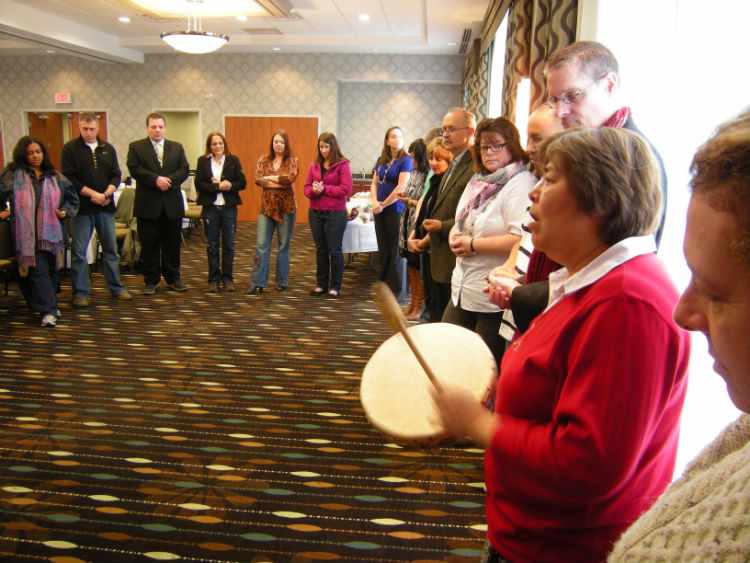
In the discussion that followed one of the guests, Sylvia, talked about a new job working with Native women.  Each work day, she explained, began with a “circle” – the creation of a space of comfort in which people could talk about their feelings.  For the first few days Sylvia didn’t get the point – they were there to work, not to have a hug-in.  By mid-week however, it made sense; when you understood the emotional state of a person at the start of the day, it informed all your interactions going forward.  There were less awkward communication problems and more appropriate supports, leading to improved outcomes. 

The notion of the shared space and even many of the rituals involved in creating that space mirrored the traditions of Shabbat.  It wasn’t just one religious faith that had landed on these practices; they seemed to be attached to religions from around the world.  This was appropriate – around the table were lineages representing Europe, Asia, Africa and pre-conquest North America.  The experience of the New Sabbath Project knitted together each of these histories into one shared community that transcended any one of our narratives.

At Ralph and Cortney’s table there were laughs and tears; deeply personal stories, tentative aspirations and questions of all kinds were shared.  Because of the nature of the space we had created, together, there was no judgment.  There was food (including Cortney’s amazing bread), there was light and above all, there was community.  Because of this, we all felt open to be ourselves, to speak plainly and honestly, as well as to listen.  It was surprising to many of us just what a fresh experience that was.

When the evening was done and the candles extinguished, we all parted and headed back into the darkness alone, yet filled in many ways.  The threads of our shared experience, however, weren’t cut – they will continue to accompany each of us on our journeys, encouraging us to seek out and weave even more lineages into our communal tapestry.

As the Rands, Marxes and Dawkinses of the world focus on a clinically pragmatic view of the world, they are neglecting a key component of the human experience – the connective tissue of community that gives us cause to come together and create a whole that’s more than the sum of its parts.

At its root, then, perhaps religion isn’t a thing designed to justify conflict and dominance; maybe it’s the thing that’s meant to bring us together.  So long as we keep a candle burning somewhere out there, that hope remains.


Wednesday, 26 September 2012

Politics Now


Speaking from my minimalist experience, I can tell you politics is a blood sport; loyalty is demanded but scarcely returned, partisan benefit regularly (and increasingly) squeezes out broadly-based good public policy and individual human value counts for nothing.
 
It's funny - for all the attention paid to developing human narratives in support of partisan ambitions, politics is ultimately a dehumanizing process.  Comparisons to warfare are spot-on except instead of your life, it's your reputation that is constantly on the line. How many front-line staff have had their names torn to shreds in the media, sometimes just for following orders?  
And that's just the external risk.  Political campaigns (which never really end, these days) are kill-or-be-killed scenarios.  When you work an election, you get to see the uglier side of our democracy under high-pressure situations with little food and sleep. Frequently, you are given ample reason to question the people and beliefs you are fighting for. In your devotion to the bigger cause, you'll sometimes even find yourself justifying lapses in your own moral standards.  Unlike war, though, you can't always count on your teammates to have your back; they're just as likely to stick a knife in it if doing so serves their interests.  Where reputations and future success are at stake, you pretty much expect to be abandoned should ever you fall.

A lot of folk in politics believe that empathy is for the weak. These are the political Bill Kilgores that talk about victory but really see nothing but the battle. They will pathologically throw colleagues, staff and even leaders under the bus or download responsibility for their actions, never thinking twice about the consequence for others. It's kill or be killed, they tell themselves. We're doing what everyone else is doing, just more effectively. This probably comes as a surprise to nobody - there's a reason why we don't trust politicians. What's more of a surprise, I'd warrant, is just how many people in politics do have a conscience.
 
These aren't the folk that are in politics primarily for prestige or position, but because they (perhaps naively) actually believe in the system.  Most of them don't last long.  Those that do invariably end up with at least some innocent blood on their hands.  If you have any shred of decency, the things that you have endured and done to stay alive or support your cause will haunt you long after the election has ended.  Operators likes this wear their political sins like a chain, unseen yet chafing.

There's a reason dedicated campaign staff emerge from from the shadows of elections looking a bit like wraiths themselves, expressing PTSD-like symptoms.  Somewhere along the journey they've started to lose faith in the vision that motivated them in the first place and, therefore, are left to question just what it is they believe in and what they have sacrificed in support of that cause.
 
Why do we fall, though?  Because sometimes it takes feeling like you're in the bottom of the pit before you can really look around at the every-day people impacted by politics.  You also have to reach the bottom before you have reason to look up and see the light.  I can think of a couple high-profile people who have seen their entire lives dissected on the public stage - that kind of deconstruction invariably leads to some painful introspection as well.  One fella I recently had coffee with is in the process of re-findging himself and trying to figure out what his life should mean.  That was the key thing, though - it has to stand for something. 

Although these folk might not always have faith in themselves, it's the people who question the status quo and suffer from self-dout that give me the most hope

Why's that?

Because while things end, endings don't always mean what we expect them to.

Tuesday, 28 August 2012

Jens Stoltenberg Leadership Primer:


If we can stop, listen, and think about what others are seeing in us, we have a great opportunity. We can compare the self that we want to be with the self that we are presenting to the rest of the world. We can then begin to make the real changes that are needed to close the gap between our stated values and our actual behavior.”
 
 
Politics isn't about leadership - it's about winning.  Winning relies as much on exploiting the limitations of competitors as it does building one's own capacity.   Leadership, on the other hand, isn't about winning - it's about succeeding.  Success doesn't shy away from responsibility or failure, nor does it proactively leave people behind.
 
 
Success is victory over limitation.


Once you've read through his tips, read this piece on Norwegian Prime Minister Jens Stoltenberg's response to both the Breivik Massacre and the report that came after it.  Because Stoltenberg has acted like a leader, his country has faith in him to grow success from the ashes of failure.  They believe things can get better.
 
 
That's the kind of leadership we desperately need today.

Thursday, 19 July 2012

Is Meritocracy A Sham? (by Walter Russell Mead)

He's obviously thought this through a bit; definitely worth a read.


I review books on the United States for Foreign Affairs; that means every couple of months a huge box of books arrives at the stately Mead manor and I go through piles of books trying to decide which ones to read for review. It’s a lot of work for not much product; the “capsule” reviews are about 200 words each. That’s much the same length as the book reports I used to write for Mrs. West back in the third grade; if I’d known how important this literary form was going to be to my future career, I might have tried harder back then.


There are times when this seems like an intolerable burden; between blogging, teaching, keeping up with the news and reading books for review, I don’t have as much time for free reading as I’d like. There are all kinds of books on 17th century French and Spanish history piling up on my iPad these days — full of insights and juicy ideas that would deepen my understanding of early modern history and generally refresh my soul, but I don’t know when I’ll get to them. (And that’s saying nothing about the literary and genre fiction I’d like to read this summer. More Hilary Mantel, more Neal Stephenson, and more Allen Furst, please.)


One of the books I’ve been reading for review is Twilight of the Elites: America after Meritocracy by Christopher Hayes. I’ll save the review for Foreign Affairs, but for Via Meadia readers, this is an interesting book because it represents an effort by a talented and thoughtful left thinker to grapple with the nature of contemporary American populism. Hayes (who I’ve never met, but would like to) is an interesting guy and his perspective a few steps to the left of the center-left technocratic consensus of the mainstream media allows him to make some interesting observations about where things stand in the United States today.


I get the impression he’s still in the group that thinks we could preserve the blue social model if we just willed hard enough; that was my view for maybe 15 or even 20 years after I first started writing about the unraveling of post-war American liberalism and what I now call the blue social model back in the 1980s. The old system worked so well for so many people that it seemed to a great many people who cared about progress and democracy that we just needed to keep tweaking this model to approach an almost ideal society through a smooth and gradual process of incremental social change.


The failure of that social democratic future to materialize, and the set of changes which have made capitalist society much more competitive and riskier pose a huge set of challenges that the left is still trying to master. Intellectually it is looking for a theory and programatically it is looking for a workable political program. So far in my view there is no real sign of progress on this front; rather than trying to resuscitate a political vision whose economic, historic and moral foundations are irretrievably lost, the left (like everybody else) has to come to take on a much more difficult task. We all need to understand how the new global information economy works, and think our way through to some kind of understanding of what kind of free, just and sustainable social organization can be raised on these still-emerging and still poorly understood foundations. That has to happen, in my view, before either the left or the right can offer meaningful political ideas about how the new society and new world should be governed.


But I’m getting away from Twilight of the Elites. What Hayes does here that is so useful and valuable is that he brings some good old fashioned left skepticism to the Mcnamara-Obama vision of a technocratic, meritocratic society run by the “best and the brightest.” What we loosely call American liberalism today is made up of several quite distinct strands; two of the most important are social populism and technocratic progressivism.


The social populism side of the left comes out of the agrarian and labor protests of the late nineteenth and early twentieth century. This was a mix of traditional American individualism and populism with a sense that the “little people” had to band together to bring down the big beasts of the capitalist jungle: the Carnegies, the Morgans, the Rockefellers and so on. The monopolists and the big capitalists were such a danger to the freedom, dignity and economic well being of ordinary Americans that the little guys were going to have to band together and act through politics before the trusts and the corporate elites crushed the life out of the American dream.


The technocratic progressives were a very different group of people, culturally and socially. They were (and are) upper middle class and upper class reformers: good government types. They saw their role as to curb the excesses of both the big beasts in the capitalist jungle and the unwashed masses of the populist movements. People like Theodore Roosevelt and Woodrow Wilson (who hated each other on a personal level but whose social visions had much in common) thought that most of society’s problems were technical rather than ideological. Good administration and effective, non-political management by well educated technocrats could solve society’s most important social and economic problems by finding a middle way between the angry left and the greedy kingpins of capitalism.


There was always a tension here. The technocrats sold themselves to the populists as the means through which the populist dreams could be achieved, but the society the technocrats wanted — and want — was very different from the one populists thought they were building. For the populists, equality was the point. They wanted an America in which ordinary people ran their own lives in their own way — as much as this was possible in a modern industrial society with all its complex dependencies.


But the technocrats were — and are — committed to the concept of rule by the best and the brightest. This is not a temporary stage on the road to a higher and ultimately more equal stage of society to gentry liberals. It is a natural division of power and responsibility based on innate differences in human beings. Gentry liberals believe that people who score high on SATs, do well in college, and get through the PhD process are, well, smarter than people who don’t do those things and that society will be better off if the dumb people get out of the way and let the smart ones make the important decisions. (And the unimportant ones too — like how big a Slurpee should be.)


This is, sort of, what Thomas Jefferson meant by a natural aristocracy. The meritocratic social ideal is that there should be an open competition to determine who is best. There should be good schools that ensure that the children of non-elite families get real educational opportunity. Alumni privilege and other extraneous factors should not affect admissions decisions at the best schools. From this process will emerge the cadre of talented, public spirited and able leaders who, to put it in the blunt, nasty way that liberal technocrats think is horribly tactless but actually true, can best make the decisions that the average person is too stupid to understand.


The “open meritocracy” paradigm is very powerful in America today and, to some degree, we couldn’t live without it. William F. Buckley (and I) might rather be governed by names selected at random from the phone book than by the Harvard faculty, but nobody wants their airplane piloted or their kidney operation performed on that basis.


But, and this is what Hayes is pointing out, there are a couple of problems with meritocracy in practice. The first is, evidently, that it doesn’t always work as advertised. The “best and the brightest” organized the financial market reforms of the Clinton years that led to the Bush bubbles and the Obama doldrums, and neither the wars in Vietnam by the Kennedy era Great Meritocrats nor the Bush and Obama era wars were triumphs of social engineering.


The second problem is that in the end, meritocracy doesn’t promote democracy. The meritocrats may have won their positions through an open competition and their kids (with some advantages to be sure) are still going to have to struggle to make it into top colleges and so on, but once they win — they’re an elite. And their perceptions about how hard they competed and how fair the competition was makes them more smug and more entitled than the old elites ever were.


The new elites don’t feel guilty about their power; they didn’t inherit it. They earned it. They are smarter than everybody else and they deserve to rule — and in their own minds at least, they also deserve the perks that power brings. Money, fame, access: bring it on.


Wealth and entitlement corrupts the meritocratic elite. Members of this elite can no longer see society easily from the perspective of ordinary people and so their decisions increasingly reflect their own interests rather than those of the people they are supposed to represent. They lose the ability and perhaps also the will to be impartial arbiters between the masses and power; they identify with power and start to use their own influence to tilt the system farther and farther away from the populists and toward the old power centers.


I’m not of course doing justice to Hayes’ book here; if I could it would have been a blog post not a book. But this critique of the meritocratic ideal from the left speaks also to the populism of the right; indeed, while Hayes loathes what he understands of the ideology and political program of the Tea Party as much as any left intellectual in America, he has far more emotional sympathy for its hatred of the überclass than many writers on his side of the spectrum.


There’s much to be said about this subject, and regular readers of these essays will see many ways in which Hayes and I worry about some of the same things, if often from a different point of view. But rather than get into all that today, there’s another point I’d like to make. This has to do with another dimension of today’s American meritocracy that I think is deeply problematic: atheism.


Now before all the atheists out there ignite a new flame war in the comments pages, let me make some points. I’m not about to argue that all religious people are nicer or better than all atheists. And there are many atheists who avoid some or all of the pitfalls I’m about to explore. I am not writing this as a criticism of particular individuals; there are lots of atheistic meritocrats in America today who I consider friends and for whose achievements and character I have both admiration and respect. And before the foreign readers go incandescent in gibbering rage, let me also point out that I’m talking much more about atheism in an American context than in a European one. The dynamic Whiggish optimism that is such a deep element of American culture needs the kind of balance that, classically, comes from a theologically grounded sense both of Original Sin and of God’s transcendence of all human history and thought.


But caveats and cautions aside, there are certain consequences of success in a meritocracy that put people, and especially American people, without a strong religious faith at great risk, and I think we can see today in American life some of the consequences that come when a powerful but to some degree godless social elite lacks the spiritual resources and vocabulary that would better equip it for its role.


The first problem is arrogance. A practicing and committed as opposed to a theoretical or a birth Christian (and I talk about Christians rather than Jews, Muslims or Hindus or other people because this is what I know best, not because I’m trying to say that only Christians derive these kinds of benefits from their faith) who succeeds in a meritocratic structure has all kinds of inner convictions and reflections that can keep his or her arrogance within limits. This doesn’t always work; the case of Woodrow Wilson is one that we should all study.


For a Christian, the belief in the equal value of all people in God’s eyes is a bedrock belief. Every human being is created directly by God; every human soul is beloved by God. Human beings are not all alike, and we have different gifts and different abilities. But each of us was created to be exactly who and what we are by the Author of the Universe, and we believe that God loves and values the child with Downs’ syndrome as much as he loves and values the Nobel-prize winning economist.


That’s right. God thinks Trig Palin is just as marvelous and wonderful and adorable as Paul Krugman. The homeless old guy with the shakes down by the subway is as important to God’s vision for the world as the Rhodes Scholar passing him by.


For the Christian, what matters about you isn’t, in the last analysis, your gifts or your talents. God uses our gifts, but he doesn’t need them. He can raise up a million children smarter than you and faster than you and more ambitious than you, should he so choose. He’s made you an intellect, an artist, an entrepreneur because his love wants you to join him in co-creating the world, not because the world wouldn’t be rich and beautiful (and efficiently governed) without you.


More, God’s knowledge, his “talents” are so much infinitely greater than your own that the intellectual distance between a Newton and a retarded child is, quite seriously, insignificant in his eyes. St. Thomas Aquinas, a great Catholic philosopher and theologian, widely considered to be one of the greatest intellects who ever lived, said that in the light of God’s presence, everything he had ever written was like so much straw. And that’s about right: God doesn’t think any of us are particularly smart, though he does, I suspect, sometimes think we’re cute when we start spouting off.


The kind of arrogance, vanity and inflamed self-esteem that flatters the imagination and corrupts the spirit of the successful meritocrat needs to be checked and humbled. Being constantly reminded on the one hand of the infinite gap between ones own limited talents and vision and the perspective of Almighty God, and on the other of the radical equality with which God judges and loves the human race is a healthy counterweight to the flattery of the world and the smugness that comes with success.
But there’s more. Serious Christians have to struggle continually against the temptation to view “merit” uncritically. To begin with, any gifts that you have are just that — gifts. Your ability to score 800 on the math section of the SAT is something for which you can personally take no credit whatever. It’s like a pretty face or perfect pitch: it’s very nice to have, but it’s God’s sovereign choice, not your sublime inner nature, that is responsible for this. And of course, he doesn’t give his gifts without a purpose.


And guess what: the reason God made you smart wasn’t to make you rich and to make you special and to allow you to swank around in the White House or at Davos. He made you smart so that you could serve — and the people he wants you to serve are exactly all those people you feel so arrogantly superior to. At the end of the day, they aren’t going to be judged on how much they deferred to you, respected you, and handed over to you all those rewards you felt you deserved. God isn’t particularly interested in what the Paul Krugmans of this world think though he wants us all to do our best to get things right; he’s interested in how much Paul Krugman and the rest of us loved and sought to serve one another.


You are going to be judged on how much you did for the “ordinary folks.” Were those Downs’ syndrome kids any better off because of the way you used your mathematical and reasoning gifts? Were the poor better fed and better housed because of the use you made of the talents God trusted to your care? Did you use your power and the freedom that came with it to help others live freer and more dignified lives, or did you parade your superiority around like a pompous and egotistical ass, oppressing and alienating the world when you should have been enlightening it?


And the serious Christian meritocrat is going to spend a lifetime being haunted by the warnings of Jesus. God actually judges the gifted and the successful by a tougher standard than he uses with the “ordinary” and the poor. The popular pundit on the television talk show needs to go home and tremble on his knees when he or she reflects on the judgment that is in store. The corporate CEO needs to lie awake at night wondering whether his business dealings have been fair; God will demand an accounting for the wages he offered to his janitors and his employees overseas. As you sit at the five star restaurant with the celebrity chef, enjoying a convivial dinner with congenial, intelligent people, you need to be haunted by the specter of the homeless outside on the street; God not only cares as much about what they eat as he cares about your dinner — he is going to ask you one fine day just what you did to make sure they were served.


Are you speaking the conventional wisdom to applause and esteem? Then know that God warns you of the judgment to come: the dreadful words of the Gospel of Luke (chapter 6, verses 24-26) must always echo in your ears:
But woe unto you that are rich! for ye have received your consolation. Woe unto you that are full ! for ye shall hunger . Woe unto you that laugh now! for ye shall mourn and weep. Woe unto you, when all men shall speak well of you! for so did their fathers to the false prophets.
Finally, the Christian meritocrat must live in the light of the doctrine of Original Sin. Often seen as some dark, dismal dogma of the bigoted and the misanthropic, this idea may be the single most necessary piece of mental equipment a successful person needs to lead a genuinely constructive life in America today.


Original Sin is the idea that human beings, despite all their talents and capacities, are deeply and hopelessly flawed. Like water flows downhill, we are constantly turning toward our own selfish goals. We are vain, jealous, petty, self-seeking. Our judgement twists away from what’s right to what benefits us and our side. We can’t keep our fingers off the scales.


It’s not just our moral choices that go awry. Our thinking isn’t straight. What we think is logic is often self interest. When our interests and our passions are engaged, we lose all mental clarity just when we need it most.


At the collective level, this explains why meritocracy cannot in itself be an answer to the political problems of the human race. There are no Platonic philosopher kings, no unmoved movers, who will judge all things and all men clear and true. And the problem isn’t simply our ignorance and partial knowledge; it’s the flaw in our natures that means that our intellects are often the least dependable when we need them most.


At the individual level, for the successful American who has gone through the right schools, won the merit badges and made it through to a position of power, influence and either affluence or great wealth, a lively sense of original sin helps protect you from the evils and temptations to which you exposed.
First, you must acknowledge and remember your own sin. Original sin is not just an abstraction; every human being has done sad and shameful things. We all have weak and shaky bits of our character. We all fall short of what we could have done and should have done; we have all wasted and misused the gifts intrusted to us. A serious Christian life keeps these truths before you as in daily prayer and meditation you weigh your thoughts and deeds by God’s standard and tremble at what you see.


Success makes you smug and self satisfied, and this makes you less fit for any useful purpose in the world. Christians today understand that the Pharisees as depicted in the New Testament do not reflect the insight and wisdom of the Jewish religious tradition that developed from the Biblical era, but without projecting this picture onto our Jewish friends and associates, the picture of the Biblical Pharisee is one to keep before us always. Legends of righteousness in their own minds, revered by the ignorant multitude, teachers of the law who applied intellectual discipline to difficult social and moral questions: what is the Pharisee but the meritocrat of an earlier day?


Think of the one who stood in the synagogue to pray, “God, I thank you that I am not like other men–robbers, evildoers, adulterers–or even like this tax collector.” (Luke 18:11) Is this not a picture of the smug meritocrat who drives a Prius, eats locally sourced organic foods, has impeccably progressive views, is effortlessly brilliant in the practice of a complex profession and for every occasion knows the right attitude to take and the right thing to say?


From the standpoint of the Gospels. much of Jesus’ public career was a struggle against the meritocratic social and intellectual elites of his day. Yet his attitude wasn’t simple demagogic populism. Over and over again he speaks of his respect for the knowledge that they have, but insists repeatedly that while it is indispensable, it is also worthless unless your heart is right. And you can’t make your heart right by study or achievement. For your heart to be right, you must be born again. You must look outside yourself, your education, your offices and your honors. Your “merit” on its own doesn’t stand. Only the merit of another can give life and meaning to who you are and what you do.


The old gospel song “Denomination Blues” says it best, perhaps: “You can go to your college, you can go to your school/But if you ain’t got Jesus you’re an educated fool.”


There are crackpots and know nothings who sing that song meaning that nobody should go to school and college. “Jesus” is all you need. And there are those who think that the right school and the right college will teach you all you need to know. But there are a great many people running around today who studied for years in top colleges and top schools without ever learning what it’s all about. In many cases, nobody ever even offered to teach them.


In any case, a serious Christian commitment serves as a moral and psychological anchor for members of an elite. Your life circumstances may be different from those of hoi polloi, you may have power and freedom that most people don’t, but if you are a serious Christian wrestling daily with your inadequacies before God and your need for God’s grace, you are living an inner life that is very similar to the lives of millions of your fellow citizens. The spiritual life is the ultimate democracy: every human being approaches God on the same terms. A Nobel economic laureate or a Fortune 500 CEO who spends time on his or her knees in honest prayer and honest spiritual struggle every day is keeping it green; for those few minutes that person isn’t a successful meritocrat whose meteoric career streaks across the sky.


Chris Hayes is not wrong that American meritocracy as it exists today is both a symptom and a cause of a society losing its footing and in danger of a real fall. And I do not say that a “Christian” or theistic meritocracy would work where a secular one must fail. (We had a Christian meritocracy in Puritan New England. The best, brightest and godliest hanged Quakers and witches.) And I repeat what I wrote earlier, to avoid misunderstanding: Christianity is not the only religious or other source of the kind of moral insight and spiritual depth that can mitigate the problems of a meritocratic society. It is the one I understand best and the one that, historically, has played the most important role in American life. I leave to others the task of describing other resources and traditions by which other Americans whose talents have brought them into important and powerful positions in our society can be guided and checked.


But with those appropriate reservations appropriately taken, I do say that the fading of serious Christian commitment in the sleek and successful ranks of America’s meritocracy plays a significant and damaging role in our national life. The renewal of Christian commitment among a significant sector of America’s elite is, I think, a necessary condition of continued American progress and success. If we get this, we will still need social reforms and social change — much of it, I suspect, not what Hayes wants, but that is another story. But if we don’t get that kind of renewal and commitment, no program of reform, however wisely engineered, can keep our liberty, our prosperity and our democracy safe, much less transform them into something richer, deeper, greater and more widely and fairly shared than anything we have yet seen.