Search This Blog

CCE in brief

My photo
Recovering backpacker, Cornwallite at heart, political enthusiast, catalyst, writer, husband, father, community volunteer, unabashedly proud Canadian. Every hyperlink connects to something related directly or thematically to that which is highlighted.
Showing posts with label Political Staff. Show all posts

Friday, 14 March 2014

Political Staff, Feudal Partisans and the Peaceable Revolution


Warren Kinsella has posted a hilarious, cheeky political cartoon that speaks to the Toronto insiders crowd.  He also suggests that, to voters, they don't care about back-and-forth sniping between campaign team members.  By and large, he's right.

People focused on getting through their day, making it through their year and maybe having some sustainability down the road want their politicians focused on real problems and real solutions.  It's a bitter pill that our system has moved so far away from these priorities.

Don't get me wrong - issues are discussed, but never without some sniping thrown in.  You can guarantee that any time an issue or a controversy blows up, high-profile political operators will blog/pundicate about it and your inbox will fill up with asks for donations.

Only Column A can stop Column B, after all.  Column B will bring upon the Apocalypse while Column A will save the middle class.

It's an increasingly specialized field, politics, requiring expensive talent and all the expensive toys and peacock feathers they demand for themselves and campaigns.  What political operatives get up to often isn't very nice - so it's no wonder they don't want us to pay attention.


Or do they?  With blogs, TV commentary, news articles, Twitter, the sausage-makers are out in front every day.  The reality of our increasingly probing communications tools is that there's a continual thinning of the political fourth wall - whether we care about the shenanigens of political staff or not, we are increasingly exposed to them.  


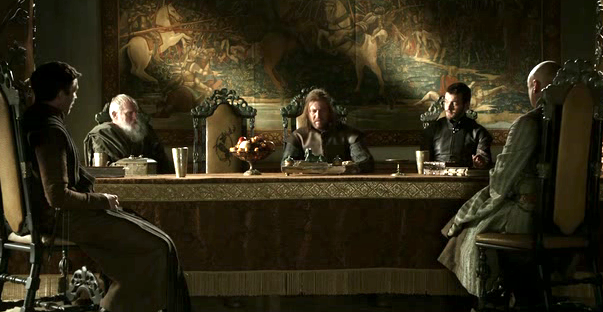
With Senate scandals, robocalls, email trails, impersonations, personal attacks and the rest of it, the picture emerging of the backrooms of politics looks less like democracy in action and more like Game of Thrones.

We don't want to care about what goes into our political sausage, but now that the process is coming to light we're understanding where the sour taste in our mouths is coming from.

Politics is a feudal business.  Ridings are often treated like fiefdoms by inside power brokers while Political Parties serve as the King's Court, trying to keep the realm in good order for the King.


The people see what's happening, see how the system is letting us down and are increasingly demanding more.  It's kinda like Magna Carta all over again.


Magna Carta (and the English Civil War that stemmed from it) led to the model of Responsible Government we have today.  Only we've lost that thread - partisan politics has tied it up into a Gordian Knot.

Which is why we're cycling back to something similar with Open Government.  It's a new Peaceable Revolution that will, given time, lead to another power shift and ultimately, more sustainable governance supported by a more Responsible Society.

History's funny that way.


Wednesday, 19 February 2014

A Post-Partisan Charter


Are they aware, all these partisans, how very similar they look from beyond the magic bubble?


There are a lot of smart people in politics.  Some of them are achingly so - folk whose brains work at such a speed that they are literally incomprehensible to more ordinary citizens.  If these smart people got it into their heads to work collaboratively and to consult with regular people, I have no doubt that we could land on some amazing shared solutions to our collective problems.  Maybe even set some best practices other jurisdictions would follow.

But that's not how the system works.  People who get in and manage to stay in function at the upper echelons of society - they are courted by the heads of interest groups, attend the fanciest of functions and eat at the finest restaurants.  That goes for partisans of all stripes.

A big part of partisan operation is believing your side deserves power more than the other guys.  You have to believe that, otherwise what are you selling to voters?  Partisans have to believe in their cause and almost revile their opponents - it's the basic ABC of sales.

And sales is what it's about.  Voters aren't participants, they're consumers that partisan shillers need to woo, cajole, threaten into donating and voting for them (or against the other Parties).  And if you're doing a good sales job on behalf of your clients, you're entitled to some entitlements, right?

So picture this collective brain trust viewing citizens as consumers whose behavior needs to be shaped via messaging, nudging them into behaving one way or another.  Picture them sitting in separate-yet-similar wood-walled board rooms pouring all their energy, creativity and savvy into framing partisan wins.

This is more than just an inefficient use of resources - it's a tragedy.

But these staff are only doing the job they are paid to do.  Remember, they are staff - not officials themselves.  They are paid by partisans (either their Party or elected officials of their Party) to serve the partisans, not the people.  Winning, not the public good, is their motivation.  Nowhere in their contract is it said that they have any form of accountability to Canadians themselves.

There was a time in the past where something similar was the case for government; it was answerable to the Crown, not to Parliament.  Cabinet Ministers are still agents of the crown - which is why we call them "Ministers of the Crown."  There's not even a legal obligation that these Ministers be elected officials.  It took the Magna Carta and English Civil War for that accountability to shift from the Monarch to the People's Representatives.

I would honestly love to see these big political brains go into work every day asking the question "how do we best serve Canadians?" instead of "how can we secure wins for our Party?"  In a dream future, I'd love to see political staff of all stripes pooling their experiences and ideas to land on collective win-win solutions.
 
That's not how it works now; it's definitely an unconventional approach.  But maybe Canada has been relying on convention a little too much of late.  

But nothing's going to change under the status quo.  Especially as jobs are tight and the emphasis is on skills and abilities other than those politics provides, staff are going to be focused on keeping their paycheques coming by serving their boss and Party to the best of their ability.  It will take more than a rare politician to change this partisan-centric culture.

Maybe it's time to rethink the system a bit - and to put a post-partisan charter on paper.


Wednesday, 13 November 2013

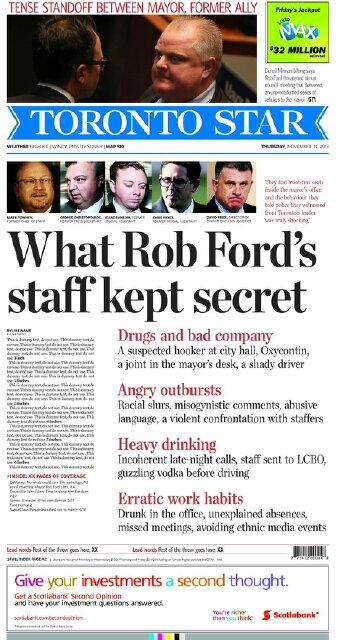
Rob Ford's Staff


Embedded image permalink
There's not much surprising left in Rob Ford's story; unless he's directly tied to a murder or dies himself, people have more or less accepted the Mayor for what he is - a sick man in an environment that is entirely unhealthy for him.  Any other offense that emerges is just more of the same.
Which may be why the Toronto Star appears to be looking for fresh material by focusing on Ford's staff.
There are a lot of egregious misdeeds that Ford's staff covered up (or didn't proactively report to other authorities).  Staff appear to have, on some occasions, put themselves at personal risk on the Mayor's behalf, too.  There are also a lot of "other duties as necessary chores like household chores that are not only beyond the scope of their job description, but entirely inappropriate for an elected official to ask of a paid employee.
The question is - why?  Why would young staff do things they should know were unethical and should instinctively had avoided?
The answer is an issue I've been trying to raise for quite some time now about the toxicity of general political culture.
A lot of political staff are young - sometimes, fresh out of school or in the case of many Ford staffers, connected to him through school.  It's not unusual for newbie staff to have no work experience beyond politics  In short, there first real-world exposure to work and work practices is through political offices, where they might very well stay for the majority of their careers.
There are no clear job descriptions for political staff, nor are there protocols.  Particularly at the partisan, level, staff never have a clear sense of who they are ultimately responsible to - Parliament, the Party or the Elected Official?  As the internal culture is all about enabling the boss so that they can keep winning elections, it's almost sanctioned for staff to cover up on behalf of the boss (see Senate Scandal). 
Staff know where their bread is buttered; knowing full well that their Member is accountable to no one expect occasionally their Party and it's in the Party's electoral interest to keep any bad behaviour under wraps, is it irrational to expect them to do what it takes to keep their jobs and the networking, free booze and brand-opportunities that come with it?  So what if that means sorting out a parking ticket on the boss' behalf - after all, that's simply the way the game gets played.
Who do staff look to for examples of what is and isn't acceptable work culture?  Other staff.  Who did those staff learn from?  Exactly.  As there are no enforced internal accountability mechanisms, no training programs, no Human Resource departments and enough swag to offset the occasional abuse they take, staff develop a political trench mentality that accepts as normal all kinds of behaviours that are theoretically unacceptable in civil society.
The same, by the way, holds true for politicians.  Their job is to win, and so long as they do that and their Party does well, everything else is secondary - including their training or skills/personality appropriateness for the job.
We can go on focusing on blame, suggesting that it's up to these staffers to intuitively buck the system and act in a transparent, ethical fashion.  Truth is, those that do tend to face consequences.  Human beings are creatures of culture and in a toxic culture, one expects to work with poison.  There is no better example of presenteeism than in political offices, which goes a long way to explaining our overall democratic deficit.
There are some politicians who are excellent employers.  There are excellent politicians that make for poor employers.  As always, most people fall somewhere in the middle.  Rob Ford seems to inhabit both poles at once - he puts his staff in uncomfortable positions, but also gives them game tickets.  The two behaviours are not unconnected.
I don't have much time for blame, because it's ineffective; I'm a problem-solver, not a finger-pointer.  The whole Rob Ford saga is a canary in the coal mine, putting in relief some of the structural issues that allowed for this sad state of affairs to be realized at all.  We won't solve the problem by replacing the people; it's the culture and supportive structure that needs to change.
There are better ways to train, support and empower political staff to be part of the solution rather than enablers of the problem.  Thing is, such change takes leaders willing to break the mold and heal a fractured, if self-serving, system.
 
Should any leader muster such courage, the results would most definitely be news worthy.

Friday, 1 November 2013

Colle On Political Staff


Colle's empathy for political staff and concern for both their immediate well-being and the impact of deleterious work conditions on their long-term interests is to be commended.

Given the enormous power, high expectations and partisan stresses being placed on them, it's no wonder stories of staff are emerging in abundance.  When it happens so regularly, it's not an individual thing, it's a structural thing.  Where are young staff learning to act against the public interest when they're spending their entire working careers in politics?

Next, there will be more questions about exactly what training and supports they get to do their job as effectively as possible.  That, in turn, will lead to interest in hiring practices, which will lead back to elected officials themselves and the institutions that support them.

Yet another reason why smart pols are going the Open Government route now - best to own up and fix one's own house proactively rather than risking being called out on poor HR management later.  There's a lot of focus on occupational mental health, productivity and innovation these days, with pressure being placed by governments on the private sector to do better.

And if there's one thing we should be noticing, it's that there is low tolerance for political hypocrisy these days.


Thursday, 24 October 2013

Political Staff: A Diet of Worms


Political staff are meant to be neither seen nor heard, serving as mandarins for their employers.  Having said that, they seem to be making a lot of headlines these days.

Rob Ford's staff have regularly featured in Toronto news for using City property for football-related activities, for bad behaviour at GO stations and of course, for allegedly being involved in illegal activity.

There's also that Queen's Park staffer who was replaced by an unpaid intern, or the Toronto Councillor who advertized for an intern to do paid-staff level work.

Not to mention the scrutiny over staff email trails, which under Open Government will be much more easily accessed than political staff are used to.

And all this is barely scratching the surface.

Political staff are often on call 24 hours a day; in addition to needing to be mind readers, babysitters for their Members on behalf of Party Whips and somehow do their day-to-day tasks without having job descriptions or training, they also find themselves serving as personal assistants to the busy and sometimes discombobulated people that are their bosses.  They often end up neglecting personal relationships in the process; there's a reason most of them are either single or involved only with other political people.

Political staff can find themselves scheduling vacations, delivering laundry, watering plants, even babysitting the boss's kids.  These are all duties that go far and beyond what should reasonably be expected by an employee often making far less money than they deserve.  The best textbook for Political Staff (as there is no formal training material) is probably The Hollywood Assistant's Handbook.

Of course, the best political staff don't mind working the extra bit because A) they know that's the cost of working in politics or B) they believe in their Member and are willing to go the extra mile so that the boss has the free time to do the same thing in an outward-facing capacity.

There's no training for Political Staff, nor is there HR support, but the same holds true for Members of Parliament.  They are supposed to be representatives of the people, whatever that means, but also shills for the Party, fundraisers for the association, small business owners (their offices) and whatever other added committee or Parliamentary Secretary positions they may have.

As I have stated before to variously receptive audiences, there's a reason why there's such a flux between good Members as employers and bad ones, or value-add political staff vs. dead weight.  It's not so much about the people as it is about deficiencies in the system.

Cowan said he has not spoken to Brisson, the former aide, and that it is not his duty to seek her out.

She's just staff - what value are they, other than as tools of the elected/appointed people who actually represent partsian interests?  Despite the huge role staff play in shaping policy and influencing public opinion of the process, they are seen as peripheral; their support is equally given minimalist consideration by Parties and, often enough, by Members.  Which has lead to all these headlines in the first place.

I've said it before - I'll say it once again.  As backroom people increasingly come under the glare of public scrutiny, it's time for politics to start doing training and HR support right.  They can start doing so now, proactively, while attention is just beginning, or they can do it reactively, after the can of worms has already been opened.

The choice has already been put before them - it's up to the Political Parties themselves to follow through.  Whatever choice they make, the people are watching.


Wednesday, 11 September 2013

Labour Woes at Queen's Park


This is but the tip of the iceberg of staff/labour woes at Queen's Park, and in political offices in general.  While there are some truly great and empowering employers within each Party, there are also plenty of horror stories about staff working without proper equipment, direction, paid peanuts and micromanaged or bullied.  It's considered part of the culture - you take your lumps because it's an honour to work for elected officials/a Political Party that many are dying for.  If you can't take the heat, get out of the fire.

Yet there also happen to be countless, ongoing complaints about staff performance issues from constituents; calls not returned, files dragged or "sorry, you need to take that up with someone else" shirks of responsibility and dropped initiatives that go out the window with staff turnover.  Then there's the whole occupational mental health movement, spearheaded by the Feds but also under discussion at the provincial level.

Somehow, nobody has tied these things together - yet.  With a growing number of political staff issues/training needs and related scandals making headlines, there's a much bigger story brewing here that smart Political Parties will take pains to get ahead of.  

Of course, doing that means thinking structurally instead of just focusing on the win - which requires a culture change that Ontario politics, or Canadian politics at large, probably isn't ready to invest in.  

The time is rapidly coming when they're gonna have to.

Not that they need to listen to me; after all, it's not like I have a record of being ahead of the curve on this sort of thing.

RELATED:


Wednesday, 14 August 2013

SDSG PLA


The devil is in the details - which, of course, gotcha headlines don't have time for.  Of course, people apparently don't have time for substance either, which is why gotcha headlines are needed to sell news (or something approximating it).
 
I don't know the details about what happened here, but here's what I do know:
 
Kathleen Wynne is the real deal.  I first met her back in 2002, when she was just a candidate.  She was sincere, authentic and she listened.  I didn't see her again until long after I'd returned to Queen's Park in 2005.  She was the same person then as she was in 2001.  In fact, in all the interactions I've had with her over the years, she has never changed as a person; whatever duties she accumulated, however "powerful" she became, she has remained the same person all the way through. 
 
I have two favourite memories of now-Premier Wynne:
 
One - a meeting with her and representatives of VOICE for Deaf Children, an organization that supports kids who are deaf/hard-of-hearing and their families.  It was a packed room, but Wynne made a point of engaging every single person in the room - she created an environment that was conducive to contribution, which wasn't easy.  The then-Minister of Education took notes herself.  Later, Wynne was pivotal in VOICE's push to have the province cover bilateral cochlear implants for deaf kids in Ontario. 
 
Two - a random run-in on Front street, not long before former Premier McGuinty stepped down and she threw her at in the ring.  Wynne and her partner Jane were on their way to a show; I was on my way from some event or other to Union station.  In passing, Wynne recognized me, addressed me by name (how she remembered, I have no idea) and stopped for a quick chat about life. 
 
She has, as a person, always embodied the traits a leaders should.  That's still the case today.
 
Nobody knows SDSG like Jim Brownell.  I clearly have a soft spot for Jim, but it's well-earned.  Jim remains, for me, the best example of what a politician should be.  Working for him remains the highlight of my career.
 
Jim was more than just a gentleman and a great boss, though - he was a man of and for his community who found, impossibly as it might seem these days, the perfect balance between empowering his riding, building his brand and supporting his Party. 
 
This was largely due to his approach - Jim had enormous pride in the people and history of his riding and a great deal of hope for what it's future could entail.  Jim could (and often did) tell you the history of every square inch of the three counties.  He loved and was loved by his community, which is why he ran for provincial office in the first place. 
 
I firmly believe that, if Jim were to run again, he would win easily - because people know he has a record of getting things done.  That personal brand, that knowledge of the riding and that political savvy would, I think, be invaluable to a Party looking to win the riding back.
 
James Borer defines leadership.  I got to know James through Jim and because of VOICE.  Today, I'm proud to call him one of my best friends.  James is a rural Ontarian from an old Ontario family (Borer Falls is named after his kin).  He's a hobby farmer with a beautiful family, including two kids who are deaf (but thanks to cochlear implants, can hear and function like any kid).  He understands the value of hard work and knows clearly what that work is for - to support his family and make a better world for them and all other families in the province.
 
James is also a highly-trained and soldier with, shall we say, a rather unique skill set.  He has served overseas and carries a great many combat scars to tell the tales, though you'll never hear them - he does what he does not for glory, but out of a sense of duty. 
 
It would be an error to mistake his causal way of speaking for simplicity.  I have watched him casually deconstruct and tie verbal opponents into knots, helping them back themselves into corners they can't see until it's too late.  James has a highly disciplined, strategic mind; he's good at assessing variables, planning contingencies and achieving victory.  I've seen him do it again and again - leadership just comes naturally to him.
 
More than anything, though, James is a man of honour who puts the mission first.  He is a Liberal because of what he believes, not because of anything he thinks the Party can do for him.  The best example of this is the Rural Roundtable he organized during the OLP leadership race - it was an event that helped the candidates connect with his community and vice-versa.  It was also an innovative format that focused on solutions, not gripes, that was widely praised by all who participated.
 
Like Jim, James is an invaluable resource in Stormont, Dundas and South Glengarry.
 
I like Bernadette Clement.  She's got a good soul, a friendly demeanour and a positive outlook.  In an ideal world, there'd be more people like her in politics.  However, ours is not an ideal world and politics is not focused on vision - it's focused on tearing opponents to shreds.  During her federal bid, Bernadette kept to the high road, worked tirelessly, but was faced with a machine that put the win before anything else. 
 
Bernadette is a natural communicator and facilitator, which was clearly evident during her role as Leadership Campaign Co-Chair.  She shined in that role - it gave me great pride to see her up there, representing my home town and embodying everything Liberals are supposed to stand for.  From speaking with her personally and interviews she's given in the past, I think it's that kind of role that suits her best and that she enjoys the most.
 
Political Staff do the best they can with what they have.  This goes for all Parties.  Unless you've spent time inside the political machine, it's hard to fathom just how frenetic the pace can be - everything is a crisis, tens thousands of stakeholders are making different and often competing demands daily, every minute is a draught from a firehose.  You simply don't get the time to wade into details on anything, nor have the time to carefully record institutional memory for whoever succeeds you.  This is one of the key reasons all Parties go through boom-and-bust cycles; what worked before gets lost in the churn, meaning it simply isn't there for future staff to draw on.
 
I have been (and continue to be) a big advocate for comprehensive political staff training and a conscious effort to develop and maintain institutional memory - I think it'd be better for the people involved and better for politics as a whole.  A key part of this process is two-way communication with those that came before and those on the front lines.  This was a key part of what Jim Brownell worked hard to accomplish, building bridges between Queen's Park and his stakeholders on the ground in SDSG and across Eastern Ontario. 
 
Without the right training, the right support and the right connections, duplication, gaps and overlaps develop.  Questions that should be asked, aren't; resources that should be tapped get ignored.  Systematic inefficiency and failure can result.
 
To me, what matters most is for the amazing people of Stormont, Dundas and South Glengarry to have the tools and support they need to reach their full potential.  The Hudak Tories seem to be about throwing people into the deep end; I fully believe their stated approach of cutting supports, reducing communication and coordination would be deeply harmful to Eastern Ontario.  The NDP has yet to put forward any kind of sustainable plan that would benefit SDSG. 
 
That leaves the Liberals, who have had many successes over the years.  The Liberal Party has stuck by the mantra of "move forward together" - an implication that success means leaving nobody behind.  That means engaging with all your partners, empowering them to support the process. 
 
There's no way to know what happened and didn't happen with the planning of this event - I can think of countless variables.  What came before, though, matters only in how it informs what comes next.
  
I still believe that open communication, proactive collaboration and respect are the right way forward - the only way forward.  Hopefully, that's what we'll continue to see.

Thursday, 1 August 2013

The Burning Platform: Brian Lilley and the Cost of Laissez-Faire Politics


Lilley makes an interesting point, as he occasionally does, though he also misses a big one.  
 
It's a general rule in politics that nobody cares what you do to achieve results - the ends justify the means.  Attack ads are a great example - nobody likes 'em, but because they work, everyone uses them.  Shouting down opponents in the Legislature, using tax dollars to fund literature critical of political opponents, intentionally spreading false rumours, etc. etc. - they're all examples of the same thing. 
 
Believe me - if the 2011 election had produced a Liberal majority, we'd be hearing far less about the gas plants.  In fact, the Opposition Parties would be mining that experience for best practises they could use.  The reverse certainly has happened.  Look at Stephen Harper's litany of sins - how many of them still make headlines?  That's why Liberals are pulling from his playbook - his tactics have worked in strengthening the Conservatives' partisan hold (though I'd question how sustainable that hold is).


Political Parties, after all, aren't charged with promoting democracy - they're charged with winning power.  Tending to democracy is, technically, the job of citizens, though we've gotten good at uploading that responsibility to others.  We elect officials based partially on the individual, but to a large extent on their Party brand; who, then, are our elected officials accountable to?  They only hear from their constituents every four years; the Party, however, interacts with them almost daily.  At our worst, we fundamentally don't care about how well our democracy functions, either, so long as we get the small-picture wins we feel matter to us. 
 
Our indifference to the political process serves as a dopper, snuffing the light of our democratic system.

 
Lilley serves as the poster boy for this laissez-faire style of democratic engagement; he doesn't care whether Rob Ford smokes crack, fuelling an illicit industry that ruins lives through addiction and ends lives through gun violence that spills out onto our streets, killing white girls like Jane Creba; Ford cuts taxes and mouths off to lefties, which is all that matters to him. 
 
When the consequences of his short-sightedness land a little too close to home, Lilley will be among the first demanding the suppliers of Rob Ford's demand face harsh punishment.  Why take the lead out of the water when it's so much easier to spend more money reactively, curing lead poisoning?  To proactively determine and address the root causes of a problem's a bit too much like committing sociology.
 
If the ends justify the means in politics, it's because we as citizens only pay attention to the process when we aren't getting what we want.  It should serve as no surprise, then, that there are no standardized checks and balances within the backrooms of Canadian politics.  Being a politician is a bit like being a parent; you don't get a manual on how to hire and manage staff, best practises for organizing offices, etc.  As with their role in general, the theory is that they either get it right on their own or get ousted next election. 
 
As such, there's nothing stopping elected officials from serial hiring and firing, paying minimum wage but providing maximum workload, providing little or poor direction, or allocating more resources to partisan advertising than to working on deliverables for their constituents.  Members can even spend their time learning Portuguese in a Spanish speaking country if they so choose - so long as they keep getting elected, what else matters?
 
The only place this complete autonomy gets checked is where the roles and responsibilities of the elected official impacts the elected official above them.  Parties need butts in seats for votes, after all; when the offhand comments of one elected official casts a shadow on the whole Party, someone has to light a fire under them to get in line.
 
So, who’s the top elected official in a Party?  The Leader – they won their seat and they won the leadership; if they happen to be Premier, it can be argued they won the province, too.  That gives them the autonomy to direct their staff as they please.  As they are responsible for the Party (Caucus included) producing results, it's the job of the Leader to deliver those results, by whatever means necessary - again, because in politics you are judged by what you accomplish, not how you accomplish it.
 
The job of leader comes with no description, but it involves a lot of fingers in a lot of pies - planning messaging and policy, getting out and meeting with constituents, stakeholders and potential partners, attending fundraisers (Parties gotta have funds), communicating with the media, communicating with Caucus, etc., etc.  One person can't do it all, so they need staff to assist.  It's all well and good to turn to other elected officials to serve as House Leader or Caucus Whip, but those elected officials have their own ridings to tend to, as well - meaning that at the end of the day, staff have to keep the machine rolling.
 
What happens when you have the staff of one supremely autonomous elected official running up against elected officials with fewer titles under their belt?  Does the hired hand representing the will of the Leader trump the official only elected in one riding?  If you're that senior staffer, being pressured to deliver results regardless of consequence, what would you do when faced with a lower-tier official not falling in line?
 
Of course, this is all just theoretical – for us private citizens, for elected officials and for staffers themselves.  There are no written protocols on responsibility, chain-of-command between staff at one tier vs. officials/staff at another.  That's all process stuff which nobody has historically had time for - remember, the means don't matter, only the ends do.  When you don't care how you get from A to B, you take the easiest route possible, even if it isn't the safest.  Political staff make it up as they go along, just as the elected officials do. 
 
When there’s no established communications protocol between partners, you end up with pushing matches that devolve into threats based on who has the most influence.  As such the people at the top (either elected or appointed) conclude “we are smart, they are dumb” to justify the application of excessive pressure to deliver the results they think are appropriate.
 
Influence, by the way, always translates into money – Members who do a lot of fundraising have more clout with the Centre.  The Centre has clout in that they can allocate or not allocate resources for elections or provide “wins” like development projects for ridings for Members who tow the line.  The end goal, of course, is always to gain or retain enough seats to hold power - not to make society function better. 
 
This doesn't apply to just one Party – that’s politics, period.  The same failings that landed us with the gas plants have led to fake lakes, robocalls, Walkerton and the 407.  There are no written rules of conduct, no communications protocols and most egregious, no training on how to do the internal stuff well.  As a result, you end up with front line staff who have neither training nor a clear mandate for their jobs, elected officials who have no internal office support, a lack of clarity of communication between all levels of the political system, so on and so forth.  Talent does sometimes get rewarded, but more than anything it's those best able to keep others in line, regardless of the social cost for doing so, that get ahead.
 
That's politics - lots of friction, lots of heat, but far less light than there could be.  Instead of finding efficient ways to channel that friction into positive, productive energy, we have this habit of pouring gas on the fire.
 
Rob Ford is great at this, which probably accounts for his success.  In other contexts, saying that supporting liberal policies is like putting a gun in someone's hand would result in a telephone call from the police for issuing a threat; when it comes from an elected official - even one elected in a different jurisdiction - the standards are different.
 
Let's not forget that the Rob Ford staffer who tried to bring some accountability to the whole crack-smoking affair got canned.  What example does that set for his replacement?
 
There's always talk about the need for politics to function more like a business; well, the best businesses offer direction, support and training to their staff; they understand they can only get out of their process what they put in to it.  Achieving, not winning, is their goal.
 
Until we start believing that the ends don't justify the means and respond accordingly - starting with appropriate internal training for Politicians and their staff - we are condemning ourselves to burn.


Wednesday, 24 July 2013

What Canada's Political Parties Can Learn From Environics


I've been pitching variations on this theme to political people for years: train your staff, motivate your staff properly and when parting ways, keep the relationship going.  I keep hearing the same sorts of answers back:
 
   "Politics isn't stable - if you want stability, join the bureaucracy."
   "Staff are transient, so we don't want to invest too heavily in them."
   "Members are elected and it's not the role of Parties to tell them how to train/maintain staff."
   "This is politics. Everyone wants in, so individuals are disposable."
 
To recap, there's no point in training the people who support Legislators, advice legislation and interact with the public, the press and other elected officials because retention isn't the goal.
 
There is a remarkable opportunity right now - the training exists, there are models out there to copy and with the constant headline-grab due to the mistakes of staff who have only ever received political training, there's a pressing need for political parties to internalize the message of this article and the best practices of some Private Sector role models.
 
Oh - and those that do are going to find it a lot easier to motivate the best work from loyal team members, too, meaning better outcomes.  I'd think that's something Parties would be after, but what do I know.
 
 
When Deane Code arrived a year ago to start her job as a senior consultant at Environics Communications Inc. in Toronto, she found her new business cards waiting at her desk. She also knew what her new co-workers looked like and how to get to their offices, thanks to a “family tree” that arrived in the mail a few days earlier, with staff photos and a map of the office.
Stacey Marson had a similar welcome to her new job at LoyaltyOne, a customer insight and strategy firm. Before she started as a co-ordinator of business-to-business public relations and corporate marketing, she got a phone call from her new boss, and a package of information – including a book written by the company’s chief executive officer.
 
The cost of replacing mid-level employees is now estimated to be 1.5 times their annual salary – factoring in recruiting costs, hiring time and training. So it’s not surprising that employers are eager to make sure newcomers quickly learn their roles and feel comfortable with the company, increasing the chances of them becoming stable, long-term employees.
 
Many companies are paying more attention to the ways they can make new hires feel confident, from providing seminars that help them understand an organization’s structure and their place in it, to pairing them with mentors who can take them for coffee and answer informal questions.
 
LoyaltyOne, which employs 1,500 staff mainly in Toronto and Mississauga, introduced its program for employee orientation (“onboarding” in human resources jargon) two years ago. It comprises eight 60- to 90-minute small-group seminars, with additional online elements, and covers everything from benefits to marketing to customer care.
 
The program is designed to be completed over about six months. Employees sign up online and fit the monthly seminars around their regular work schedules.
 
Diane Dowsett, LoyaltyOne’s assistant vice-president of talent management and the driving force behind the program, said the format evolved after surveying staff and finding they wanted face-to-face interaction, shorter sessions rather than half-day events, and scheduling flexibility.
 
The company used to offer orientation in a two-day “boot camp,” but Ms. Dowsett said spreading the information out over a few months makes it easier to absorb.
 
“Joining a company is like learning to speak a new language: In the beginning, the words wash over you and you understand one in five, but over time if you have repeated exposure and people willing to make the effort, you become fluent pretty fast,” she noted.
 
At Home Depot Inc., employee orientation is propelled by the company’s focus on the store level. Store employees receive two days of orientation (in person and online) as well as 35 to 40 hours of training about specific products in their department. And head office staff are required to put in 24 hours at a store in their first three months, including at least a four-hour shift in the first 30 days.
“Everything we do at Home Depot is around supporting store associates because they are front line with the customers,” said Kim Forgues, vice-president of human resources, noting that the practice came about as a way to connect support staff with the stores.
 
“It really gave me an understanding of what’s happening in the stores and how I can help people in the stores provide the best customer service,” said Erika Botond, a manager of public relations and communications for Home Depot, who was hired about a year ago and completed her training in the paint department.
 
New hires value the opportunity to interact with their colleagues. At Environics and Home Depot, a buddy system pairs new and established employees. Environics also hands out a quiz that forces new employees to interact with co-workers across the company to answer questions such as “Which Environics employee met Taylor Swift backstage at a concert?”
 
Employees also want to hear from their managers. At LoyaltyOne, such feedback prompted Ms. Dowsett to incorporate a “graduation” session about the company’s vision and culture, led by the CEO. “People love the fact they get access to the CEO and all of our business leaders so quickly and so it’s a really good opportunity for them to foster engagement,” she said.
 
“Employees come in and do their job for eight hours without being able to see the bigger picture of what they’re looking toward,” LoyaltyOne’s Ms. Marson noted, adding that the orientation program “creates a united work force going forward to the same goals.”
 
Another thing new employees seek is feedback and a bit of personal attention. “I circle back with all new hires, whether or not they’re on my team, four to six weeks after they start,” said Josh Cobden, senior vice-president at Environics.
 
Mr. Cobden, who was hired 16 years ago, recalls a time when the company – which now has 120 employees and offices in Toronto, Montreal, Ottawa and Washington – was small enough for the whole staff to take new hires out to lunch.
 
Given the expense of hiring and training a new employee, companies are finding that paying close attention to a newcomer right from the start pays off with an engaged, long-term staff member.
At Home Depot, for example, Ms. Forgues notes that a 90-day “check-in” with new employees resulted in a 15-per-cent decrease in turnover in the past year.
 
“The type of people we hire are high performers, who put pressure on themselves to demonstrate that hiring them was the right decision,” Mr. Cobden noted. “But what they don’t know is that we put as much pressure on ourselves to prove that joining us was the right decision.”