Contents:
A Proven Recipe: Collaboration Works
Why Competition Doesn't
The Profit Paradox
Ingredients for Success: Start with a Stone
Why WAKATA
Everyone is trying to motivate innovation. The standard method of increasing incentives and fostering competition doesn't seem to be doing the trick - Finance Ministers and Prime Ministers are growing frustrated with the lack of results.
So - how do you foster innovation?
A Proven Recipe: Collaboration Works
 Ontario Premier Kathleen Wynne is famous for her campaigns and her office culture - everyone loves working with her. They have a good time, they get recognition (frequently and intentionally from Wynne herself) and they do work that matters.
My former boss, retired Stormont-Dundas-South Glengarry MPP Jim Brownell, was famous for his Brownell Nights - pub evenings where ideas were shared and bonds formed over food and drink. These nights not only boosted staff morale and encouraged team-development, they also resulted in some cool ideas, a few of which resulted in policy and regulatory action. Brownell Nights weren't just about drinks, they were a conscious effort to create a collaborative space under the Brownell banner that got things done and in the process, strengthened the brand. It worked.
Why Should I Care is a civic engagement event/speaker/series/pub night started by Terri Chu, a wickedly smart engineer who embodies the 7 traits of successful entrepreneurs to a tee. From humble beginnings in Terri's kitchen, WSIC has grown into a monthly event that attracts the kind of speakers you generally have to pay big bucks to hear at The Canadian Club, including Art Eggleton, John Tory, Rosario Marchese and Dr. Ilse Treurnicht of MaRS. The reason the model works so well is that it empowers the audience to participate, it gives speakers an opportunity to engage with a different crowd and of course, there's food.
Over the recent Ontario Leadership Race, my friend James Borer organized a Rural Roundtable - a tweak on the typical debate format that challenged participants to bring forward ideas, not criticisms. Everyone loved it - the conversation was positive, everyone gained new insight and a couple of cool ideas were introduced to the discussion.
In each of these cases, everyone from the organizers to the staff to the volunteers to the attendees have walked away glad to have been part of something special. The reason for this that in each of these cases, everyone involved, from all angles, felt like actual participants.
Why do Political Parties have trouble with membership? Why is voter turnout on the decline, with a resulting shrinking of the policy idea water hole? It's because people don't feel engaged, don't feel their participation is respected and don't believe they can truly contribute. Oh, and there's not enough food, either.
Collaboration works.
Why Competition Doesn't
The prevailing theory is that competition drives innovation - the desire to beat the other guy or to make oodles of cash through the selling of something new is what encourages entrepreneurs to work harder and develop the exciting, innovative ideas and products. Key to this notion is the myth of the lone innovator, the creative stalwart who gets hit by idea lightening, out of the blue, birthing fully-formed ideas that will change the world. It's a compelling myth, this, despite being one that has no basis in fact.
Nothing comes from nothing, especially ideas. The lone innovators we idolize in actual fact have stood on the shoulder of others, just as today's innovators stand on theirs. You can't make soup without raw ingredients - if you've never made a soup before, having someone else's recipe gives you a starting point to add your own flourishes to the mix. Why should we ever think innovation would be different?
To a large degree, it's because we associate innovation with profit and to lesser degree, problem-solving. The evidence doesn't support this, either - most exciting innovations stem from whimsical inspiration, not a planned outcome. This isn't to say having a "why" in place doesn't matter - you need a destination if you're to recognize the paths that will lead you there. If gravity wasn't on Newton's mind, he might have viewed that apple as a pain, not an opportunity. It's a glass half-full/half-empty thing; if you think you're having a bad day, you will invariably notice only the things that back up that premise. The same holds true for a positive demeanour. Innovation works the same way - you could have a billion ideas connect in your head, in passing, but its the ones that illuminate your pervasive theme that will stand out and be noticed.
 But I mentioned profit. Standard wisdom once again provides an intuitive, counter-factual perspective on innovation - people are motivated by greed and fear, which is why a carrot-and-stick approach works best in keeping people productive. If it works for widget-making, it must equally apply to creativity. This is the labour-management equivalent to wielding a hammer and viewing every problem as a nail - we are deluding ourselves that our existing tools are fool-proof and misattributing failure. Pollsters do it. Stock-pickers do it. Politicians do it. It's everywhere.
The fact is, carrots and sticks are good for motivating physical work, because they target our reactive mind. Innovation is all about being proactive, adding value to what already exists. You don't motivate creativity by making people think reactively, but by incentivizing legacy. This is a simple truth that is backed through rigorous testing, lived experience and even neuroscience. Whimsy, not necessity, is the mother of invention.
The Profit Paradox
This puts us in a bit of a spot - why on earth would conventional wisdom be so wrong about the role of competition and profit in motivating innovation? Surely any idea that off-the-mark would be weeded out, wouldn't it?
 Do you read your horoscope in the newspaper? Do you accept the results of polls as indisputable fact? Does fortune-telling persist?
Yup.
I always nod and smile when anyone tells me confidently, aggressively that they're good at what they do. Then I do my homework to see if that's actually the case. Surprisingly, it often isn't.
If innovation is whimsical, cause-driven and relies on curiosity and collaboration, financial competition is all about a lean focus on profit and promotion. If you want to sell, you have to market and you absolutely have to have the tenacity to close a deal. Like physical labour, it's the carrot-and-stick system that motivates the aggressive, competitive, successful sales people.
Confidence sells. Aggressiveness sells. Bluster, charm, great hair or a brilliant smile sells. A complex understanding of the associations between cognitive labour motivation, workspace design and fostering innovation? You've lost 'em at A.
The reason the Myth of the Lone Innovator persists is because the people who are successful at selling innovation want it that way. They want it believed that only they have the ability you want and you're going to have to pay to get it. Quite frankly, they're so good at what they do that nobody can challenge them on their presentation; those who do will be put-down, dismissed or threatened with law suits. The great patent fights of history are what this looks like in practice.
 Intellectual property is only profitable when it's supported by law, force or that same sales ability - which is why the greatest innovators always have partners - there's the brains, then there's the business. Sometimes, you get the two in one package, but not often. Nowhere near as often as we'd like to believe.
By the same token, the great sales agents are great at never failing themselves - blame will always, always rest on someone else's shoulders. It's a form of narcissism, really - brand over substance and a blatant refusal to accept responsibility.
So what does that leave us with? The really innovative people are driven to do. The best sales people are motivated by what they get out of the deal. It's therefore the latter that control the narrative of the former for the general public.
 Ingredients For Success: Start with a Stone
What's the best work or volunteer experience you had? Was it the one that paid you the most money? Was it the one where the rules were rigid and everyone was obliged to stay within their boxes? Or was it the one that was fun, engaging, collaborative? What sort of ideas did the team come up with?
Back to Kathleen Wynne. As mentioned, her campaigns are always fun, engaging, meaningful experiences for her teams. They also came up with some cool material, varying from collector's item swag, a dance introduction for her convention speech and an award-winning website designed by Taylor Scollon. Oh yeah - they also won.
What makes Wynne's campaigns work? She embodies the parable of stone soup - the idea that something - a person or a vision - is required to bring disparate elements together to create a whole that's more than the sum of its parts. Call it inspired teamwork.
Most teams are teams in name only - in practice, they function more like a series of canoes paddling side-by-side; each faces the current alone instead of collaboratively pulling together. It's less complicated, maybe, but it's also far less efficient. Plus, when you give people a mandate to paddle together and challenge them to figure out how, that's when you come up with ideas like the horseless carriage.
I have four rules that guide my work with any sort of team, but volunteers in particular:
1) Keep them fed
2) Make sure they get the chance to do meaningful work - this means rotation and the opportunity to provide input
3) Acknowledge their contributions
4) Make sure they feel as part of the team - not tools of a core group of organizers. To treat people as team members, though, you have to actually see them as team members.
This approach takes time, involves a lot of emotional validation and time spent listening instead of doing, but it works. Greta Hoaken is a great example of the sort of talent you can find if you give your people half a chance.
When you include your team members, you encourage them to put their skin in the game as they get to share the glow of the end product. It allows them to feel truly part of something larger than themselves - they will thank you for that. Engaged people also tend to be more willing to share and play with ideas - the more ideas you have to start with, the better your end solutions are going to be.

There's another key benefit to this approach that makes a difference - respecting people and letting them participate breeds loyalty. This is important, because most people seem to think loyalty is owed to a brand and therefore, volunteers (or employers) can be manhandled in any way the top dogs want. In fact, this discourages innovation, disenfranchises volunteers (making them more likely to walk) and makes existing team members less productive.
One of Canada's most respected political organizers once told me that campaigns invariably end up being run by a small group of organizers who are the only ones who get stuff done. This individual has a habit of domineering a room and disregarding ideas that don't originate in their circle, a trait all too common in organizations across the political, private and Not-For-Profit spectrum. Chris Mazza provides a good example of just how well this top-down, closed-communications approach works. Worth noting - this person did not work on Team Wynne's campaign.
Why WAKATA
The idea of collaboration leading to stronger, more sustainable results might be somewhat foreign to traditional capitalist culture, but that doesn't mean it's foreign to everyone.
No, I don't mean communism - the Great Socialist Experiment wasn't about collaboration, either; it was all about caste and silos.
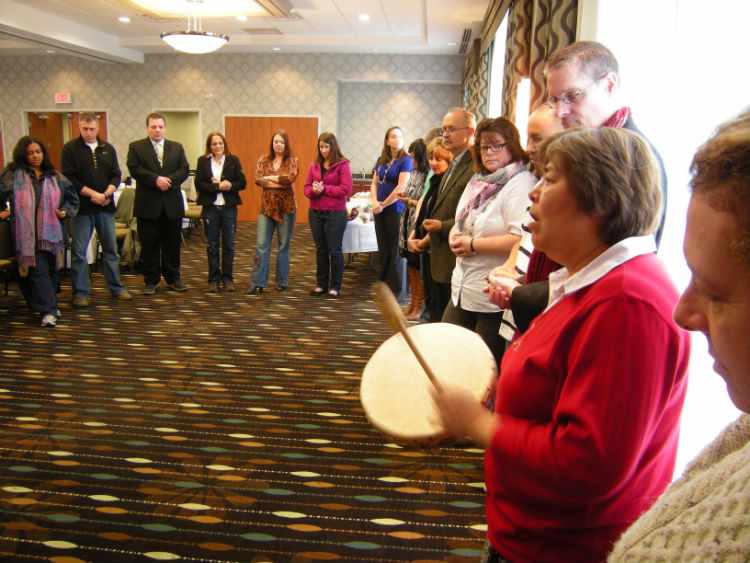
I'm referring to Talking Circles in particular, although there are plenty of cultural examples to chose from. Some of the most innovative, enterprising people I know have a mixed bag of ethno-cultural background themselves. Their exposure to different perspectives has fueled their growth as critically-thinking, creative individuals. Some of them have even turned their experience into a new model for post-secondary education.
There are shared workspace models out there that allow people of different backgrounds to work together. There are a few exceptional work models that actually nurture collaboration, rather than sticking people in a room and hoping it happens or worse, pitting people against each other in a futile attempt to nurture innovation.
But what does a truly collaborative work and workspace model look like? What would it require to function, to produce tangible results and contributions and empower people to shine? How could you make this concept more than just a matter or work, but a lifestyle?
Understanding is the place where diversity meets and innovation happens. WAKATA is the pot.
There's money to be made from the concept - there's legacy to be created and brand that can be built. Most importantly, there are solutions out there waiting to happen - they lack only the right connective tissue.
It's something worth having a conversation about, don't you think?
POST SCRIPT
If a culture of open, respectful collaboration is the Holy Grail for innovation and productivity, would that make a culture of top-down management fueled by fear the Golden Calf?
If so, it's no wonder Stephen Harper is so frustrated with the lack of innovation and job development coming out of his government. It's not too late for him to change his approach and get back on track - he simply has to be willing to actively listen to others and just maybe have a bit of faith in people.