Search This Blog

CCE in brief

My photo
Recovering backpacker, Cornwallite at heart, political enthusiast, catalyst, writer, husband, father, community volunteer, unabashedly proud Canadian. Every hyperlink connects to something related directly or thematically to that which is highlighted.
Showing posts with label Shared Service Models. Show all posts

Wednesday, 8 January 2014

Could This Have Saved Ashley Smith?


Two six year-olds were playing at recess when one fell.  The girl reacted to her friend's fall and subsequent distress by laughing and hitting him on the back.  This, of course, upset her friend even further, leading the girl, in turn, to laugh even more and hit the boy again as she became more hyperaroused.  The teacher on duty, knowing that the girl had great difficulty with social conventions and controlling her motor actions when hyperaroused, intervened as follows: She showed the girl how to console her friend by softly telling him that everything would be all right.  She then demonstrated for the child to pat her friend gently on the back.  Almost instantly, both children down-regulated.

If we look at this situation and apply how we might instinctively act, we see that there is potential for the teacher to admonish the girl for being too rough.  In this instance, chances are that the girl (and her friend) would have become even more upset and dysregulated.  As it was, the girl genuinely wanted to be kind, but her poor social skills and problems with motor control made this difficult.  With the wrong kind of adult response, the girl might continue to have ongoing problems in the prosocial domain.  With her teacher's keen understanding and gentle encouragement, however, the girl was able to learn an appropriate response to the situation and model it.

According to her adoptive parents, Ashley Smith apparently had a normal early childhood.  When she started to hit puberty (the time when the neural systems of the human brain responsible for executive function start to mature), she started to display anti-social behavioural changes.  From there, Ashley Smith's life spiralled downward into juvenile court and prison, with some diagnoses of mental health issues along the way.  

Her sad life ended, as we know, in suicide.

What if Ashley's parents had been able to learn about strategies like the one outlined above and the cognitive science behind them?  What if her teachers or prison guards had knowledge of the neurochemistry behind behaviour and been able to approach Ashley differently?  What if those same prison guards knew to look for behaviour and causes in each other and felt comfortable in providing peer support?

Could such strategies and culture shift have also saved the life of Staff Sergeant Ian Matthews?  What about Canada's veterans?

Of course, this scenario is geared just towards teachers.  It was, after all, included in a teacher-resource manual. 

There is no reason why any teacher should proactively be looking to apply such behavioural comprehension and management strategies to a justice system tragedy.  There's no reason a correctional service policy-planner should be reading a teacher resource, either.  

We have silo-based systems that encourage people to stay on target, lest they get lost on tangents.  

The sorts of cross-pollination ideas which can and should happen don't, and for a well-identified reason that also goes back to cognitive function.  We like to tell ourselves we're rational creatures, but we really aren't.  We're reactive, using fight or flight (or punishment and isolation) when there's a better way.

This is the culture change Don Tapscott refers to when he talks about networked intelligence.  It's the power of behavioural insight the Mowat Centre wrote about.  It's the sort of innovation we keep talking about, but are challenged to actually realize.  


It's within our power right now to collectively do something to prevent the next Ashley Smith or Ian Matthews from killing themselves.  We can reduce bullying, reduce crime, increase workplace productivity and positively impact quality-of-life if we can just change the view from looking through a mirror darkly.


Or, we can focus on individual toughness and invest more in crime and punishment.  

That's what's worked so far, right?

UPDATE:  But a more precise application of the criminal law, based on a better appreciation of its limits, is not evidence that we no longer know where or how to draw the line.  Quite the contrary: We are drawing it with a sharper pencil.

Who am I to argue with Andrew Coyne?

Here's the new mentality - it's behavioural economics, stupid!


But a more precise application of the criminal law, based on a better appreciation of its limits, is not evidence that we no longer know where or how to draw the line. Quite the contrary: We are drawing it with a sharper pencil.

Friday, 24 May 2013

@OCEInnovation - Yours To Discover


So, three concepts that relate to this:


Cognitive Labour

Hubworld Ontario

Inspired Teamwork

Understanding is the place where diversity meets and innovations are sparked.
 

May 27 – 28, 2013
 
On behalf of the Government of Ontario, I am delighted to extend warm greetings to everyone participating in the Ontario Centres of Excellence Discovery Conference.
As Premier, I believe that innovation and creativity are vital to strengthening our institutions and energizing our economy. It is also key to securing our future.
Building communities of knowledge — enterprises and individuals who share information, exchange ideas and discuss best practices — is essential to creating a strong innovation infrastructure. That is why I would like to commend the delegates to this conference for coming together to discuss the challenges facing your respective sectors — and to offer ideas and possible solutions.
I wish to commend the Ontario Centres of Excellence for hosting this conference. Conferences like this strengthen the linkages we have established and set the stage for future innovations and partnerships.
Please accept my sincere best wishes for a productive and highly successful conference.
 

Wednesday, 20 March 2013

Collaborate by burning the midnight oil, like Edison (Harvey Schachter)


I would have to agree with this.  After all, understanding is the place where diversity meets and innovation develops; understanding, of course, is a cognitive function.
WAKATA isn't just a concept - it's intended to be a solution.


By Sarah Miller Caldicott
(John Wiley, 284 pages, $25.95)
It was common for the scientists hired by Thomas Edison for his innovation factory in Menlo Park, N.J., to toil into the late evening or early morning hours, their boss alongside them. He often ordered a midnight lunch of meat, bread, cheese and beverages for the entire crew, to fuel their overnight discussions and theorizing. Gathered together over food they were – take your pick – innovating, collaborating, or both.
 
Innovation is a hot item these days. Mr. Edison’s great-grandniece, Sarah Miller Caldicott, found that in the first five months of 2012, 250 books were published with the word innovation in the title. But she wonders if in seeking the Holy Grail of innovation, companies (and authors) are actually looking in the wrong direction.
 
After studying her famous relative, she believes the secret to success is in the collaboration that those midnight lunches reflected. “Perhaps it is a culture of collaboration that we should be seeking as the Holy Grail,” she writes in Midnight Lunch.
 
Obviously, one doesn’t preclude the other; innovation and collaboration can go hand in hand. The problem is that most people think of innovation as solitary, stunning breakthroughs that emerge through the power of a singular mind, a Newton lying under the apple tree, Archimedes in his bathtub, or Mr. Edison in his laboratory. But Ms. Caldicott reminds us that the inventor of the light bulb, the phonograph and the motion picture camera (among many other devices), was not a solitary creator.
 
“He viewed collaboration as the beating heart of his laboratories, a sustained resource that fuelled the knowledge assets of his sprawling innovation empire,” she writes. “From his earliest days renting space in workshops and small laboratories, Edison collaborated with others. Realizing the value of sharing his inspiration with people who held different skills than he did, Edison felt a unique bond with those who laboured with him.”
 
She stresses that the modern fascination with teams does not necessarily mean we are collaborating. Teams too often operate as individuals working alongside but separate from each other. Collaboration involves interweaving a group of people’s work so the talents of everyone are leveraged for a significantly greater gain.
 
Ms. Caldicott pieces together four phases of collaboration, each containing two elements, so eight factors in all to consider:


Phase 1: Capacity

It starts by creating the foundations for collaboration to thrive. For Mr. Edison, the first element was creating a “collaboration soup,” formulating a diverse group that represented a cross-section of experience, thought styles and creative potential. He relished, and sought, diversity. “It is not always necessary, perhaps not always desirable, to be a specialist in a subject in order to make suggestions to it which starts useful angles of research,” he noted. “We specialists are likely to get into ruts of our specialties out of which it is difficult to progress.” The second element is to assemble small teams of two to eight people who, through collegiality and the nimble search for discovery, can make a breakthrough in understanding.


Phase 2: Context

The team must then focus on developing a new context to frame the problem. That happens through a combination of individual learning plus hands-on collaborative working, which Ms. Caldicott dubs “solo meld” and “group meld.” First, the individual team members pursue their own learning process, questioning their assumptions, reading widely, and considering analogies that might broaden their thinking about the issue at hand. “Individuals prepare insights without locking down on any specific idea or direction,” she says. Then they come together as a group, discussing their insights developed in that solo meld, and pushing each other to new ideas, through methods that include experimenting with prototypes and developing stories to explain possible solutions.


Phase 3: Coherence

The team needs a central, binding force to integrate the collaborators. “Like a kind of gravity that permeates the entire group, coherence connects team members with an invisible grasp that allows the team to keep functioning even if there are disruptions,” she observes. That collaborative momentum comes as the members emerge at various points to inspire each other to move ahead and, secondly, through communication of the progress they are making toward their collective goal.


Phase 4: Complexity

In complex projects, teams must jettison the hierarchical mentality and organize in more fluid patterns that allow them to adapt to shifting conditions – what she calls “smart layers” that can connect the actors in different ways. Keep procedures, structures and other entanglements to a minimum. Document what the group is doing so you can track what has been accomplished (Mr. Edison constantly wrote about his ideas and progress in notebooks).
 
Midnight Lunch comes at innovation from a useful, different perspective. It’s not always easy reading, and readers can get lost in the details of the eight elements of collaboration. But Ms. Caldicott provides a nice blend of storytelling about Mr. Edison and other creative thinkers that can add to your knowledge about collaborative innovation.
 
 
Special to The Globe and Mail
Harvey Schachter is a Battersea, Ont.-based writer specializing in management issues. He writes Monday Morning Manager and management book reviews for the print edition of Report on Business and an online work-life column Balance. E-mail Harvey Schachter

Wednesday, 29 August 2012

Introducing Guardly - A Look At the Future of Public Services?


Guardly is a brilliant, innovative application of social media and new technology to a societal need.  Not only does it allow for services to get to where they're required and fast - it brings the whole conversation to the intended user in a way that is accessible and intuitive for them.  This is the next iteration of the whole "get your health card like a pizza" theme redesigning social services to mesh with how people behave rather than trying to train them to behave in a way that works for services.


Now, how can this concept be expanded to broader applications, boosting the economy by creating new markets and improving service delivery, benefiting both users and providers?  If you read my blog, you know that I have proposed the creation of a map-based, user-friendly online service aggregate, something the US is now pursuing with their digital government strategy.  When Canada gets around to building its own model, we'll need an App that connects those services with users in their daily lives, via mobile device.  Guardly (or tools like it) can be the connective tissue between users and online service delivery.


That's big-picture; on a more immediate level, there's a ready-made opportunity that would allow Guardly to test out the broader application of their product in a related field (security and safety), helping to address a major social issue at the same time.  That field is the interaction between our police, mental health service providers and persons suffering from mental illness themselves.


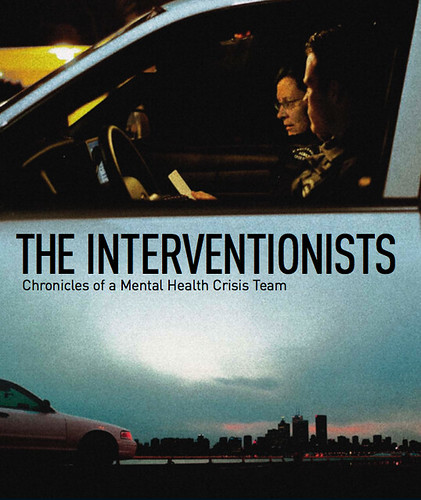
At Gerard Kennedy's recent Mental Health Matinee, I had the opportunity to view The Interventionists, a documentary that follows Toronto's Mobile Crisis Intervention Team (MCIT) as they dealt with calls involving Emotionally Disturbed People (EDPs).  It was pretty shocking stuff, though none of it unexpected.  We know what happens on our streets, even if we choose to ignore it.  After the screening, I had a chance to speak with one of the MCIT Officers, Mike Zawerbry, about the work (which he was very passionate about) and ask if he felt there were other tools he could use to enhance his services. 


Officer Zawerbry said that having one online portal that aggregates what mental health services are available in town by type and location would be incredibly useful.  If that portal could include tips on recognizing mental illness symptoms and suggested responses for de-escalation responses, that would also be helpful.  For it to be of real-time use, this portal would have to be accessible by mobile phone and intuitive to use.  You can't be fumbling over functions when there's someone trying to harm themselves or someone else in front of you.


Overdose at Occupy TorontoThe MCIT program is a partnership between the Toronto Police and St. Joseph's Health Centre.  Completely separate, the Schizophrenia Society of Ontario's Justice Mental Health Program (JMHP) provides support and training for people on both sides of the law (including families) related to mental health.  Same sort of deal; if the services JMHP and some self-guidance tools were available, would such a service help de-escalate problems or provide more rapid support access?  If individuals with diagnoses of mental illness had their own profile information on their personal devices, could they use that as a self-help and help-seeking tool when they have moments of distress?


An App like Guardly could be tweaked to help fill this gap.  Would such a service help keep people out of hospitals, the justice system and jail cells, reducing service cost?  If so, would that be worth funding?  On the other side of the equation, how much could be saved in terms of unnecessary service use/preserving human dignity/maintaining safety and security?


Ontario is looking for innovative ways to stimulate the economy; it's looking to improve service delivery and provide additional support for their front-line workers - they're also looking to improve quality of life outcomes in the province. 


Guardly might just have an App for that.

Monday, 11 June 2012

An Era Exploding - in Opportunity


This is true, though it needn't be.  We aren't being backed into a corner by economic challenges; the social challenges that are mounting in response to the financial ones aren't a nail in a coffin.

Instead, we have an unparalleled opportunity to break the mold, rethink the way we do business, govern, and participate in society. 

We can have staff transition strategies.  Governments can coordinate shared service models empowered by one service platform that is open sourcedBusinesses can create new markets, empower employees and reduce the barriers that constrain productivity and lead to mounting insurance costs, but also broader health care costsOnline training can be expanded and students given more power, twinned with more mentorship, throughout their ongoing studies.

It's all there for the taking - we just need the will to think it through and make it happen.