Search This Blog

CCE in brief

My photo
Recovering backpacker, Cornwallite at heart, political enthusiast, catalyst, writer, husband, father, community volunteer, unabashedly proud Canadian. Every hyperlink connects to something related directly or thematically to that which is highlighted.
Showing posts with label Barack Obama. Show all posts

Monday, 3 March 2014

Obamawan Kenobi


When you're dealing with a bully, it's hard to find words that will have any impact.  "On the wrong side of history" was a great line - Russians have something of a relationship with history.
The quote above, though, was brilliant. 
Think it through for a second.  Putin is a tough guy, hyper confident in his ability to swat down any opponents.  His pride is important to him.  If the US simply threatens consequences, so what?  It becomes a pissing match. 
But in the predatorial rush for conquest and the blindness of pride, Putin hasn't thought his position through as thoroughly as he might have (or, more likely, thought less of his potential opponents). 

This brings us back to "wrong side of history."  If Crimea is his Anschluss, Putin has good cause to look at what happened to Europe's last minority-hating, expansionist leader.  When you're facing unceasing resistance from within that gets worse the more oppressive you become, combined with external pressure (arms, economic), the long-term sustainability of neoTsardom becomes less tenuous - and therefore, less appealing.
Meanwhile, it's not just about short-term economic losses until and unless the world accepts the Russian Anschluss - if other countries kibosh arms trade with Russia, they're not going to wait to find new sellers.  China's got its sights on a couple of Russian market opportunities already.
Coming off of whatever high Sochi gave the Russian people, they probably won't be so excited to see themselves as being on the wrong side of history.  Especially as Russia's felt pretty wronged itself in the recent past.
Fierce resistance, foreign state consequences, low internal morale and permanently lost economic opportunities - all for one man's stubborn ego?  It's a bum deal and everyone knows it.  Except maybe Putin.  But those in his inner circle won't be so naïve.
It may be that no argument will sway Putin from a destiny with self-destruction.  That's unfortunate.  But there will always be someone close to the centre of power who recognizes the trend-lines of history and will consciously choose to land on the ride side.
You offer a way out to the person in charge.  When they refuse, you offer it to the man next to them.
Obama may not be as conniving in his planning as all that, but by at least framing the internal consequences of his action, Obama has given Putin time and cause to back down. 
Come, Putin, Crimea's not worth the effort.  Let's talk about the Arctic instead.

UPDATE 4/3/14: The trip wires must be laid out in plain sight, so that there can be no doubt as to the consequences if Russia crosses them.

Yup.  Set the field of battle and you often don't need to fight the war.  It's basic Sun tzu.

Tuesday, 17 September 2013

Sacrifice and the Death of Political Conviction


It's easy to glean why Obama has backed down - it's the same reason any government backs down on principles they held dear before coming to power. 
They don't want to wear the consequences of their actions.  They'd rather stay in power and delude themselves with the hope of leaving a positive legacy for the history books.
Or, you get the Putins, Assads and Kims of the world, equally enamoured with power but unwilling to entertain the notion of defeat of their principles.  These folk quash opposition through force of arms and use propaganda to spread the wold of their own righteousness.  These dictators delude themselves that, as empire builders, they get to write their own history - I'd like to know which examples they point to as justification of this, 'cause I can't think of one.
In both cases, the guiding principle seems to be this:
Sorry, folks - that's not leadership - nor is it democratic. 
Power is not an end, it's a means.  The role of Government is to implement policy reflective of the needs and, where warranted, wants of society.  That's not what we have - instead, we have Parties that seek out coalitions of support and develop wedge policies designed to keep them in power, even at the expense of the health of their constituencies.
A moderate form is what Quebec is doing, targeting minorities to curry favour with a coalition of voters they think will support them.  More extreme is the blatantly racist policies of Hungary's Jobbik or the hate crimes being perpetuated by Greece's Golden Dawn.  At the extreme ends of this spectrum you have North Korea and Syria, who turn the oppression and murder of their own people into a heroic nationalistic cause.
We in the West like to tell ourselves we are people of conscience; we don't engage in wars, we just play at them.  Attack ads, robocalls, wedge policies and fiendishly clever Machiavellian tactics; our political War Rooms employ every political, tactical and communications weapon they can think of to destroy their opponents - but not really destroy them, we're too sophisticated for that.  Bullying competitors and destroying reputations is okay, but hey, we've got principles.  There are lines we simply don't cross, right?
As often as not, these political soldiers twirling their moustaches behind the curtains are hired guns who love the fight more than they believe in the cause.  It why they can so easily flip a position and spin it an indication of resolve.
But how many of these operators would be willing to fall on their sword for what they believe in?  Again, I can't think of one.  Really, though - why should they?  That's not the example being set from the top.  When it's all about staying on top, leaders dedicate far too much of their time pushing others down.  That's not sustainable.
Obsolescence should be the first imperative of all leaders; that doesn't mean clinging to power but as quickly as possible ensuring it is comfortably and confidently in the hands of your troops and ensuring the right infrastructure is in place so that any one person can be replaced.   
Humility is essential for leadership; the fact is, if you really believe what you are doing is right, you should be able to communicate it to everyone, not tailor your message for a few.  If you can't, there's a good chance that you're wrong.  There's no shame in that - no one person is perfect.  The solutions we are capable of when we willingly work and compromise together are always the best for society at present - hence democracy, which we can't honestly say we have now.
Sacrifice.  Killing or demonizing others, throwing your own people under the bus and a reliance on scapegoats or straw men when the going gets tough isn't proof you believe in what you're doing - quite the reverse.  As Andrew Coyne has elegantly stated elsewhere, leaders demonstrate conviction of action when they put themselves in the line of fire.
Conviction isn't determined by what people say about you down the road, nor who you step on to get your way.  Conviction is demonstrated by what you do today and how much personal risk you are willing to take in furtherance of your beliefs.
For all our talk about human rights, freedoms and liberties, equality for all and the rest of it, we are rank hypocrites unless we are willing to put ourselves on the line to ensure everyone has the privileges we cherish.  After all, you can't have rights without responsibilities.
There are all sorts of things we can do right now to stem the violence in Syria; each of them involves risk for the West.  If we truly believe in all the things we say we do, that won't matter.
All it takes is conviction.

Tuesday, 10 September 2013

Syria: The Milgram Experiment


Case in point?  Syria.


Forget Marxism - Randian objectivism is the major political philosophy at play today.  Couched in "heroic" terminology, the essence of Rand's philosophy is this - self-interest is the only noble pursuit and a fancy justification for "my mind is already made up, don't confuse me with the facts."  She misuses the term axiom (a premise so true that it is universally accepted without controversy) in a way that the laissez-faire crowd has latched on to with pride.

We're back to Syria.  Sitting in a coffee shop or 'round the kitchen table or boardroom table somewhere in North America, how do we really know what's happened in Syria?  It's in our best interest not to get involved in other people's business, even where innocents are being slaughtered - that's a bit too much like committing sociology.

Footage on TV could be faked - or, it could be misrepresented.  There's nothing axiomatic about what we're seeing, right?  I used a fancy word, so my position is validated!

Reports from Doctors Without Borders?  They're pointedly not assigning blame, so that doesn't help us any, does it?

Lots of people are saying Assad bombed his civilians with chemical weapons - Assad agrees chemical weapons were used, but says it was the other guys that did it.  How can we know for sure who's guilty on our side of the pond?

This is where the Milgram experiment comes in:


Here's what'll happen if Obama caves in to "the Russian proposal."  Having already said he hasn't used chemical weapons, Assad's stockpile will be overlooked, moved, made inaccessible and therefore, the existence of them will prove unaxiomatic - you can't believe in what you can't see, right?

Meanwhile, word will spread that the rebels have chemical weapons that they received from Saudi Arabia or whatever.  That's how self-interested players in power operate, after all - present rumour as fact and make your opponents work to prove it's false.  With the Syrian and Russian governments, probably with some nods from China, point to this as evidence that they've been right all along, Western citizens looking for excuses not to get involved will defer to the "authorities" and dismiss the faceless, unelected rebels as deceitful.  The burden of proof, after all, always lies with the weak.


Believing what they want to believe - that there's no reason for them to take any responsibility - more and more Western citizens will demand their governments stay out of the fray.  For his part, though, Assad will have two tools at hand; one, a discredited opposition that he can continue to call out as liars, regardless of the facts and two, ammunition that he needs to escalate his attacks - after all, you have to fight fire with fire, right?


It's a story we've seen before, that we continue to see played out across the world and in our very own backyard.  North Korea?  Not our problem.  Falun Gong?  They're a bit airy-fairy, so you can't take their arguments seriously.  Ethnic violence and systematic abuses faced by Roma-Sinti?  Honestly, can you trust a Gypsy?  Abused and missing First Nations' women?  Drunks, drug-addicts and if anything is being done to them, it's by their own kind, so not our problem.  


If any of this was of real concern, why, the authorities would be doing something about it.

Wake up, people - we are the authorities of our own actions and, in a democratic system, our governments'.  It's not "do unto others as your governments dictate" - it's "do unto others as you'd have them do unto you." 

What Rand described as consciousness - being aware of something - is really just awareness.  True consciousness is the realization you can do something about it.

There's only one way to get ahead of these avoidable tragedies that we all wear by our inaction as much as our action; that's to own up to our responsibility to society, both here and abroad.  

Syria is as good a place to start as any.

UPDATE: I've been asked about what I would like to see us do, so in broad brushstrokes, here you go.

We (the West or just Canada if no one else is ready to pony up) should get in on the ground in the hot zones.  The goal wouldn't be to threaten one side or the other, but to put ourselves in the line of fire - with the risks and responsibilities that entails.  If we place our troops around the civilians with a mandate to protect themselves and those behind them, it forces aggressors to decide how committed they are to killing their own people.  If Assad kills Canadians/Western troops in the process, they are essentially declaring war on all of us.  Either way, he's forced to own the consequences of his actions.

Canadians can help out with mediation on the diplomatic side, but if aggressive defence is called for, we are skilled at that, too.  Is it interventionist?  Absolutely.  If we believe in protecting the innocent, intervention is called for.


Sunday, 21 July 2013

Obama: Trayvon Martin 'could have been me' 35 years ago


The nation’s first black president said Americans need to look for ways to move forward after the shooting and trial in Florida. And he said it may be time to take a hard look at “stand your ground” self-defence laws, questioning whether they contribute “to the kind of peace and security and order that we’d like to see.”
 
“Where do we take this?” Obama wondered aloud during an unscheduled appearance in the White House briefing room. “How do we learn some lessons from this and move in a positive direction?”
 
Obama: Trayvon Martin 'could have been me' 35 years ago
                 His appearance marked his first extended comments on the Martin case since neighbourhood watch volunteer George Zimmerman was acquitted last weekend of second-degree murder and manslaughter charges in Martin’s death last year. Jurors found that Zimmerman was acting in self-defence when he shot the unarmed black teenager. Zimmerman identifies himself as Hispanic.
 
Obama said that as people process the verdict, it’s important to put the pained and angry reaction of many African-Americans into context.
 
Protests and demonstrations, he said, are understandable, adding that “some of that stuff is just going to have to work its way through — as long as it remains non-violent.”
“It’s important to recognize that the African-American community is looking at this issue through a set of experiences and a history that doesn’t go away,” he said.
 
The president said that distrust shadows African-American men: They sometimes are closely followed when they shop at department stores; they can draw nervous stares on elevators and hear car locks clicking when they walk down the street — experiences that he said he personally felt before becoming a well-known figure.
 
“It’s inescapable for people to bring those experiences to bear,” he said.
 
Obama said black Americans recognize a history of racial disparities in how laws are applied on the death penalty and involving drug cases, but he also said the African-American community was not “naive about the fact that African-American young men are disproportionately involved in the criminal justice system, that they’re disproportionately both victims and perpetrators of violence.”
 
Call for "soul searching"
 
The president said it’s time “for all of us to do some soul searching,” though he said it’s generally not productive when politicians try to orchestrate a national conversation that ends up being stilted and politicized.
 
He added that conversations within families and at churches and workplaces, where people may be more honest, could help people to ask themselves, “Am I wringing as much bias out of myself as I can?”
 
Overall, Obama said, race relations in the United States actually are getting better. Citing his own daughters and their interactions with friends, the president said, “They’re better than we are. They’re better than we were.”
 
“Each successive generation seems to be making progress in changing attitudes when it comes to race,” he said.
 
The president declined to wade into the detail of legal questions about the Florida case, saying, “Once the jury’s spoken, that’s how our system works.”
 
But he said state and local laws, such as Florida’s “stand your ground” statute, need a close look.
Obama said it would be useful “to examine some state and local laws to see if they are designed in such a way that they may encourage the kinds of confrontation” that led to Martin’s death. He questioned whether a law that sends the message that someone who is armed “has the right to use those firearms even if there is a way for them to exit from a situation” really promotes peace and security.
 
And he raised the question of whether Martin himself, if he had been armed and of age, “could he have stood his ground on that sidewalk” and shot Zimmerman if he felt threatened when being followed.
 
Obama also said the country needs to look at ways to improve local law enforcement through better training and resources, and needs to look for ways to “bolster and reinforce” African-American boys.
U.S. Attorney General Eric Holder has said the Justice Department has an open investigation into the case. The department is looking into whether Zimmerman violated Martin’s civil rights.

Saturday, 6 July 2013

Don't Let It Happen Again


The opposite of love is not hate, it's indifference.
 
- Elie Wiesel
 
The picture above if of my grandfather, Buchenwald survivor Ed Carter-Edwards and my eldest son.  They are laying a rose on a plaque at the site of the former Nazi Concentration Camp; the plaque lists the dozens of countries who lost citizens in Buchenwald.  These nations include places like the ANZAC countries and Canada that were nowhere near the line of fire in WWII.
 
It just goes to show - when we allow hatred to flourish, no one is safe.
 
My grandfather ended up in Buchenwald because he went to fight for his country against a cause he knew to be wrong; there was no way he could have predicted the path signing up set him on and the impact that journey would have on his entire family.
 
When my grandpa first returned to Canada after the war, he was told by his own commanders not to speak about his experiences.  The fear these well-meaning folk had was that my grandpa's PTSD would serve as a detriment to him finding and keeping work - best to sweep the whole thing under the carpet and go on as if nothing ever happened.
 
Back then, the culture was to keep your head down and carry on.  That's exactly what happened at Buchenwald; as Allied nations went about returning order within their borders, Buchenwald became Soviet Special Camp II and the atrocities continued. 
 
There's a lesson in this; we can never, never afford to turn our back on hatred and discrimination; like a weed or a cancer, it has to be stamped down from the outset.  When we ignore the resurgence of violent racism, we doom ourselves to repeat history.
 
I don't want my son to have to endure the horrors his great-grandfather did.  No thought pains me more than that of my boy signing up to fight another war against hatred made policy in Europe, possibly facing the exact same risks his grandfather did.  But if could very well happen if we don't step up, speak out and take a stand against intolerance.
 
Which is why I am asking for your support.
 
Third Generation Buchenwald is a grassroots organization of children, grandchildren and friends of Buchenwald Survivors spread out around the world that is working very hard, year after year to raise awareness of exactly what happened in Buchenwald and to speak against the hatred of politics wherever it occurs.  There's no large organization or sponsorship dollars behind us; we're just a group of people who refuse to be indifferent to the horrors of the past.
 
To do this work effectively, we need your help.  We need you to pay attention and, if you're willing, to help us bring all these passionate people from around the world together under one roof to plan the way forward, including an exhibition that can bring this story around the world.
 
You can help us by donating here.
 
To learn more about Third Generation Buchenwald, watch this short video.
 
Whatever your resources, whatever your comfort level, please help.  Hatred is on the rise out there; we can do something about it, but only if we act now.
 
Don't be indifferent.  Don't condemn our children to endure the same fight our grandparents did. 

"We, the survivors, are not going to live forever.
You, the young, are not only the preservers of our legacy, you also embody our hope for a peaceful world – the kind of world we have always hoped for."
 
Bertrand Herz, President of the International Committee Buchenwald Dora and Kommandos, on the occasion of the 60th anniversary of the liberation, April 2005

Monday, 11 February 2013

Cognitive Dissonance and Neutral Ethnicity: A Bank Note Bafflegab


What does a traditional Canadian look like?  What is traditional Canadian iconography?  While there is absolutely value in having a consistent national identity that nurtures common ground and fosters a society comfortable with collaboration, there's a big risk in trying to present that image as static. 
 
Of course we know that Aboriginal people predated Europeans - but how often do we stop to think about migration patterns since then?  The first Europeans to settle Upper and Lower Canada were not the same that settled, say, Newfoundland or the Prairies.  The customs, culture and languages of the regions that became Canada were different from the outset.
 
You could argue that whatever the country looked like at Confederation is how it should remain - a notion perhaps alluded to by Conservatives who feel the need to "undo the damage" done by Pierre Elliot Trudeau to their authentic Canadian ideal.  Alas, the world has changed a bit since Confederation and the socio-cultural equivalent of horses and bayonets simply aren't sufficient to meet the modern need. 
 
Even when you look at the developmental tastes of our society over time, they have changed independently of what government does.  I don't feel that immutable tradition is being desecrated by Tories who depict a Santa dressed in blue - but then I know how the whole Jolly Elf thing started in the first place.
 
The very idea of an unwavering "national" tradition or a static "national" identity is fabricated.  Even within families, traditions are modified over time to match the tastes of new generations and the availability of resources at hand.  It's a fascinating thing to see traditions that stemmed out of practicalities (superstitions like holding one's breath while walking past a cemetery or customs like the Korean show of respect in touching one's wrist while shaking hands or pouring tea) carry on long after their original purpose has been lost.
 
What's even more fascinating, though discouraging, is the related trend of solving cognitive dissonance (the holding of two opposing views, such as "I'm not racist" but "I don't take a South Asian male seriously as a leadership candidate") with confabulation.  Case in point - if seeing a non-Caucasian female doctor on a bank note makes you feel uncomfortable, but you don't want to believe it's because the notion of an ethnic other taking over a piece of official iconography feels threatening, you can simply say it's "non-traditional" and revert to a "neutral ethnicity" like your own.  Think I'm exaggerating?  Look at Fox and Friend's response to Crayola introducing varied skin-tone coloured markers.
 
Or, look at the whole Barack Obama birther movement, now apparently the anti-Colin Powell movement, too.  Here's the ironic bit - as society has increasingly stigmatized stigma, we've put increased pressure on people to not identify themselves as a perceived negative, such as being stigmatic.  But we all stigmatize, to some degree; it's a natural limbic response to external stimuli.  Hating haters is a form of stigmatisim itself.
 
Like any phobia, stigma can be overcome, but only when you recognize you have it, like a medical condition.  Fear is no different than vision impairment or asthma; natural but manageable, with the right tools of accommodation.
 
Which is why I think that Kathleen Wynne, herself a breaker of traditional models, has it right:
 
"I want to thank all of those who have dedicated their lives to the pursuit of equality ... and everyone who has contributed to this moment and others like it, by refusing to be guided by prejudice or by doubt."
 
Change, like age, is not a choice; even our own tastes will vary over time.  We can try to deny it and cling to traditions, but scratch the surface a bit and you'll find those traditions aren't as solid as you think they are, either.  Reacting to uncertainty with fear is natural, but how we respond to that fear is entirely up to us - when we're conscious of how and why it exists.
 
What can lie in our control is how we respond to change - but only when we're conscious of how those responses are shaped.  When you refuse to give in to fear, you push it out of the driver's seat.  Like going to the gym, though, emotional control is something you constantly have to work at.
 
And that, I think, is something worth noting.

Thursday, 13 December 2012

Is Ontario In the Closet about Stigma?


It's a sad fact, but homophobia still plays a role in politics; so do racism and gender-bias, among other stigmas.  Sheila Copps was regularly dismissed in a way she never would have been if she were male.  There are still plenty of folk in the United States who simply refuse to accept the notion of a black president and try to confabulate reasons why  Obama can't be legit.  

At the same time, Sheila Copps was an elected politician; POTUS Obama was just elected for a second term.  There was a time when women weren't allowed to vote and black men were enslaved.  In the Ontario Liberal leadership race, there are candidates who are gay, who are women, who are visible minorities - there's even one with a physical disability.  These accomplishments are significant victories that have been hard-won and need to be vigorously maintained, but we're headed in the right direction. 

I have enormous respect for trailblazers who refuse to believe there are certain positions that are simply off-limits to some and choose not to accept that some blatantly stigmatic attitudes aren't worth challenging.  In changing society's perceptions, these outliers enrich us all by forcing us to think more broadly.  Some of them make excellent leaders, given the opportunity.

Discrimination is like wine (easy to consume but leaves a nasty hangover) but with time, in iterations, it's being watered down by experience and understanding.  Stigmas are the same as any phobia - they can be overcome, but only when confronted.  

Monday, 12 November 2012

Campaign Narratives: The Art of Political Shading


That's the single most important lesson people engaging on political campaigns can learn.
 
 
Of course, that's easier said than done.  How do you create an image that resonates in the minds of the general public?  Political operatives have been developing this craft of political branding for centuries, yet it remains more art than science.  Smart folk like Stephane Dion and Michael Ignatieff have tried to articulate their brand in logical, academic terms - and fallen far short of success.  Same with Mitt Romney - he thought that his track record of tough success in business spoke for itself and therefore spent the first chunk of the just-finished Presidential campaign simply speaking to that record. 
 
 
This bold-strokes message won Romney the first Presidential debate; it also proved to be his ultimate downfall.  What he and perhaps his campaign team didn't realize - or rather, didn't think mattered - was the way his messaging coloured in the brand outline they had established. Romney could not be other than he was; the more he spoke, the more public traction he gained, the clearer it became to the average American that he wasn't one of them.  His essence was painted with the rich primary colours of old-America elitism. 
 
 
For his part, Obama's initial falter was not due to his words, but his image.  President Obama at the beginning of the campaign was just that - a President wrapped up in the busy-ness of office, running for reelection.  His messaging had the wonkish, sharp lines of academia and created an image inaccessible to the average American.  It was when he refound his 2008 palette featuring the warmer hues of hope, promise and commonality that he once again registered with the electorate.
 
 
That's the key; we can talk about the science of politics all we want, but politics is meant to be art.  One of the tricks you learn in crafting art is that defining a pictorial narrative or a portrait isn't always about bold lines that force an impression upon your audience, but rather a more subtle, strategic manipulation of light and shadows to build an image in their mind's eye.  You don't build the picture for them - you control the context they see and allow them to construct your image themselves.
 
 
That's the Philosopher's Stone of political branding, the key lesson that opens the doors to success; sophisticated narrative building isn't just about simple, blunt lines and volume, but about shading in prescribed context that allows your candidate to shine through.
 
 
Stephen Harper, knowing that his personality is all sharp-edged policy with the odd splash of angry reds and cold blues wisely stays out of the public spotlight.  His tenure as Prime Minister has been more about defining others than defining himself.  Team Harper has relied on shadows to create their narrative and portray their opposition; troubles lapping at shores, not in it for you, etc.  This approach has worked so far because none of Harper's opponents has successfully created their own palette.  As mentioned before, previous competitors used lines and ran campaigns devoid of texture; Thomas Mulcair has so far drawn from the same dark shading that has defined the Harper narrative.
 
 
Which creates an amazing opportunity for the next Leader of the Liberal Party of Canada.  With shadows the texture of choice on the Canadian political scene, there is an incredible need for contrast.  Great artists have realized that the use of light can be far more powerful tool in defining a narrative that resonates with a diverse public.  Light can block out blemishes, provide clarity, builds horizons and supports broad visions.  Best of all, light will always dominate over darkness; it's political physics.


There are now two accomplished artists involved in the race for the Leadership of the Ontario Liberal Party - it will be telling what hues they choose to use to define their narratives for the people.
 
 
UPDATE: It should come as no surprise that the OLP Leadership candidate that won did so based on her merits; Kathleen Wynne has filled in the texture of her entire career with integrity, thoughtfulness, strategic thinking and no small dose of empathy.

Thursday, 8 November 2012

Go Fast, Go Alone - Go Far...


“Mr. President, We want you to succeed. … Let’s challenge ourselves to find the common ground that has eluded us.”
 
 
I'm a rational optimist, so I know it's possible for people of opposing views to find and build on common ground.  I don't think people are fixed - I believe in evolution, both genetic and social.  When we focus on similarities, we always find we have more in common than not.  It's a good place to build.
 
There will be partisans on both sides who refuse to give an inch and who push for partisan victory, biting extended hands at the expense of the national interest.  The greatest test true leaders face today is to resist the urge to jump on selfish, short-term gain, fueling our political tragedy of the commons and to set the example for the more rabid partisans in their midst.
 
There is no challenge we can't overcome, no mountain we can't move, when we're all pushing in the same direction.
 

Wednesday, 7 November 2012

America may run on Foreign Oil, but it's Guinness that fuels the President


How many likes does this guy deserve?

Guinness?  You're welcome.

Love,

POTUS Obama

Barack Obama Victory Speech 2012

Courtesy of the National Post, which likes its pictures big:

AP Photo/Jerome DelayPresident Barack Obama speaks at his election night party, Wednesday, Nov. 7, 2012, in Chicago. President Obama defeated Republican challenger former Massachusetts Gov. Mitt Romney
You’ll hear the determination in the voice of a young field organizer who’s working his way through college and wants to make sure every child has that same opportunity. You’ll hear the pride in the voice of a volunteer who’s going door to door because her brother was finally hired when the local auto plant added another shift. You’ll hear the deep patriotism in the voice of a military spouse who’s working the phones late at night to make sure that no one who fights for this country ever has to fight for a job or a roof over their head when they come home.
That’s why we do this. That’s what politics can be. That’s why elections matter. It’s not small, it’s big. It’s important. Democracy in a nation of 300 million can be noisy and messy and complicated. We have our own opinions. Each of us has deeply held beliefs. And when we go through tough times, when we make big decisions as a country, it necessarily stirs passions, stirs up controversy.
That won’t change after tonight, and it shouldn’t. These arguments we have are a mark of our liberty. We can never forget that as we speak people in distant nations are risking their lives right now just for a chance to argue about the issues that matter, the chance to cast their ballots like we did today.
AP Photo/Nam Y. HuhBarack Obama speaks at his election night party Wednesday.
But despite all our differences, most of us share certain hopes for America’s future. We want our kids to grow up in a country where they have access to the best schools and the best teachers. A country that lives up to its legacy as the global leader in technology and discovery and innovation, with all the good jobs and new businesses that follow.
We want our children to live in an America that isn’t burdened by debt, that isn’t weakened by inequality, that isn’t threatened by the destructive power of a warming planet. We want to pass on a country that’s safe and respected and admired around the world, a nation that is defended by the strongest military on earth and the best troops this — this world has ever known. But also a country that moves with confidence beyond this time of war, to shape a peace that is built on the promise of freedom and dignity for every human being.
REUTERS/Adrees Latif Barack Obama and Vice President Joe Biden after the president gave his acceptance speech in Chicago Wednesday.
We believe in a generous America, in a compassionate America, in a tolerant America, open to the dreams of an immigrant’s daughter who studies in our schools and pledges to our flag. To the young boy on the south side of Chicago who sees a life beyond the nearest street corner. To the furniture worker’s child in North Carolina who wants to become a doctor or a scientist, an engineer or an entrepreneur, a diplomat or even a president — that’s the future we hope for. That’s the vision we share. That’s where we need to go — forward. That’s where we need to go.
Now, we will disagree, sometimes fiercely, about how to get there. As it has for more than two centuries, progress will come in fits and starts. It’s not always a straight line. It’s not always a smooth path. By itself, the recognition that we have common hopes and dreams won’t end all the gridlock or solve all our problems or substitute for the painstaking work of building consensus and making the difficult compromises needed to move this country forward. But that common bond is where we must begin.
Win McNamee/Getty ImagesPresident Obama Holds Election Night Event In Chicago
Our economy is recovering. A decade of war is ending. A long campaign is now over. And whether I earned your vote or not, I have listened to you, I have learned from you, and you’ve made me a better president. And with your stories and your struggles, I return to the White House more determined and more inspired than ever about the work there is to do and the future that lies ahead.

Tonight you voted for action, not politics as usual. You elected us to focus on your jobs, not ours. And in the coming weeks and months, I am looking forward to reaching out and working with leaders of both parties to meet the challenges we can only solve together. Reducing our deficit. Reforming our tax code. Fixing our immigration system. Freeing ourselves from foreign oil. We’ve got more work to do.

But that doesn’t mean your work is done. The role of citizen in our democracy does not end with your vote. America’s never been about what can be done for us. It’s about what can be done by us together through the hard and frustrating, but necessary work of self-government. That’s the principle we were founded on.

REUTERS/Larry Downing

This country has more wealth than any nation, but that’s not what makes us rich. We have the most powerful military in history, but that’s not what makes us strong. Our university, our culture are all the envy of the world, but that’s not what keeps the world coming to our shores.
 
What makes America exceptional are the bonds that hold together the most diverse nation on earth. The belief that our destiny is shared; that this country only works when we accept certain obligations to one another and to future generations. The freedom which so many Americans have fought for and died for come with responsibilities as well as rights. And among those are love and charity and duty and patriotism. That’s what makes America great.
 
I am hopeful tonight because I’ve seen the spirit at work in America. I’ve seen it in the family business whose owners would rather cut their own pay than lay off their neighbours, and in the workers who would rather cut back their hours than see a friend lose a job. I’ve seen it in the soldiers who reenlist after losing a limb and in those SEALs who charged up the stairs into darkness and danger because they knew there was a buddy behind them watching their back.

ROBYN BECK/AFP/Getty Images

I’ve seen it on the shores of New Jersey and New York, where leaders from every party and level of government have swept aside their differences to help a community rebuild from the wreckage of a terrible storm. And I saw just the other day, in Mentor, Ohio, where a father told the story of his 8-year-old daughter, whose long battle with leukemia nearly cost their family everything had it not been for health care reform passing just a few months before the insurance company was about to stop paying for her care.
 
I had an opportunity to not just talk to the father, but meet this incredible daughter of his. And when he spoke to the crowd listening to that father’s story, every parent in that room had tears in their eyes, because we knew that little girl could be our own. And I know that every American wants her future to be just as bright. That’s who we are. That’s the country I’m so proud to lead as your president.
 
And tonight, despite all the hardship we’ve been through, despite all the frustrations of Washington, I’ve never been more hopeful about our future. I have never been more hopeful about America. And I ask you to sustain that hope. I’m not talking about blind optimism, the kind of hope that just ignores the enormity of the tasks ahead or the roadblocks that stand in our path. I’m not talking about the wishful idealism that allows us to just sit on the sidelines or shirk from a fight.
We’re not as cynical as the pundits believe. We are greater than the sum of our individual ambitions, and we remain more than a collection of red states and blue states. We are and forever will be the United States of America
I have always believed that hope is that stubborn thing inside us that insists, despite all the evidence to the contrary, that something better awaits us so long as we have the courage to keep reaching, to keep working, to keep fighting.
 
America, I believe we can build on the progress we’ve made and continue to fight for new jobs and new opportunity and new security for the middle class. I believe we can keep the promise of our founders, the idea that if you’re willing to work hard, it doesn’t matter who you are or where you come from or what you look like or where you love. It doesn’t matter whether you’re black or white or Hispanic or Asian or Native American or young or old or rich or poor, able, disabled, gay or straight, you can make it here in America if you’re willing to try.
 
I believe we can seize this future together because we are not as divided as our politics suggests. We’re not as cynical as the pundits believe. We are greater than the sum of our individual ambitions, and we remain more than a collection of red states and blue states. We are and forever will be the United States of America.
 
And together with your help and God’s grace we will continue our journey forward and remind the world just why it is that we live in the greatest nation on Earth.
 
Thank you, America. God bless you. God bless these United States.

Obama and What Comes Next


I was standing on a roof at Daisy when Barack Obama won his first presidency.  There was a sense of pervasive hope in the air - a good man had won.  More than that, a good black man had won in a country where racism was (and is) still prevalent.  It seemed that the American dream - work hard, work together and you can achieve anything, even the presidency - was actually becoming reality.  Complete strangers, even competitors, high-fived each other and let out whoops of joy.  Life was good.
 
That was four years ago.  The world's a starkly different place today.  We have a global economic crisis, rising ethnic tensions and hot spots of conflict around the globe, growing hotter with each passing hour.  Opportunities are scarce and good, capable people are struggling to keep roofs over their heads when they could be focusing their energies on solving some of our societal problems.  I don't look forward with a sense of enthusiasm any more; there remains, however audaciously, a strand of hope.
 
The reason we have our economic, our ethnic, our legislative and our national challenges is easy to comprehend - people are refusing to work together, to find common ground, to put the well-being of the whole ahead of the well-being of the individual or the tribe.  Partisanship rules the day, at the expense of policy.  Those at the top aren't sharing; those at the bottom are giving up on the system and taking their frustrations to the streets.  It's as true here in Canada as it is in the US - and it's certainly true in many other places in the world, too.
 
Obama first won on a cry of hope that the world responded to.  In global polls, it was clear that he is the President the world wanted this time, too - not to make America weak, but to set a positive example of inclusive leadership that all can follow.
 
The challenge President Obama now faces isn't his alone - Congress, the Senate, partisans friends and partisan foes all must bury the hatchet and start working together.  They must try to find common ground rather than undermine the positions of their foes.  How Obama inspires that cooperation (or not) will define his second term and his legacy to the world.
 
It's a big challenge, one no single man or woman can overcome alone.  Obama is right - we rise and fall as one people, not just Americans, but citizens of a global village.  Let's rise to the challenges of today, together, and build a better world not just for ourselves, but for everyone.
 
Let's move forward together.


Monday, 5 November 2012

Barack Obama: Real Leaders Bring People Together


Real leaders don't set their people against each other to try and gain personal success - they put their people first, always, and seek ways to bring them together. 
 
 
Dear Sophia,
 
Thank you for writing me such a thoughtful letter about your family. Reading it made me proud to be your president and even more hopeful about the future of our nation.
 
In America, no two families look the same. We celebrate this diversity. And we recognize that whether you have two dads or one mom what matters above all is the love we show one another. You are very fortunate to have two parents who care deeply for you. They are lucky to have such an exceptional daughter in you.
 
Our differences unite us. You and I are blessed to live in a country where we are born equal no matter what we look like on the outside, where we grow up, or who our parents are. A good rule is to treat others the way you hope they will treat you. Remind your friends at school about this rule if they say something that hurts your feelings.
 
Thanks again for taking the time to write me. I'm honored to have your support and inspired by your compassion. I'm sorry I couldn't make it to dinner, but I'll be sure to tell Sasha and Malia you say hello.
 
Sincerely,
Barack Obama
 

Thursday, 1 November 2012

Barack Obama: Leaders Stand with Their People


If you're a cynic, you probably don't believe anyone, especially presidential candidates on the eve of an election, do anything that isn't self-serving. You might even think that's the way things should be; individuals duking it out for superiority. It's what Ayn Rand believed. It's what Mitt Romney and Paul Ryan believe.

But it isn't leadership.

There's nothing like a natural disaster to test the depth of politicians' preference for small government.  Whereas Romney might have asked Donna Vanzant if she had her insurance paid and talked about how his policies would reduce red tape and allow her to better plan for the next crisis, Obama got right in there and responded to her not as a citizen or a potential voter, but as a human being. The hug, the reassurances, the positive redirection might seem like little things, if you've never suffered a loss - but if you have, it can make all the difference.

I guarantee that Obama gained her vote that day. His empathetic response to victims of Sandy (and they are victims, through no fault of their own) has renewed a lot of support for him.

People will follow true leaders into the depths of hell, knowing their Commander in Chief has their back. You can only make that level of commitment and inspire that kind of devotion if you believe in something greater than yourself, grander than your own aspirations.  It's too late when the crisis hits to think about preparation. 

Leadership puts 100% of the people first in times of feast and famine; they are proactive, not laissez-faire in their approach.  There's only one candidate for President who has a demonstrated ability to do that.

AND Obama shows where leaders get the hope they lead with - from their people.  Amazing.
Tuesday, 23 October 2012

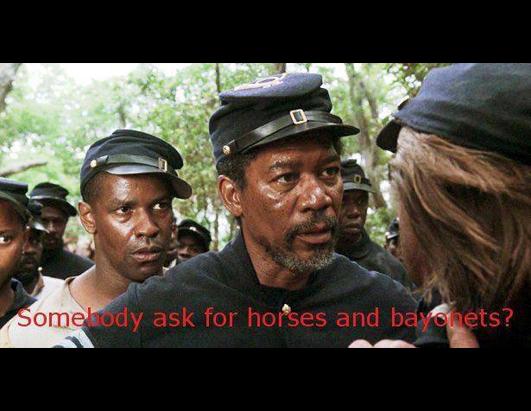
Horses and Bayonets Get the Meme Treatment


Like binders full of women before it, the moment Obama dropped that zinger, the tweet-o-sphere was predicting an ensuing meme.  It didn't take long!
 
The go-forward question is, how can you channel the power of the meme as a force for good?


Memes are coming...


Sean Bean, the meme machine:


Kinda appropriate for the bicentennial of 1812... it's got the horses and bayonets at least!


Risque, taking the Romney's an elite" into "like a plantation owner" territory...
Carried on by connecting his supporters with grey coats
 
 
If Romney's only the apprentice, does that mean Dick Cheney's still active?


Yee haw!  Though I question whether Romney knows how to ride...


More direct
 

Damn it, Barry - you sank my campaign!


Damn it, Ryan, I told you to fetch the horses and bayonets, not a bird!
 
 
There are so many ways you can play with this.  Take any pop-culture phenomenon, affix horses and bayonets, and you have something that someone like me will endless post and share.  There is, however, the ever-present risk of taking it too far, both in terms of demonizing the target and creating additional offense with the comparisons.
 
If used wisely, though, memes are communication gold.  You don't need to go @vikileaks for traction - it's the #tellviceverything's that leave an impression, empower people to engage and can be fun, too.