Search This Blog

CCE in brief

My photo
Recovering backpacker, Cornwallite at heart, political enthusiast, catalyst, writer, husband, father, community volunteer, unabashedly proud Canadian. Every hyperlink connects to something related directly or thematically to that which is highlighted.
Showing posts with label Conscious Society. Show all posts

Wednesday, 2 September 2015

Human Starfish: "'Everyone is the media'


"I pretended not to have seen, I pretended not to have heard because I didn't want to be responsible."

- Adalbert Lallier

The picture above came to mind as I read this article on the controversy caused by viral pictures of a drowned Syrian child, barely more than a baby.

It's a picture of Buchenwald Concentration Camp post-liberation; the well-dressed folk walking by the stacks of dead bodies are residents of Weimar, the centre of culture for Germany where Goethe and Schiller worked and lived.  

Weimar is a short drive down the hill from Buchenwald.  The smoke from the crematorium chimneys would have been visible from town.  The gunshots would have been heard.  More than that, inmates were transported through town.  There was no way the people of civilized Weimar could not have known something inhuman  was happening on the hill where Goethe took walks and thought.

Yet clearly, these people were disturbed and horrified by what they saw in Buchenwald, when it was right in front of them and impossible to avoid.

They couldn't pretend they didn't know something was going on next door to them, hidden behind the birches.  

"I can recall back in the '60s and '70s when we would see photos like this posted in newspapers regarding the Vietnam War," he says.


"We simply now have media that can reach more people and it's becoming more difficult for people to avoid seeing them."


The most famous example of these Vietnam War pics is at right.  The girl in the picture, Kim Phuc, is now a Canadian Citizen.  Her napalm scars remain.

Pictures like that have an impact that statistics or sound bites can't.  We're looking at real people, moms and dads, sisters and brothers, seniors, children - like anyone's family.  And the people in these pictures are enduring horrors that are uncomfortable to see.

We don't like pictures like this.  They make us feel despondent, or angry; they may even give us cause to worry about what the future holds for our own children.

Isn't it great that we can make that unease go away by reminding ourselves we have our own problems and our own solutions?  Or by making a donation to a cause and then comfortably changing the channel knowing we've done our part?

Thing is, there should be save venues, known venues for this kind of gruesome communication to happen; the news, which can be avoided, or magazines with marked pages that can be skipped over. Other people's tragedies have no place in the Facebook pages or Twitter feeds of the nation - that's a bit too much like suggesting that world and our world are one and the same.

That really makes us feel uncomfortable.

I've been to some corners of the world where bad things happen on a regular basis, where poverty and the consequences of poverty are dire.  Of course, being a Canadian, I don't need to travel far - there are First Nation reservations where conditions are pretty bad.  There are even communities and buildings in our big, civilized urban centres that reflect conditions that would make us feel uncomfortable to see in a magazine.

The truth is, we are as wilfully blind in our own way as the people of Weimar were in theirs.  We can tout the wonders of free market capitalism and talk about how it's improved the whole world, skirting over marginalized workers in places like Bangladesh that hold the free market pyramid up.

We can point to federal missions or donations or the loss of Canadian soldiers in places like Afghanistan and say "we've done our part, the rest is up to someone else."

Embedded image permalinkThis dead kid?  Honestly, it sucks to be him, but it's his parents' fault he's dead, no one else's - right?  Or bad luck to be born into a war-ravaged region of the world, but that's their own problem to solve - isn't it?  


As Westerners, we have a ridiculous amount of power that we neglect to use.  We can shape the policy of our governments - not resort to picking platforms and pitches sold to us.  We can stop buying products from companies who's practices overseas we dislike, and encourage good corporate ethics as a result.

We can decide to be allies to peoples in need in various capacities, and we can accept the risk that comes with such actions as taking on a small portion of the burden they should not have to carry alone.

But no one can force us to do these things.  No one has the power to persuade us, if we choose not to be persuaded.

At present, we lean towards laissez-faire engagement as a global citizen, despite holding the power to change everything by the choices we make.

Online, in person, through our efforts, our conversations and our consciousness, we are the message.

Right now, the message isn't particularly comforting.

If pictures of dead children bother you, great - that means you're human.

When the medium is everyone and what we choose becomes the message, all of these seas of troubling issues will eventually wash up against your shores.

What are you prepared to do to help keep future children from suffering the fate of starfish?

Sunday, 7 December 2014

Less Calling than Justification


Let's go with this a bit.  When "al-Canadi" (ie, John Maguire) sais "it's your own people turning against you at home," he may kinda have a loose thread similar to a point.  "Our own people" assumedly meaning Canadians, and "turning on" meaning a rejection in part or whole of something we see as part of our Canadian fabric, there's lots of that - look at voter turnout rates as an example. 
 
Or the calls for an overhaul of our structure of governance (like Open Data) or economic model (shared economy).  There are a lot of beefs out there with things that aren't working, ranging from education to infrastructure repair.  Hell, I recently heard a finance guy calling for revolution.
 
None of these folk are rushing to the Middle East to oppress locals in the name of Islam, though, are they?  Much less attacking domestic targets.  If anything, we're trying to increase political transparency, not help catalyze a police state in response to terrorism.
 
Which, naturally, is the goal of ISIL and any other terrorist organization.  They'd love to see Canada become a hermit state, and love it even more if we collapsed into a civil war.
 
But that's not what Maguire is pitching as his motivation.  No, he's heard "the call" and is inviting Canadians (through petulant videos) to convert to Islam, or at least the version he's twigged on to.
 
What Islam has to do with trying to invade Turkey and oppressing locals is beyond me, but then I know that what ISIL is doing isn't really Islam.  It's barbarism, given name to justify it as something else.
 
And that's the rub, right there.  Whether it's ISIL seeking to destabilize others with violence or Maguire calling on other people to become like him, both approaches have zero-sum, apocalyptic end-games.
 
ISIL wants legitimacy, they've got the faux-Islam thing, but they're also expansionist.  Whatever the rhetoric, it's less a matter of their elite thinking about the end of days, so much as feeling like they're bringing the kingdom of heaven themselves, setting themselves up with the divine right to rule by force.
 
Recruits like Maguire are pushing for conversion; they want the world to take on their world-view.
 
What the common thread?
 
It's justification.  It's absolution through elimination of the Other.
 
If I, say, use a homophobic slur, or slap a child, or shoot an unarmed black youth, and I'm the only one who does the mean thing, then I'm a bad person.  If more and more people do it as well, though, then I was just ahead of the curve, wasn't I?
 
This is the truth that probably goes unnoticed by the Maguires of the world as much as it does by any people or organizations that justify inhuman acts of oppression in any form by saying "that's the way the world works."
 
The world might be a greedy, violent, short-sighted place, but it's also dynamic.  Extinction is written into the mainframe of our ecosystem. 
 
We like to think we're better than that, don't we?  In some way superior to the rest of the animal kingdom out there?  Civilized, rational actors, etc.?  Are we not therefore able of being more than our genetic blueprints?  Of being more than the selection of the fittest?
 
Maybe.  A lot of folk don't bother thinking that far ahead; they stop at the justification bit, declare themselves "histories actors" and whittle away their humanity, delving into the heart of darkness within. 
 
Canada has, at least in our popular myth, always tried to be more than this, the dominance game.  Instead of justifying bad behaviour through destroying or converting others, we've tried to build a state of plurality where diversity of opinion is seen as a strength, not a weakness.  By empowering different points of view, we're that much closer to the truth, to more sustainable solutions, etc. 
 
We're not trying to convert others; we're trying to grow something greater than the sum of its parts. 
 
We can make the conscious choice to own our actions and reactions rather than justify them.  It's a harder road than putting self-interest first and dehumanizing others or insisting they have to be like us to be human. 
 
To do so is to submit to something greater than oneself, or one's tribe.  It's to think of open-endings and of growth rather than of Armageddon and ends justifying means.
 
Not that there's anything new in this.  We might just be due for a reminder.
 

Monday, 10 November 2014

Crie de Coeur for Culture Change in Politics


A powerful, insightful piece into the closed, messy world of politics that anyone who's worked in that space will recognize.
 
I picked the one quote above because Copps is absolutely right - we all tend to be too rash in judgment without taking the time to get informed.  I myself have been on both sides of this equation.  Empathy is not a human strong suit and in politics, it's often seen as a liability.
 
So, confession time to lay the scene appropriately - I am not and will not claim to be holier than anyone.  I have unintentionally crossed lines, misread cues and equally been left in vulnerable positions by people with power to impact my career.  I am also guilty of weighing heavy judgment on people under whom I did have some degree of authority and, in trying to put a cause or brand first, have done harm.
 
Unlike a Rob Ford, though, I'm not content to rest on my human failings as a permanent crutch; I aspire to be better.  It keeps me busy.
 
In general, though, politics isn't about being a better person - it's mostly about winning, a lot about knocking down the other guy and somewhere in the mix is something about public good.  The biggest problem with politics, and moreso as broadcast tools like television and especially social media have entered the fray, is an obsessive need to control the narrative.
 
Enter spin.  Spin isn't lying; it's about framing the truth.  As in, selecting which aspects of the truth get focus and wish don't.  Not telling the whole truth isn't the same thing as flat-out lying; it's more like half-lying.
 
 
Politics is like no other field of work out there.  Politicians spend much of their time away from home, playing roles that aren't clearly defined.  They have actually job descriptions, but they don't match the reality of the roles they play.  Even when they do a good job, they can expect to be criticized.  Job performance is, ultimately, measured by just one thing - the ability to win seats.  A retail politician who accomplishes nothing other than perpetual wins is a success, even if they fail their constituents (ie, Rob Ford).
 
Politicians are employers, although their loyalties are divided between parties, constituencies and their own ambitions.  Staff likewise have to find balance between serving their masters, serving the constituents who elected their masters, serving the political parties that have no mandate over their work but existential control of their careers.
 
And none of these folk receive training in the basics of their work - payroll, HR management, project management, facilitation, etc.
 
Many elected officials like it this way - a lack of structural clarity gives them more absolute control over their staff, a poor-practice reality enabled by parties that don't really care what happens in offices, so long as wins are achieved and boats aren't rocked. 
 
In many ways, politicians are like "the talent" - the really good ones have electric personalities, can sell a message with vigour and are masterful at raising funds and winning seats.  Big personalities tend to come with big liabilities, though - some of the most "effective" talent among politicians and staffers can be abusive, manipulative and cruel. 
 
These aren't great traits to have in a collaborative, cohesive workplace.  In fact, such personalities are toxic to high performance and effective work.  Politics isn't about collaboration, though - it's a blood sport.  Party players will attack each other; internally, backs are perpetually stabbed.  Schoolyard gossips reigns supreme.
 
All this before you get to the outside influences.  Everyone wants to curry favour or pick fights with politicians; some of the shrewd players will try to get their hooks into staff, winning inside operatives.  In addition to the pressure to be all things to all people, never mess up despite not having training to know what a good job looks like, politicians and their staff are constantly exposed to free booze, ego-stroking lobbyists, threatening advocates and angry constituents.  There is little praise in politics, unless blatantly strategic.
 
It's a tragic irony that the environment in which our public policy gets made is often among the most toxic workplaces there is.  How focused on doing policy right can all of these people be if so much of their day-to-day existence is focused on the perks and perils of life in politics?
 
 
Which is in no small part why we, the public, hate our politicians.  We see the bad behaviour, we recognize spin for what it is and become disgruntled.  It has never been the case that people are sheeple or that we have short memories; rather, it's that we see no alternative to dealing with the bad boys that swell the ranks of politics and, therefore, choose not to engage at all.
 
Political culture is toxic; politics attracts strong personalities and egos; citizens don't much pay attention regardless and when we offer criticism, it's rarely constructive.
 
This is not a system that can continue, uninterrupted, as it is, no matter what the successful, aggressive political people tell us.  They're like natural resource extractors, half-convincing themselves that things will never change. 
 
We are all of us standing on the burning platform.  Poor political choices and general civic disengagement are letting the toxicity of our Parliaments creep into every corner of our world.  The blatant racism we experienced in the recent municipal campaign is just a taste of what's to come, if something doesn't change.
 
It's no good getting mad at the aggressive alphas of politics - they win because we let them and succeed because, frankly, there's no alternative.
 
It's crucial to call attention to the abuses that happen within the system - sexual assaults, bullying, negligence, abuse of the public purse, etc. - but it's equally important to recognize tough reactive measures aren't going to stop bad behaviour, merely drive them underground.  The walls will become that much more opaque, exacerbating the problem.
 
Jian Ghomeshi became #ghomeshi because, for decades, no one intervened.  We can get made at him and demand justice, but what really matters is that we learn from how this happened with empathy (the understanding of emotion, not the enabling of it) and apply lessons across the board to prevent future Ghomeshis, and Patrick Brazeaus, and Mike Duffys and Dean del Mastros from happening.
 
This is the crie part - tell me if you've heard this refrain before.  The truth is that we don't know what we're doing.  We don't understand why we choose not to recognize the harm we often do.  Tough bosses who bully their employees often think they're doing them a favour; victims of harassment that don't take it are seen as disruptive to the culture instead of being victims or, worse, are applauded for standing up for themselves.
 
Remember the whole "women should golf" thing?  Ever heard the phrase "eat what you kill" in terms of business or "dog-eat-dog world" in relation to any sector?
 
It's laissez-faire culture; throw the kids in the deep end and reward the ones that survive, even if it's by forcing others under.  We have a culture that encourages aggressive competition, a focus on sales and those without power proving themselves to those with.  Yet we have a growing recognition of such power imbalances lending themselves towards abuse.
 
The two ends cannot hold.  If we want a survival-of-the-most-competitive, the very nature of that culture encourages abuses.  How else do you cull the weak?
 
Which is why, in my view, political culture keeps getting more and more toxic and will continue to do so while the status quo holds. 
 
We cannot expect the people within the system to be the sole progenitors of change; the toxicity of our political culture is like lead poisoning, but it's society as a whole that's put the lead in the pipe.
 
There is a desperate need for culture change in politics; through open government initiatives, there's even a movement to catalyze such change.  It cannot and will not happen in a climate of disaffection, bitterness and even rage; people on the inside rightly feel the need to protect themselves from the mob. 
 
We need to be more than a mob if we want change.  We have to be more than passive audiences or reactionary forces.
 
We cannot do this if we remain committed to passing judgment, placing blame and seeking vengeance.  Such does not move us forward.
 
There is a way to move out of our spiral down the drain of civility, but it cannot come without a deep recognition that the problem isn't external, but internal.
 
None of us are blame-free, nor are any of us strictly victims or perpetrators. 
 
Until we recognize this basic truth, none of us are free.
 

Friday, 24 October 2014

New Music on Untangled Strings


Since seeing the Avengers: Age of Ultron trailer for the first (but certainly not last) time this morning, I've had its eerie rendition of Pinocchio's "I Got No Strings" stuck in my head.
 
It's a brilliantly subversive use of a classic Disney tune for a modern Disney film.  The revamped tune's tone is perfect for the bleak emotional landscape we're seeing as the foundation of Age of Ultron. 

More than that, though, it speaks to one of the core, defining dichotomies of human nature; the urge to be independent and to create, but the fear that our creations may cut their own umbilical cords and maybe not evolve the way we might want them to.
 
Different is all-too-often equated with evil, or even eerie.  Change is frightening.  Loss of control is frightening.
 
Of course, fear (and all our other limbic programming, including hate) is the puppet master.  We are none of us free while we play by rules that predate us by millions of years of evolution.  Of course, we can't cut those cords, either - they are a necessary part of our construct.

What we can do, when we consciously work at it, is learn the notes our emotional chords are capable of hitting, then teaching ourselves how to play them.  That's when we can take the old tunes and create something new, but rooted out of them.
 
When we can write our own music with the notes that are given to us, that's when we're free.
 
I'm going to play you something beautiful; everyone singing grace.  We want to be part of the world; we know we need to change.  We're all strings on a divine instrument; when we play together with harmony, it's a wondrous thing. 
 

Saturday, 18 October 2014

Heroes Belong to All of Us


DC is a for-profit company.  They exist to make money.  Why should they do something that doesn't serve that purpose?  Why should any of us do things that don't serve our direct interest?  If there's no immediate ROI, if there's risk and the potential that our efforts may not succeed, what's the point?
 
But there's more to being a human being that self-interest.  Our ability to be more than the sum of our parts, together, is core to what makes us human.  It can be very hard to do, though - in a world that often seems petty, self-interested and cruel, it's can be a frightening thing to be the first one to think and do differently.  There's always the chance no one will follow, and then you're out there alone.
 
Superman is a trademark, but the idea behind him is as old as story telling.  Superman is the adult in the room, the strength to carry us when we're weak, the shield at the front that gives us all courage to move forward. 
 
Superman inspires - that's what heroes do best.
 
Poor Jeffrey Baldwin is an unconventional hero; he saved no lives and fought no wars, expect perhaps the one that was his short life.  For a moment, though, despite everything that he endured, in spite of the hardship that was all he knew, Jeffrey Baldwin was Superman.
 
And thanks to the heroic efforts of Todd Boyce, he will remain Superman.
 
That's it - the big secret, the thing left in the box, the piece of the puzzle we simply need to raise our gaze to see.
 
Heroes aren't brands to be bought into; heroism is human aspiration we crave, reach out for with tentative hands but, when the light shines bright enough, we embrace.
 
We need heroes - that's why we create them.

I believe there's a hero in all of us, that keeps us honest, gives us strength, makes us noble, and finally allows us to die with pride, even though sometimes we have to be steady, and give up the thing we want the most. Even our dreams.


Monday, 29 September 2014

Id vs Super Ego: The Conscious Tonic


Populism is like the teenage brain; emotion runs high and drowns out logic.  It's Id vs. Super Ego.
 
There are all kinds of examples of populism out there right now, from the crass to the dangerous.  The former, unchecked, invariably leads to the latter, which is why we have a conscience in the first place - it's how we plan ahead.
 
Therein lies the big secret that's being missed.  When you focus on messaging and attacks both verbal and non-verbal, you're trying to control an opponent or audience.  You want to limit their frame and stoke emotional responses - which is likely what they're trying to do, too.  It's political escalation.
 
How we redress this isn't through force or functional fixedness, but through the application of behavioural economics.  You can't teach the old maestro a new tune, but you can twig them with a familiar refrain. 
 
Our is not to do or die - ours is to question why.
 
Why matters.
 

Sunday, 28 September 2014

Why History's Actors are History's Prisoners


Got it.  Arming and training local opposition forces to take out the Big Bad. 
 
The US has clearly never taken that approach before and regretted it - especially in the Middle East.
 
Those hyper-confident folk who magically land on ideas like this that are too great to fail don't need to reflect on the lessons of history - that's for reality-based pols and the like.  After all - history's actors command and control the world and all its lesser creatures, right?
 
Which reminds me - I have heard rumblings for years that the death of bin Laden had done nothing to quell the tide of terrorism in the Middle East; indeed, like Hydra, the one head has been replaced by two or more.
 
This is just one piece of an increasingly fractious big picture, too - there is a growing amount of civic unrest out there, even in so-called stable countries.  The water hole of our resources continues to shrink, opportunity continues to become the playground of an increasing few and people out there are becoming angry.
 
Those in the bubble don't feel the changes, and therefore don't believe they're happening.  The world, to them, is as it has always been.
 
Ignorance is the most insidious form of enslavement.
 
Confidence is not the same as mindfulness.  Until this lesson is consciously absorbed, we are doomed to do this again, and again, and again.

Saturday, 27 September 2014

Capitalism's Fordian Flaw: Ignorance is Not Bliss


Man against man?  Check.
Man against himself?  Check.
Man against nature?  Rob Ford is spoiling for that fight.
 
Rob Ford is a functionally fixed man with a deep level of delusion.  He sees himself (except in his darkest moments) as the embodiment of the Horatio Alger myth; the fella who fought his way to the top and will fight to stay there against any comers, be they other politicians, the press, his substance abuse or even cancer.
 
It's a narrative that his family clearly fuels, partially because they want it to be true but, it must be said, partially because they see the benefits of that particular narrative.
 
The only sort of story people love more than a Fall is come-back.

We love us our fighters.  They don't just come in the pugilistic category; Erin Brockovich is a fighter in the mold of Ellen Ripley, who is a fighter.   Stephen Hawking is revered for his ability to fight against his own failing body to achieve great things; the Dalai Lama fights against the easy course of violence and remains functionally fixed on his agenda of peaceful protest.
 
This is the capitalist dream; the implication is that anyone, if they have enough grit, can become the President of a company or the country.  It's that trait - tenacity - that matters above all else. 
 
In fact, it replaces all else.  Anything that detracts from personal grit is bad; anything that surfaces it is good.  Socialism, as such, is bad; it unnaturally holds individuals down in a learned helplessness instead of freeing them to God's gift of individualism.  Better to put a gun in a man's hand that he may fight for himself than a roof over his head and domesticate him. 


This is why even those who detest Rob Ford put him in a special category reserved for those who do not quit.  Whether we like or despise the process or results, people admire tenacity.  He's the Dean Moriarty of Toronto Politics, the holy goof who, now that it's a universally-feared illness he's fighting may very well emerge as something more.
 
Anyone who has even a shred of social conscience wants Rob Ford to succeed in his battle with cancer.  At some level, it's because we feel that if someone with the personal failings and health challenges of a Rob Ford can win, then maybe we or our loved ones can, too.
 
Rob Ford's personal faults and excesses have transformed him into a superhuman.
 
 
We can only hope that he does, but if he succeeds, it will be in spite, not because, of his personal habits, his family and inner circles enabling or the laissez-fair culture we live in.
Rob Ford has told us many times how he has changed his ways; his proclamations have invariably turned out to be lies told not only to us, it seems, but to himself as well.  Ford clearly has moments of doubt, but largely is able to convince himself that, rational actor that he is, he is always in the driver's seat where his behavior, or health, or political battles are concerned.
 
He is what we would have him to be - sucks it up, he keeps his dukes up, he stays the course - he is driven.  Clearly, it's worked for him, right?  Despite everything, he's mayor - and that, that title, his wealth, his public persona, that's what matters.  That's what defines success.

Yet Ford is a man in clear disarray; his health suffers, his family suffers, his community suffers.  Even now, he's putting his recovery at risk because he is driven.  His brother is equally driven. 
 
Campaigning and speaking engagements are good exercise for battling cancer?  Give me a break.
 
Cancer, like substance abuse or any mental health problem, is not something external that we, as individuals, fight against - it is a part of us that, without external support, will consume us. 
 
Rob Ford embodies the great leaping logic gap of capitalism; success is not an individual labour.  Health is not an individual enterprise.  We human beings are not rational actors, nor are we islands in a tame sea. 
 
Rob Ford's cancer is not an invading force.  It's part of the biological system that is Rob Ford.  Rob Ford's addictions are not demons imposed; they are part of him. 
 
Rob Ford is not a saviour nor a sinner, external to our society - he is one of us.  And we are part of him.
 
We are as functionally fixed as Rob Ford, yet equally beset by doubt. 
 
Does the fight make us happy?  Does it sustain us where failed relationships with loved ones does not? 
 
Does money bring us joy?  Do we enjoy having it more than we get frustrated with those seeking to take it from us?  Do our daily labours, our long commutes make us happy?  Does having the latest fashion or smartphone fill us with a sense of completion?
 
Does the frame of individual as silo make us feel powerful, or disconnected?
 
If we are investing so much time and energy in activities that bring us doubt and are fraying both our world and our selves, how rational are we truly?
 
The only time putting the race before sustainable health makes sense is when we are being chased.  In a civilized, competitive world, the only predators we face are each other and ourselves.  And nature still consumes us all.
 
Capitalism has no answer to this reality - it's about pushing ahead, not looking around.  Developing context and crafting solutions is what sociology is for.
 
Something I wish everyone, Rob Ford included, could be conscious of.

Monday, 8 September 2014

Fire and Water: Storm Front Coming


And in that bright October sun
We knew our childhood days were done
And I watched my friends go off to war
What do they keep on fighting for?


War is fire.

It has a voracious appetite that will consume everything in its path - land, cities, people, even children.  It doesn't matter that we didn't start the fire.

It doesn't discriminate.

War is sparked by the friction of politics, rubbing moods raw, wearing ethics down until the very fibre of our dark hearts is laid bare.

Sticks rubbed together with enough force can start the fire of war.

Sticks brought together with a lil' bit of tape and vision can create a bed, or a building, or a community. We can even keep the darkness at bay, when we learn to tame that spark for light rather than heat.

But you can built naught with ashes but tombs.


As the weather changes, there are a growing number of brushfires emerging, growing hotter, spreading.


Will the world burn?  I think not.  But our saving grace won't come at our hands.

There are other forces at work besides fire; as the weather changes, we're seeing storms of increasing ferocity dashing against aged infrastructure ill-equipped to keep the force of nature at bay.

The last man standing cannot hold back the tide; he will have no one to turn to for aid.  

It is the folly of man that we recognize our place only after we've overestimated our power.

It's the wisdom of humanity that we plan ahead.  

What gives us the grace to look beyond our immediate selves to temporal realities?

I think you know the answer.


Friday, 18 July 2014

Emerging Consciousness


These biases are emotionally wired.  Some of them are learned, some of them are genetic programming, but they all exist to make us feel a certain way so as to catalyze a behaviour.  The problem is, emotional reactions are one-size-fits all, meaning they're often wrong.
 
My favourite example is how we might feel scared of an unwilling to touch a burn victim.  Why would that be the case?  It's likely that our limbic brain is perceiving unhealthy-looking skin that looks like something that could be contagious, like an ebola, and is encouraging us to stay away for that reason.
 
It's a reaction grounded in reasoning, but one not appropriate to the situation.  The same holds true for a white woman scared by a black youth on a subway, when there's really no in situ cause to validate that fear.
 
Homophobia is another one.
 
These biases are pervasive on countless levels that we're not even aware of (for the reason that our body is designed to take care of all this situational management stuff for us) - ignoring homeless people, being more interested in what attractive people have to say, disliking ideas that differ from ours or loving what a confident voice says, even if it's crap.
 
We make unconscious, reactive decisions all the time that we then justify consciously; it's the Vic Toews syndrome, one we are all susceptible to in differencing degrees under varying circumstances.
 
The only way to overcome these biases to realize that having them doesn't make us weak, or flawed, or evil.  Also, just because we feel a certain way, it doesn't mean that instinct is a good one to trust.  We have to learn to step back from our feelings - appreciate them for what they are and listen to them, but not to stop there.
 
This is the process of consciousness, of becoming aware of what influences our thoughts - and, at the same time, understanding what influences the thoughts of others.
 
A conscious society is a long way off, but I can see we're moving there in fits in spurts, even while reactive hatred and war continue to spread, like an illness.
 
I don't know if I have hope for us, or even our children, but we will get there.
 
I've got faith in that.
 

Sunday, 18 May 2014

Doug Ford the Sociopath Gets Challenged


You might think Doug Ford would take counsel before opening his mouth about issues of mental health and cognition given that his brother is, among other things, a drug addict.  I wouldn't - like many others in Toronto, I have suspicions that Doug Ford is a sociopath.


 - superficial and portray themselves as smarter than others
- delusional
- figure they can get away with anything (like blatant cash bribes)
- they lie, all the time, with ease and confidence
- feel neither guilt or shame
- don't learn from mistakes; they double-down
- their heart "goes out" to no one - not even their own brothers


Does that sound at all like Doug Ford, the Worst Brother Ever?  You see where I'm coming from then.


So, back to Ford's comments about autism.  He mentions "violent behaviours" like screaming.  How does he feel about punching your own friend, beating a friend, barrelling through an elected official to go join a fight or saying things like "get her a shot right now or I'll fucking break her..."?


Autism is not a cause of violence.  That's a facile, ignorant comment made by simpletons looking for a quick answer.  Violence is not a product of mental illness, the way we tend to view it.  If that were the case, we'd have to label a lot of hockey players and fans as mentally ill, wouldn't we?  They engage in violence and calls for violence all the time. 


Violent behaviour is a response to that which makes us uncomfortable, which we feel threatens us.  We respond to threats reactively, the same way we pull our hand back from a hot stove or feel an urge to lie down while in high places; this threat-response behavior manifests as stomping on a bug, smacking a child who talks back, promising consequences to employees to question us or screaming at a world that feels threatening, seems not to make sense.  Like Rob Ford does, or like some autistic kids do - depending on their circumstances.


There's really no difference - the reactive behaviour is the same whether you're flipping out at Pride or screaming because nobody's communicating the way you do.


Which is what happened to Jacob Barnett for ages.  Haven't heard of him?  You will - he's the autistic kid who many think will be the next Einstein/Newton.


Temple Grandin was misunderstood by many - now she does TED Talks.


Winston Churchill had mental health issues.  Abraham Lincoln had mental health issues.  It's quite likely that Stephen Harper could be diagnosed with a "mental illness" - as Bob Rae was.  These aren't weak men - they're dynamos, catalysts, outliers.  You'd be surprised how many "mentally ill" people have shaped the course of human history.


What we don't get - what people like Doug Ford, pathologically incapable of understanding others as they are don't get - is that different isn't bad.  It's different.  It's the interaction that defines good and evil.  The more empathy you have, the less sinful you become.


Being black, or gay, or tall, or autistic doesn't make you good or bad.  These are all aspects of the elephant, one trait amongst the many combinations that make us all unique. 


When we focus on the negative, we become angry, fearful, reactive (and violent) to. 


When we seek comprehension, we are inquisitive, patient, engaging and, ultimately, powerful in that special Ender Wiggin way.


Rob Ford has, through his illness, shaken a status quo that was desperately in need of being shaken.  He is a parody of all the norms we have come to accept of politicians.


Doug Ford is something even more extreme - a glimmer of what we could become, as a society, if we choose to focus on what irritates us instead of seeking common ground.


We can opt to stand against that which we disdain or makes us uncomfortable, as the Fords do - but that's a path that history teaches us has a dead end.


The alternative is to get beyond our own stigmas and learn how to understand, rather than react to.

When we learn to look beyond ourselves, that's when community truly begins.


Doug Ford sees himself as tough, better-than, shiny, independent.  There's nobody better than him - certainly not some autistic upstart.  Why, Dougie could wipe the floor with an autistic nobody, physically or verbally.


Hey Doug - I've been diagnosed as on the autism spectrum; that makes me your inferior, right?  But I'll bet you're not brave enough to go toe-to-toe with me in the arena of ideas.  You've got nothing but bluster; I've got everything, including the facts.


I've called you a sociopath, Dougie - I'm telling you that you're a lesser-than.  Are you going to take that?  Want to prove you're smarter than I am by disproving everything I've written here?


I'm betting you aren't.  Shows how weak your position is, doesn't it?


Friday, 16 May 2014

Awesome Things


awe·some
ˈôsəm/
adjective
  1. extremely impressive or daunting; inspiring great admiration, apprehension, or fear.
    "the awesome power of the atomic bomb"

Awesome is one of those words that defies its own meaning.

How can seven letters convey the grandeur of a thunderstorm, the vastness of the plains, the beauty and terror of the sea?  It can't.


People are big on fish tales - always trying to outdo each other with the better narrative.  So, we've come to use the word awesome a lot - so much that maybe it's lost some of its capacity to inspire or intimidate.


We're also big on simplification; we want our narratives as non-cumbersome as possible.  Simple plans, simple solutions, sound-bites, old stories retold in new ways.

When we put our blinders on, though, we are ignoring the true gift of humanity, the thing that has driven us since before the written word - the ability to see beyond the cave and wonder at the light beyond.

That's why I love this video, especially at the 1:08 - 1:10 mark.  The editors knew what they were doing - by amping up the volume, what had been a cute experience instantly becomes something more, something transcendent.

A group of people got together, dared to be different, made music, and made other people smile.  They impacted those lives, changed their moods for the better.

People did that.

To me, that's awesome.  But then, I'm pretty easy to impress.


Monday, 12 May 2014

An Unorthodox Hope


There's lots to be worried about in Canadian democracy these days.  We keep being told what to believe by  a government that ignores and even attacks the evidence.  Meanwhile, Canadians are tuning out a lot of unpleasantness we should really be concerned about.

Is a variant on 1984 underway?  Are we low-hanging-fruit and simple-messaging ourselves back to the stone age?  Has instinct won out over rational thought and query?

I tell you no, and I'll tell you why.

The story of history is replete with failed empires and lost civilizations.  Easter Island's slow acceptance of less than they had is a common tale.

When you look at the big picture, though, we have always, always kept moving forward.  We face new challenges, like epidemics or transit, and find new solutions.  You simply cannot have a growth-oriented economy or population that lives within its means.  These concepts are antithetical to each other.

Intransigence and decline never win - progress continues, because that's what evolution does.

Something worth being conscious of.

Thursday, 1 May 2014

The Wolf of Toronto and Margaret Wente: Look Closer


What does the TFW program have to do with Rob Ford's substance abuse problems?

Quite a lot, when you get down to it.  


Temporary Foreign Workers (TFW) are the path to least resistance; between a choice of a more demanding, higher-costing employee who might feel working for you is a necessary burden versus a cheaper foreign worker who sees working for you as a ticket to a better life, it's really not a hard choice to make.

Spend less, get more for it.  Have lower responsibility costs.  What's not to like?  That way, you have more money for other things.  That surplus cash could go to strengthening your business through R&D, or expanding your operations.  At the same time, it could go to a nicer car or a more expensive Scotch.  

Does it make a difference whether your interest is growing your company or raising your own profile?  

Absolutely it does.

If you're goal is to maximize your contribution to something larger than yourself, like your company, you're activating a differing set of priorities than if you're seeing company growth as a way to aggrandize yourself.  It's the difference between, say, having a trophy wife vs investing in a family.

In the first case, you want that which makes you look and feel good; in the second, you want to empower something that carries on after you.


As it stands right now, capitalism is designed around mathematical economics; it assumes that all players in the game are rational actors with a suitable level of self-interest, yet interested in achieving balance.  Markets are supposed to find balance between supply and demand, promote dynamism and the rest of it.


But that's not how it works, does it?

Some people are more aggressive than others.  Some are more likely to make impulsive choices than others.  None of us are truly rational, whatever we like to tell ourselves, and as such aren't good at balancing our own short-term interests vs our long-term interests, which are largely invested in the societal whole.

This brings us to the FTW program.  What was a good idea on paper has actually resulted in a variant on the Tragedy of the Commons (also a book by the amazing Alison Loat and Michael MacMillan). 

Employers looking to maximize their gain and minimize their expense are abusing the system, because why not?  After all, potential Canadian employees are looking at the low-wage, low-respect jobs available in sectors like Fast Food and deciding that the effort and embarrassment potential of working such jobs isn't worth the pay it brings, especially if there's a welfare-state floor beneath them to ensure they avoid poverty.


So the solution, you might say, is to scrap the welfare state entirely - take that floor out from under a laissez-faire labour market and force them to choose between poverty and working undesirable jobs.  I mean, what's the alternative?  Either the welfare state bankrupts us or imported poverty leads to all kinds of social decay.  Close the doors to foreign labour, force Canadians to embrace their Right to Work.

But that's only part of the problem.  The reason why employers are importing lower-cost FTW in the first place is that they don't want to invest any more in labour costs than they have to.  If you take away unions and labour regulations, these same employers will look for ways to reduce their labour costs further - less breaks and benefits, amalgamating positions without increasing wages, etc.

That's fine, you might say - this forces employees to become more desirable as labour, more competitive in how they sell themselves and demand more from their employers.  Except not everyone is capable of being competitive, any more than everyone is capable of winning a marathon or curing cancer.

The people that tend to get ahead in competitive markets are the ones who are good at being competitive, to the exclusion of all else.  That means elbows-up, step-on-throat tactics and a functionally fixed approach to problems.   


People like Rob Ford or Jordan Belfort are the embodiment of this approach.  These are two guys who aren't afraid to get what they want.  They are the epitome of laissez-faire capitalism; they live life to the fullest, spend freely and have no qualms about doing what it takes to win.  

Even if it means breaking some rules to get there.

What else do these two gents have in common?  They've both made terribly short-sighted choices that have worked well for them in the short term, but been negative to many of those around them.  They've both suffered in the long term, too.  

Oh yeah - and both have addictive personalities.

It's telling that Belfort, as portrayed by Leonardo DiCaprio in The Wolf of Wall Street refers to money as a drug.  That's exactly what it is.  


This isn't me saying that money is the root of all evil - that's mythic crap that over-values money as a concept.  Money is power - if you have it, you can accumulate stuff, build brand, make yourself feel and look big.  It's hardly unique in these traits - lots of drugs make people feel more powerful than nature has made them.  Cocaine does the same thing, as does its low-brow derivative, crack cocaine.

These addictive drugs increase the flow of a neurotransmitter called dopamine in your brain. 

Dopamine makes you feel powerful, in control, "high" - as in higher than everyone else.  It's a good feeling, one that's awfully hard to come down from.  Which is where the addictive factor comes in.

Rob Ford denies his problems, lives life like he's king of the world, feels that only he can help the poor black kids on his football teams, thinks only he gets how simple the solutions to our problems are (Subways, people!  Subways, subways, subways!) and gets annoyed by this notion that you have to weigh consequences before you act.

He's an extreme case, as is Jordan Belfort, but they are fairly representative of all dopamaniacs; want more, want to spend less, self-interested and as a result, socially irresponsible.  Having money, owning a team or owning a gun are all dopamine-inducers.  They make you feel like you're king of the world, or at least your own castle.

Let's go back to the words of Margaret Wente - we're hooked on foreign workers.  Hooked, as in addicted to.  Why would that be?  


Foreign workers are the labour equivalent to crack cocaine - they get the job done quicker, cost less and still give you that dopamine fix.  Whether they're temporary or end up sticking around, though, what they don't encourage you to do is invest more time and effort in your labour, building out your company in a sustainable way.

Maybe if you're working in a strictly transactional service industry, that's fine, though even then a focus on doing things cheap tends to result in shoddy infrastructure across the board.  If sustainable growth is your goal, though, you really have no choice but to invest more in your labour.


This reality was brought home to North America during the Labour Revolution and is slowly coming to light as countries like Bangladesh, who've swallowed up much of our old Traditional Manufacturing industry, suffer their own consequences of inadequate labour and infrastructure investment.


They're going through the same physical labour pangs we did a century ago as we try and re-position ourselves, through foreign labour, to go through the same turbulence a second time.

This fundamentally isn't about mathematical economics or the pros and cons of capitalism vs communism; as we have seen throughout history, both systems still lead to dopamaniacs seizing power at the expense of the majority.


What these series of interlocking challenges, like a Seldon Crisis, are fundamentally about is behavioural economics - the science behind why people behave the way we do.  

A system like Capitalism promotes addiction - to money and the power it brings.  A system like Communism promotes addiction - to power and information and the power they bring.  Both are self-serving, not by design, but by a lack of design-thinking.

Adam Smith and Karl Marx both meant well; the problem was that neither of them understood neurochemistry.

We've seen how communism falters and we're both hearing and seeing how capitalism isn't up to the challenges of our modern context, either.  Any system that promotes and rewards dopamine fixes, by its very nature, is doomed to result in structural challenges.

So where does this leave us?

Fortunately, there's another neurotransmitter out there that provides a better foundation for sustainable socio-economic infrastructure.  It's called oxytocin (not to be confused with oxycodone) and in many ways, it is the anti-dopamine.


Oxytocin does wonders for the body - it reduces emotional stress, negates fear, improves health and most importantly, it also provides a positive feeling - not power, as is the case with dopamine, but of personal value.  

When you score a point or make a buck, you get a dopamine hit - feels good, helps you focus on getting the next one, whatever the cost.  It leads to competition, which produces winners and losers.

When you donate to charity or give up your seat on the subway, your system floods with oxytocin - you feel good, your environment comes into clarity and you feel even more inclined to help others.  Best of all, when you get an oxytocin hit, so does everyone around you.
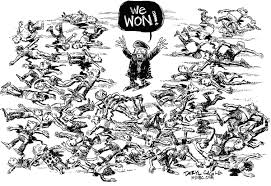


Let's break that down a bit further - competition promotes individual wins, which promotes competition, which cataylzes fear, antagonism and a sense of urgency to not fall behind.  It results in short-term thinking and leads to tragedy-of-the-commons scenarios.


Oxytocin promotes engagement, empathy, collaboration and the ability to think further ahead, without the crippling fear often associated with risk-taking.  It results in shared solutions and people moving forward together.

Yes, there are sociopaths, psychopaths and narcissists out there; we do need to be cautious of con artists and terrorists and all those who are hard-wired to prey on the weak.  But to have a system that is entirely designed to encourage predatory, dopamine-fueled behaviour isn't the way to minimize those risks.

Instead, we need to rethink how and why we structure our society so as to optimize our collective opportunities by maximizing individual potentials.

Fortunatley for us, we're already well along this path.  We just don't know it yet.
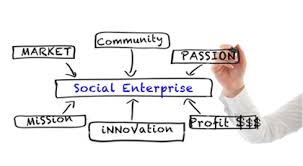

After all, what is healthcare, if not a way to support the weak?  What is specialization, if not an effort to integrate individuals into a collective whole?  Can a nation or a community survive without shared infrastructure and a genearlly agreed-upon code of conduct?

Society isn't and never has been about trickle down or individual competition, it's been  about developing into a collective organism, a networked intelligence.

We're seeing, at the periphery, the next phase of our social evolution away from individual competition towards collective success right now.  It's coming in the form of Open Government and Open Data, through the connective tissue of social media and a whole new focus on empowerment.

Especially when it comes to labour.  In the post-transactional, knowledge-based economy, customers want experiences, not just products.  They want to feel good about the choices they make, which means they want to know that the people they're interacting with - your front line employers - are happy with their lot in life, too.


How fast we move through this transitional period depends on how quickly we come over our collective addiction to money and status and start valuing what we give and how we contribute more.  


As contribution isn't addictive, it doesn't result in the same functional fixedness we see in people like Rob Ford, or the devaluation of others we see playing out through the TFW program.

Political Parties, individual politicians and corporate entities can win big by embracing the concept of the responsible society and investing in corporate social responsibility.  In fact, we see that happening already.

The question for these power-seekers is this: do they have enough self-control to overcome their addiction and start leading by example?

If we look closely enough, we can already see the answer emerging.