Search This Blog

CCE in brief

My photo
Recovering backpacker, Cornwallite at heart, political enthusiast, catalyst, writer, husband, father, community volunteer, unabashedly proud Canadian. Every hyperlink connects to something related directly or thematically to that which is highlighted.
Showing posts with label Mitt Romney. Show all posts

Monday, 3 February 2014

John Tory: Competition vs Accomplishment

Patrick Swayze - Nobody Puts baby in a corner


If you're maybe kinda sorta contemplating a bid for higher office, this was about as clever as thing to say as that time Mitt Romney talked about having binders full of women.

From a behavioural perspective, however, there's something really interesting to be mined in this.


Tory makes a point; men do tend to be more selfishly aggressive than women (in that the average man is more aggressive than the average woman, not that selfish aggressiveness or passiveness are unique to each gender).


It's not a uniquely human thing; across mammalian species, males tend to be flashier in their appearance and more likely to fight with each other for status and dominance (which largely reads as increased access to women).  

Physical features like the peacock's tail and the deer's antlers are biological testament to this. 

Now think about this in a social context for a second.  We automatically assume that aggressively standing up for one's interests is a good thing, be it the better cut of meat or the corner office.   Competitive men are more likely to get what they want, therefore making them better investments.  

Right?

In nature, the more competitive male gets the resources, gets the female and passes on its genes.  In theory, the socially more aggressive male will make more sales and be of greater value to their employer; this aggression gets rewarded through higher wages and corner offices.  Eventually, they and the companies that employ them become too big to fail, right? 

Not really, no.  Aggressive, alpha salesmen are selling brand more than they are product, ignoring or downloading risk to people less important or competitive than they are.  They fail all the time - the higher up they get, the more people there are carrying the risk for them.

Aggressive sales isn't always a good thing, especially when the product or service isn't that great.  The focus shifts from being about the quality of a product and more about tearing down competitors - kinda like political attack ads. 


The other thing about an aggressive focus on winning is that, by the very nature of competition, success of one comes at the expense of someone else.  What happens when your competitors don't cave so easily?  Syria provides a great example of how badly this approach can turn out.

War has traditionally been the province of men not because they're tough enough to fight, but because on the whole, fighting comes more naturally to them. 

The ability to sell products/services of lower quality, the drive to push down competitors and aggression as a default - these might be great skills to have in a sales environment, but they're also a recipe for stagnation and failure.  Feudalism, Wall Street collapses and the hollowing out of democratic politics are all examples of where elbows-up aggression gets us.  

How many brutal women dictators can you name?  Exactly.


History is the story of humankind moving in the opposite direction, towards increased social-emotional fluency, collaboration and a focus on results rather than sales pitches.  It should come as no surprise that, as women have become more fully empowered and integrated into society, we've become less violent, more sophisticated, more balanced and even more innovative.

The last is key, especially in fields like politics.  If you think that policy development is a social equivalent to natural selection, with the best ideas already in existence needing only tough salesmen to ensure the best policy genes are carried on, fine.  But what if the solutions at hand aren't up to the challenges of the day?

Reproduction isn't about carrying one person's genes forward - it's about getting the best blend of each. 

Smart policy (admittedly, a rare commodity) works the same way.  It blends perspectives and approaches to create the best adapted and flexible end product.


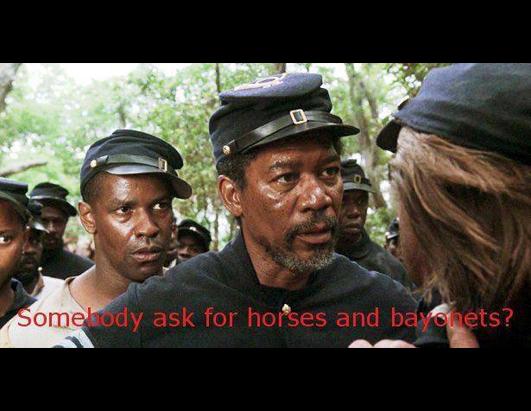
If you're so focused on winning and selling what you have that you can't view alternative perspectives as anything but competition, you're losing the ability to incorporate, grow and build partnerships.  You may grow big and strong, but as a result you lose the ability to adapt and, as the world change, you become as irrelevant as horses and bayonets (or for that matter, coal plants).

Smart companies have recognized that it pays to be adaptable and to work with employees to ensure they have the tools, accommodation and compensation they need to succeed rather than wait for their workers to come to them.  

That way it's the best talent, not the most aggressive negotiators, who rise up the ranks and keep the organization competitive in an evolving landscape.

It doesn't sound to me like John Tory spent much time seeking out, understanding and supporting the best talent in his teams.  Like far too many bosses, he played the laissez-faire game, hoarding his money until someone came and aggressively convinced him to part with it.

As such, he represents traditional models of leadership that are proven less effective, especially in economies that are heavily dependent on innovation.  It's a shame, really, because he understands how destructive a winner-take-all approach can be to sound decisions getting made.


It's probably true that women are less likely to spend their time demanding more from their bosses; by the same token, it's equally likely that women leaders are more likely to do the right thing and empower their employees so they can spend more time working than negotiating.


Something I think John Tory should be familiar with.

Monday, 12 November 2012

Campaign Narratives: The Art of Political Shading


That's the single most important lesson people engaging on political campaigns can learn.
 
 
Of course, that's easier said than done.  How do you create an image that resonates in the minds of the general public?  Political operatives have been developing this craft of political branding for centuries, yet it remains more art than science.  Smart folk like Stephane Dion and Michael Ignatieff have tried to articulate their brand in logical, academic terms - and fallen far short of success.  Same with Mitt Romney - he thought that his track record of tough success in business spoke for itself and therefore spent the first chunk of the just-finished Presidential campaign simply speaking to that record. 
 
 
This bold-strokes message won Romney the first Presidential debate; it also proved to be his ultimate downfall.  What he and perhaps his campaign team didn't realize - or rather, didn't think mattered - was the way his messaging coloured in the brand outline they had established. Romney could not be other than he was; the more he spoke, the more public traction he gained, the clearer it became to the average American that he wasn't one of them.  His essence was painted with the rich primary colours of old-America elitism. 
 
 
For his part, Obama's initial falter was not due to his words, but his image.  President Obama at the beginning of the campaign was just that - a President wrapped up in the busy-ness of office, running for reelection.  His messaging had the wonkish, sharp lines of academia and created an image inaccessible to the average American.  It was when he refound his 2008 palette featuring the warmer hues of hope, promise and commonality that he once again registered with the electorate.
 
 
That's the key; we can talk about the science of politics all we want, but politics is meant to be art.  One of the tricks you learn in crafting art is that defining a pictorial narrative or a portrait isn't always about bold lines that force an impression upon your audience, but rather a more subtle, strategic manipulation of light and shadows to build an image in their mind's eye.  You don't build the picture for them - you control the context they see and allow them to construct your image themselves.
 
 
That's the Philosopher's Stone of political branding, the key lesson that opens the doors to success; sophisticated narrative building isn't just about simple, blunt lines and volume, but about shading in prescribed context that allows your candidate to shine through.
 
 
Stephen Harper, knowing that his personality is all sharp-edged policy with the odd splash of angry reds and cold blues wisely stays out of the public spotlight.  His tenure as Prime Minister has been more about defining others than defining himself.  Team Harper has relied on shadows to create their narrative and portray their opposition; troubles lapping at shores, not in it for you, etc.  This approach has worked so far because none of Harper's opponents has successfully created their own palette.  As mentioned before, previous competitors used lines and ran campaigns devoid of texture; Thomas Mulcair has so far drawn from the same dark shading that has defined the Harper narrative.
 
 
Which creates an amazing opportunity for the next Leader of the Liberal Party of Canada.  With shadows the texture of choice on the Canadian political scene, there is an incredible need for contrast.  Great artists have realized that the use of light can be far more powerful tool in defining a narrative that resonates with a diverse public.  Light can block out blemishes, provide clarity, builds horizons and supports broad visions.  Best of all, light will always dominate over darkness; it's political physics.


There are now two accomplished artists involved in the race for the Leadership of the Ontario Liberal Party - it will be telling what hues they choose to use to define their narratives for the people.
 
 
UPDATE: It should come as no surprise that the OLP Leadership candidate that won did so based on her merits; Kathleen Wynne has filled in the texture of her entire career with integrity, thoughtfulness, strategic thinking and no small dose of empathy.

Thursday, 8 November 2012

Go Fast, Go Alone - Go Far...


“Mr. President, We want you to succeed. … Let’s challenge ourselves to find the common ground that has eluded us.”
 
 
I'm a rational optimist, so I know it's possible for people of opposing views to find and build on common ground.  I don't think people are fixed - I believe in evolution, both genetic and social.  When we focus on similarities, we always find we have more in common than not.  It's a good place to build.
 
There will be partisans on both sides who refuse to give an inch and who push for partisan victory, biting extended hands at the expense of the national interest.  The greatest test true leaders face today is to resist the urge to jump on selfish, short-term gain, fueling our political tragedy of the commons and to set the example for the more rabid partisans in their midst.
 
There is no challenge we can't overcome, no mountain we can't move, when we're all pushing in the same direction.
 

Thursday, 1 November 2012

Barack Obama: Leaders Stand with Their People


If you're a cynic, you probably don't believe anyone, especially presidential candidates on the eve of an election, do anything that isn't self-serving. You might even think that's the way things should be; individuals duking it out for superiority. It's what Ayn Rand believed. It's what Mitt Romney and Paul Ryan believe.

But it isn't leadership.

There's nothing like a natural disaster to test the depth of politicians' preference for small government.  Whereas Romney might have asked Donna Vanzant if she had her insurance paid and talked about how his policies would reduce red tape and allow her to better plan for the next crisis, Obama got right in there and responded to her not as a citizen or a potential voter, but as a human being. The hug, the reassurances, the positive redirection might seem like little things, if you've never suffered a loss - but if you have, it can make all the difference.

I guarantee that Obama gained her vote that day. His empathetic response to victims of Sandy (and they are victims, through no fault of their own) has renewed a lot of support for him.

People will follow true leaders into the depths of hell, knowing their Commander in Chief has their back. You can only make that level of commitment and inspire that kind of devotion if you believe in something greater than yourself, grander than your own aspirations.  It's too late when the crisis hits to think about preparation. 

Leadership puts 100% of the people first in times of feast and famine; they are proactive, not laissez-faire in their approach.  There's only one candidate for President who has a demonstrated ability to do that.

AND Obama shows where leaders get the hope they lead with - from their people.  Amazing.

Tuesday, 23 October 2012

Horses and Bayonets Get the Meme Treatment


Like binders full of women before it, the moment Obama dropped that zinger, the tweet-o-sphere was predicting an ensuing meme.  It didn't take long!
 
The go-forward question is, how can you channel the power of the meme as a force for good?


Memes are coming...


Sean Bean, the meme machine:


Kinda appropriate for the bicentennial of 1812... it's got the horses and bayonets at least!


Risque, taking the Romney's an elite" into "like a plantation owner" territory...
Carried on by connecting his supporters with grey coats
 
 
If Romney's only the apprentice, does that mean Dick Cheney's still active?


Yee haw!  Though I question whether Romney knows how to ride...


More direct
 

Damn it, Barry - you sank my campaign!


Damn it, Ryan, I told you to fetch the horses and bayonets, not a bird!
 
 
There are so many ways you can play with this.  Take any pop-culture phenomenon, affix horses and bayonets, and you have something that someone like me will endless post and share.  There is, however, the ever-present risk of taking it too far, both in terms of demonizing the target and creating additional offense with the comparisons.
 
If used wisely, though, memes are communication gold.  You don't need to go @vikileaks for traction - it's the #tellviceverything's that leave an impression, empower people to engage and can be fun, too. 
 

Jesus Loves Obama


I'd be really curious to see just which election race this pastor is following, because there ain't no Muslim in the Presidential debate.
 
But what if there was?  To quote Coiln Powell - is there something wrong with being a Muslim in the USA?
 
There's also been questioned raised about Obama's authenticity as an American, despite his birth certificate proving otherwise.  Is there something wrong with being an immigrant in a nation of immigrants?  Yes, there's a a law about Presidents having to be born in the US, but is it a valid one?  The US is lucky in that its borders remain consistent, but what if they didn't?  Is it birth or belief that determines who is committed to the country?
 
Back the Christian thing, though.  I wonder how thoughtfully these "Obama's not a Christian" types have considered the underpinnings of their faith.  Their approach is more cult-like, focused on insiders and outsiders to the religion than they are Christ's actual message. 
 
 
The disparagers of diversity shouldn't need reminding that Christ himself wasn't a Christian - he was a Jewish reformer.  The first Christians weren't card-carrying members of Club Christ, either; they were believers in a man and his vision of a world that stood for something more than individual gain (granted, I think his message was Sufi-esque rather than directly literal).  Christianity began much more in the vein of Occupy, except rallied behind a leader, than it did an institution.  All the trappings of an organized religion came later.
 
The same, oddly enough, holds true of Islam.  Islam holds Christ up as a prophet rather than an end-game and kicks the ball further down the field to Mohammad.  Islam is no more a repudiation of Christianity than Christianity is a repudiation of Judaism; both offspring of the original Abrahamic religion are, if anything, adaptations to time, place and context, just was was Martin Luther's Reformation.
 
 
It shouldn't have come as any surprise to faithful Christians that Libyan Muslims praised God upon finding Ambassador Stevens alive in the Benghazi embassy and tried to get him help.  They were simply acting out a shared principle: So in everything, do to others what you would have them do to you, for this sums up the Law and the Prophets. (Matthew 7:12)
 
In my opinion, those who wish to carry on the mission Christ laid out shouldn't be focused on division - that's a bit too much like casting the first stone.  Likewise, they shouldn't be looking to demonize any man or woman as being "un-Christian" - the act of demonizing itself is unbecoming of Christians.
 
But how does that help Christians who want to ensure they have a President that reflect their values?  That's a church and state thing - leave unto Caesar that which is Caesar's.  You can support a candidate that reflects your beliefs, but to demand only leaders that share the Christian brand is to stray from what Christ taught in the first place.  Instead, what Christians can do is what everyone else does - advocate and empower candidates with their perspective: And the Lord’s servant must not be quarrelsome but must be kind to everyone, able to teach, not resentful. (2 Timothy 2:24)
 
What would Jesus do were he around today?  He would love both Barack Obama and Mitt Romney; he would probably love Ahmadinejad, al-Assad and Kim Jong-un, too.  Instead of campaigning against, he would share his counsel with both sides, and anyone else willing to listen.  This is no surprise if you're a Christian, because that's exactly what the Gospels depicts Jesus as doing in his time.  True followers of his message will do the same.
 

Wednesday, 17 October 2012

Binders Full of Women - Romney Cues the Meme Machine


People love memes.  They're a powerful, infectious form of communication.  Memes can work for you or against you.

This one is definitely not spooling out in Romney's favour. 


One Does Not Simply Walk Into Mordor:


Nobody Puts Baby in a Corner:


Hey, is that a blackberry?


Touche...


Yeesh!


Even more yeesh:


The Most Interesting Man in the World:


Cute and cheeky:


Even cuter and cheekier:


Is this CanCon?

Binders Full of Women Tumblr meme Mitt Romney Presidential Debate Barack Obama funny Ryan Gosling

I'm waiting for someone to do a Call Me Maybe: Hey, I just met you, and this is crazy, but you're a woman so get in my binder.  Or something.

There are tons more and they just keep comin'.  What's your favourite?

Wednesday, 19 September 2012

Consumer Based Health


I've always been fascinated by the way we view our relationships with service providers. In my blissfully ignorant youth, when people referred to "their" real estate agent or "their" trainer, I assumed they had to be exceptionally wealthy to afford a retinue of specialized retainers like that.  Of course, we don't actually own our consultants and contractors.  Implying we do is simply a way of denoting status, the modern equivalent of long fingernails; we don't have to do the work, we have people for that.    It's not a notion that has ever sat comfortably with me.  Now that I'm actively out there consuming specialized services, I make a point of not propertizing (a neologism for you) those providers. I use a real estate agent; he's not mine. I see a physiotherapist - I don't own her.

It's this last that got me thinking about how we view health care.  I was in for physiotherapy today and got to talking with the kinesiologist treating me  about how the brain adapts to pain.  A funny little thing, this: we pattern things like posture and physical response to the programming our noggins have created to adapt to injury, even after the original source of pain is gone. If you spend long periods hunching over a computer terminal and find yourself hunching the rest of the time, too, it's that behavioural patterning at play.  Left unabated, it can change the curvature of your spine and cause all sorts of spin-off problems.

The kinesiologist and I also talked about the sorts of exercises and activities people can do to reset these posture programs over time - a key part of the injury recovery process. The challenge is, one visit a week to "your" physiotherapist isn't going to do that. Significant changes in behaviour come from regular, consistent practice - something you can only pay someone to do to you regularly enough to have long-term impact if you are rich as thieves.  For the rest of us, we have to internalize our own care through exercise regimens, etc.

A big challenge this kinesiologist faces is getting this message through to her clients.  If they don't make the time to do their exercises at home, they will not get better.  She can give an initial push and serve as a stop-gap, but a full return to health involves active patient participation.  The problem is, everyone is too busy with work, kids or the commute and far too stressed out to worry about their own health. Besides, they can pay someone to do that (like their physiotherapist) or pay for a product like ibuprofen to fill the gap.  That's how we solve problems in our society - by buying the solutions.

How often do we view our family doctor as just another service provider, like our accountant or our real estate agent?  Have we hired them to make sure we stay in good working order, like a car mechanic?  The capitalist theory suggests that if there's sufficient demand, supply will emerge to match; we are specializing our skills to an increasing degree to be competitive and besides, we define success as having the ability to pay others to do the stuff we don't want to.   When was the last time you made your own furniture?  Do you grow your own produce?  Heck, do you even know where those things come from?  The further up the food chain we are, the more stuff we can have and the less general work we need to do.

This, naturally, got me thinking about Mitt Romney. We've all seen or read the quote:

"All right, there are 47 percent who are with him, who are dependent upon government, who believe that they are victims, who believe the government has a responsibility to care for them, who believe that they are entitled to health care, to food, to housing, to you-name-it."

Romney is a pro-free market capitalist who is a big fan of consumer culture. In his mind, everyone should have the responsibility to work hard and by hook or crook, find profitability. When they do, they'll be able to pay for more stuff and expand the economy.  They'll also be able to afford not to do things, like serve in the military.

Whatever the Romneys of the world try to tell themselves, we are working hard.  At the lower end of the economic spectrum there are countless folk holding down two or more jobs, trying to make ends meet and save up for their kids' education. In the middle you have folk busting their butts to garner recognition and earn the next raise or promotion. Even at the top you have executives putting in 12 hours a day to keep their operations afloat. Heck, I even see homeless beggars in position starting at the crack of dawn.  It's a very scant percentage of people who can afford not to work at all.

We work hard at what we do - we expect others to work hard at what they do. But what happens when those interests collide? What about when the service we are paying for is the maintenance of our own personal health?

Healthcare is a huge industry. Everything from pills to acupuncture and even health promotion services like spin or yoga classes generate a lot of revenue. Public health services are also a multi-billion dollar industry. In fact, public health care cost the Ontario taxpayer $49 billion in 2011.  But are we getting better?  Whether we thinks we're victims or players, how healthy is our reliance on outsourcing health - and, like bad posture, is this pattern-forming behaviour?

We live in a consumer/producer based society. Every aspect of our life, even parenting, has been affixed with a dollar value and is offered on the market by someone as a for-profit service.  Maybe you think this is a good thing.  Me, I make a point of getting in my exercises so I can heal myself.  for me, independence isn't about holding ownership over the labour of others; it's about gaining the ability to be master of my own fate.
 

Thursday, 31 May 2012

The Business of Governing


  - Mitt Romney


  - From the Toronto Star


Reward the elimination of others?  You can only think this way if you've never had to worry about money yourself.

This, folks, is where "government as business" becomes problematic.  See, when you own a business, you are focused on the bottom line - generating revenue, managing expenses, seeking out opportunity for growth.  Period. 

While I agree it's important to keep our governing institutions on sound financial footing, there's more to government than that.  Employees are also citizens and more to the point, citizens aren't employees.  If anything, they're the employers.  If I hire a company to, say, take out my garbage and find that it's happening less and less regularly because that company culled staff to save costs and "save me money" I would not be impressed.  I'm paying money to get my garbage taken; if that doesn't happen, why should I be paying, period?

Then there's the fact that Holyday thinks senior bureaucrats deserve to get higher salaries for cutting the income of other Torontonians.  At a time when unemployment is on the rise and EI is being gutted.  What message does this send?  What model is being encouraged?  Would a young Torontonian think twice about taking a job with the City if they figured they would be pilloried for being civil servants, have their value questioned by the Mayor and possibly end up being let go, anyway?  Are people going to move here for that and a reduction in services, to say nothing of the transit mess?

There's more to success and sustainability than just dollars.

Richard Majkot takes this a step further:


He's not referring to the best here, but the most cutthroat; the ones who don't mind breaking other people's eggs to make omelettes.  The best aren't in it for the money.  The types of people who deliver creative solutions to problems want skin in the game, legacy.  If they feel that's going to be tainted by association with people who are going to give quotes like that to the media, that's yet another reason to think twice.

Instead of getting the best, this hyper-competitive, carrot-and-stick mentality attracts the types of personalities that have brought Goldman Sachs, ORNGE and SNC Lavalin recent notoriety.  Which brings you back to the headlines, tarnishes your brand and undermines confidence in your leadership.

Creative destruction, indeed.


Thursday, 24 May 2012

Why Mitt Romney Should Listen to Colin Powell (But Won't)


Colin Powell is a brilliant military strategist - the Sun-tzu kind that sees conflict as costly and inefficient.  For him, success isn't defined as being the last man standing, but rather in terms of security, stability, economic growth and quality of life.

Powell does a brilliant presentation on leadership that should be mandatory reading for anyone who aspires to lead others.  He gets this command stuff, which is why it behooves folks like Mitt Romney to listen.

So why doesn't he?

Romney's track record suggests he defines success as quashing everyone he sees as different from himself.  His business history of slashing and burning teams - the people he theoretically led - fits within the same hawkish approach he's taking to foreign policy.  Romney's not about leadership - he's about dominance.  He probably embraces the "with us or against us" mentality.  For him, America isn't defined by what it stands for so much as what it stands against.

So, the Soviet Union, er sorry, Russia - is the black hat to the US' crusading gunslinger.  Gay marriage isn't just another way of building a family - it's a threat to decency.  It goes on and on.  Leadership is proactive - Romney is reactive.

I'm not so much about winning as I am about success.  I'd love to see a decent competitor for Obama, because that's how you generate new, well thought-out ideas - not by attempting to eliminate competition, but by challenging yourself to do better.  Romney decidedly fails to meet that standard.

We're all better off when we raise the bar - not lower it, as Romney seems determined to do.  Just think what the tenure would be if the match-up was Powell vs. Obama.  We'd all be benefit from genuine police discussion that would result from that race.

Friday, 11 May 2012

Mitt Romney, Limbic Thinker


That's kind of the point, isn't it?  Young Mitt didn't think - he reacted to what he preceived (believed) to be a threat to the status quo, and reacted aggressively.  Based on Romney's own recollection, it could have been any kid that was different - it was the lack of conformity that caused Romney to act in an aggressive, offensive way.

This isn't the first time Romney's conscious cognition has been brought under scrutiny.  In fact, there seems to be a lot of "might makes right" in Romney's overall presentation, instead of consciously thinking ahead.  It's not a good basis for decision-making.

Leadership isn't about reacting - it's about careful contemplation and getting input.  This kind of approach leads to the best, considered, balanced decisions. 

The American people should think hard about what sort of leader they want in these variable times; the more they think about it, the clearer their option will become.


Monday, 9 April 2012

American Yin, Chinese Yang - and Canada's Tao


This is so true, yet so counter-intuitive to progress:


It's invariable that the big powers will see each other as competitors; it was by being competitors to previous big dogs that they attained their own supremacy in the first place.  When everyone is waving around national pride through sticks, flags and rhetoric, though, it becomes increasingly hard to back down gracefully - unless there is an intermediary to facilitate that process.

This has always been Canada's best, most natural role.  We are a nation that represents all others - as such, we are the world's pre-eminent negotiators, peacekeepers and solution-finders.  Prime Minister Harper has perhaps tried to side-track us from this true calling, but frankly, now is when the world needs Canada as an international Centre more than ever.


After all, doesn't history teach us that the only way forward is together?


Saturday, 25 February 2012

Mitt Romney's Faulty Memory


I find this fascinating. 

A guy who could potentially be leader of the most powerful nation in the world relates a fabricated memory to a rapt audience – and yet the story barely registers?

This man’s mental faculties could very well decide whether the US (and its allies) go to war, how the US (and global) economy shakes out, social services, etc, yet this mental slip is not seen as worthy of consideration?