Search This Blog

CCE in brief

My photo
Recovering backpacker, Cornwallite at heart, political enthusiast, catalyst, writer, husband, father, community volunteer, unabashedly proud Canadian. Every hyperlink connects to something related directly or thematically to that which is highlighted.
Showing posts with label #CommitSociology. Show all posts

Sunday, 24 August 2014

Stephen Harper: On the Wrong Side of Sociology


Stephen Harper doesn't think there's ever a good time to commit sociology - especially not when it comes to reverse-engineering criminal activity.  


For him, criminal acts are criminal acts; they don't have context, they aren't the result of pre-mitigating factors - they just are.  It's like Vincent from Collateral; it wasn't his pulling the trigger that killed the guy, it was the bullet and the fall.  

No connection whatsoever, see?  There are no venn diagrams in Harper's world.

Harper believes people are rational actors motivated by financial self-interest - except for those who aren't. Considering how statistics suggest that ethnic minorities make up the bulk of prison inmates and social service users, it's a good thing he doesn't make generalizations - he'd end up being one of those guys who thinks Islam is evil or black protesters in Ferguson are animals.

When PM Harper talks tough on crime, reduced regulation for corporations, etc., he's simply trying to create a fully-functioning free-market economy where rational, self-interested actors compete through their labour and pricing to achieve a balance of consumption and cost, supply and demand.

It's a political narrative that helps distinguish him from his foes, but it's also a perspective he is functionally fixed on, unable to waver from.  
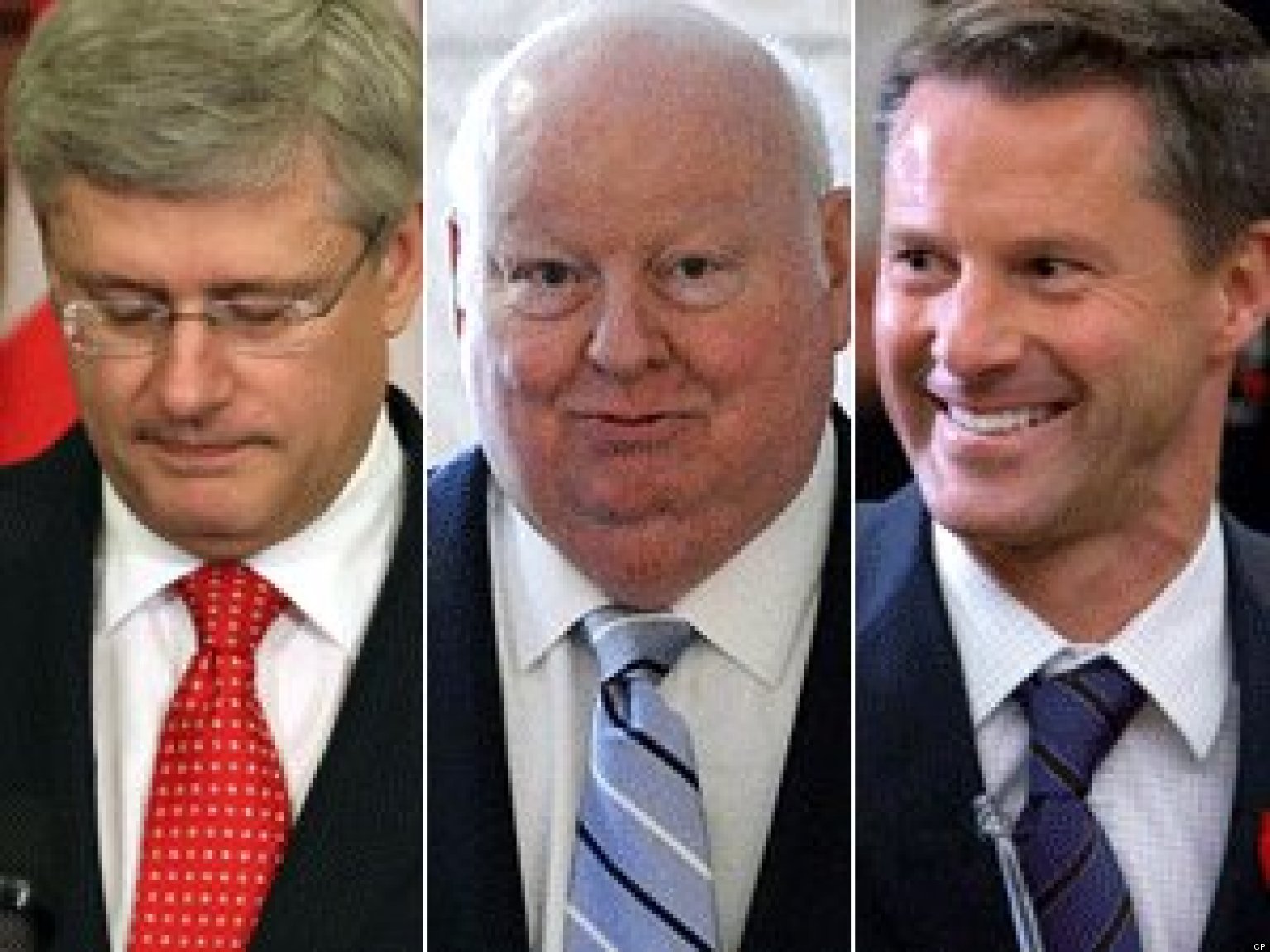

Yet his position is full of holes.  Was Mike Duffy a rational actor?  How about Nigel Wright?  Was Kouvalis in the right with misleading phone calls, or Peter MacKay with his political truths?  Is trying to portray your chief rival as a feminine poof a rational and financially-motivated, or is it relying on what his team has identified as social perceptions?  

By theorizing that Canadians don't care about the workings of Parliament, is he suggesting Parliament - the engine of democracy - isn't rational, or in the interests of the people?

Harper is incapable of lateral thinking, incapable of understanding his foe - he's a bully, and that's his ultimate limitation.  The reason he's so adverse to meeting with all the Premiers at once is that in that type of scenario, he's Prime Minister among many rather than the top dog in the room.  Harper needs to be the most authoritative person in the room - he's simply uncomfortable with the notion of peers.

In this, he's like the folk on Wall Street - they figure that power is theirs and the kids they want to hire are in it for the money.  Pay people enough and they'll do whatever; the more you pay, the better the talent you can attract, plus afford to weed out lesser talent.

Thing is, Wall Street is losing the battle for talent and innovation.  The sorts of people they should be attracting are more interested in growth, empowerment and contributing to something of social value than they are in their personal financial interest.  


It makes sense; in an increasingly interconnected world, most of us are seeing quite clearly how connected we all are.  The broader impacts of our action or inaction are more and more clear, meaning that we're getting that to commit sociology is the best way to promote our own self-interest.

Altruism is selfishness that plans ahead, after all.

Yet Harper and Wall Street both seem to think there's a general ignorance among the general public that serves as a natural resource for their consumption.  In practice, both act as though people aren't rational, but rather, easily manipulated.  Both are paying the price as a result.

While other governments are committing sociology - through education programs, through behavioural insights and the like, Canada is an innovation laggard.  While the US military is the biggest North American consumer of Positive Psychology, Team Harper refuse to accept their own findings around mental health and social-emotional resilience.

So focused are they on the notion that they are history's actors, they are willfully blinding themselves to just how quickly they (and as a result, we) are falling behind at social evolution.

In the Knowledge Economy, it's people who think and work in the exact opposite way Harper does that will succeed, attract the best talent, build the strongest brands and have the greatest impact on society. Companies are pursuing more employee-sensitive onboarding practices and becoming more Open with their information at the same time Harper's government is moving to become more closed.  


User-Generated-Content is being encouraged at the same time as all political parties are pushing canned messages.

The truly innovative providers are looking at differing cultures not as threats or irrelevancies, but as idea mines to be tapped for new solutions, services and products.  As we're focused on structural wellness and whole-person health that bridges the work/life divide, First Nation practices ranging from the talking circle to the medicine wheel are being explored.

Meanwhile, Harper's numbers aren't as great as they once were.  Clearly, there's no connection between his fall in popularity and the inability of his party to adapt to the times.  They just need to stick their head in the sand on internal conflicts/systematic issues and keep poking civic fears about the zombie hoard, and they'll come out on top again.  Then they'll have to tweak the rules again to keep those crazy sociology-committers from succeeding under the existing, democratic rules of engagement.

Which brings us neatly back to Sellinger's words.  

From Ferguson to the Middle East to murdered Aboriginal Women and at-risk youth, we are all aware that increasingly closed and top-down governments are fuelling civic unrest and allowing structural issues to exacerbate.  We worry less about seas of troubles then potential domestic collapse.


We want the confidence of knowing our leadership shares our views and is prepared with a vision and a plan to do something about this burning platform.

At this stage in the game, it's almost criminal not to be committing sociology.  Such are the pitfalls of not thinking ahead, I guess.


Tuesday, 17 June 2014

Team Harper to Commit Sociology, Continued


Free trade involves exchange, which involves trust.  You don't get trust without shared language, alignment of interests - all that common ground kind of stuff.

Which, of course, is the opposite of what divide and conquer, trouble lapping at our shores messaging accomplishes.  In everything that they have done, Team Harper has sought to bred suspicion and build walls between provinces, communities, citizens - all the while stifling information so as not to taint their ideological message.

It's great for reinforcing top-down control, North Korea style, but it's terrible for fostering a thriving business climate.  To build a community of the willing, you have to commit a bit of sociology.

If James Moore is serious about breaking down the walls that divide Canadians - and I'd like to think he is - he's going to have to buck the trend his leader has set and embrace a different way of engaging.

Fortunately for him, Open Government provides the perfect conduit for that.

Were I Moore, I'd be hopping on a motorbike with Richard Pietro this summer and bringing this message of open dialogue and shared solutions right to the people - even if it means going over the head of the Prime Minister.


Wednesday, 30 April 2014

Corporate Canada to the Rescue


Just yesterday, I posted that Stephen Harper is no strategic genius; I stand by that.  There's genius in this, but I don't think it was all Harper, or even all intentional.  And as with everything the Harper Conservatives do, there will be unintended consequences that bite them in the ass.

First - Bronwen Evans is right.  Corporate Canada should be out there supporting our military.  The reason it's safe for them to do business other than munitions is because we have a semi-thriving democracy - that's in no small part due to the sacrifices of our men and women in uniform.

It's in the Private Sector's best strategic interests to support our military.  A bit of advertizing on the side makes them feel good, like they're getting their money's worth.  I have no problem with that, so long as there are no pushy sales tactics being deployed against the vets and their families at the same time.

If I were to hear that Air Canada or VIA followed up with sales letters to these families ("we looked after you, now you should be using us exclusively") I'd be pretty pissed and hope you'd be, too.


Canada's a bit behind on the Corporate Social Responsibility (CSR) game, so that's not impossible.  If you look beyond our borders, though, you'll see that smart companies are recognizing that doing good for good's sake is strong enough advertizing in and of itself.


Two of my favourite:

Companies like Apple have recognized that supporting Gay Marriage actually helps build brand loyalty  
NASCAR Nation has recognized the community-building value of supporting a social cause, like environmental sustainability.

We're seeing more of this kind of thing in fits and spurts across the board - Open Data initiatives that are designed to inform and engage the public, changes to labour practices that empower and better support employees, angel investment of money but, even more importantly, time and expertise to help boost good-concept Not For Profits that lack the resources to organize or outreach properly.


In short, we're seeing the Private Sector step up in fits and spurts at a time when Government funding for Not For Profits is dwindling.


This is Score 1 for the Conservatives - they dislike government and prefer the private sector anyway.  

They'd love to see a minimalist government strictly focused on policy, with implementation being done by other parties.

But here's where it gets interesting.

While the Harper Tories are all about promoting traditional Conservative values (tough competition at the front-end of labour, with would-be employees needing to aggressively market themselves to employees, no social services so people are forced to up their game, minimal environmental protections so as no to impede maximum profit through maximum extraction), the Private Sector is moving in the other direction.


And NASCAR Nation is all about climate change and how to green our communities.  The Corporate Sector is picking up where government leaves off, but not in the way I think the political right intended.


Outside of the industries the Harper Government prefers, like the Alberta Oil machine, we're seeing, dare I say it, more centrist and even socialist approaches to engagement from the very people the Conservatives hope will carry forth their message.

There's no surprise in this - a changing economy requires a new approach and businesses that are looking past the four-year election cycle really have no choice but to consider the impacts of less oil, poverty or climate change on their operations.

So in a way, Team Harper are getting what they want - government does less, the Private Sector does more, even if it comes with sponsorship opportunities attached.

Should the Private Sector start looking more to the Centre for their own best practices, however, I can only say this - Team Harper shoulda seen that coming.

Monday, 24 March 2014

Tikkun Olam: Rethinking Depression


Private, in terms of how we feel about it but very public in how it manifests and impacts societal functioning.

Which is why I (and many, many others with far more knowledge and expertise in mental health) think it's time we need to broader our horizons a bit and stop thinking about depression and mental health in general as an individual illness instead of what it is - a social issue.

When we look at mental health - let's focus on depression and anxiety for the moment, as those are the two conditions easiest to understand as developed conditions, like Diabetes Type II or carpal tunnel syndrome - as social issues, the solutions become less about one person and more about context.

You don't solve lead poisoning by focusing on the sick any more than you can stop starfish being washed up on the shore by throwing them back in one at a time.  

Mental health is a social illness with a shared solution.  Only when we get that into our heads can we aspire to peace of mind.


Tuesday, 25 February 2014

The Arrogance of Man


Man against himself - not an issue when that man is delusionally confident, right?

Man against man - it's about what gets taken away from you, or who you can vilify as justification for taking more.

But it's man vs. nature that reminds us what real power truly is.  Twitter trolls, empire-builders, Wall Street narcissists and psychopathic dictators can rise to the top of the social heap, but no amount of money or bluster can save you when the storm hits.

You can't spin it, deny it or gain from it - all that does is create panic.

The temerity of thinking otherwise will always, always be man's downfall.

One of the reasons it's a good thing it's increasingly not up to just us.

There's really only one way to prepare for apocalyptic disasters, don't you know...


Thursday, 9 January 2014

Colonial Education and the Mean Dean at York U


Me thinks this Dean needs to get his ass back to class for a bit.  Maybe spend some time out in the real world, too.

The point of education is to prepare individuals for success in society.  That means knowledge, skills and sociability, through accommodations where necessary.

The opposite of education is imposition - telling people what to think, how to act, so on and so forth.

This Dean thinks he's being an advocate for the former, but he's actually embodying the former.

What career opportunities is the young man in question preparing himself for?  He says he's taking online classes so as to avoid contact with women.  He's also saying this is due to religious beliefs, though which religion isn't clear; religious scholars were asked about the position and remained puzzled.

The real question here is why this gent feels so against being in public space with women.  There may be very legitimate reasons that are being masked by religion, consciously or unconsciously.  

The fact remains, regardless of what training this fella gets, the moment he steps out his door he'll be in a world filled with women.  Some of them may even wear skirts and short-sleeves; shockingly, some might even be gregarious and opinionated.

There's a whole movement in education towards self-regulation, empowering individuals to have better self-control, understand and manage stressors better and to by and large being more consciously able to  function within a social setting.  It's the tonic to stigma, discrimination and communication fails.

This Dean doesn't seem to know or care about this.  A young man has expressed religious concerns about socializing with women, dammit, and deserves to be accommodated.  The opinions of the girls in these classes are "not relevant or an appropriate consideration."  They may have won the vote, but they're not going to impose their politics at York U!

Accommodation isn't about creating silos between individuals - it's about empowering people to succeed in a social context.  Hearing aids are accommodations.  Translation services are accommodations.  ECEs are accommodations.  Segregation is not an accommodation, nor is telling people their opinions don't count.

Mean Dean is a boss, not a leader.  It's people like him that are stalling society and putting up walls that disengage youth, the people we need to be actively encouraging to be engaged.

Instead of perpetuating a top-down colonial mentality based on ignorance and gut-feelings instead of evidence-based best practices, maybe it's time this Dean commit a bit of sociology and look into this whole social-emotional self-regulation business.

Who knows, he might learn something.

Monday, 6 January 2014

Proof Doug Ford Doesn't Believe in the Free Market


So there are some tree removal companies offering a square deal and some who aren't.  How is this "just not right?"  

Clearly, the people who offer the better deal are going to get business; the gougers won't, and therefore will either have to adjust their fees or go out of business (or spend more on misleading advertizing promoting themselves and demonizing their competition).


It's basic free market economics - if a service has value, then more people will want to pay for it, meaning more people will offer it, leading to competition.  As we all know, competition leads to better value-for-money.  

Which, naturally, is why Conservatives are all in favour of equitable competition, transparency of information, debate, so on and so forth.

Then there's this whole "after what people have been through, it's just not right" nonsense.  Look, we're talking about big boys and girls, right?  If they did what they should have, they planned ahead, got insurance, made sure not to have mature trees on their lawn that could drop branches on their roofs, so on and so forth.  Employers played smart and had work-from-home plans in place in case of storms.  

So what if the power went out?  Folks who were prepared had generators and knew better than to buy into the whole leftist, anti-independent functioning crowd and their carbon monoxide talk.  People need to learn to live within their means, spend their money wisely and in a forward-thinking manner; reliance on the State in times of hardship is childish.  Falling victim to gougers, con-artists and their ilk is just a sign of stupidity, and we've no need for this sort of person in the first place.

Because if you're against social housing, welfare, public healthcare, market regulation, organized labour and everything that Doug Ford proudly stands against, then it applies equally to city-wide emergencies as it does to individual ones.

This is the key thing that hard-right Conservatives constantly fail to recognize; there are always people in crisis out there, just as there will always be more broadly impacting crises down the road.  In fact, the more individuals are stuck scraping by day-to-day, the less able we all are to manage big challenges like floods and epidemics.
You can't help your neighbour when you're just getting by yourself.  It also doesn't matter how wealthy you are, if a bad flu bug hits, you're just as vulnerable as the poor person.  The more poverty there is, in fact, the more vulnerable everyone is.

All the public services they stand against exist to help everyone in crisis, whatever and whenever their crisis may come.  Without them, we lack flexibility to adapt and become easier pickings to the gougers and cons.

Yes, we need to do a better job of coordinating and evaluating these services, but the answer isn't cuts but integration.  That's what Open Government, in fits and spurts, is trying to do.

It's good that Doug Ford has recognized the fallacy of the Free Market in times a time of wide-spread crisis; the question is whether he'll internalize this lesson and carry it forward.  The next time social housing, youth programming or emergency funds hit the headlines, we'll have our answer.