Search This Blog

CCE in brief

My photo
Recovering backpacker, Cornwallite at heart, political enthusiast, catalyst, writer, husband, father, community volunteer, unabashedly proud Canadian. Every hyperlink connects to something related directly or thematically to that which is highlighted.

Friday, 21 February 2014

The Solution to Stigma is Community


I love this story; it captures so many of the positive themes that are out there, waiting to be connected, that can only be connected when people get past what they can take or what others are getting and instead focus on what they can give.

Alvena Little-Wolf Ear made one of the toughest decisions a person can make - to get out from under bullying the hard way, but in the only way that solves the problem.  

She didn't walk away.  She didn't hit back or take our frustrations on someone else to build a reputation for toughness.

Nope.  She decided to build on her own strength and become a rock for others.

This is the kind of hero we like to hold up as a model - the kind that overcomes any obstacle to win in the final act.  But the truth is, not everyone can do what Alvena has done.  Not everyone is cut out to be a leader.

But when we have leaders - true leaders, the kind with visions and determination to help others - they can empower peers and complete strangers to follow in their path.

This is the kind of leader we need today; not the ones who rise above, but the ones who build community.


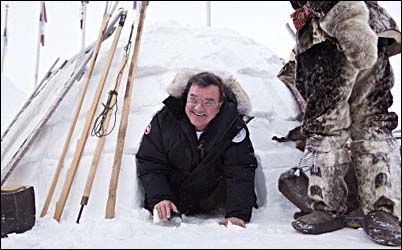
I Out-Winter Flaherty

flaherty igloo


It's a nice igloo, Minister.

But I made mine myself.  And I slept in it.

Believe me, it's a completely different feeling when you lie in a bed you've made yourself, with your own resources.  It may be harder to build than to cut down, but the sense of accomplishment is worth it.


Thursday, 20 February 2014

Horse Drivers and Outlaws: Politics IS Tribalism


I'm not sure Kate Heartfield would have written this piece were she not an editorialist in need of attention-getting opinions to present.  I would hope she realizes that politics doesn't run on intelligence, at all.  Good guys and bad guys, scapegoats, countless dollars donated to Parties that are telling us we don't have enough money in our pockets to function?  

Partisan framing tugs at emotions.  It concocts coalitions to deliver wins.  Then it looks at policy.  It's audience, issue, emotion and then, at the tail end, appeals to our self-delusions of being rational actors.

Partisan politics is tribal.  It is anything but rational.  And until we consciously accept that our strings are being pulled by vested interests who are just as trapped using Plato's Desktop as they try to develop a newer, tablet-y version of politics, it'll stay this way. 


Andrew Coyne: Canada's Hari Seldon

Stephen Harper's Canada: The Non-Society


Does anyone remember the Great Parliamentary Crisis of 2008/09?  Stephen Harper's Conservative Government proposed eliminating the public subsidy political parties get in an election.  The Opposition Parties opposed this move, and planned to bring the minority government down.
 
Instead of taking the issue to the public, Harper decided to prorogue Parliament. 
 
To the ensuing outcry that Team Harper was circumventing the democratic process, then-House Leader John Baird said this:
 
"We'll go over the heads of the members of Parliament; go over the heads, frankly, of the Governor General; go right to the Canadian people."
 
The big problem with that statement, of course, was that it reinforced the argument being made against the Tories.  Who, exactly, was going over the heads of Parliament and the Governor General?  The government, or the Conservative Party?  Government is legally an agency of the Crown, represented by the Governor General, answerable to the people's representatives, Parliament.
 
The Conservative Party had recognized their superior ability to raise money from the public and decided to undercut their opponents' ability to compete with them on the paid media war.  Faced with opposition from Parliament, the Conservative Party circumvented that opposition.
 
Now, the Conservative Party has a majority - a challenged one, thanks in no part to scandals related to their partisan fund-raising apparatus.  In addition to Mike Duffy and Pamela Wallin were key fundraisers for the Tories.
 
The Conservative Government has brought forward a new bill, the Fair Elections Act, which increases the amount of money Political Parties can raise and kills the public's ability to promote voter participation.  Particularly impacted by this move are Canadians with disabilities/mobility challenges and youth.  As it happens, these groups don't tend to be traditional supporters of the Conservatives.
 
It's worth taking a look at the Conservative's economic policy as a good frame to understand what they're trying to do with our electoral system.  They have decided that it's in Canada's best interests to be strictly a natural resource export economy; more external trade will create better opportunities for us to sell these resources while anything that gets in the way of the process, like eco-extremists, are threat to their plan.  Anyone who may have other ideas about what Canada should look like are excluded from the process, defunded and demonized.
 
That's exactly what they're trying to do with our politics.  The Conservatives are attempting to reduce electoral competition (you need big bucks to play) on the back end and reduce voter participation on the front end.  Big picture, it's people with money or that fit a narrow definition of citizen that are encouraged to play.  Those who do play will play dirty - it's compete to win, victory absolves sin.
 
There's no place for the public in this picture, no real sense of confederation, just individual interests competing monetarily for success.
 
Which brings us back to John Baird's statement.  It's rather telling when a Party feels it's okay to circumvent the process and "go over the heads" of both their boss and auditors to get what they want.
 
Now, it's as if the Harper Conservatives are willing to go over the heads of the Canadian people who won't support them, either, to get what they want.
 
There's a reason the Tories don't believe in committing sociology - from their apparent point of view, there's just them and the people in their way.
 
So much for the Just Society.  After all, we're an empire now, aren't we?


Roots and Umbrellas: Weathering the Canadian Spring


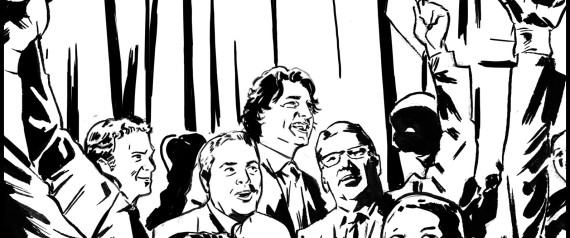
Justin Trudeau has positioned himself as the voice of change in Canadian politics.  His team has come to the conclusion that a coalition of middle class, youth, and a few other key demographics can buy this message and vault him to the PMO.


To distinguish himself as different from what came before, he has strategically distanced himself from some established political staples.  In times of old, it was common wisdom to surround yourself at big conventions with the winningest faces in your Party's history, hoping some of their shine will rub off on you.  

Not ironically, there are more than a few would-be Liberal candidates out there who spent more time selling their tenuous links to Trudeau than trying to define their own vision and brand.

There's no question that something has to change in Canadian politics; our system has gone off the rails, with partisan convention trumping the actual constitutional functioning of Parliament and government.  


The system as-is offers little shelter to every-day Canadians.  Even MPs don't know what they're supposed to stand for or who they're answerable to these days; on paper it's their constituents, but everyone knows the balance of power lies in the hands of the Party, not the People.


What good is a strong hand at the till if not everyone is allowed on the boat?

Which is why I think disbanding the Liberal caucus was a good thing, in principle (which isn't the same thing as smart politics, but I digress).  There have been disparaging words thrown his way for dismissing loyal Party stalwarts and "kicking them to the curb."  While I can understand the sentiment behind that feeling, I think it's really a symptom of the culture of entitlement that pervades our politics.

The once-Liberal Senators haven't been kicked out of the Liberal house so much as they've been set free to follow their conscience instead of partisanship interests.  And that's what the Senate is supposed to do.  In fact, partisanship on the whole is more convention than the law of the land - it has its value but often becomes a thick lens that obscures our politicians' ability to see and hear Canadians.

But I don't think it's smart to completely distance oneself from the past, good or bad.  

Here's why.

1) Canada is a temporal creature that must be understood in the context of where we've come from to properly determine the right course forward.  Engaging with leaders of old is about more than just borrowing their brand; it's about receiving their counsel.  What's been tried before, what didn't work?  What meta-trends have they seen form over time that younger people might be able to read about, but not feel and understand in their bones?

2) Today's seniors were yesterday's youth.  If you turn your back on the past, you are choosing not to represent those who shaped today's present.  It's bad for policy, bad for image and equally as important, it sets a precedent you might not like.  History shows us how this works.

3) Those who fail to understand history...  I have been involved in a few leadership campaigns where relative Party "outsiders" decided they were going to change the system that they felt was flawed and exclusionary.  They were determined to "do politics differently."  

Once they won, that is.  When it came down to the brass tacks of political logistics, I saw nothing different between their operation and the operation of the establishment.  Top-down hierarchies, closed-door meetings of insiders, divide-and-conquer strategies, so on and so forth became the fire in which this opportunity to do things differently would be forged.  

You cannot do politics differently by simply switching the paradigm and leaving those in the ivory towers and skyscrapers to rot.


4) Canada's future must be built on common ground.  

We cannot talk about big tents or moving forward together if we are consciously leaving people behind.  It's as simple as that.  This isn't cheap rhetoric or an idealistic fantasy - it's fact.  The greater the collaborative diversity, the stronger our chance of successful adaptation.  


From severe weather to increased political unrest in places that have been stable for generations, things are changing out there.  We need all hands on deck to weather the coming storms.

So yes to sunny ways, to the essence of good leadership - which is persuasion, not force, and setting the example, not micro-managing from afar.

But a tree without roots cannot hope to grow far and it never hurts to carry an umbrella.  That's the sort of experienced wisdom our elders have to share.

Wednesday, 19 February 2014

Mutant Pride: Ellen Page Represents


Good for Ellen Page.  I don't imagine it's an easy thing coming out, or even admitting to yourself that maybe you aren't what society expects you to be.  There's got to be some cognitive dissonance that goes along with that which must be taxing.  It reminds me of a quote from X-Men: First Class - 


The X-Men have often been used as a metaphor for people who are stigmatized for their differences; it's worth noting that gay actor Ian McKellan has said friends and colleagues told him his acting improved after he came out, as though he was suddenly better able to inhabit his roles.

Both Ellen Page and Ian McKellan play the roles of mutants in the X-Men franchise.

Accompanying Page's coming out has been the usual trolling responses anyone gets when they come out as gay, having a mental illness or anything else that makes them "extra-normal."  Straight people don't make a big deal out of their sexuality, why do gay people have to parade themselves in front of everyone?

Reading these comments got me thinking - why does it matter that people public declare themselves "extra-normal?"  

It matters internally for the reason stated above - no one should have to live in denial of themselves.  Of course, no one should have to fear reprisal for being themselves, either, but that's clearly still not the case.  

From Toronto Mayors to Russian Presidents, LGBTQ people are still heavily stigmatized by many for something other than the content of their character.

Which is why coming out matters externally, too.  Whatever we tell ourselves, gay people are still considered "extra-normal" in the same way that you don't see that many women on Bay Street or black men in politics.  It's considered a kiss of death to publicly disclose you have a mental illness - and this in spite of the grand tradition of great leaders, innovators and catalyzers all being a bit "extra-normal."


When a black man becomes President or a popular actress comes out of the closet and retains her career afterwards, a message is sent to others in society that it can be safe for them to live externally who they are internally.

In essence, the message conveyed is that mutants can co-habit successfully with their more normal (straight, white, whatever) peers.

Of course, the end goal should always be to get to a point where there's no need for people to come out, because we'll have an expanded enough understanding of what it means to be human that it really won't matter what your faith, sexuality or any of it is.  You'll be exposed to variety and encouraged to find and be true to yourself from day one.

That vision of society is still a long way off, though.  In truth, we may never get there.  

So I'm glad that people like Ellen Page are prepared to stand up and take pride in who they are, "extra-normal" or no.  If we're ever to retire the notion of "extra" from humanity, it's going to take people folk like her to lead the way.


  1. @Poynter Silly @guardian. You can't catch gay by hanging out with people. But you catch Awesome from hanging out with @SirPatStew!
MT “@Gruaig_Rua: @Poynter Silly @guardian. You can't catch gay by hanging out with people."