Search This Blog

CCE in brief

My photo
Recovering backpacker, Cornwallite at heart, political enthusiast, catalyst, writer, husband, father, community volunteer, unabashedly proud Canadian. Every hyperlink connects to something related directly or thematically to that which is highlighted.

Tuesday, 23 October 2012

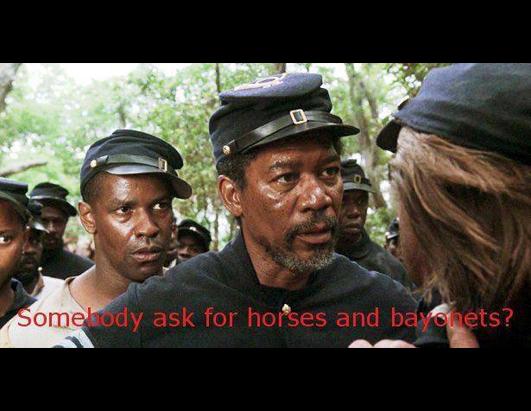
Horses and Bayonets Get the Meme Treatment


Like binders full of women before it, the moment Obama dropped that zinger, the tweet-o-sphere was predicting an ensuing meme.  It didn't take long!
 
The go-forward question is, how can you channel the power of the meme as a force for good?


Memes are coming...


Sean Bean, the meme machine:


Kinda appropriate for the bicentennial of 1812... it's got the horses and bayonets at least!


Risque, taking the Romney's an elite" into "like a plantation owner" territory...
Carried on by connecting his supporters with grey coats
 
 
If Romney's only the apprentice, does that mean Dick Cheney's still active?


Yee haw!  Though I question whether Romney knows how to ride...


More direct
 

Damn it, Barry - you sank my campaign!


Damn it, Ryan, I told you to fetch the horses and bayonets, not a bird!
 
 
There are so many ways you can play with this.  Take any pop-culture phenomenon, affix horses and bayonets, and you have something that someone like me will endless post and share.  There is, however, the ever-present risk of taking it too far, both in terms of demonizing the target and creating additional offense with the comparisons.
 
If used wisely, though, memes are communication gold.  You don't need to go @vikileaks for traction - it's the #tellviceverything's that leave an impression, empower people to engage and can be fun, too. 
 

Jesus Loves Obama


I'd be really curious to see just which election race this pastor is following, because there ain't no Muslim in the Presidential debate.
 
But what if there was?  To quote Coiln Powell - is there something wrong with being a Muslim in the USA?
 
There's also been questioned raised about Obama's authenticity as an American, despite his birth certificate proving otherwise.  Is there something wrong with being an immigrant in a nation of immigrants?  Yes, there's a a law about Presidents having to be born in the US, but is it a valid one?  The US is lucky in that its borders remain consistent, but what if they didn't?  Is it birth or belief that determines who is committed to the country?
 
Back the Christian thing, though.  I wonder how thoughtfully these "Obama's not a Christian" types have considered the underpinnings of their faith.  Their approach is more cult-like, focused on insiders and outsiders to the religion than they are Christ's actual message. 
 
 
The disparagers of diversity shouldn't need reminding that Christ himself wasn't a Christian - he was a Jewish reformer.  The first Christians weren't card-carrying members of Club Christ, either; they were believers in a man and his vision of a world that stood for something more than individual gain (granted, I think his message was Sufi-esque rather than directly literal).  Christianity began much more in the vein of Occupy, except rallied behind a leader, than it did an institution.  All the trappings of an organized religion came later.
 
The same, oddly enough, holds true of Islam.  Islam holds Christ up as a prophet rather than an end-game and kicks the ball further down the field to Mohammad.  Islam is no more a repudiation of Christianity than Christianity is a repudiation of Judaism; both offspring of the original Abrahamic religion are, if anything, adaptations to time, place and context, just was was Martin Luther's Reformation.
 
 
It shouldn't have come as any surprise to faithful Christians that Libyan Muslims praised God upon finding Ambassador Stevens alive in the Benghazi embassy and tried to get him help.  They were simply acting out a shared principle: So in everything, do to others what you would have them do to you, for this sums up the Law and the Prophets. (Matthew 7:12)
 
In my opinion, those who wish to carry on the mission Christ laid out shouldn't be focused on division - that's a bit too much like casting the first stone.  Likewise, they shouldn't be looking to demonize any man or woman as being "un-Christian" - the act of demonizing itself is unbecoming of Christians.
 
But how does that help Christians who want to ensure they have a President that reflect their values?  That's a church and state thing - leave unto Caesar that which is Caesar's.  You can support a candidate that reflects your beliefs, but to demand only leaders that share the Christian brand is to stray from what Christ taught in the first place.  Instead, what Christians can do is what everyone else does - advocate and empower candidates with their perspective: And the Lord’s servant must not be quarrelsome but must be kind to everyone, able to teach, not resentful. (2 Timothy 2:24)
 
What would Jesus do were he around today?  He would love both Barack Obama and Mitt Romney; he would probably love Ahmadinejad, al-Assad and Kim Jong-un, too.  Instead of campaigning against, he would share his counsel with both sides, and anyone else willing to listen.  This is no surprise if you're a Christian, because that's exactly what the Gospels depicts Jesus as doing in his time.  True followers of his message will do the same.
 

Monday, 22 October 2012

The Linguistics of Politics


The Koreans invented their own writing system - they did it to ensure literacy among the broader populace, as learning Chinese characters was a complicated task that only elites with free time could master.  The resulting phonetic alphabet is one of the easiest to learn in all of human language.  The system was designed with the user in mind; the rules were carefully recorded and taught to ensure continuity.
 
King Se-Jong created this system because he understood the intrinsic value of knowledge and communication.  He wanted to spread the light of wisdom throughout his kingdom, knowing the benefits would be countless.  The Chinese system was still kept in tandem because there was value in having multiple systems to record and share ideas, both to inform and provide counter-balance.
 
Now look at this writing system, undeciphered, lost to history.  The Mr One Hundreds might have created their own system for political reasons; to be distinct from the Mesopotamians or to ensure that only the elites had access.  They defined themselves, after all, on how many people they ruled over - not by what they accomplished.  So cautiously did they guard their literary secrets, however, that the system could not be sustained.  Without collaboration, without sharing, without embracing diversity, their story ended up going extinct.
 
It's the same with writing as it is with language, culture or ethnicity.  That which stagnates in isolation dies.  That which embraces diversity, transparency and collaboration evolves and continues.


Proto-Elamite script

Sunday, 21 October 2012

The Harper Government's Values


The Harper Convervatives have values, of a sort.  They believe that might makes right and that those with power make the rules, but aren't beholden to them.  They see themselves as an empire, now, and look down in contempt at those rooted in what Karl Rove called the reality-based community.
 
Team Harper has no respect for Parliament.  They have no respect for process.  In the words of John Baird, they think nothing of going over the heads of Canada's duly elected representatives and even the Governor General to get what they want.  The only judges they say they respect are Canadian voters - yet they routinely misinform Canadians or withold information, trying to ensure that the only message that gains traction is their own.  Anyone who disagrees with them is at increasing risk of being branded an enemy of the state.
 
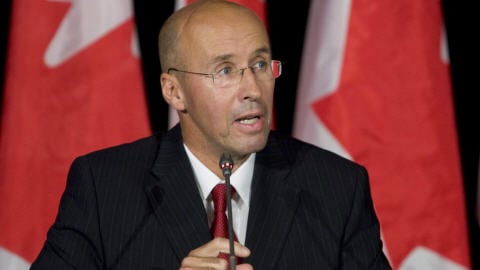
Team Harper has even taken to disparaging the Parliamentary Budget Officer, Kevin Page - a man they appointed to a position they created. 

Conservative operatives provided false claims against an MP of unquestionabler character, Irwin Cotler.  They have questioned the commitment to Canada of a man who risked much in the name of unity, Stephane Dion.  In their quest for power, the CPC have even attempted to bribe a dying man.
 
Harper attempts to convince us that Canadians don't care about such matters - that integrity, honesty and the will to find shared solutions don't matter in today's worlds.
 
You can argue that these are values, the sort of values that elites have always emposed upon those they sought to rule.
 
I would argue, though, that the Harper CPC's values aren't the same as Canadian values.  Not by a long shot.

PTSD a very real — but mysterious — problem for soldiers (by Peter Worthington)

 
The Harper Conservatives are all about fighting, dominance, etc.  They don't seem to care about the individual or social psychological consequences of their aggressive approach to politics.  Our democracy is suffering.  Our soldiers are suffering.  It's not too late, though - they can turn the ship around.  If they won't, then perhaps it's time for a new captain.

PTSD a very real — but mysterious — problem for soldiers


TORONTO - In recent years, it’s become generally accepted that post-traumatic stress disorder (PTSD) is a genuine affliction that can affect those in high-tension, physically and emotionally charged jobs: Military, police, fire-fighters, emergency medical people.
Soldiers, especially, are prone to PTSD. In fact, the greatest threat to Canadian soldiers on dangerous missions (like Afghanistan) is not roadside bombs, ambushes or enemy fire, but PTSD.
It’s estimated that up to 25% of soldiers in danger zones come down with some degree of PTSD. And symptoms can occur years after the experience, and/or be manifested in alcoholism, severe depression, aberrant behaviour, even suicide.
PTSD is an invisible war wound that can be as devastating as a missing limb. Or more so. Often unrecognized, there is also stigma attached — though not as much as in the past when PTSD was variously labeled as shell shock, lack of moral fibre (LMF), battle fatigue, even cowardice.
These days PTSD is accepted for what it is. Soldiers basically feel relieved if they don’t come down with it – or don’t think they are afflicted. Often they just don’t know. Research is never-ending about the causes and incidents of PTSD.
In the U.S., it’s estimated that PTSD afflicted up to 20% of those who served in the second Iraq war; 10% who were in the brief Desert Storm campaign; 30% who served in the Vietnam war.
When undiagnosed and untreated, PTSD sometimes leads to suicide.
A recent news item that caused concern was 38 U.S. Army soldiers committing suicide last July — a grisly record, considering that in a volunteer army, all applicants are supposedly screened for emotional and physiological stability and such.
Since the beginning of the war in Afghanistan, over 2,600 American soldiers have committed suicide — compared to 2,000 who died fighting. That’s a horrendous statistic.
Of 187 U.S. military personnel who committed suicide up to August this year, 116 were on active service, 71 in reserves. It’s probable they all suffered from PTSD.
In the Canadian military, 20 soldiers committed suicide in 2011—up from 12 in 2010. While not on the scale of the U.S. military, it’s still a concern because volunteers in our military are also screened for emotional stability.
While there is research to determine types who might be susceptible to PTSD — and even more research on how best to treat the ailment — there is virtually no research underway on personalities unlikely to succumb to PTSD.
And there are such types who seem immune to stress disorder.
The Bellwood Health Clinic in Toronto specializes in treating those afflicted with PTSD. And it’s not just soldiers. Police, firefighters, individuals in hazardous jobs are all susceptible courtesy of their occupations, though for obvious reasons they get far less attention than the military.
(As an aside, it has always puzzled me that a young nurse in an emergency ward can be exposed to horrendous injuries yet not come down with PTSD, while a soldier who is trained to expect the worst, may find it traumatizing).
At Toronto’s Bellwood Health Clinic, Michael Hartmann, clinical manager of the PTSD/trauma program, and Dr. Simone Arbour, research coordinator, suggest that what may tip the balance with a soldier, say, in Afghanistan, is not what he endures but the horrors he sees others subjected to. This seems a valid observation, since being in the eye of a hurricane is often easier than being on the fringes.
One of the problems of soldiers returning home with undiagnosed PTSD, is that they often have no outlet for their feelings. Family members and friends can’t fully understand what they’ve been through, thus they turn inward and emotionally further isolate themselves.
Bellwood staff find families can be vital for helping veterans readjust. The longer PTSD is dormant and untreated, the more rigid and obsessive it can get.
Some soldiers have done several missions in Afghanistan while being afflicted throughout with varying degrees of PTSD, that steadily intensify.
What makes Afghanistan so prone to cause PTSD is that every time a soldier left the base for any reason, he/she was constantly aware that a they could run into a roadside bomb could at any time. In some cases, a soldier in Afghanistan might never have been shot at, never engaged the Taliban in a fire-fight, yet came down with PTSD from simply driving in streets or the countryside.
Every soldier was always aware that someday the law of averages was likely to catch up with him. Every trip outside the wire increased the odds for an incident.
In that sense, Afghanistan was more nerve-wracking than a conventional shooting war like WWII or Korea, or even Vietnam.
When asked if there’s any way to detect those likely to be susceptible to PTSD, the answer from Michael Hartmann was a blunt: “That’s the million-dollar question.”
It’s an answer the army would like to know. Training, morale, discipline, understanding, all help to prepare an individual, but there are no guarantees. Lt.-Gen. Romeo Dallaire coming down with PTSD after commanding UN Forces in Rwanda during the time of genocidal slaughter, brought acceptance and respectability to the ailment, but did little to lessen its prevalence.
U.S. and Canadian statistics alone indicate need for research into personality types resistant to PTSD. As far as one can determine, those who have the ability to put events behind them and move on without looking back, seem less prone to come down with PTSD. But the human psyche can take only so much.
In World War II, Field Marshal William Slim remarked of the Burma campaign that “the British soldier is not braver than other soldiers, he is just braver longer.”
That assessment could apply to those who don’t come down with PTSD. It just takes longer to get them. No normal person can endure horrors indefinitely without cracking.
Now that Afghanistan is kaput for Canadians, the task of dealing with PTSD “victims” (if that’s the right word) is the responsibility of Veterans Affairs, which these days has to deal with a different sort of wounded soldier than in past wars.
Not all PTSD is the same, but all types can be crippling and all deserve the support that is given to those who have visible, life-altering wounds.
In many case, PTSD is a war wound — and soldiers who are wounded for their country have earned and deserve everything the country can do to repair the damage.
Most would agree with this, but words and deeds don’t always coincide.
Too many of Canada’s wounded feel now that the shooting is over, they are being abandoned. Sometimes, their only protector is media publicity, because that’s what grabs the attention of politicians who make the decisions.


Presence, Bullying, PTSD and the Resiliency Solution


Look at Dianna Booher's list of traits common to people who "lack presence":
 
  1. Others often interrupt you as you speak.
  2. Your recommendations carry little weight with decision makers—or even your friends.
  3. You often hear, “I’m not following your point. Would you repeat that.”
  4. Your stories seem to “fall flat” and have no impact during formal presentations.
  5. You often lose emotional control during meetings, either displaying anger or withdrawing.
  6. You have difficulty facilitating discussions among strong personalities.
  7. In a group, you feel more comfortable standing off to the side than in the center of activities.
  8. Team members often make decisions on important issues without asking for your input.
  9. When others ask questions or seek your opinion, you have difficulty thinking on your feet to respond clearly, concisely, and completely. You typically feel that you need a “re-do.”
  10. Others point out inconsistencies in your behavior. What you say you value and believe doesn’t match what you actually do. You don’t demonstrate the “courage of your convictions” to act. Consequently, you seem irresponsible or unpredictable to others.
Then, ask yourself what kinds of people tend to be targeted for bullying and ask yourself, why?
 
Then, look at the sorts of behaviours that stem from Post Traumatic Stress Disorder and the consequences that stem from it.
 
Lastly, dig into Positive Psychology and the Resiliency Solution.  If the sorts of behaviour that encourage bullying can be overcome and if the inclination to bully those who "lack presence" can be trained against, what kind of difference would it make to include educaiton that covers this kind of thing in our schools?
 
We're already starting to do it through Social Emotional Learning and programs like Ontario Shores' mental health curriculum.
 
We can make the difference - not be reacting to bullying, but proactively educating and training individuals against it, like a bullying innoculation. 
 
It's a social win, a political win and a fiscal win, just waiting for someone to take the lead.

Shocking: I agree with John Snobelen


 - Snobelen
 
 
 - Me
 
Leaders don't dominate the spotlight - they lead.  Politics used to be considered a higher calling, something the individual undertook to contribute to something larger than themselves - not to enlarge themselves.
 
It can be that way again.