It was two years ago that I sat down with Diane Mckenzie and Cortney Pasternak to talk about mental health. I told them, as I had previously told mental health professionals, politicians and the consultants who woo them from across Toronto that a number of distinct trend lines were starting to merge into one emerging reality.
The main threads I wove together were as follows:
Mental Health Crisis: Countries around the world were starting to identify, by name, a mental health crisis of massive, expensive proportions. As we'd done away with the institutionalization of "crazy people" (much as we'd done away with leper colonies) were rejoining a society that simply wasn't set up to accommodate them. Even worse - we really have no idea what mental health looks like. By and large we still focus on the need for people to "act normal", essentially identified as an outlook and approach to life that properly supports economic functioning.
But there was the rub; mental illnesses like depression and anxiety were popping up in the workplace at an increasing rate. In fact, it was starting to look like some work conditions/expectations/management norms were causing mental illness, much as poor physical labour conditions can result in physical injury.

Presenteeism and Canada's Innovation Deficit: Presenteeism is on the rise across Canada, and not because people are catching more colds. For some reason,
we are not as productive as we could, should and truly need to be. Common management wisdom was (and is) trending towards a problem with employees - they have become needy and are demanding more recognition, more ownership of work and the like.
Silly employees - that's not how the world of work functions, they'll say. Work hard, work your way through the ranks from assembly line to front-line management to middle management and who knows, you may make partner one day.
A big part of the blame for this needy-employee syndrome is being placed on the shoulders of unions, who have gotten too big for their britches and are making unsustainable demands from employers around things like wages and benefits. Work is a carrot-and-stick business; employees need to be more productive, resulting in a more productive company, which will then allow for increased wages as incentives to keep up the good work. That's simple economics, right?
But cognitive science has demonstrated clearly that traditional wage carrot-and-stick motivation doesn't work when it comes to motivating innovative productivity. If you're making widgets or digging in mines, yes, the promise of more cash can incent you to work faster, but when you want employees to be developing, selling and implementing new products and services, carrots and sticks literally fire up the functional part of the brain, not the creative one.
Instead what you get is de-motivated employees, inclinations towards micro-management and overall corporate stagnation. When financial times are tight and your firm isn't growing, what do fiscally-minded bosses do? They cut jobs, cut wages and shrink the overall pie - moving their company (or country) in the opposite direction of sustainable growth.

Yesterday's Policy Solutions For Today's Problems: At the time of our chat, there was a widespread belief that the Political Right was on an unstoppable trend towards success, with expectations that the progressive movement in Canada had ground to a halt.
Policy focuses seemed to reflect this reality; unions were in everyone's political cross-hairs, corporate tax cuts and de-regulation were favoured tools and the path to economic prosperity was largely defined as harvesting and exporting natural resources courtesy of trade deals that had to emerge. There was some lip-service paid to innovation, social enterprise and the whole Knowledge Economy thing, but Canada's strength had always been in resource exports - if it ain't broke don't fix it, right?
A Shift in Global Consciousness: While Canada was increasingly focus on hard-nosed sales and labour efficiencies, the rest of the global village was grappling with a changing reality. More and more citizens were accepting the notion of detrimental climate change due to industry-induced environmental degredation.
While Canadian politicians worked to shore up their traditional manufacturing economic base and woo back those who had fled to cheaper pastures, the countries we were reducing our labour supports to compete with were facing backlash due to illness, injury, loss of life and unbalanced profit-sharing. Folk in places like Bangladesh were demanding better treatment and work conditions and, thanks to social media and a trend downwards in working conditions in the Western World, were gaining international support in their demands.

Civic Unrest: Occupy, Idle No More, Arab Spring, so on and so forth - in fits and spurts, the have-nots were finding there voice and doing it so in increasingly global fashion. An underlying theme was that something in the current model must not be working, because it was clear far too many people were working hard or trying hard to work but barely making ends meet while others seemed to have a better deal. In countries like Canada and the US, the 1% have been identified as the problem; in places like Greece, there's a trend towards blaming immigrants. Whatever the root cause, consensus is building that something's gotta give.
To make matters worse, this reality is playing out against a backdrop where a privileged few are being exposed as playing by a different set of rules than everyone else. When big C Conservatives like Mike Duffy or Peter Shurman extol the Calvinist virtues of jobs being the best social program, but are quietly taking their own share of gravy, people get upset. When politicians break the law - drunk driving, drug use, so on and so forth - without punishment yet minority groups are subjected to racial profiling even when they are following the rules - again, something's gotta give.

Political Staff: To an increasing degree, politicians caught in lies or misdeeds or simply not properly informed of a given issue are passing the buck to their staff. In a sense, you can't blame them - in as hostile a political climate as we have, no politician can risk been seen to be prone to human error, so somebody has to go under the bus. Staff fit the bill nicely; they're easily replaceable, by and large young and untrained. It's easy to blame them for mistakes and discard them as a way to demonstrate to the public action taken.
But the undercurrent reality is that political staff are subject to some of the most impossible labour expectations out there. They receive precious little training that isn't partisan in nature, are expected to function as soldiers but are treated like servants and by the nature of the business, have to be available at all hours and mindful at all times of how they present the Party brand. The boss mentality is rampant in politics, from the top down - disgruntled MPs and MPPs are expected to protect and promote their leader first, their own ridings second; political staff are expected to keep their bosses happy, ensure their win yet do all this while ensuring they are towing the Party line, with information flowing from the top down only.

Poverty, Justice and Back to Mental Health: So, we have people with significant mental illness on the street, unable to function without proper accommodations and unable to fit the narrow expectations of employers. We have employees who are worried about their jobs, upset at their bosses and trying to find a square deal; if it isn't in wages, it comes through things like printing out their kids' homework on company paper or stretching coffee breaks to the max (i.e., presenteeism).
You have political staff realizing that the only way to do what's expected of them is to break the rules - which has led to scandals ranging from deleted emails to Senate follies to kids fraternizing with drug dealers at the boss' behest. Then you have those individuals who, seeing no hope of entering the modern workforce and succeeding in the way the 1% does turning to alternative avenues, like crime.
Enter the justice system and social service providers. More people on the street, unemployed, ill, agitated and breaking the law from within the system or on the streets adds more pressure to anyone charged with keeping society healthy and orderly. Police are a good example of this.
With some prominent police suicides, incidents of excessive use of force (like in the Sammy Yatim case) it's becoming clear that those front-line service providers who end up managing all this mental mayhem are suffering themselves. The Canadian Association of Chiefs of Police have taken this big picture so seriously that they're holding an all-encompassing mental health conference in March, trying to bring players together to discuss how we can fix all these disjointed but socially (and economically) taxing realities.
Which brings us to our last thread -

Cognitive Labour and the KISS Paradox: Canada says it wants integrated solutions for complex, multi-lateral problems, but in reality it doesn't want to have to think to understand them. Politicians have recognized the value of simple, repetitive sound-bite messaging to trigger emotional reactions (and donations and votes) from citizens. Employers expect their employees to wrap their heads around complex details, but only communicate the bare-bones essentials in almost pictogram simplicity for them to understand. They're busy, doncha know.
The Keep It Simple Stupid premise ties in neatly with the corporate So What mentality - if you can't make me care, i.e. trigger an emotional response in the way politicians do with their base, then whatever you had to say wasn't so important anyway.
But this extends beyond mere explanations; it extends to the whole business culture. Bosses of all stripes aren't looking to be challenged, they want to be obeyed and supported. Potential employees have to earn the right to work for them by having the right personality, the right track-record and that ability to "speak their language" - sometimes at the expense of an ability to speak their clients' language.

A subtle result of this trend is a spread of traditional bureaucratic culture to all areas of the Canadian economy and a dumbing down of process, which again impacts both presenteeism and innovation. Low-hanging fruit has become the staple of our economic, political and policy diet. You'd be shocked at the number of successful people and their teams who have no idea how to organize a database or create a phased implementation strategy.
Actually, you probably wouldn't. Because from misspelled signs at conferences to ill-conceived cover-ups or mismanaged businesses ranging from RIM to Canada Post, we're seeing the consequence of this dumbed-down approach unfold daily in the news.
They think they do, because what they communicate or have communicated to them is simple to understand, but therein lies the problem - Canada has declared war on complexity and is suffering the consequences. Its the law of diminishing returns; you get what you pay for.
Which brings us back to The Agenda.

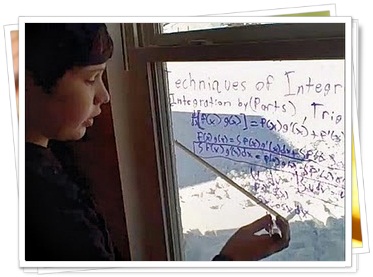
Jacob Barnett is autistic (and yes, he is autistic, rather than has autism, much as a deaf person is deaf rather than has deafness - it's genetic and forms a part, if not the totality, of who the person is). He has trouble focusing on the sorts of things society would probably rather him pay attention to - sports and sales and trades skills. He talks fast and uses maddeningly big words and concepts.
By all rights, he should be on the street, because he isn't doing his part to fit into our economic model. And yet, because he's had supportive parents and some great mentors along the way, Jacob has harnessed his "illness" and
is already being touted as the next Einstein.

To any student of history and mental health, there's nothing surprising in this. Our greatest leaders, thinkers and catalyzers have all been different shades of crazy. Were they not, they would have been like everyone else and we'd still be using
Plato's Desktop as a table. There have been times in the past when what we now call crazy people were labeled prophets and oracles and were both revered and feared. Where the fear has been the greater reaction, we've called these people witches or worse.
Today, though, we don't believe in magic, nor mystery - we pretty much assume we have it all figured out and that history has ground to a halt. We need only keep on keeping on as we've done throughout the Age of Industrialism. Of course, this is nonsense; the truth is that the majority has become complacent in our comfort levels and is prepared to ignore warning signs of our decaying social model because we'd rather things stay as they are.
The problem is that the world has changed and our stagnant, complacent selves are falling behind. Try as they might to ignore this reality and shore up the past as a bulwark against the future, conservative-minded leaders are losing ground, as are the countries they lead.
Subjects that periodically come up for discussion on shows like The Agenda, too.
Which brings us right back to where we began - the hidden potential of the brain and the fostering of life-long mental health or, as I like to call it, maximizing personal potential and nurturing a conscious society.
There are a lot of smart, "unusual" people out there - introverts, egoists, fast-talkers and deep-thinkers who have never stopped being exceptional, but have learned how to mask it. They are bureaucratic staff in the federal Treasury Board or in Ontario's Cabinet Office; they are thought leaders in companies like Optimus SBR, Enivronics or any number of social entrpeneurs connected to MaRS or the Centre for Social Innovation.
These virtuous schemers are looking ahead as only they can and seeing what the elephant in the room looks like - a global social shift from our current burning platform to a new foundation for growth. As global civic unrest grows, these folk are recognizing the reality - we can no longer afford for them to stay in the background, thinking. We need for them to start organizing, to start figuring things out.

As Big Idea, landscape-changing innovations ranging from Twitter to the Open Government movement take hold, there will be a slow shift from the Innovators to Early Adapters in this new mentality that stops penalizing lateral thinking and starts trying to harness, emulate and capitalize on it. As that process continues, we'll see a shift from Early Adapters to the Early Majority, but that won't be an easy process. It never is.
Which is where
The Conscious Revolution comes in to the picture. At the same time as we see a general degradation of the status quo, the average person will grow weary of fighting against and start looking for something to believe in. This shift from reactive
fear, anger and despair to
hope and vision will, in no small irony, require the very cognitive processes folk like Dr. Doidge are talking about - social-emotional literacy, self-regulation, mindfulness and positive psychology are part of this picture.
To frame it much more simply - we'll experience a gradual shift from seeing all things mental as illness-based to wellness-based. Whether we choose to call it such or not,
mental fitness will come to the fore, as will all the things that support it - changes to the education system, work-life balance, accommodations and social interactivity.
None of this will be an easy process;
social change never is. In fact, every major shift we've experienced, from The Renaissance to the Industrial Revolution has taken a great deal of cognitive labour to achieve.
I'd be interested to see how many people read this through in its entirety - feel free to leave your thoughts in the comments. In the big picture though, it doesn't matter how well we understand the trajectory we're on, because it's an incredibly long-term project. We might not get all this conscious cognitive stuff but I guarantee that for our great, great grandkids, it'll all be intuitive.
UPDATE: I'm worried that I'm not going to be able to communicate fluently if I don't catch up.
There's something to that, but if you aren't prepared to question yourself, you won't see it coming.