Search This Blog

CCE in brief

My photo
Recovering backpacker, Cornwallite at heart, political enthusiast, catalyst, writer, husband, father, community volunteer, unabashedly proud Canadian. Every hyperlink connects to something related directly or thematically to that which is highlighted.
Showing posts with label Emergency Preparedness. Show all posts

Friday, 29 August 2014

Money and Emergency Management


So many different facets to this story, it's hard to know where to begin.
 
I'll start with the low-hanging fruit.  Why do we pay first responders so much?  Theirs is a job few people want to do, but such is the case of janitors, too - and nobody's arguing sanitation services are breaking the bank.  They tend to be on the lower-end of the pay scale.
 
The reason why first responders get paid what they do is twofold; they have specialized training to manage crises that most people will never comprehend, much less learn themselves.  Heck, how many of us know basic first aid or how to do the Heimlich? 
 
Second piece - what they do saves lives.  That's something we can't do; if we're in a car accident, or have a heart-attack or whatnot, we need them to save the day, period.  That is something we're willing to pay for.
 
What's really interesting, though, as we get mad at the costs of first-response personnel, is how mad we keep getting at nanny-state legislation that's designed to reduce the need for first responders.
 
How about texting while driving, or crap food in our schools, or work lives designed more for the good of the company than the health of the employee?  Diabetes Type II is manageable; cardiac health can be managed and even people who've had heart attacks can significantly reduce their chances at recidivism if they exercise, eat healthy and reduce their stress.
 
Yet we're not willing to inconvenience ourselves/work lives in the interest of self-preservation - essentially, we've outsourced our own well-being and, as a consequence, social sustainability to first-responders, emergency room doctors, etc.
 
We don't want to pay them to do it, or at least not as much as they're getting.  They don't want to do the job if they don't feel they're getting fair value for picking up social slack.  If they don't do it, or do it with less gusto, what happens then?
 
Of course, few first-responders get into the biz to make a pile of money - there are less strenuous ways to do that.  They do it because they care, because they like the idea of being on the frontlines, etc.  Money is something that keeps them there, sustains their living and post-career life (which can be a hard adjustment after decades of living crises day after day). 
 
Then there's the money side of things.  It always, always costs more to react to a problem after the fact than to invest and avoid it up front.  Yet we've got a culture that is increasingly focused on short-term ROI - if I can't see the benefit of my investment in four months, say, I don't want to do it. 
 
Even though it means more painful changes and higher costs down the road, as is the case with our infrastructure deficit, with a focus on crime and punishment over sociology, etc.
 
Then there's the responsibility factor.  Who is in charge of preventing accidents?  Who leads when a crisis hits, or a series of long-term crises hit?  None of that's clear and citizens aren't part of the conversation - we're service consumers, after all, rate payers - not social participants.
 
It doesn't have to be this way; there are models emerging out there of how we can do the broader emergency preparedness thing better.  If more people had the capacity to reduce crises and respond effectively at the front-end, we'd have less demand, less need and lower cost to the tax base on the back end.
 
The emergency responders aren't the problem - they're filling a market need.  If we reduce their pay, reactively, we'll find lower uptake in their role, meaning things will get worse.  We'll either have to up their pay after the fact or find an alternative solution.
 
Me, I like the shared solution angle better.  It's challenging, which makes it fun, plus it's efficient.  It does, however, require active participation and more than a little sociology-committing.
 
How about you, reader?  What are you prepared to do?

Thursday, 7 August 2014

Noah's Infrastructure


Am I smiling?  Yes I am.  We've had such relative stability in Canada for so long that we've become complacent.  The each man for himself/Jedem das Seine message has appealed, because enough Canadians have not had to worry about basic things like food, shelter and security.  Instead, they had the luxury of focusing on things like earning and keeping more money to do whatever they wanted with it.


This is the frame that many governments, best embodied by the current crop of federal Conservatives have presented to us.  We'll keep the threats at bay and open doors - you guys earn, produce, sell, spend.  Tax has become a dirty word, as though politicians are sifting through the pockets of the nation strictly so as to line their own.


Of course this isn't true.  Taxes pay for public infrastructure and public services.  These are essential things in any community - you can't privatize everything, because who would pay for it?  Would one BIA pay to maintain the roads in its community, or the water pipes, or hydro lines?  Of course not, they'd demand that others who use that space chip in.  How about highways?  Should the people who ride it be the only ones that pay?  What about companies that ship goods?  They would invariably include the cost of transit infrastructure into the price of their goods.  It goes on and on.

While public consultation, planning, implementation and maintenance is far from a perfected science, it is necessary.  Yet public infrastructure has been neglected, both in terms of maintenance and in terms of upgrades.  Why?


In other words - infrastructure projects aren't the low-hanging fruit we're looking for (though they are the heroes we need right now).

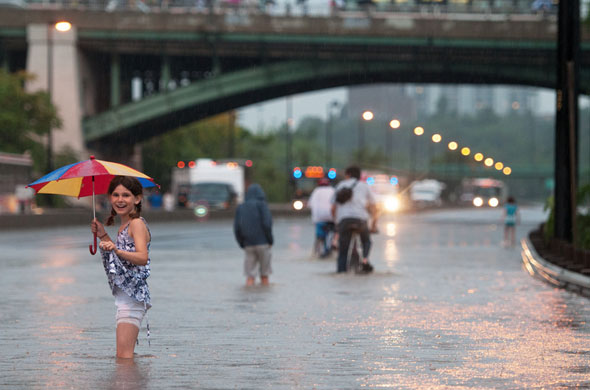
Burlington floods.  Toronto floods.  Manitoba floods.  See a pattern emerging?


The scale has shifted, folks.  The signs are there, but far too many of us aren't seeing them; far too many of our decision-makers are opting to ignore them.  Those that are tasked with solving the problem are overwhelmed; there is no way for a tiny group of planners to weather the storm, if you'll pardon the pun.

And they are afraid to be crucified if they get it wrong.

So here we stand, folks - 

- We want things to stay static, or revert to how they were when the world was a different place.
- We want more for ourselves and are more resentful about sharing.
- Governments are telling us the only threats we need to worry about are foreign terrorists, fraudster immigrants and lazy and/or leftist Canadians.
- There's no money, we're told - though there's a ton of it, just not in the reach of the general public or being spent to the public's structural benefit.
- and the waters continue to rise.


I've written about all this before, of course, much as I wrote about the resurgence of mental health, the rise of government digital platforms, a shift in public engagement, etc.  It's kind of my thing.


I have also written about what we need to be doing to prepare for the severe weather ahead of us, starting with a massive culture change from "me first" to "go the distance together."

Emergency preparedness needs to be promoted and facilitated everywhere, from marginalized communities to Bay Street towers to the rural north and east and west.  Community action plans on what to do when severe weather crises hit need to be devised and supported, but those require engaged communities.  


Behavioural Economics tells us what we can do to nudge that kind of capacity building which, at the same time, can build more resilient, adaptable people and populations that will also be better positioned for economic success and civic engagement.  A bit of sociology-committing can ensure we have proper communication tools for emergency management coordination and hand-offs between citizens and public servants.


It's a challenge, to be sure.  It's not as selfishly sexy as most politicians would want, as it implies that we, not they are the answer.

But make no mistake, it is what's coming.  The time to start preparing for this storm of change is now.

Are you onboard?


Sunday, 9 February 2014

Strategic Depression: Something to Chew On


Depression is on the rise, so it's worth taking a closer look at.  Maybe even a sustained look.

We've got this trend right now towards simplicity - we want bullet-point messaging, one-off solutions, so on and so forth.  Tough-minded leaders are taking hammers to social problems and when that fails to do anything constructive, they move on.

Of course, a focus on simplicity when dealing with complex systems is short-sighted; as a result, the middle-class is hollowing out, the economy is becoming untethered, the democratic deficit is growing and our integrated social fabric is unraveling.  Oh, yeah - and there's that persistent mental health crisis thing.

Additionally, we've seen some worsening of weather lately - ice storms, floods, so on and so forth.  It's becoming increasingly clear that the systems we have in place today aren't equipped to handle the challenges we are facing, natural, internal or systematic.

There's nothing sadder than watching tough-minded leaders stranded like starfish on the beach when reality crashes over the fire-wall of their simple plans.  "It was just good business," they'll tell us in hushed tones.

Canadians don't much trust their leaders right now; instead, they're looking inwards for direction and ruminating just a wee bit more on how to prepare for what comes next.  Maybe a few of them are even starting to wonder how we can proactively shore up our future in spite of the failings of our social bosses.  You know, like Churchill did.

Something to think about, is all.

Tuesday, 12 November 2013

Lessons from Haiyan for Stephen Harper and Rob Ford


If you haven't heard, the Philippines has been devastated by typhoon Haiyan.  Some 10,000 died as a result of the initial onslaught, but that is only the beginning.  It won't be long before the after-effects of the storm - disease, starvation, violence bred from desperation - begin to swell the numbers of Haiyan's victims.  In fact, an each-man-for-himself mentality is already taking hold, with people looting and fighting over what limited resources there are.


The Government of the Philippines is in no way up to the task of managing this crisis.  Left to fend for themselves, things would only get worse.  Fortunately for them, the UN and international partners, including Canada, are stepping in to offer much needed help.  Thanks to forward-thinking planning, we have well-trained, well-equipped professionals able to strike out for crisis zones at a moment's notice. 


We also have an amazing, scalable emergency management framework that is becoming an international norm.  Shared practises, terminology and professionalism are allowing Crisis Response personnel from across the country and around the world to work seamlessly, efficiently and quickly in tandem.  

Relatively new to the disaster relief game are online coordination platforms like Ushahidi that allow real-time, multi-level coordination between assets, logistics and needs.  It's amazing, really - one system can connect a concerned citizen writing a cheque in Argentina to Red Cross resources landing at a port to US military personnel on the ground in any disaster zone, anywhere in the world.  Some entrepreneurial leaders are even re-purposing war vets into disaster relief teams, ensuring they have meaningful work that harnesses their skill sets and accomplishes good.


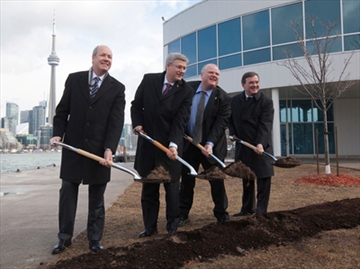
It's great to see new parks being built in Toronto - everyone loves a ribbon cutting, especially the governments who want nice, visible wins to sell come election time.  But the DVP is a problem still in need of a long-term solution.  The recent flooding has raised questions of just how prepared we are for the next disaster; there are still public buildings in this city without emergency lighting and with mold issues caused by the water damage.


Federally, we have a government that attacks both public servants and the information sharing process with gusto.  Leaders like Rob Ford and Stephen Harper are selling the message that the governments of which they are the leaders are oppressive creatures to be starved, rather than connective tissue that allows for circulation of resources.  Among those poor sods who feel their jobs of proactively trying to prevent the next Danzig, or the spread of infectious disease or even ensure we have sound infrastructure for the vulnerable are vital, morale is low.

One has to ask - if Canada were to face a natural cataclysm of similar scale to a Haiyan or even a Katrina, and if it were to strike more than one jurisdiction at a time - how prepared are we to manage it?  When we have leaders that are staunchly anti-society, who would the people rally behind and look to for inspiration when disaster strikes?

There is no economic reason why Canada should be expending resources in the Philippines; they're not major trading partners, we stand little to gain from supporting them.  On humanitarian grounds, though, it's the right thing to do.  There's also this little thing where, when we proactively assist others in their time of need, those acts of altruism build confidence and appreciation that can be reciprocated in things like bilateral free trade agreements or help should we ever face similar consequences.


We can play the populist card, appealing to the selfish instincts of society.  We can pillory all opponents or even potential opponents, clearing the landscape of opposition.  We can cut corners and bend rules behind the scenes in ways few residents will notice, until the aggregate fractures of these actions come to light.

But that's the approach that has landed both Rob Ford and Stephen Harper in the messes they face right now.

These, then, are the lessons Canadian leaders should take from Haiyan:


All of these can be summed up in one neat, tidy phrase - do unto others as you would have them do unto you.

It's not a new message, but one we'd do well to remember; after all, those who forget yesterday's lessons are doomed to repeat yesterday's mistakes - and pay the consequences for them.