Search This Blog

CCE in brief

My photo
Recovering backpacker, Cornwallite at heart, political enthusiast, catalyst, writer, husband, father, community volunteer, unabashedly proud Canadian. Every hyperlink connects to something related directly or thematically to that which is highlighted.

Wednesday, 14 May 2014

On Youth Employment, Chow is Half-Way There


Let's skip past the candidate fun and games, because there's a real challenge here with tangible solutions that are pretty awesome.

Here are the facts:

- Particularly in the work culture we have now, employers want low-risk, low-commitment and cheap hires.  Only a few firms are getting ahead of the curve and recognizing that "spend money to earn money" applies equally to investing in your workforce

- What are the training opportunities that exist for youth out there?  We can talk about a specific trade - construction, for instance, or programming - but we're moving back towards a top-heavy, laissez-faire market where would-be employees are expected to do all the sales and convince the employers of their value (on the golf course, as an example).

- Customers, for their part, are looking for more than products - they want experiences.  They want to engage with firms, products and services where they get to be a bit of the process and can tell that the teams love what they do and feel empowered to take ownership of their work.

- Canada's corporate culture is largely stuck in a 20th Century, Industrial Economy mentality; they don't get the dynamism, interactivity and post-transactional relationships that are defining modern HR practices and economic opportunity.

- One-off employment opportunities for youth, especially marginalized youth, isn't translating into full-time offers; too often it's companies taking the matched, cheaper labour costs for a short-term project then moving on, which doesn't help youth at all

That's all the bad news.  The good news is that the tide is turning.  

- There's a move towards Corporate Social Responsibility (CSR) not just as a branding exercise, but a means to add value to a companies work, empower employees and develop in-kind partnerships

- User Generated Content (UGC) is a growing thing - corporations, political parties and a growing host of organizations are making users part of their solution and part of their team, with engaged staff serving as the interface - this is what the whole Open Data and Open Government building a city that thinks like the web thing is about

- Many organizations, such as Make Web Not War, are looking at doing CSR through in-kind donations of time and expertise rather than just donating cash.  It's a bit of the teach an individual to fish mentality 

- instead of a lump-sum grant, dedicate staff hours to do organizational, communications and other activity while teaching the tricks of those trades to members of the team being supported

- youth with great ambition but less access to specialized skills training or traditional job opportunities are trying to strike out on their own through entrepreneurial efforts - what they lack, more than anything else, is the refined skills to excel at and sell what they do

So, with all that in mind, here's something for Team Chow to consider:

Don't just hire youth for government infrastructure projects; match those contracts with entrepreneurship/life skills training opportunities.  Find partners (maybe Swerhun, Exhibit Change, Canadian Training Institute - build up some vendors of record) you can put on retainers that get funded by successful applicants to go in and provide life-skills, communications, etc. training for hired youth.

A company landing a city contract will have access to a cheaper pool of youth labour, but those youth are going to walk away with more than just a line on their CV; they'll be spending some of their time in class, at events or in the field learning and applying the value-add skills that will really help them succeed in the future.

Start wiring these engaged, empowered youth into social movements like SoJo, Girl Geeks TO and Open Data TO, you're actively shaping the next generation of community leaders, and they will remember you for it.

There's a market for this; there's precedent for this; there's a need for this.

Chow's half-way there, it seems; just imagine how much further she could go if she committed to bringing Toronto's youth along with her.

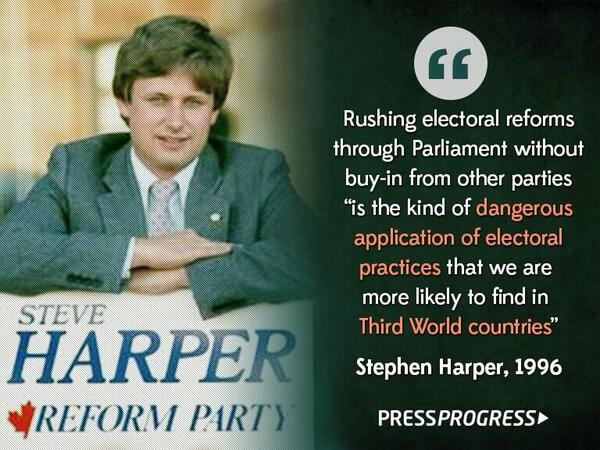
In #cdnpoli, You Either Die a Hero...


Embedded image permalink

... or pull a Stephen Harper.


Yeah, other Parties may not have bought in to the Fair Elections Act, but a majority of whipped Con MPs did, and that's most of Parliament, so that's what matters most, right?  Or at least, that seems good enough for the PM now.  Funny how perspectives change when you're holding the reigns, I guess.

Remember when Harper was all about reforming the system?  It looks like the system reformed him, for the worse.

Absolute power, absolute corruption, etc.  Unless your conviction is strong.  Looks like Harper's wasn't.


Tuesday, 13 May 2014

Dean's Chuckle of the Day


This, coming from Dean Del Mastro.

He must therefore be really pissed at the Conservative Party of Canada who, despite being government, has misrepresented how government is formed, permitted blatantly false robocalls, attempted to bribe a dying man, bullied public servants, attempted to bury evidence that disagrees with their positions, so on and so forth.

Duty bound.  Serious breach of duties.  It'd be a total side-splitter, if it weren't our democracy at stake.

Monday, 12 May 2014

An Unorthodox Hope


There's lots to be worried about in Canadian democracy these days.  We keep being told what to believe by  a government that ignores and even attacks the evidence.  Meanwhile, Canadians are tuning out a lot of unpleasantness we should really be concerned about.

Is a variant on 1984 underway?  Are we low-hanging-fruit and simple-messaging ourselves back to the stone age?  Has instinct won out over rational thought and query?

I tell you no, and I'll tell you why.

The story of history is replete with failed empires and lost civilizations.  Easter Island's slow acceptance of less than they had is a common tale.

When you look at the big picture, though, we have always, always kept moving forward.  We face new challenges, like epidemics or transit, and find new solutions.  You simply cannot have a growth-oriented economy or population that lives within its means.  These concepts are antithetical to each other.

Intransigence and decline never win - progress continues, because that's what evolution does.

Something worth being conscious of.

When Peter MacKay Jumped the Bed


There's Jumping the Shark - that moment when a TV show runs out of gas and starts to decline.  This is different, though - by trying to control the flow of evidence to shape CPC direction, MacKay, like Pierre Poilievre before him, are more like monkeys jumping on the bed.

Look, I get it - Team Harper feels like they're an Empire now, "history's actors" and all of that.  They feel like they can shape policy however they want; Canadians don't care and all the Opposition can do is bleat after the fact.

Media can say "no more monkeys jumping on the bed" but there's no imperative for government to listen.

The thing is, though, that they may feel high and mighty, jumping the bed as they do, but the reality is that gravity isn't on their side.  Less education and tougher sentences?  Less social service, less support for workers?
Who, historically, does this approach benefit?  Who does it fail?  What happens when you've got disproportionate members of minority populations feeding an increasingly-expensive incarceration complex, yet insufficient workers for menial jobs?  

What happens when squeezed middle classes are looking for someone to blame, and government keeps pointing to interest groups?

The reason evidence runs contrary to CPC policy directives is because those directives don't work; the doctor has a point about bed-jumping.  Just look at those monkeys that came before you. 

The "each to their own", "work makes you free", tough-on-crime approach has time and again failed, largely because it involves a complete lack of sociology-committing.  More descriptively framed, of course, "sociology" - the study of society - mixes with anthropology and psychology in the field of behavioural economics. 

You don't need to go so far as to study neuroscience or study patterns of history, however, to get where the Empire trend leads.  How many Empires have lasted the test of time?

Exactly.  They tend to fade away, like Neanderthals or homo erectus.

Team Harper can deny the evidence and go with their instincts all they want - like every other Empire in history, the only ones they're fooling in the long term is themselves.  

Silly monkeys; those tricks are for kids.


Stephen Harper's Canada: We Stand Indifferent to Thee


In a way, Stephen Harper is right - multiculturalism is a failure.  We in Canada talk a good game about acceptance and tolerance (or at least, we used to) but the reality of bigotry has never gone away.  If anything, it appears to be getting worse.

This isn't due to certain cultures not being meant to co-exist.  It's also got nothing to do with "society" being a socialist ruse to grab power.

The reason we have problems is that we have emphasized tolerance - I don't care what you do, so long as it doesn't effect me - over understanding and empathy.

I recently had a chat with a political organizer from Toronto's South Asian community.  A young, Canadian-born woman, she was expressing frustration with some of the homophobic beliefs being expressed by members of the local Sikh community.

"Do they really want to be leaning against one minority community that bugs them," she said, "when we're still a minority that many of you white folk don't want to deal with?  I keep telling them that when you're near the bottom of the pile, it makes zero sense to pick on the one group below you."

But this is exactly the sort of mentality being encouraged in our politics.  

Issues are being carved out and sold/pitched to individual groups.  We don't debate any more - we micro-target and message.


Information is being taken away from the people and emotional triggers are being hit for populist gains.  


The goal is to stir up feelings of anger, or fear, or even hope - encouraging individuals to place all their eggs in one leadership basket.  Only they, the message goes, can stop a forest fire.

At the same time, we're being told that our comfortable lifestyles are being threatened - by troubles lapping at shores, by greedy corporations or by special interest groups.  Only (insert leader's name here) can stop the fire from spreading.

Meanwhile, we're being told what we don't care about - we don't care about the working of Parliament, we don't care about silly science that disagrees with partisan messages and we certainly shouldn't care about our neighbours.  


Canadians have been comfortable and because we've been comfortable, we've become disengaged.  We practice ignorance and mistake it for tolerance.  We talk of multiculturalism, but it has become a series of disconnected silos that are rubbing up against each other uncomfortably.

Worst of all, our leaders are ignoring where these trends are leading us - even as we see where disaffection and self-interest has brought nations like Greece.


Canada has ceased to be a nation that represents something, and instead have become an embarrassing hodge-podge of competing tribes with definitively provincial attitudes.


Until we wrap our heads around what Canada used to represent and, at our best, what we can all represent - stronger, engaged individuals for a stronger, more dynamic whole - we will continue to fall.

We're a long way yet from reaching bottom.  God willing, we'll smarten up long before we get there.


And by God, I mean us - after all, God helps those who help each other, no?


Redesigning Public Services in Ontario


The Liberals have a plan - go in and work with service providers to find cost-saving efficiencies.  The Tories have a plan - cut funds and force service providers to find efficiencies.  The NDP - well, the NDP have mantras.

Each of these Parties is trying to solve the wrong problem.

When you cut funds, people don't look to provide better services - they feel desperate themselves and will seek to shore up their own positions.  With drastic cuts count on labour strife, on the one side, but increased opacity of facts on the other as organizations realize they need to sell well rather than do well if they're to make the cut.

When you get in with individual agencies or communities and try to help them fix their financial woes, you're still missing the structural problem.

As a recent example - the Provincial Government recently decided that tackling Type II Diabetes would be a good investment.  Fair enough - it's incredibly costly, healthcare-wise, places a massive burden on families and support networks and leads to a reduced quality of life.  Did I mention the cost?

Diabetes Type II is preventable, by the way - through things like appropriate diet and exercise.

Governments have tried to minimize the uptake of commercial products that exacerbate the likelihood of getting Type II diabetes (things like pop) through bans and the like.

It hasn't gone over very well - companies like Coca Cola have done a magnificent job baiting and switching, presenting the issue as more one of government taking away free choice from the people.

Do you really want government determining what your kids can eat and drink in school?  How totalitarian!  How Dickensian!

No, corporations would much rather government keep its nose out of the consumption of the masses, meaning they're free to sell whatever they want, using whatever persuasive techniques they want.

"Momma, Johnny gets to have Coke for lunch and dinner, why can't I?"

"But honey, Johnny is obese and is going to end up diabetic, having a heart attack and needing knee and hip replacements by the time he's 40."

"Johnny's momma loves him, that's why he gets Coke.  Why don't you love me?"

Coke doesn't care if little Johnny is hospitalized and removed from the workforce by 40 - they're not paying for healthcare.  In a global economy, they don't even need to have anything other than storage facilities in Canada.

But I digress.

Ontario wanted to address Diabetes Type II without going the ban route - instead, they opted for education.  Funding was provided through the Ministry of Health to municipal government agencies, like Toronto Public Health, to develop programming and train community groups to teach their folk about diabetes.  

The training consisted of a three-day course provided to whoever was sent by groups that received money.  Those groups would then be responsible for passing the training along, resulting in the communities most likely to get Diabetes Type II becoming more informed about prevention.

Sounds great, but.

The NFPs that signed up for these classes were by-and-large not focused on health.  In fact, many of them were simply so desperate for operational dollars that they were signing up for whatever program handed out cash and considering themselves clever for doing so.  After all, the way public funding of Not-For-Profits has been going, these folk can't afford to hire organizers, fundraisers or lobbyists able to get them the support they need.

Their work is important, even vital - but nobody's selling it well and nobody's funding that work.  So they're championing Diabetes Type II instead.  They send people to the training with little-to-no understanding of what their mandate is.  They get some information and a couple of toys over three days, and then are sent off into their communities to train their peers.

There was no evaluation of the knowledge absorbed.  No evaluation of the efficacy of the program.  

There are no metrics to ensure consistency of training, absorption or behaviour changes by communities and the most important stats of all, changes in Diabetes Type II rates by community.  Without these metrics, there's no telling if the process worked, who's got best practices, what approaches work best in individual communities, etc. 

The entire program was a waste of dollars, essentially serving as a band-aid to keep completely unrelated services afloat because sustainability has been leached out of the system.

This was a Liberal program.  Under the Tories, it would be gone.  Score one for efficient use of public dollars!  Yet the problem would remain - in fact, it would get worse.


The same holds true for any program cut, any regulation decrease or policy shift that places more emphasis on individual, corporate success at the expense of the structural whole.  

Think the duplication, gaps and overlaps we have now are bad?  Just imagine what they'd be like with no process in place at all.

Again, across the board we're trying to solve the wrong problem - it's not more money or less money or more regulation or less regulation attempting to nudge individual behaviours that's required - real efficiencies are found through better structure from top to bottom.

Last I heard, there were efforts underway - finally - to at least map out services provided to youth in Ontario.  I argued that, to be effective, that map should look like a flow-chart; what money tagged for what purposes was being sent to where, between and across Ministries.  

It's like doing a leak-test on a house; if we don't know how the money is being distributed on the front line, we can't know where the holes are or where individual sectors have simply gotten better at demanding more.

When it's all about individual success, after all, it's he who manipulates best who comes out on top.  

Just ask Coca Cola.

The options on the table seem to be: we can collectively subject ourselves to the whims of government, through regulations, or we can put ourselves at the mercy of well-funded private sector interests with all the latest science on how to manipulate our "free" choices so that they win.

Of course, there is an alternative - one that would see a restructured government doing a better job coordinating its efforts, working with private sector and not-for-profit sector partners under the supervision of an engaged public.

It is time for a change in Ontario, and across the board, but it's not one we can demand of others unless we're willing to step up ourselves.

We can have an Open Government, but not without active participation on our part.

The only catch is this - the only way to have ownership over your future is to be a responsible member of society.