Search This Blog

CCE in brief

My photo
Recovering backpacker, Cornwallite at heart, political enthusiast, catalyst, writer, husband, father, community volunteer, unabashedly proud Canadian. Every hyperlink connects to something related directly or thematically to that which is highlighted.
Showing posts with label North Korea. Show all posts

Tuesday, 2 September 2014

IGN on ISIS: Fear the Mind Killer


Watch this video wherein IGN staff are asked why it it that we love to fear zombies.  The answers, I think, are pretty bang-on:

- Fear of the loss of self
- They are the Heart of Darkness manifest
- There's a little part of us that fears Armageddon, the end of the world we know
- There's a little part of us that craves Armageddon, the end of the world we know
- Zombies are kinda human, but not really human - meaning it's okay to cut their heads off
- There's something terrifying about the perceived natural process of things (sociology to some, societal decay to others?)
- Fear that we're the rational actors we like to tell ourselves we are and could become zombies ourselves
- That mindlessness is infectious (ie Rome is the mob)

I love the concept of zombies, because they're such an apt metaphor for the human condition.

Which brings us to ISIS.  The people who flock to ISIS, whatever they might tell you, aren't all born-again Islamists or whatever.  Like those who join any aggressive cult, there is a drive to belong, to have power, to be safe against the zombie hoard and to survive the apoclypse.

It should come as no surprise that the US Joint Chiefs of Staff have warned us that "This is an organization that has an apocalyptic end-of-days strategic vision that will eventually have to be defeated."
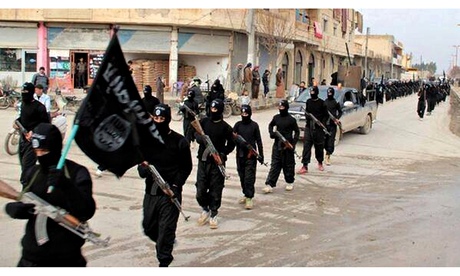

ISIS is essentially a bunker for the apocalypse who fear the zombie masses of the Other.  The Other, oddly enough, that they have no issues beheading, because you know - if you're not us, you're a zombie.

Funny how, if you look to the left, you can't pick out any particular individuals, can you?

What happened as the walls went up around Ferguson?  The police started to get aggressive and call protesters fucking animals.  The use of force went up and the threats to kill escalated.

What response does the West have for terrorism, or society have for Ferguson?  Lines get drawn, sides are chosen and the other begins to look suspiciously like a person impersonation, not a neighbour.

Fear your neighbours, suggests ISIS - they could be one of us.

Fear outsiders, say North Korea, libertarians and Canada's Prime Minister - they mean to take away your individuality and even your life.

What's the consistent thread through each of these scenarios?

The more we fear the Other, the more distance we put between them and us.  They are a threat, inhuman.  It's okay to hate them - our hatred of what they could do to our individuality is, in fact, a purifying force.

Don't feel guilt.  Don't feel shame.  If you don't cut their heads off, they will destroy or worse, convert you. It's our tribe against the zombie hoard; you're either with us, or you're one of them.

Now, go back and read IGN's list.  Notice anything?

The more we dehumanize the Other, the more we feel compelled to band together, circle the wagons, stay on-message.  The more we identify them as an inhuman threat, the more justified we feel in treating them inhumanely.  As we feel increasingly outnumbered, the count-down clock ticks ever more loudly; no time to think, act now!!  Always be closing!


Fear is the mind killer.  It's as simple as that.


Saturday, 5 July 2014

The Collapse of Canada, Inc.


If a vibrant Canadian democracy, an engaged Canadian public and healthy public debate about policy were things Harper cared about, then yeah - he's have a huge problem on his hands.
 
But the truth is he fundamentally doesn't care about any of those things.  Harper is an ideologue who thinks anyone who opposes his way of doing things is either clueless, dangerous or some combination of both.
 
Only he understands the real issues facing Canada; only he knows how to fix them.  Anyone who disagrees with him needs to be ignored, shouted-down, bullied, fired or disengaged. 
 
If only 20% of the voting public went out to the polls, but all voted Harper, he would claim that his majority government was reflecting of Canadians' support of his way of operating.  Then, he'd clamp down harder on everyone else.
 
Government isn't a business, nor is democracy.  It's about community and engagement, not consumption and transaction.
 
They don't care - they're focus is on wins, not sustainability.  If we don't want our country to turn into North Korea, it's we citizens that need to step up our game.

Sunday, 29 September 2013

Jason Kenney's Paradise


Its estimated that at least 200,000 political prisoners are in North Korean Gulag concentration camps, some 50,000 for being Christians.


Although we've come close, I've not yet had the pleasure to chat with the Honourable Minister Kenney as of yet.  What's meant to be, will be, etc.  


Kenney's pretty good about getting out of the Ottawa safety zone and putting himself in the line of fire.  The fact that he's so liberal about using his Twitter account is a great thing; it makes him feel more accessible to the common Canadian social media user.  In fact, it was a recent tweet back-and-forth about this 2012 story about  Kenney referencing "foreign gangsters" and gun violence in Toronto that led me to looking at his stream and landing on the entry posted above.

Yes, Kenney's an ambitious political animal and his public presence is designed to enhance his profile - you can't hold that against him, because that's what someone with his goals is supposed to do.  But consider this - there are no votes in North Korea.  The vast majority of Canadians have no idea nor in-depth interest in how bad things are there.  There are a growing number of Korean-Canadians, many of whom will harbour some concerns about their kin in the Hermit State, but it'd be hard to argue this is a topic he can truly milk for political advantage.

So - out of all the topics, demographics and communications stratagems he could be dedicating his tweets to, why this? 

And what does some 50,000 for being Christians have to do with foreign gangsters?

Today's crop of leading Conservatives have a habit of using "with us or against us" rhetoric; not just in terms of partisan or urban/rural divides, but in terms of who they see as real Canadians/real people and those they don't.  In this world, there are people like us, there are threats, there are marks and then people who simply don't matter.


Don't fall in line with our demands?  You don't get a choice, pilgrim.


Some of this is wedge-politics, certainly, designed to engage some voters, dismay others.  But when you consistently push the "fear The Other" button, a pattern of underlying beliefs starts to emerge.

When Jason Kenney - or Rob Ford, for that matter - assumes that the people committing gun crimes in Toronto are foreign-born, it's for the same reason that Birthers have such trouble accepting that Barack Obama is a real American; real Americans aren't supposed to behave (or look) like that.

Yes, it's discrimination, but discrimination doesn't come out of the blue; there's a cognitive basis for stigma that serves a purpose in some cases, but leads to false assumptions in others.  As with his colleague Vic Toews, the ambitious, driven and True Conservative Kenney doesn't feel the value in committing sociology; not when his gut instinct provides such clear and emotionally resonant answers.


All people are created equal, start from the same playing field and therefore, have the chance to achieve success if they pull up their bootstraps and work hard.  Poverty, racism, postal-code stigma and societal nurture don't, in fact, exist - they're constructs of lazy people (or non-people) who need to either be kicked in the ass or somehow removed.  When they're out, there somebody else's problem.

It's like marginalized Canadians, be they youth or "special interest" groups - they keep whining like their lot in life is someone else's problem, right?  If they can't get their own act together, why should we help them?  Should they get to a point where they threaten the rest of us, well, that's why we're serious about getting tough on crime.

North Korea is about as far "out" as you can get - there's zero public anywhere in the West to actively do something to stop the human tragedy that plays out there, daily.  But when you hear stories from real, live human beings that humanize these atrocities, you begin to feel their pain and realize that, by doing nothing, you are complicit in their pain.

Then the cognitive dissonance sets in.  If they're like us, then we have to act.  Do unto others, etc.  But acting is not in our best interests; it's actually better if we leave 'em dehumanized.  It's very hard to remain indifferent when it's your own people being harmed.

I don't imagine this is a conscious effort, but when Kenney, the practicing Christian focuses on the Christian component of North Korea's gulags, he's actually working to convince himself that they are like him.  Because part of him knows that indifference is not acceptable.

Like I always say - everyone can be reached.

Individually, we're lost, but together - there is hope for all of us.

Why Should We Care What The World Thinks About Canada?


Nobody does trade with North Korea.  No political leader anywhere in the world, even China, takes the successive Kims seriously.  The only reason people give in to North Korea's insistence on not taking "no" for an answer is because they have actual weapons of mass destruction.

But Kim Jong-Un himself is a joke, a cartoon villain parodied by media all over the world.  And because of his tight control of information, that's the end of the story.  The millions who suffer daily in North Korea under his information-starved, authoritarian rule are pretty much ignored.  But hey, inside their borders, they know it doesn't matter what the rest of the world thinks, anyway - their leader has told them as much.

I know there are people who like Stephen Harper's approach to unions, "special interest groups" and Opposition Parties; he's the boss, they're the problem, good for him for putting those who would undermine our country in their place through whatever means necessary.  There are equally those who relish the soundbites they get of their PM, talking tough to Barack Obama or sternly reproaching European leaders for their economic policies.  Take that, former colonial powers!

Alas, those aren't the people who decide whether to sign trade deals with Canada, whether to relocated businesses to Canada or to listen to Canada on issues ranging from security to poverty reduction.  

Schoolyard politics makes for good fundraising letter fodder, but poor international relations.  People don't trust Harper; a man so willing to put his partisan interests first that he'll snub his own country for the benefit of an ally can't be counted on to act responsible in trade negotiations.

There was a time when Canada knew what it stood for and the world knew why we mattered.  Canada's best destiny was and still is as the adult on the world stage, always reliable and always trusted to build bridges and find solutions.

We can lead again - but not until the petulant approach to foreign policy favoured by Harper is discarded.

Until then, we're not punching above our weight - instead, we've become the punchline.

Tuesday, 7 May 2013

In The Dark and Left Behind: Harper's Canada Starting To Look Like North Korea?


"Critics see a politically motivated attempt to change the science agenda in Canada; the government has consistently defended its changes, saying it wants to fund projects that offer a more immediate return on investment."

I actually believe this to be the case.  The Harper's Canada Government is doing to Canada what Disney is doing to Star Wars - cut the frills and focus on core product offerings.  Short-term Return On Investment is the only thing that drives them; if a service, process or product can't be proven to make a short-term profit, get rid of it.

The problem with this tough-minded "business as government" approach is that it completely ignores social and conservational economics.  Easter Islanders did the quick ROI thing, too - as a consequence of not planning ahead they destroyed their island and devastated their society.   As any farmer could tell Team Harper, if you don't leave some fields fallow for a time, you suck them dry of nutrients.  You might as well burn your lands and boil your sea.

There are additional consequences to the narrow-mindedness of the CPC's governance style.  By walking away from international forums (like the UN), trying to bully foreigners who challenge them (like James Hansen) and by talking domestic smack in inappropriate global forums (Margaret Thatcher's funeral, for instance) the Harper Government is rapidly eroding Canada's legitimacy as a serious player in the world stage.

By playing every single card for a narrow, questionable domestic agenda and undermining Canada's democratic institutions, bureaucracy and science in the process, Team Harper is basically telling the world that Canada's stepping away from the international adults' table.

In addition to that, the world's full of populations that care about the sustainability of the global environment and things like freedom of the press and corruption-free governance; if Canada, once known as a shining example on the world stage falls, those populations will push their democratic governments to censure or stop doing business with Canada.

Much as Canada has done with Iran.

When other nations stop taking you seriously, they cease to see relations with you as an asset.  As they walk away, bilateral deals and opportunities dry up.  That creates increased internal pressure, as these lost opportunities weigh on businesses and families both.  If Team Harper continues to put partisan wins ahead of the long-term sustainability of the country, they will only clamp down even harder on dissent, removing debate from our democracy and leaving a limited, poorly-considered suite of policy ideas available to them.

There's a model out there of what that kind of system, left unchecked, looks like - North Korea.

Thursday, 7 March 2013

Communist Libertarianism: The North Korean Paradox


With China on the slippery slope towards pseudo-capitalism, North Korea is really the last Cold War Communist State left.  The more isolated they become, the more frightened they get, shoring up their firewalls and threatening any trouble that might even possibly think about lapping at their shores.  Alas, North Korea reflects all that went wrong with the Stalinist Experiment - corrupt leaders that feel entitled to their frills, poorly-informed decisions, resource inefficiency, a suffering populace and the thing that irks me the most - waste.  Waste of materials.  Waste of talent.  Waste of opportunity.
 
Opportunity, of course, lies in change, adaptation, growth.  You can't have progress without change, which requires a certain personal flexibility and a willingness to listen to and work with others. 
 
Progressives, as we know, get branded as pinko lefties by the political right; trying to force social contracts and new ideologies on the people who are just fine as they are, thank you very much.  Libertarians in particular are anathema to centrally-generated, centrally-imposed policy, particularly where it comes to their right to do whatever they please with their resources on their land.  "Back off, government," say the landowers - this is our land."  Libertarians can get pretty belligerent when they feel their personal and territorial liberties are being threatened. 
 
One of those personal liberties they cherish, of course, is the ability to protect their territory.  While the Second Amendment was about having a populace armed to protect against external threats, the political right, led by the NRA, have reinterpreted it to be about the right to bear arms and protect personal property, including self.  There are lots of threats lapping at the castle walls, a man's got to be able to defend his family, or something to that effect.  The NRA spends a whole lotta money fighting for the individua's right to bear arms
 
When innocent people die because of those arms, the NRA is quick to point out it's not their ideology, but external threats that are the problem.  Their Spokesman Wayne Lapierre issued a statement that was carried by Fox News to every corner of the US:  "In a race to the bottom, media conglomerates compete with one another to shock, violate and offend every standard of civilized society by bringing an ever-more-toxic mix of reckless behavior and criminal cruelty into our homes—every minute of every day of every month of every year.”
 
But wait a minute. 
 
Anti-change, anti-external imposition, the desire to keep people off your land, protect it with guns and thump your chest at anyone who comes near your territory?  That sounds awfully familiar.  It sounds something like North Korea.
 
Ah, but I'm only saying that because I'm a lefty, pinko progressive.  I'm either incapable of understanding how things really work or am choosing to ignore the facts.  True libertarian/politically right people aren't interested in ruling over big territories or other people, they just want to be left alone to their own space.  You don't interfere in their business, they won't interfere in yours. 
 
It just so happens that because we have a corrupt, socialist system in place, the world isn't working the way it's supposed to.  Which is why people like Randy Hillier proactively work to get out the non-freedom lovers like Norm Sterling to make room for properly anti-government libertarians like Jack MacLaren.
 
Ditto Rob Ford - the Lord Mayor was so upset with the corruption and entitlement of leftist Mayors that he had no choice but to do whatever it took to win office and set things to right.  We're very lucky he's there - he's all that stands between us and the leftists on City Council.  He's also the only hope the kids of Don Bosco have of getting ahead in life.  Mayor Ford, you see, knows the right way to motivate people to be independent, so long as they listen to him.  Those he can't help, he can shout down - or incarcerate, or run out of town
 
The checks and balances of a democratically elected government and an impartial bureaucracy have helped to filter out some of Mayor Ford's policy approaches.  One wonders what he'd be up to, as leader, if those checks and balances that infuriate him so didn't exist.  Then again, he does have the undying love and support of Ford Nation in his corner.
 
Power is about getting and maintaining control.  Libertarians want control of their own lives, but in a social context, that absolute freedom has to come at the expense of someone else's freedom.  Totalitarianism is basically libertarianism at the state level.  Both libertarians and totalitarians want the freedom to exercise their control in their territory however they please and think that they're the ones who have all the answers. 
 
Despite what they tell themselves, freedom from others isn't the goal - control of territory and resources is.  People, after all, are territorial animals.
 
Like all animals, people maintain territorial control through threats and, where necessary, strength.  Handguns are to people what horns are to bulls or rhinos - and nuclear deterrents are the same thing at the state level.  Costly and expensive propaganda is the state-level equivalent to the peacock's tail.  Control is about preventing external incentive to change, which is what progress is all about.
 
Knowledge is progress.  The handgun and the nuke are the products of progress, as are all weapons and fences that help protect one's territory.  All aspects of society, in fact, have been engineered not by isolationist individuals or regimes, but by collaborative people.
 
Progress isn't about forcing change, so much as libertarianism is about stopping it.  Just like the North Korean regime keeps trying to do.  Fortunately for both, progress is like time - you can't stop the inevitable.


Tuesday, 12 February 2013

North Korea


Doesn't matter how many people say "the enemy of my enemy is my ally" - it's still not true.  Ignoring the bad behaviour of allies doesn't make it go away; it makes you culpable.  By continuing to ignore the threat of the North Korean state not only to its neighbours and possibly the US, but to its own people.
 
I remember living in South Korea during the September 2011 attacks on the US; to my Korean friends, it seemed a tragic but distant "over there" problem.  They lived in the shadow of a much more present threat.  I had the chance to set foot in North Korea at Panmunjom and look North Korean soldiers in the eye - they are made of the same flesh and blood as are their Southern cousins.  The gap between them is less a matter of walls, landmines and flags than it is one of culture, experience and fear, but both of these chasms can be bridged.
 
Someone just has to see the path and be willing to lead people forward.  China could be that leader; their leadership could build some positivity into China's brand and increase their international respect quotient in the process.  To do that, though, they need to stop looking at themselves as a future umbrella and instead see themselves as drops in the ocean
 
There stands a train station in South Korea with a sign that says "To Pyeongyang;" everyone will be a little better off when that train can leave its station.


Friday, 9 November 2012

Warren's Where's Waldo Method of Engagement


I can't imagine Warren Kinsella is a big fan of Carly Rae Jepsen, being a punk and all - but he clearly understands the value of a catchy meme.  He has started to roll out endorsements for the Ontario Liberal Leadership Candidate he supports (can you find who it is in the picture above?) but instead of just feeding his audience names and title that might not have meaning for them, he's challenging his readers to identify who the endorsers are themselves.  This accomplishes four things:
 
1) It engages readers in his candidate; figuring out who backs that person becomes a viral campaign, creating a community of engagement around them
 
2) It motivates his audience to take the lead in identifying the supporters, ensuring everyone has a chance to know who they are...
 
3) ... but as that information is crowd-sourced, the information comes from the community rather than being delivered to them by the campaign itself.  This adds an automatic level of accessibility and authenticity to the endorsements that biased political staff would be hard-pressed to achieve on their own
 
4) Letting the crowd do the work and handing out gold stars to those who find the info first builds competition, which gets people more active, but it also rewards the experience of participation with a dopamine rush, the same sort of thrill you get from winning at bingo (but also the same neurochemistry that can get you hooked on slot machines)
 
Of course, there's a whole science to this; someone with an NLP background or even a rudimentary knowledge of how cognition works can tell you why people react this way.  With a bit of practice, it's not difficult to proactively shape those responses by managing the stimuli your audience receives, creating the sort of community experience you're looking for.  Kinsella's great at doing this in person - he'll engage crowds directly within the first moments of a presentation, getting them to clap for themselves, etc. to make his talks their experience, not just his.
 
There's nothing new to these tricks of the engagement trade.  Religion has done this for agesGreat artists or speakers (like politicians) use these tools to their advantage all the time.  Conversely, poor leaders do the reverse - instead of creating communities of experience, they block external stimuli and trigger fear rather than engagement.  These are the cultists, setting themselves up as saviours from troubles lapping at shores and holding you to that fear and dependence on their protection, trying to foster a kind of crowd Stockhom Syndrome.
 
What's perhaps more recent a phenomenon is the internalization of these techniques through things like Positive Psychology and Cognitive Behavioural Therapy.  These sorts of practices work kind of how exercise or yoga does, except from the inside out rather than the outside in.  These conscious exercises provide effective methods to manage emotional disorders or to overcome duress (though not always in exclusion).  When you become aware of how your own neuropsychology works, you begin to see how external and internal conditions shape your mood and thoughts the same way any drug would.  That's when they become your tools to use, rather than someone else's to abuse.
 
Of course, all of this requires a lot of thought, time and discipline.  Why bother?  Wading into the fine print of brain function is boring.  You get a decent rush from playing the game right in front of you and besides, consequences are things that happen to others
 
Keeping track of where Waldo's at is enough to keep anyone occupied and entertained.