
What does the TFW program have to do with Rob Ford's substance abuse problems?
Quite a lot, when you get down to it.

Temporary Foreign Workers (TFW) are the path to least resistance; between a choice of a more demanding, higher-costing employee who might feel working for you is a necessary burden versus a cheaper foreign worker who sees working for you as a ticket to a better life, it's really not a hard choice to make.
Spend less, get more for it. Have lower responsibility costs. What's not to like? That way, you have more money for other things. That surplus cash could go to strengthening your business through R&D, or expanding your operations. At the same time, it could go to a nicer car or a more expensive Scotch.
Does it make a difference whether your interest is growing your company or raising your own profile?
Absolutely it does.
If you're goal is to maximize your contribution to something larger than yourself, like your company, you're activating a differing set of priorities than if you're seeing company growth as a way to aggrandize yourself. It's the difference between, say, having a trophy wife vs investing in a family.
In the first case, you want that which makes you look and feel good; in the second, you want to empower something that carries on after you.

As it stands right now, capitalism is designed around mathematical economics; it assumes that all players in the game are rational actors with a suitable level of self-interest, yet interested in achieving balance. Markets are supposed to find balance between supply and demand, promote dynamism and the rest of it.
But that's not how it works, does it?
Some people are more aggressive than others. Some are more likely to make impulsive choices than others. None of us are truly rational, whatever we like to tell ourselves, and as such aren't good at balancing our own short-term interests vs our long-term interests, which are largely invested in the societal whole.
Employers looking to maximize their gain and minimize their expense are abusing the system, because why not? After all, potential Canadian employees are looking at the low-wage, low-respect jobs available in sectors like Fast Food and deciding that the effort and embarrassment potential of working such jobs isn't worth the pay it brings, especially if there's a welfare-state floor beneath them to ensure they avoid poverty.

So the solution, you might say, is to scrap the welfare state entirely - take that floor out from under a laissez-faire labour market and force them to choose between poverty and working undesirable jobs. I mean, what's the alternative? Either the welfare state bankrupts us or imported poverty leads to all kinds of social decay. Close the doors to foreign labour, force Canadians to embrace their
Right to Work.
But that's only part of the problem. The reason why employers are importing lower-cost FTW in the first place is that they don't want to invest any more in labour costs than they have to. If you take away unions and labour regulations, these same employers will look for ways to reduce their labour costs further - less breaks and benefits, amalgamating positions without increasing wages, etc.
That's fine, you might say - this forces employees to become more desirable as labour, more competitive in how they sell themselves and demand more from their employers. Except not everyone is capable of being competitive, any more than everyone is capable of winning a marathon or curing cancer.
The people that tend to get ahead in competitive markets are the ones who are good at being competitive, to the exclusion of all else. That means elbows-up, step-on-throat tactics and a functionally fixed approach to problems.
People like Rob Ford or
Jordan Belfort are the embodiment of this approach. These are two guys who aren't afraid to get what they want. They are the epitome of laissez-faire capitalism; they live life to the fullest, spend freely and have no qualms about doing what it takes to win.
Even if it means breaking some rules to get there.
What else do these two gents have in common? They've both made terribly short-sighted choices that have worked well for them in the short term, but been negative to many of those around them. They've both suffered in the long term, too.
Oh yeah - and both have addictive personalities.
It's telling that Belfort, as portrayed by Leonardo DiCaprio in
The Wolf of Wall Street refers to money as a drug. That's exactly what it is.

This isn't me saying that money is the root of all evil - that's mythic crap that over-values money as a concept. Money is power - if you have it, you can accumulate stuff, build brand, make yourself feel and look big. It's hardly unique in these traits - lots of drugs make people feel more powerful than nature has made them. Cocaine does the same thing, as does its low-brow derivative, crack cocaine.
Dopamine makes you feel powerful, in control, "high" - as in higher than everyone else. It's a good feeling, one that's awfully hard to come down from. Which is where the addictive factor comes in.
He's an extreme case, as is Jordan Belfort, but they are fairly representative of all dopamaniacs; want more, want to spend less, self-interested and as a result, socially irresponsible. Having money, owning a team or owning a gun are all dopamine-inducers. They make you feel like you're king of the world, or at least your own castle.
Let's go back to the words of Margaret Wente - we're hooked on foreign workers. Hooked, as in addicted to. Why would that be?

Foreign workers are the labour equivalent to crack cocaine - they get the job done quicker, cost less and still give you that dopamine fix. Whether they're temporary or end up sticking around, though, what they don't encourage you to do is invest more time and effort in your labour, building out your company in a sustainable way.
Maybe if you're working in a strictly transactional service industry, that's fine, though even then a focus on doing things cheap tends to result in shoddy infrastructure across the board. If sustainable growth is your goal, though, you really have no choice but to invest more in your labour.

This reality was brought home to North America during the Labour Revolution and is slowly coming to light as countries like Bangladesh, who've swallowed up much of our old Traditional Manufacturing industry, suffer their own consequences of inadequate labour and infrastructure investment.
They're going through the same physical labour pangs we did a century ago as we try and re-position ourselves, through foreign labour, to go through the same turbulence a second time.
This fundamentally isn't about mathematical economics or the pros and cons of capitalism vs communism; as we have seen throughout history, both systems still lead to dopamaniacs seizing power at the expense of the majority.
What these series of interlocking challenges, like a
Seldon Crisis, are fundamentally about is behavioural economics - the science behind why people behave the way we do.
A system like Capitalism promotes addiction - to money and the power it brings. A system like Communism promotes addiction - to power and information and the power they bring. Both are self-serving, not by design, but by a lack of design-thinking.
Adam Smith and Karl Marx both meant well; the problem was that neither of them understood neurochemistry.
We've seen how communism falters and we're both hearing and seeing how capitalism isn't up to the challenges of our modern context, either. Any system that promotes and rewards dopamine fixes, by its very nature, is doomed to result in structural challenges.
So where does this leave us?
Fortunately, there's another neurotransmitter out there that provides a better foundation for sustainable socio-economic infrastructure. It's called
oxytocin (not to be confused with oxycodone) and in many ways, it is the anti-dopamine.

Oxytocin does wonders for the body - it reduces emotional stress, negates fear, improves health and most importantly, it also provides a positive feeling - not power, as is the case with dopamine, but of personal value.
When you score a point or make a buck, you get a dopamine hit - feels good, helps you focus on getting the next one, whatever the cost. It leads to competition, which produces winners and losers.
When you donate to charity or give up your seat on the subway, your system floods with oxytocin - you feel good, your environment comes into clarity and you feel even more inclined to help others. Best of all, when you get an oxytocin hit, so does everyone around you.
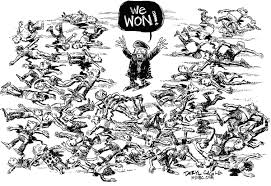
Let's break that down a bit further - competition promotes individual wins, which promotes competition, which cataylzes fear, antagonism and a sense of urgency to not fall behind. It results in short-term thinking and leads to tragedy-of-the-commons scenarios.
Oxytocin promotes engagement, empathy, collaboration and the ability to think further ahead, without the crippling fear often associated with risk-taking. It results in shared solutions and people moving forward together.
Yes, there are sociopaths, psychopaths and narcissists out there; we do need to be cautious of con artists and terrorists and all those who are hard-wired to prey on the weak. But to have a system that is entirely designed to encourage predatory, dopamine-fueled behaviour isn't the way to minimize those risks.
Instead, we need to rethink how and why we structure our society so as to optimize our collective opportunities by maximizing individual potentials.
Fortunatley for us, we're already well along this path. We just don't know it yet.
After all, what is healthcare, if not a way to support the weak? What is specialization, if not an effort to integrate individuals into a collective whole? Can a nation or a community survive without shared infrastructure and a genearlly agreed-upon code of conduct?
Society isn't and never has been about trickle down or individual competition, it's been about developing into a collective organism, a networked intelligence.
We're seeing, at the periphery, the next phase of our social evolution away from individual competition towards collective success right now. It's coming in the form of Open Government and Open Data, through the connective tissue of social media and a whole new focus on empowerment.
Especially when it comes to labour. In the post-transactional, knowledge-based economy, customers want experiences, not just products. They want to feel good about the choices they make, which means they want to know that the people they're interacting with - your front line employers - are happy with their lot in life, too.

How fast we move through this transitional period depends on how quickly we come over our collective addiction to money and status and start valuing what we give and how we contribute more.
As contribution isn't addictive, it doesn't result in the same functional fixedness we see in people like Rob Ford, or the devaluation of others we see playing out through the TFW program.
Political Parties, individual politicians and corporate entities can win big by embracing the concept of the responsible society and investing in corporate social responsibility. In fact, we see that happening already.
The question for these power-seekers is this: do they have enough self-control to overcome their addiction and start leading by example?
If we look closely enough, we can already see the answer emerging.


