

 Fiscal conservatives in the vein of a Rob Ford or a Tim Hudak think thusly - centralized spending is bad. Public services are doomed to be less effective that privately offered ones; poor, sick, under-educated and damaged people are chaff that free market competition will separate from the wheat. But where does the chaff go?
Rob Ford would like to see them leave the city. In reality, they move into slums and onto the street and from there, into hospitals and prisons. We are all acutely aware of the problems being faced in both those institutions.
Here's the thing that nobody wants to accept - fiscal conservatism in the absence of a social conscience doesn't work. It never has and it never will. Competition doesn't result in greater opportunity for everyone; it results in those with less scruples getting ahead. You know who are the real flag-bearers for free-market competition? Drug dealers. Smugglers. Pornographers. Snake-oil salesmen. Those who prey on the weak and rely on coercion either by force of words or force of action to keep competition at bay. It's bread, circuses and alcohol, the tools used by would-be tyrants from Rome through the European colonization. Nothing has changed, except for those times when we look past immediate selfish gain and think about the bigger picture.
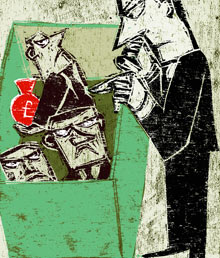 People who get ahead don't instinctively look to give back to society or create opportunity for others; most figure they got where they did through grit and a willingness to step on a few heads, so it's up to others to do the same. Social success is like a game of asshole; it's more by luck of the draw that those at the bottom get ahead. I know people at the top and bottom of the economic food chain with the exact same skills and personality; what led them to different paths were life events largely beyond their conscious control. When you've got to the top, you feel entitled and look down upon those who don't fit within your same frame of aggressive, single-minded success.
Nobody wants to hire someone they view as a social failure and whoever they bring on, they're going to try and give them as little in return as possible. The ones that get the decent salaries and benefits are the uber-confident, aggressive types, regardless of skill. When that trend is followed, you end up with corporate configurations like Goldman Sachs and "successful" politicians like Rob Ford or Tony Clement. Chris Mazza wasn't an accident - he was a product of our increasingly survival-of-the-fittest competitive society.
The decline starts by limiting hiring; that means less people in the workforce relying on more public services, also suffering the stress that comes with being a nobody in a society that defines personal worth by employment, not ability to contribute. It also results in the people at the top demanding more and expecting to do less to get it, because they think they're entitled to eat the whole cake. When the top takes more than its share and the bottom, seeing no opportunity for advancement, starts to give up trying and just survive on what crumbs they can get, economies start to wither. It's what's happening now and what's leading to these resource reductions in the first place.
 Trimming back the supports that help elevate all citizens only increases the opportunity divide between aggressive haves and less-confident and less-educated have nots. When there's no glass floor, crime invariably increases, placing greater demands on reactive social justice services and driving a flaming wedge between social classes - and in communities as diverse as Canada's, between ethnic and religious groups, too. It's a recipe for all-out chaos.
Those aggressive people who are willing to take risks do so at the expense of others, not themselves. They know they can always strong-arm government into bailing them out or just fire staff and carry on as always. Those who aren't aggressive are more risk-adverse, meaning they stagnate, leaving society to stagnate along with them.
This is why "every man for himself" simply doesn't work. People at all levels need to collaborate, to be empathetic to the plight of their neighbours, to be willing to share risk and responsibility to move society forward. The rise of civilization is the story of centralization and collaboration. Where this falls, anarchy returns.
 So what is it that gives people cause to work together - to feel empathy, not contempt for those of lesser aggression, or to work harder than we might think we're capable of? Spokes may come together to form a wheel, but it's the centre hole that makes the wagon move. Society needs a strong centre of gravity, a shared vision of where we can go to bring us together. This can be religion; the Golden Rule is a universal one for a purpose. It can be government; when a leader is charismatic enough, when their vision is both compelling and pragmatic enough, they can inspire whole nations to follow them.
There is a lovely little folk tale called "Stone Soup" that tells of a man who comes to a village full of selfish hoarders who don't want to share what's theirs with him, or with each other. The man produces a stone and proclaims he will make stone soup, the most amazing and tasty dish of all. As he boils his stone in a pot, others become curious - they want to partake in these riches, too. The man encourages people to join him and freely offers his soup, but lets it be known that if he had a carrot, or a potato, then the soup would be even better. It's this motivation - to give a little but get something more, individually, in return - that convinces the villagers to contribute what they have. In this manner, the man convinces the people through vision, not force or a fruitless laissez-faire approach, to come together and create something greater than they could do on their own. In this way, the man leads and inspires by example. When his work is done, people say "amazing, we did it all by ourselves."
Time and institutional fatigue have eroded the stones that brought us together - faith in something larger than ourselves be it a god, a nation or a social purpose. Without this centre, we're adrift. Pretenders will suggest that it's external threats we need to focus on and in this way, encourage us to abdicate our own responsibilities to each other. It's an easy message to buy into, but it's not leadership.
What we need today, more than ever, are leaders with the stones to bring people together. You can go faster on your own, perhaps, but we can only go far together.


