Search This Blog

CCE in brief

My photo
Recovering backpacker, Cornwallite at heart, political enthusiast, catalyst, writer, husband, father, community volunteer, unabashedly proud Canadian. Every hyperlink connects to something related directly or thematically to that which is highlighted.

Tuesday, 25 February 2014

Stephen Harper: The Straw That Broke the Back of Responsible Government


Tell me if you remember any of these quotes from the 2008 Parliamentary crisis:


"It's a kind of coup d'état." - Jean-Pierre Blackburn, MP

A coalition government would be "irresponsible and undemocratic." - Jim Prentice, MP

The Conservative government "will use all legal means to resist this undemocratic seizure of power." - Stephen Harper, MP


Please note the letters behind the names of each of these Ministers of the Crown - M for Member, P for Parliament.


Stephen Harper and his whole caucus are elected Members of Parliament.  It's by virtue of convention that, in Canada, the leader of the Party with a majority of seats in the House of Commons forms government.

By convention.  

By law - by our Constitution - whoever forms government is accountable to Parliament.  By law, the Prime Minister must be able to retain the confidence of Parliament, the people's elected representatives.  Government, legally speaking, is the Crown and her advisors - the Ministers of the Crown.

What we have now are the people's representatives who's job is to hold government to account being government, and keeping Parliament at bay.  It's as though the lawyers, the jury and the judge were all one and the same.  They aren't serving two masters in this fashion; they're strictly serving their own interests.


As I will be telling several Grade 10 classes today, a responsible government, that pillar of our Westminster Parliamentary/Constitutional Monarchy system that came out of Magna Carta, is one where government is responsible to Parliament - not citizens.  Citizens elect Parliaments, not governments.

Here's another gem of a quote for you: Stephen Harper responding to a reporter's comment that his government had been found in contempt of Parliament, to whom he is accountable:


Harper was probably right about that.  But that's a big part of the problem.

There is no legal mechanism by which Canadians can hold our government to account except through our elected Parliament.  When we disengage from how Parliament operates and focus strictly on government, we're essentially shutting the door on our levers of control.  Is it any wonder our current government is encouraging us not to care about Parliament?  Or putting the responsibility for electoral engagement strictly in the hands of partisan interests?  

First, you tell people not to care about their only means of holding government to account.  Then, you ensure that only partisan interests can promote voting - which they will do, but only to those they want to vote.  If that's not irresponsible and undemocratic, I don't know what is.


When we donate to Political Parties with a growing amount of money, we are essentially delegating the power that is constitutionally invested in our democratically elected Members of Parliament and giving it over to political operatives who are, at best, elected by partisans only - though most of them aren't elected at all.

Let's be clear - we, as Canadians, don't elect government - we elect Parliamentarians to hold government to account.  

Government is the employee, Parliament is the boss, we are the Board.
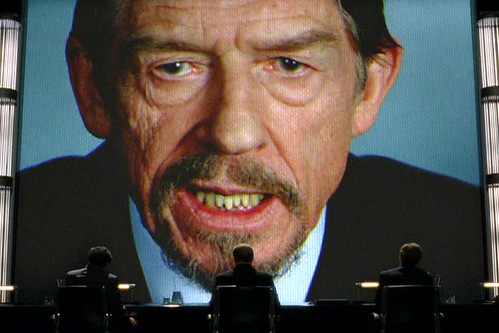
As Stephen Harper has increasingly consolidated power, he has done everything within his power to undermine Parliament and any body that is designed to hold government to account.  

He and his partisan team have gone above and beyond to attack and marginalize any and every Opposition leader in Parliament who has the job of holding government to account.


I'm less worried about whether Trudeau is "in over his head" - that's just a line, a message point crafted by un-elected PMO staff that is now being parroted by Conservative MPs that seem to be partisans first, the people's representatives second.

I''m more troubled by how this Conservative government is increasingly going over the head of every legal tool that exists to hold them accountable.

Because in the system of government we have right now, on paper and in practice, when government doesn't account to Parliament and Parliament answers to Political Parties, not citizens, then there is no accountability to Canadians at all.  

Unless, that is, you pay the price of admission and join a Political tribe.  But that wouldn't be very democratic, would it?

It's supposed to be the House of Commons, not the House of Partisans.  If access to the system comes at the cost of a Party membership, it's not democracy.

Team Harper aren't to blame for the gradual erosion of our Parliamentary democratic system - but it's quite possible they have broken it beyond repair.

It took Magna Carta and later, the English Civil War to deliver a responsible government; it may just be possible that we need something similar to give us the responsible democracy we both need and deserve.


Monday, 24 February 2014

Forward, Boldly


I love this:


Somewhere along the way, complacency and supreme, extravagant comfort has become our objective.  We aim to get rich, have the bigger house, gain unquestioned authority.
 
This is weakness of the structural variety.  Times change, climates change, demographics and their needs change.  To be at the cutting edge of change, you can't be static.
 
Our leaders need to stop measuring their accomplishments in terms of what lies behind them - it's time all of us remember that our greatest triumphs have yet to be achieved.


Someone is Listening

Good For Tim Hudak, Evolving with the Times


It takes a big man to admit when they're wrong.  This couldn't have been easy for Hudak, but it was the right thing to do and he deserves credit for doing it.

But you still have to feel bad for Dave Brister.

In the interests of moving forward, though, let's focus on the fact that Hudak has shown a willingness to question his own approaches, listen to others and make adjustments were appropriate.

So - those traditional manufacturing jobs.  Change sucks and is really, really hard on those who've already carved their niche in life and would like to keep things that way.  

Here's the deal, though - the reason they're leaving Ontario is because they're going to places with poverty-level wages and almost no protections for labourers.  Like Bangladesh.  Those manufacturing operations that are moving to the States aren't so much creating new jobs down there as putting more work on existing labourers.

Either way, this more-work-for-less-pay approach isn't going to work for those jurisdictions; as we're seeing in Bangladesh, they're just simmering towards the sorts of labour revolts we've already been through that landed us with unions in the first place.

Ontario's solution isn't to freeze our economy in the past with massive industry subsidies that don't work or to reduce our quality of citizen life in favour of old-school work, but to look forward.  That means new opportunities, new dynamism on the part of all employers, employees and labour groups, training and a revisit of our traditional, hierarchical, pay-fixated model of work.

I remain convinced that Hudak could surprise everyone and gain some massive wins by being the Labour Nixon that goes to the Union's China, engaging directly with unions themselves.  

Will he do it?  Probably not.  Politicians tend to be more focused on wins that solutions, to their (and our) detriment.

But hey - he's come this far.  Shows that anyone is capable of evolving with the times when they open themselves to progressive thinking.

John Tory's Challenge

Canadians are not being bold – Transportation discussion blog by Fred


Good for Tory for running.  It's not an easy thing to do, throwing your hat into the ring - especially when you've done so a couple of times in the past and had that hat stepped on.

I've had a couple chats with JT since his last loss, and the thing that impressed me the most was his frustration with politics-as-usual; the partisan positioning that focuses on individual wins rather than shared solutions.  He said he's tired of the backroom fights, the wasted opportunities, the cynicism of it all.

Here's where his challenge lies.

Win or lose, Tory's last kick at the can should be an opportunity to campaign with integrity, creativity and to catalyze more User Generator Content, building positive momentum through being a conduit, not messenger-in-chief.  Done with Sun-Tzu like strategic acumen, it's possible to win and win big by delivering wins for others and building on commonalities instead of dividing the field and expecting some troops to deliver for you.

With folk like Tom Allison on his team, it's possible he'll make moves onto this common ground.

But at the same time, come on - this is politics.  Everyone plays dirty, everyone is in it to win and whatever people can get away with, they'll do.  There are big machines out to get Tory, specifically.

Tory also has Nick Kouvalis on his team - the guy who took pride in faking calls to John Tory, passing misinformation around about Irwin Cotler.  Kouvalis believes ending careers is a noble profession - his profession.  He's all about the win and his brand as a winner, so I wouldn't count on him pulling out any stops.

At the end of the day, these are the sorts of people that get in to politics and with the right guidance and leadership, there's no reason the negative edges of some can't be tapered and the collaborative instincts of others can't be honed.  

It's what Tory has said he wants to see.

The question remains - is he up to the task himself?

We want to care, John - it's up to you to show us why we should.


Sunday, 23 February 2014

The Blind Master


  - Scott Adams, via CamMi Pham


One of the most influential people in my life was a fella named Eddie Dombrowski.  He was a middle-aged Polish-Canadian when I knew him, one summer long ago as an Ontario Ranger.  Eddie was sub-foreman for a camp I was in.  He was a rough-and-tumble, salt-of-the-earth kinda guy.  Took no slack from anyone, was focused on the work but knew how to have a good time.


This one day, we were cutting down growth around white pines when I hit a wasp's nest and started to get stung, bad.  Eddie saw me rush out; first thing he said was, "Where's your Sandvik?"  I'd dropped my axe when I first got stung.  "You'll have to go back and get it," Eddie said without sympathy.  "You'll know not to drop it next time, woncha?"

That was an important lesson, one I've tried to keep front-of-mind since; don't ever let the pain of the moment allow you to make mistakes you'll regret down the road.  

But it wasn't the most important thing I learned from Eddie.

That came at the end of the summer, when all the kids took off for home and, due to a scheduling mix-up, I ended up the only ranger left until the next day.  I ended up part of the end-of-year party, drinking with all the folk who'd been charged with managing the camp until then.

Before the party, a very quiet Eddie had chatted with the camp foreman, his boss.  When the talk was done it was like he'd run a marathon - he seemed suddenly very tired, but relieved.  When the beer started to flow I found out why.  

Eddie, the man who worked non-stop, kept kids in line and helped them overcome some of the fears and weaknesses of youth had found out his contract would be continued; he'd be in EI over winter, as he always ways, but would be able to pay to support his family for another year.

Since then I have never, never made assumptions about people income assistance from government, because you just never know.

I've been blessed to run into all kinds of unintentional tutors this way; a young street merchant in Marrakesh, a homeless woman in Venice, a bus driver in Ecuador - the list goes on.  

These encounters have drummed in one key message that I pray I never forget - to judge others is to shut out an opportunity to learn.  


Why Open Data Matters


I came upon this Globe and Mail story via Twitter while at Podcamp; I was there to discuss the importance of Open Data.

The quote stood out to me, because it summed up the argument I'd been making rather neatly - that is, that civil servants were being made to serve partisan, not public interests.  I copied it and the link and put them in my calendar as a reminder to post about later.

Jordan Sinclair isn't a Minister's office spokesman, not a partisan - he's from the department.

So, it's later.  I went in to the story and looked for the quote.  It wasn't there.  In its place was this: 

A spokeswoman for Employment Minister Jason Kenney said the report reflect "the period of time under the previous Liberal government," from 1993 forward.  

The line about a public servant parroting partisan messaging was gone; in its place, a partisan attack directed at a previous government.

Did I read and copy the quote wrong?  That doesn't seem right, as after a Google search I still managed to find it over at the CBC website.  But I didn't read the CBC story until now - I got the quote from the G&M story and saved it in my calendar along with the hyperlink I pulled from the very same page - the very same page that doesn't feature that quote at present.

There are all kinds of creepy implications about this turn of events, but the one that should alarm us the most is that evidence and consequence are being ignored when they contradict partisan messaging.

At some point in the not-too-far-distant future, the consequences of ignoring the facts will come back to haunt us.  I don't know about you, but I'd much rather solve a problem before it emerges rather than wait and place blame after the fact.

Especially when I know what the truth is.  That makes me accountable, too.  It doesn't matter what self-serving shenanigens the partisan people are up to - if I know there's a problem and choose not to act, I own some of the blame.  So do we all.

So, yeah - Open Data.  

The peaceable revolution can't come fast enough.