Search This Blog

CCE in brief

My photo
Recovering backpacker, Cornwallite at heart, political enthusiast, catalyst, writer, husband, father, community volunteer, unabashedly proud Canadian. Every hyperlink connects to something related directly or thematically to that which is highlighted.
Showing posts with label Tribalism. Show all posts

Sunday, 28 September 2014

It Gets Darker Before the Dawn


The best information. 
 
What would that be, exactly?  It doesn't refer to an understanding of behavioural economics and a thorough analysis of the causal conditions that lead to criminal behavior - that's too much like committing sociology.
It probably has nothing to do with geopolitics, especially the local equity imbalances that ISIS recruiters, like any gang, tap into to gain converts.
 
No, one imagine that the information provided will be of more the carding variety - suspicion by association.
 
Then there's the whole "focus on their safety" piece, which is most troubling.  "To serve and protect" puts the people's interest first, not the safety of officers.  It's inherently a risky job, but by getting in early, engaging with a community and working on initiatives like mentorship programs, active police help reduce crime in the first place.
 
A focus on safety tends to involve less interaction and when it comes, it comes with greater armament so as to reduce officer risk. 
 
Ferguson is a great example of how this plays out in practice; well-armed police with their usual suspects list caused and escalated a tragic situation one expect to hear about from the streets of Syria, not suburban USA.
 
Or think the G20 - police had information about black block plans to escalate street violence and fed right into that beast, creating a public relations nightmare and increasing tensions among citizens and the police, already high and already growing higher.
 
"I don't talk to cops," a youth told me on the streetcar the other day.  This after I interceded when hearing her say "I hate all cops," dehumanizing them in the same manner as which carding dehumanizes certain ethnic groups.  Tell us more about the youth who are choosing to join with ISIL, government: are they ethnic minorities who feel marginalized in their Canadian context, singled out by police, ignored by employers, looked at with suspicion on the subway?
 
There are a lot of good officers out there.  I hear from them, sometimes, about the struggle they have within the current police culture that focuses on strength, wins, and threats more than it does public service.  I hear the exact same thing from youth entering that culture, which is alarming.
 

Why?  Because the folk of ISIS are brutal alphas with a superiority complex.  The God they worship is not the one of Islam; if anything, they have fallen for the false god prophesied by Islamic eschatology.
 
The thuggish converts to ISIS rape, pillage, torture, abuse power and focus on destroying others in defense of "their cause" which is a create a state in which they have absolute unquestioned authority and the respect of the international community because they're such bad asses.
 
Suspicion, fear, threat of arms, abuse - those aren't the tools of enlightenment.  They are, however, increasingly the hammer of choice for security.
 
As they say, it's darkest before the dawn - but the dawn is a long way off.  It's going to get a lot, lot darker - which why now, more than ever, we need to keep the candle of enlightenment burning.


Friday, 9 May 2014

Winning vs. Accomplishing in Politics


It's counter-intuitive, I know, in a competitive industry like politics.  Support something your opponents can claim as a win?  Terrible idea.  Allow an opponent to take credit for your idea and benefit from the praise?  How self-destructive is that?

Politics is about winning and winning is about beating your opponents, full stop.  As the saying goes, you can accomplish great things in politics, but only when you're in power.  It's better to stand against something you believe in if it means denying your opponents a victory; after all, you can just implement the same policy when you're in power and get the credit for it.

Even if that means standing in the way of good policy for your constituents.

If your job is to represent and promote the best interests of constituents, though, isn't it counter-intuitive to stand in the way of what's going to improve their lives?

Such is the cognitive dissonance of Party Politics; winning politically on the macro level now trumps individual responsibility on the elected official level.  The losers in this bid to win, sadly, are the people.

It doesn't have to be this way.

Some words of advice I once received from what you may consider a surprising source - "our job is to serve the client's interest.  Sometimes that means helping your enemy bet a win.  Just remember who your priority is."

Wise words, those, ones I've taken to heart.  They came from Leslie Noble.

Leslie, in addition to being one of Tim Hudak's advisers, is a very successful government relations consultant.  Clients love her because she's good at pushing their issues forward.  She doesn't do it by attacking and bullying her targeted politicians, as some lobbyists do - instead, she identifies what a given audience's priorities are and designs solutions that are made up of little wins for everyone across the board.

Granted, she's not running for office - but why would she need to?  She accomplishes her objectives - scores wins for her clients, if you will - perfectly well from the outside.

You'd be surprised (or maybe not so much nowadays) how much our political agenda is shaped by people who aren't in political office.  They have identified the end-goals of politicians and Parties - to win - and have learned how to nudge them in certain directions with the trade off being of helping them win.

Is it diabolical?  No - it's strategic.  It also happens to be short-sighted.

Winning, you see, implies an end-game; a zero-sum situation where one party walks away the winner and the other is the loser.  This doesn't happen in politics, because there's always another election, always an opposition (unless you have a one-party system, which I don't think anyone is in favour of).  

The more combative you are this time around, the more combative they are going to be next time around, leading to an escalation not of evidence-based debate, but heated rhetoric and personal attacks.  
Kind of like we're seeing now.  

What happens in this scenario, of course, is the system loses - citizens get tired of the choices available to them, realize just how much the system is being gamed and tune out.  Eventually, they will fight back.

It's the same thing with those private, vested interests manipulating the politicians to deliver individual wins that put money in their pockets - by narrowing policy focus to a thin wedge of issues and disregarding/demonizing all others, imbalances occur.  

Take the Oil Industry, for example.  They're wealthy, influential and have a very narrow mandate - to make more money by extracting and selling more oil.  What happens if oil extraction is environmentally damaging?  Not their issue - stamp it out.  What happens if the available oil sources dry up or are impossible to extract?  Not something they want to consider - bury the issue.  

And what is policy designed to support the oil industry exclusively results in a dearth of social capacity for anything else, like advanced manufacturing, clean/green energy tech, so on and so forth?  If oil's your thing, you don't care - like playing the stock market, you maximize your winnings and then cash out.  What happens after is someone else's problem.

But balancing problems, weighing consequences and devising forward-thinking policy is the job of our politicians.  When they're focused on power grabs and beholden to wealth-generating industries, you can see how cracks start to appear in the system.

Kinda like we have right now.

So, where do we go from here?  Is it possible to disrupt the influence of special interest groups like Oil on Political Parties?  Can we disrupt the influence Partisan interests has on narrowing the policy discussion?

We certainly can.  In fact, it's already happening.  

The reason we don't have big names or nascent interest groups crying out for public attention around things like #OpenGov and #OpenData is because they aren't interested in winning - just accomplishing.

We're going to hit a tipping point in the very near future where smart, self-interested people are going to see the massive opportunities for wealth and power that are available through the Open Movement.  

That's when you'll start hearing about what's already begun.  When the selfish start promoting altruistic, informed and lateral participation, that's when we all win.

Thursday, 24 April 2014

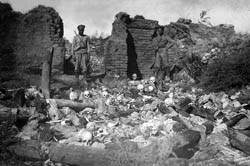
Sins of the Father: Tribalism and the Armenian Genocide


He did this after being forced to visit to Ohrdruf, a labour camp not far beyond city limits.  This visit was demanded by one General Eisenhower, who at the time was Supreme Commander of the Allied Expeditionary Forces. 


It was Germany, 1945 - the end of World War II.  Ohrdruf was a sub-camp of Buchenwald, one of the Nazis' infamous Concentration Camps and the setting of the attempted genocide traditionally referred to as The Holocaust.


I know a bit about Buchenwald.  In fact, I was there but a week ago, celebrating the 69th Anniversary of the camp's liberation by Eisenhower's forces.  My grandfather, as you may know, spent time in Buchenwald as an inmate. 

While other Allied soldiers experienced the atrocities of Buchenwald in the immediate aftermath (due to a very wise decision by Eisenhower), my grandpa was one of 168 Allied Airmen who were there at the peak of the Camp's operation.

I've heard the faith-shattering stories from many, many survivors: the inhuman conditions of the camp, the dehumanizing treatment by the SS and Camp Kapos, the illness, starvation and being worked to death.  And always, the constant plume of smoke rising from the crematorium's chimney.

Buchenwald rests on the far side of a hill visible from Weimar, once the centre of German intellectualism.  The smoke from that chimney would have been visible to the naked eye of the people of Weimar.  It's hard to imagine the gunshots from the hill wouldn't have echoed as far of the town as well.


The people of towns like Weimar and Gotha would have known, or at least have had ample evidence to piece together what was happening just beyond their borders.  Yet they chose not to see, not to hear - they didn't want to be responsible.


But they were responsible.  In turning a blind eye and by their inaction, they chose to do nothing and evil triumphed. 

At least for a time. 

The war ended, atrocities came to light and consequences began to be felt.  The people of Weimar were made to visit Buchenwald and see what exactly they'd turned a blind eye to.  When they could no longer deny what had happened - when they were forced to look upon the horrors they had permitted to happen in their midst - they wept.

Times have changed in Germany; now, the City of Weimar has pledged to condemn and fight against such tyranny in the future.  It doesn't matter whether such matters are federal in nature.  Matters of jurisdiction don't matter any more - what's morally just does.

The same holds true of a new initiative in Spain seeking to create a community of municipalities that declare themselves anti-Fascist.  Municipalities are realizing that, while their federal counterparts get mired in the complexities of foreign affairs and strategic diplomacy, they are unfettered in their ability to stand up for what's right.

Today, when my grandfather and other Buchenwald survivors from across the globe return to Weimar, they are greeted as friends.  These survivors, in turn, view the people of Weimar as friends.  In fact, some of the best friends we have are young Germans who volunteer their time to support commemoration efforts because they feel exactly the same way we do; the Holocaust happened, it was horrible, and it's up to all of us to remember the past and prevent it from happening again.

One of the most important lessons my grandfather has taught me is that it is wrong to blame the child (or grandchild) for the sins of the father.  It's possible that one of my German friends is the grandchild of an SS guard who worked in Buchenwald - I don't care.  I know who they are, what they believe in, and that's what matters to me.


The Armenian Genocide was just that - a systematic and intentional attempt to eradicate an entire people.  It was immoral, wrong, inhuman and those who perpetrated the massacre of 1.5 million Armenians deserve to be remembered for all time for what they did.

But it happened in 1915, a very long time ago.  None of the Turkish politicians fighting against the Armenian Genocide being called what it is were alive when it happened.  They are not to blame for the sins of a past generation.

Look, I get their concerns.  People by and large are still tribal - we generalize people all the time and heap whole hosts of assumptions and lineages of the past.  Politics in particular is bad for this - Parties will take credit for the work done a century ago by people who had completely different perspectives than they did, while equally tarring opponents with the negative legacies of anyone who shared their brand once upon a time.


In a tribalized view of the world, a Turk is a Turk and an Armenian an Armenian - ne'er the twixt shall meet, each generation carries the weight of their tribal past.  By the same token, in a tribalized view of the world, there's us, who are real people, and them, who aren't.  


The Nazis didn't view Jews or Poles or Homosexuals as fellow human beings - they dehumanized them, which is why they were able to to treat them like animals.  The same held true for the Turks who killed Armenians, or the Americans who massacred First Nations, or any other ethnic conflict anywhere in the world.  

Tribalism perpetuates false divisions and dehumanizes anyone you can describe as not like you, which is a group that invariably grows larger the more you pursue a path of exlcusion.

But the world isn't tribalized any more, is it?  There are children out there of mixed Turkish, Armenian, Dutch and whatever else descent who don't view themselves as the embodiment of one lineage, but the progenitors of something new.

My children are a mutt-mix of European lineages, plus a couple strands of East Asian.  How do they self-identify?  As Canadian.


To me, that's the whole point of Canada - we're not a competing tribe.  We're not a monochrome people.  We are a confluence of every ethnicity, every ideology, every religion and every way of looking at the world.


By virtue of being a bit of everyone, we don't have the luxury of cherry-picking arguments or picking one side over another.  The very mix of our population forces (or at least, should force) us to look at the bigger picture, empathize, take the time to understand and focus on what we can learn from the past to improve the future.

This has been a trend this week which has carried through writings by Don Lenihan and Andrew Coyne; we must get passed entrenched ideologies, we must embrace this thing called responsibility. 

Today's young Germans are no more the perpetrators of the Holocaust than today's young Turks caused the Armenian genocide or young Canadians build the residential school system.  But we do have responsibility to learn from these sad chapters of history so that we don't repeat the mistakes of our forefathers.


Fortunately, this is starting to happen.  In fits and spurts, the people are recognizing that they aren't tied to one history, nor one brand; even in Turkey,Young Turks are pushing back against the official denial of the Armenian Genocide.

It's unfortunate that we have a rising tide of politicians taking the "not my problem" approach once favoured by the Mayor of Gotha.  It's not going to work out very well for them in the long run.

Fortunately, we have a growing mass of individuals stepping out of the dark cave of tribal identity and seeing the world for what it is - a complex dynamic environment that doesn't live in the past, but rather evolves rapidly into the future.

As always, it will be our governments shaming us either through "strategic" positioning in places like the Ukraine or "strategic" ignoring of crises such as that in Syria or the Sudan.

It takes an engaged people who recognize that not knowing isn't an option to speak truth to power and break the sway of tribalism.

One day, we will be the mothers and fathers whose actions will be discussed by our grandchildren.  Instead of focusing on what someone did in the past, maybe it's time we start thinking about what legacy we want to leave behind ourselves.


Tuesday, 20 August 2013

Policing and Politics: Putting Mission Before Tribe


We humans are a tribal species - it's hard-wired into our genetic code.  There's value in knowing what is prey and what is predator in the same way it's useful to have the ability to identify friend from enemy.


Think about that for a second; we identify with others based on a series of often arbitrary markers (type of clothes we wear, music we listen to, profession we practice, sport we play, faith we practice, Political Party we align with).

We externalize people the same way; we can look down upon whole groups of people who dress a certain way, who listen to a certain music or have a different ethnicity.  


I have all kinds of fun conversations with self-identified tribal people (lawyers, politicians, political operatives, law enforcement officers) who will rail with impunity against perceived others and act in a manner they would vilify their perceived opponents for.  One of my recent favourites involved a long-standing Liberal who referred to Conservatives as "all fucking assholes" with no morality, suggesting they need to be shown no quarter.  Of course, I regularly hear the same thing from the other side of the spectrum.  Stephen Harper clearly thinks that way.


Policing is a highly tribal field, partially from necessity; when you're in the line of fire, you need to know who is on your side and who isn't.  The distinct uniforms, vehicles and jargon used (to say nothing of the training) reinforces the notion that you are somewhat above the majority and definitively set against a specific subset - criminals.  Criminals don't wear redcoats, don't all speak the same language, so you have to identify them quickly in some form or fashion.  

It just so happens that crime emerges most commonly from those who are marginalized.  It's a fact of history that, in countries like Canada, there are far more marginalized "visibility minority" communities than "white" ones.  The cognitive association game comes in to play - cops are more likely to assume black men are bad guys in the same way Liberals or Conservatives are more likely to view each other as villains rather than human beings with lineage and motivations.


The reverse is equally true; when you feel threatened by The Other it's a natural instinct to surround yourself with the familiar - people who look, think and speak the way you do.  This is why it's so common to find neighbourhoods that skew heavily towards one ethnic group or another.  It's also why, in fields like policing or politics, loyalty is valued above actual skill.  


The Fords have focused on the concept of Ford Nation - a tribe with a loosely defined belief system that you're either "in" and understand or you're "out" and you're a threat.  Mark Towhey was part of this system, until such time as he began to challenge the behvaiour of the Chief - at that point, he'd disengaged himself from the Tribe and was rebranded as The Other.  Of course, what Towhey was trying to do was his job - not as part of the Mayor's Court but as his Chief of Staff and as a public servant.  Price, however, puts the tribe first - even though his behaviour is questionable, the Fords will trust him as one of their own.


Politics is the essence of tribalism; Parties will fight against The Other and engage in ethically questionable practices to fend off the barbarians at the gate.  Since they are In and everyone else is Out, there's a certain sense of entitlement that comes with the status.  We have lots of examples of how this plays out gracing the headlines these days.

The problem is, we don't accept the concept of tribalism in polite circles any more - it makes us sound too uncivilized.  If you point out that a Tribe - say, a Political Party - doesn't practice what it preaches, it will react in a tribal way by ostracizing or attacking the source of the complaint.  The reaction then gets justified or ignored - they aren't being tribal, it's the other person who is out of line.  Omerta and circled wagons are the norm, rather than introspection and growth. 

Which brings us back to Mark Towhey.  Towhey, a military man, understood the concept of "the mission comes first."  That meant the Ford mandate moreso than even the Fords themselves.  Instead of being a courtier enabler, Towhey appears to have tried to help his boss realign so that their mission wasn't compromised.  For this loyalty to mission, he got fired.  It's tribally-motivated actions like this that will prove Ford's undoing in the end, as is always the case in politics.

What's the solution to this paradoxical dilemma, where competitive fields promote tribal identification, which emboldens bad behaviour, which perpetuates the division?

"The error that I think the force made was focusing the policy towards the rank-and-file officers.  I really think that race relations policy should be geared to top management.  As such, those policies would be articulated by management and it percolates down through the system."

In Other words, leaders need to start leading by example.

We simply have to stop enabling and protecting the folk at the top from their own failings - it's those failings that define the culture which perpetuates the cycle.  Of course, that means mixing up the people at the top of an organization (a police force, a Political Party) to be more reflective of those they will engage with in the field.  It also means teaching the people at the top that it's not about them, nor is it about the tribe - the mission must always come first.

It's as true in politics as it is in policing.