Search This Blog

CCE in brief

My photo
Recovering backpacker, Cornwallite at heart, political enthusiast, catalyst, writer, husband, father, community volunteer, unabashedly proud Canadian. Every hyperlink connects to something related directly or thematically to that which is highlighted.
Showing posts with label Make Web Not War. Show all posts

Friday, 29 August 2014

Please help me set my #OGT14 table! (UPDATED)


Events take place starting at 6:30PM in Jean Pigott Hall at Ottawa City Hall, 110 Laurier Avenue West, Ottawa. The doors will be open at 6PM.

I have to fill a maximum of 8 minutes of speaking time saying something poignant about why you can't have Open Government without a Responsible Society.

What I wasn't counting on was this - I've been assigned a 2 x 6 table that I need to populate with something.  Here are my directions:
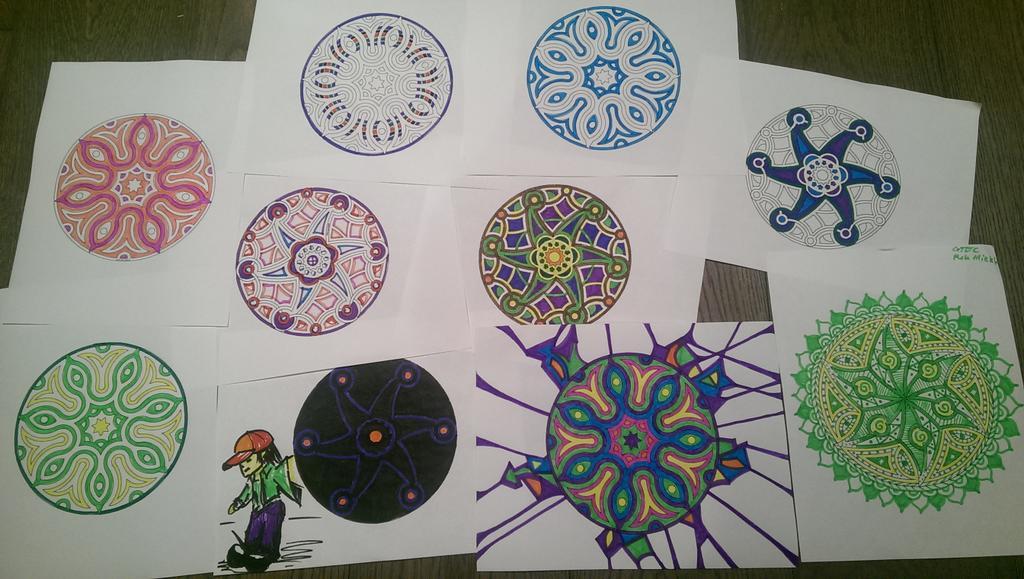
Embedded image permalinkRemaining décor is up to your imagination. Bring your own displays, banners, posters, props, pamphlets, swag ... Etc, but be aware that they will need to be free standing or on the table.
Here's where I need your help.

My firm Wakata Inc. is dedicated to public affairs with a social purpose; I like to frame my partner Jen Li and I as the stone in the soup, bringing people and organizations together and facilitating shared solutions.  While I'm going to #OGT14 as me, not as Wakata, I want to hold true to what I believe in.

So - what should I display on my table?  Who can I promote, what shared solutions can I hint at in my space?

M first thoughts were that I'd like to promote the following:

Samara - democracy renewal
Why Should I Care - civic engagement
Exhibit Change - improving communication and comprehension
SoJo - a cool web platform that will create community and help individuals turn ideas into action.
MaRS Solutions Lab - anyone planning policy past the four-year cycle deserves some space!

I would have included Make Web Not War, but I imagine they have their own table, being the patrons of #OGT14 and all.

Those are my first thoughts, though I would need some resources from them to put on my table around the stone I just asked Richard Pietro to pick up for me somewhere between Vancouver and here.

What do you think?  All cool suggestions are welcome - and feel free to share them on Twitter using #OGT14!


UPDATED Sept 2 2014:

And the gold star for first carrot goes to Samara!  Samara has offered materials about their Everyday Political Citizen project for my #OGT14 table.

Samara is a perfect compliment for what OpenGov and Responsible Society are all about - our politics can do better, but not without an informed, engaged public.  Their Everyday Political Citizen project is designed to recognize and celebrate the democratic catalysts in our midst; the people who ask questions, who encourage you to get informed, who believe that it's through direct engagement that we can make a difference.

My #EPCitizen nominee for this year, as it happens, is Richard Pietro.

Richard has picked up a stone out west for me to use as the centrepiece of my table, the thing that brings groups like Samara (and hopefully, SoJo, WSIC, Exhibit Change, MaRS) together.  This is appropriate, because his #OGT14 tour has served the same role this summer - bringing together an incredibly diverse community from across the country around one shared theme:

Open Government.

Richard's brought the stone, Samara the first ingredient - but there's lots of space left!  Who's up next?


Wednesday, 30 July 2014

Why Richard Pietro Deserves Your Support


I've been in and around politics for pretty much my entire professional life.  I've supported many candidates - sadly, less than I've actually worked for.  

I'd like to think my experiences both positive and negative have given me at least a wee bit of insight into what works and what doesn't when it comes to a political campaign and a "winning" candidate.

So when I ask you to support someone I believe in, who I feel can really change our country for the better, you've got reason to wonder when the ask is coming.

Here's the thing; my guy isn't looking for donations or even votes.  He's not running for anything and, in fact, is decidedly sick of politics-as-usual.

All he wants is for you to get engaged.  He believes that we're better, stronger, more adaptable when we work together openly.

His ask isn't empty rhetoric; he asks no more than he is already doing himself.  With the Open Government on the Open Road #OGT14 tour, this fella is literally bringing the Open Government conversation from coast to coast.

My friend is gaining support for his efforts here and even internationally.  

It's not because he's got the most seasoned campaign team behind him.  He doesn't; most of the people helping him are doing something they've never done before.

It isn't because of the massive funds he's raised; Make Web Not War chipped in $10,000 as a patron and that's pretty much all there is.

No barrage of strategically planned advertising is pushing the Open Government message to its audience.

People support this fella because they believe in him, are inspired by what he says and deep down, beneath the layers of cynical sediment they agree.

Meet Richard Pietro, folks.  We're going to be hearing a lot more about him.

Or, better yet - you can be part of the Open movement.  If you're on Twitter, follow him at #OGT14.  If you're on the path of his tour (schedule found here) stop by for a listen.  

Check out Canada's Open Government Action Plan, here.

Above all else, though, get engaged.  Join the conversation, do some homework on Open Government and Open Data, question - be a catalyst.

The reason I support Richard is because he believes in us.  Hopefully, that's a team we can all get behind.


Thursday, 3 July 2014

#OGT14: The Adventure Begins

Embedded image permalink


He's off.
 
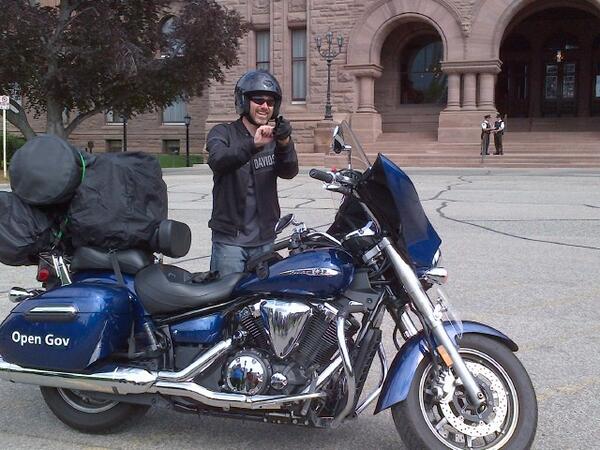
Richard Pietro has set off on the journey of a lifetime, an epic trek of exploration across Canada in pursuit of community and in promotion of Open Government.
 
In communities from coast to coast, regional organizers are setting up events like the one that happened last night at Toronto City Hall where Richard will discuss what Open Government is, how Open Data can improve everything from our economy to our democracy and, importantly, how where we go for here is up to all of us, together.
 
Richard's journey has been in the works for a long time, with a great deal of support from the folks at Make Web Not War, especially Keith Loo and Bruce Chau.  Make Web Not War has revitalized the artist/patron relationship, providing Richard with $10,000 in support of his tour - #OGT14, for those of you on Twitter - with the ask of nothing in return.
 
It's important to pause on this for a second.

Make Web Not War is a corporate social responsibility arm of Microsoft.  It has a financial purpose (drive traffic to their cloud), but that comes second to their mission, which is to promote the values of openness, transparency and engagement they believe in.  And they've given $10,000 to a little French Canadian guy with a dream and a motorcycle.
 
The people who've dedicated countless hours to Richard's quest have not done so for monetary gain, or to build their own brand - nobody's made headlines or fortunes from this venture.  They, like the MWNW team, believe as Richard does, that our future must be shared, open, accountable and engaging.  It's this vision that has brought everyone together, sharing their skills, times, resources and networks to make Richard's trip a success.
 
Why?  There are so many causes, individuals and whatnot out there, seeking dollars and donations of time and resources - why has Richard garnered the support he has?  He's not a politician, a corporate leader or a wicked salesman.  He's a server with some knowledge and a dream.
 
There are many reasons as to why people are so willing to empower Richard in the realization of his Open Gov on the Open Road tour, but one towers above all others: Richard is the embodiment of his dream.  Open, authentic, collaborative and engaging, Richard lives his life in the exact manner that he envisions our country functioning.  You can learn more about his Principles for an Open Live here.

We believe in Richard because we know that he believes in his vision and ideals. 
 
We believe in Open Government because it's absolutely necessary for us to move forward.  It may be corny to say, but we believe in the willingness of Canadians to engage, too.  Canadians do care - they just need opportunities to participate.
 
Richard is a catalyst, setting small stones in motion.  The hope is that as his journey progresses, interest and participation will grow; like Forrest Gump, he will inspire the country to go on the adventure with him.
 
A former backpacker, I know what it's like to start off on an unfathomable quest across a continent with nothing but your kit, a couple coins and whatever charm and empathy you can muster.  As the world you left behind closes in and carries about it's business, you find yourself unattached, a tumbleweed blowing across the country, touching down on the lives of countless others.  Maybe you leave a kernel of an idea or two behind; maybe you act as a social synapse, bridging those communities together.
 
It's the best feeling in the world.
 
At the same time, I know what it's like to feel the immensity of landscape, to experience the tight bonds of community as an outsider and that wearying feeling of waking up each day with no idea what to expect of the day ahead.
 
Richard will be putting his head down in a tent for much of his trip - and as his dad says, Richard's idea of camping tends to be sleeping in a bad Holiday Inn.  He has to carry his whole world on his bike, through varied landscapes and whatever weather Mother Nature throws his way.  There will be cold, wet days, cold, dark nights, moments of fatigue and loneliness and a feeling of being lost where, I'm sure, Richard will question his purpose.


As a former backpacker, I know all too well the challenges that are in store for him.  I had a chat with Richard's dad today, who expressed concerns about what happens if his son gets caught in a flood, or finds himself without enough food, or if lord know what else happens to him. 
 
As a dad myself, I can relate to his concern.  It's not an easy journey to take on your own, this quest of his.
 
This is where we come in, Canada.
 
Richard Pietro has a dream, one that is shared by many, if not most of us - that we need to renew the relationship between citizen and government and that government needs to be more open, accountable and engaging.  We, as citizens, need to want to engage. 
 
As he rolls across the Canadian landscape, Richard is daring to do what many of us have longed for someone to do - he's picked up the gauntlet and is being the change we collectively want to see in our country.  Here's how we can help.
 
If you see Richard on his quest across Canada, offer him an encouraging word.  I'm sure a bite of food wouldn't hurt, from time to time, too.  If you're on social media, follow his tour via #OGT14 on Twitter; there will be videos that emerge, feel free to share them. 

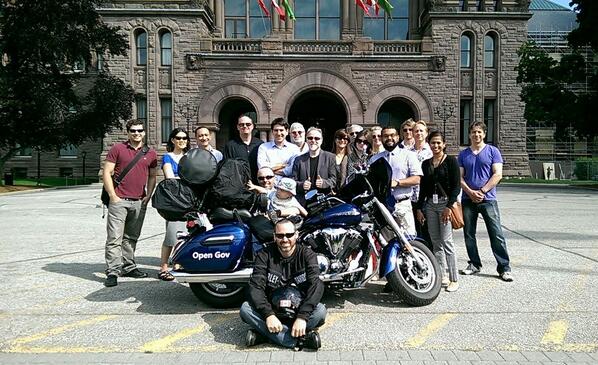
Embedded image permalinkIf you feel so inclined, hop in your car or on your bike and join him for a spell, as Bruce Chau has done already.  We can be Richard's community as he seeks to bridge Canada's communities together.
 
More than all of this - if you believe in the mission, if you believe in the vision, then engage.  Post a video, write a blog piece, attend a session, take pictures, talk to friends, make new friends.  Write to your Member of Parliament, call up your local press.  Talk to your kids about what it means to be a citizen.
 
Richard is one man on a bike, but what he is doing, he's doing for all of us.  Canada doesn't belong to one community or to elected officials; it's something we are all part of.  When we recognize this and engage, we can shape the country we want to have, together.
 
Which, ultimately, is what openness is all about.

Embedded image permalink

Monday, 2 June 2014

Open and Yellow: Effective Advertising Starts with Why


@YellowPages_ca gets a tip of the hat for a brilliant ad campaign currently adding some freshness to Toronto's subway system.
 
Most ads promote a company, service or product directly.  They tell us what they are in flashy phrases, tell us how they do it better than anyone else and of course, tell us we want what they have to offer.
 
This wasn't Yellow Pages' jumping-off point.
 
Yellow Pages clearly thought through why they exist - to provide people access to the services and information they need.  How might they do so more effectively?  Through the development of an App, of course.  They adapted to the times to ensure they were implementing their why in the most effective way possible.
 
Then, they developed an ad campaign that carried their why further.  Instead of using ad space to tell people what they do and how well they adapt to the times, they designed a campaign that actually demonstrates what they do.  It's mercilessly efficient; no opportunity to implement their why is wasted.
 
Even better, the campaign is clearly targeted to the end-users that are being exposed to these ads.  What do people using public transit do?  Well, the use public transit to get from point A to B.  Why should the care about Yellow Pages?  Yellow Pages can help them use the tools they use already more effectively, giving them more access within their existing patterns of behaviour.
 
That's smart, but that's barely scratching  the surface of what these ads achieve.
 
By promoting local business areas, Yellow Pages is supplementing the work of local BIAs - something individual businesses will surely be appreciative of.  By providing information about things to see and do in Toronto, Yellow Pages is enhancing and aiding the City's Economic Development and Culture division.  The City (and its elected officials) will surely recognize the value of that.
 
It's CSR, advertising and social capital-building, all at once.  So what's this got to do with #OpenGov and #OpenData?
 
Across the board, government is struggling to implement it's why effectively.  This is in no small part because governments and bureaucracies are focused on what they do, not why they do it.  What they do is provide services, build and maintain infrastructure, create and enforce laws and occasionally consult with stakeholders (like voters).   
 
Why they do it is murkier.  That's their mandate is the short answer, but why is this mandate important?  Why do we need government at all?
 
Government is not focused on individual wins or maximizing the profit of shareholders any more than its goal isn't to put a chicken in every pot.  In practice, government is a Social Gardener - it exists to foster sustainable, dynamic growth across the system.  Strong individuals, strong communities, a strong society.
 
This is why we are seeing increasing interest in Open Government and Open Data across the board - how might government better empower citizens and companies to cross-pollinate and support each other?  How might government spend less time (and money) in sales or defense and more implementing their why?
 
Governments could do worse that follow Yellow Pages' example.
 
Through opening public data and making it accessible as possible, Government empowers citizens to see what the landscape looks like so that they might navigate it better.  Transparency isn't just about letting people see into the sausage-making process; it's an opportunity to clearly articulate the why in each and every decision and engagement.
 
By embracing the tools that people use and designing both their services and promotions with end-users in mind, government can design services that are actually meant to be used, rather than simply exist should someone decide to look for them.
 
The other key thing that government could learn from Yellow Pages is that ROI isn't always a clear-cut two-step process.  Sometimes adding value because you can helps achieve your why more effectively than only committing to something transactionally.
 
There are plenty of people in government who think the way Yellow Pages does, just as there are plenty of external partners ranging from Make Web Not War to Samara to the Maytree Foundation who feel the same way.

Government doesn't need to be all things to all people any more than Yellow Pages needs to deliver every service they promote.  That's not their why.
 
It's time government rediscover their purpose and spend less time maximizing revenue or downsizing services and instead dedicate their time and resources to improving efficiency by reducing duplication, gaps and overlaps within the system.  They might generate less profit that way, but they'll inevitably reduce costs, which leads to the same goal, and they'll improve circulation within the system.
 
I can't think of a better why than that.


Thursday, 22 May 2014

Open Data Solutions for Toronto's Transit Mess


Toronto transit is a bit of a mess, but it's a problem that stretches beyond infrastructure.  When everyone is traveling the same arteries at the same time of day, each impatient to get where they're going and intolerant of delays, problems happen.

We can blame Public Works and Infrastructure for shoddy repair plans; we can blame aggressive drivers for clogging up intersections by racing lights; we can blame pedestrians, politicians or whoever else we want for the general congestion of our roads, but that doesn't help matters.

Instead of focusing on blame, let's look for solutions - which, in turn, present opportunity for entrepreneurs.

Players involved in our transit nightmare include:

- commuters
- planners
- business owners (who set work hours and, as such, standardized commute times)
- politicians
- business owners and residents (who dislike construction that impedes traffic to their venues/homes)
- construction firms (eager to make coin doing the work)
- police and Emergency Services (direct traffic, deal with accidents, etc)
- Metrolinx and the TTC - planning side, comms side, front-line workers, etc.
- Taxi drivers.  Oh, those taxi drivers.
- Bicyclists and the organizations that represent them
- Tourist/conference authorities in town
- the airports
- Municipal governments of bedroom communities
- anyone else?


There are lots more than this.  If you want a thorough assessment of who's impacted and who needs to be part of the solution conversation, go talk to Bianca Wylie at Swerhun - she's a world leader at this stuff. (She's on twitter - @biancawylie)

The two main, unavoidable factors here are 1) people need to get where they're going and 2) the roads have to be up to par for transit to happen.

Do the people need to get where they're going at the same time?  Do they need to get where they're going all the time?  What role can staggered working hours, work-from-home schedules, etc. play in reducing gridlock and related lost productivity?

There are big, structural challenges in here that, if politicians were to bring to stakeholders in different sectors, creative, shared solutions could be developed for.  

But let's get real - that's not going to happen any time soon.  People are way too focused on their own, micro problems to pay attention to how their behaviours play into the macro problems we all share.

Which brings us to Transit and Open Data.


If you're not familiar with RocketMan, it's worth checking out - an App for your phone that tracks public transit via Open Data provided by the city.  Instead of waiting for a bus that may or may not be on time, you can check your App and see where it's at in relatively real time, saving you from standing around needlessly.

Think about this for a second - free, public data made available resulted in an innovative solution that helps the public but also made an entrepreneur money.

How cool is that?

Back to transit construction.

It's a given that construction is going to happen - there's now way around it.  It's also a given that this construction is going to impede transit flows.  

But what if you had an App that mapped out construction zones for you and helped navigate around it? 

If we had real-time congestion metrics (recorded by cameras at busy intersections, for instance) you could feed that data into the App too.  Someone commuting from Etobicoke to downtown Toronto would be able to check their App, see where construction was happening that day and determine a couple of alternative routes to get where they're going and figure out (roughly) the time required.


In an ideal world, you'd get scenarios where an employee could tell their boss the commute time looks to be a dismal 3 hours of lost productivity; the boss would then say "work from home today so you don't lose productive hours" and then any direct communication could be done virtually.  And, you'd have one less body on the road.

It's all doable.  With the App side, if there was an entrepreneurial App designer out there they could get started on this immediately.  Talk to Keith McDonald at the City of Toronto's Open Data team (@COTkeith on Twitter) or check out Make Web Not War (@WebNotWar on Twitter) to find open data sets that could help you with planning.  They may even be able to offer you advice.

The key point to all this is that we don't need to be so reliant on politicians to come up with one-size-fits-all plans on our behalf; we have the tools we need to make positive change happen ourselves.  We just need the will and support to get moving.

And we all want to keep moving, don't we?


Friday, 24 January 2014

It's the Culture, Stupid: Corporate Welfare and Horatio Alger


The Horatio Alger myth is closely associated with The American Dream - the belief that with honesty, hope and hard work, anyone can rise from the ashes of poverty to the heights of power.

This notion of the ability to succeed despite an inequitable playing field has been co-opted by Objectivists and Libertarians on the Political Right; in their take, the villains have been replaced by governments.  If it weren't for oppressive, stifling regulation and burdensome taxation, they say, businesses would flourish and enterprising individuals would get ahead.

The problem, they will tell us, is that regulation and taxation stifles the ambitions of corporations large and small; the welfare state coddles individuals, oppressing their natural ability to rise up and succeed.  Get rid of the system, let the free market do its thing, and everyone will magically start behaving in a successfully selfish, go-get-'em way.

Individuals should look to the wealthy bankers, lawyers and country squires for inspiration - after all, if they could succeed, anyone can.  It's just a matter of the have-nots getting over themselves and doing what it takes to get ahead.

After all; if Horatio Alger could do it, anyone can.


Last night I had the privilege to attend the relaunch of Make Web Not War.  MWNW is a passionate community of tech enthusiasts primarily, but increasingly boasting representation from the world of communication, policy and community activism.  The goal of MWNW is to catalyze an Open Society, where people freely share information and work collaboratively for a better world through - you knew it was coming - honesty, hope and hard work and an actual sense of community (raise all ships, go far together).


The sponsor for MWNW is Microsoft, a corporate giant.  They have put a great deal of money into their open community initiative and are proactively engaging in other open society projects such as Open Data Day Toronto.  

That bears repeating - they make money by doing what they do well and are investing back into the community, despite whatever taxation and regulation impediments may be in their way.

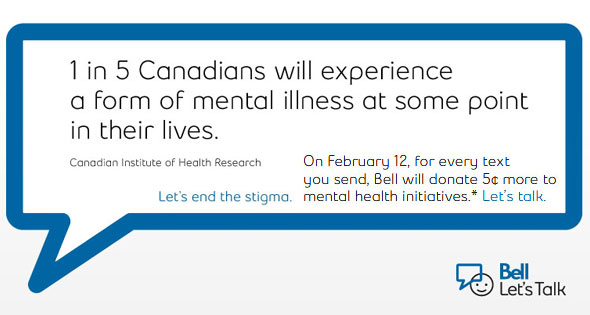
Microsoft isn't alone in this; organizations like Bell Canada have invested heavily in Let's Talk, a suicide/crisis hotline.  Corus Canada invests in education initiatives.  There are countless examples of successful businesses that aren't sitting on their capital, but investing it back into their communities.  


They aren't waiting for regulatory or taxation changes - they're succeeding and contributing on the strength of their own drive, offerings and vision.


Then, take a look at a company like RIM.  RIM had a huge burst of success that actually declined as Canada/Ontario's regulatory and taxation burdens declined.  What government did had nothing to do with RIM's failure; they simply stopped being as innovative and trend-setting as they had been.  The became complacent and sought to beat existing trends, not set new courses.

And what of the car manufacturing industry?  Is it government's fault they aren't succeeding?  The Political Right has derided the provision of "corporate welfare" propping up failing industries in much the same way as they deride welfare for individuals.  Meanwhile, the Political Left gets mad seeing government dollars end up lining the pocket of increasingly wealthy CEOs.

Why on earth would CEOs be pocketing money that could be better used to incent productivity and innovation from their teams?  Is that, too, the fault of government?  If so, then how do you explain Make Web Not War or Bell Let's Talk or the private support for Open Data Day Toronto?

I've said it before and will keep repeating the same message (that's what they teach you in politics): what's good for the goose is good for the gander.

If the Political Right expects individuals to pull up their boot straps and find success, no matter what circumstances of poverty they find themselves in, then the same must hold true for corporations.  They don't need excessive tax breaks or the strip-mining of regulation; if so, then their successful, pro-social peers couldn't have succeeded either.

If it's the fault of Canada's unemployed and working poor that they're falling behind, then it's the fault of capital-hoarding companies that they aren't pushing envelopes, too.  

Of course, that's a simplistic assessment that misses the big picture.  We have crafted a culture of self-interest in Canada, one that largely fits the objectivist narrative of one Stephen Harper.  When you put your own wealth first, then that becomes your only goal.  You're not interested in helping others, or investing in others, but rather in reducing costs so that you can retain more income.  Which is what Right To Work is all about, too.

So here's a new spin on an old theme - it's the culture, stupid.  

We are encouraging people to be hewers of wood and haulers of water, profiting much from as little innovation and investment as possible.  It's true from the top to the bottom; we want sellers, not pioneers, and counter-intuitively are motivating the kind of behaviour that's holding us back.

Not that it should matter what policies are set from the top, nor the hurdles that lie on the path to social consciousness.  

If Microsoft can do it, Canadian CEOs, so can you, without waiting for some magical government vanishing act to make your lives easier.

So quit making excuses and get it done.