Search This Blog

CCE in brief

My photo
Recovering backpacker, Cornwallite at heart, political enthusiast, catalyst, writer, husband, father, community volunteer, unabashedly proud Canadian. Every hyperlink connects to something related directly or thematically to that which is highlighted.
Showing posts with label Funding. Show all posts

Tuesday, 4 March 2014

OpenGov: Want Structural Solutions? Quit Funding In Silos!


Part of the push behind the whole Open Government/Open Data movement is that policy advisers and makers have realized they simply can't solve all the problems that lie before them.  

That's nothing new, of course; what's changed is that, thanks in no small part to social media gaffes, mistakes and ignored policy pieces are coming to light in rapid, viral fashion.  Add to this a toxic, hyper-partisan political climate where every gap, overlap or oversight is pilloried as the devil's work and you've but an unsustainable dynamic.

One of the key problems identified in actually solving structural issues in jurisdictions at all levels is internal bureaucratic culture.  Decisions are made at the top and instructions are flowed down with little explanation and no context.  Differing departments can be working on a piece of a bigger puzzle without any idea what the end picture is supposed to look like.  


Even worse is what's called "the black hole" phenomenon, where results collected at the front end get flowed to the top without any comment or indication of what worked/what didn't/how that information is informing the decision-making process.


Add to this the "clay layer" of middle managers who are in a state of stasis - probably never going to go up the ladder, but damned if they're going to take challenges from below.  Fresh ideas from the bottom and any exposition from the top gets stopped in this layer that traditionally hoards knowledge like it's their ticket to survival.

Sidebar - this identified cultural problem is what the political culture is increasingly trying to resemble.  Always a step behind, they are.

A perfect example of why this is a failed model is program funding.  Governments, as you know, fund programs.  Some new programs are developed from within the bureaucracy while others come from the political government of the day (and as often are not, have political motivations).

So the process works like this:

Political Side has an idea - let's say it's that cutting down on incidences of Type II Diabetes will cut healthcare costs (and improve lives).  They give money to Ministries with narrow mandates of how to allocate these funds down the chain.

Ministries turn that money into funding streams - they will give it to health agencies, but with narrow mandates of what kinds of programs they can create and flow funding to front-line service providers for.

Front-line service providers will apply for funding - which means tailoring their ask to perfectly match the requirements of the proposal, which has been increasingly narrowly defined from the top down.  It's no wonder grant-writers get paid so well; knowing how to frame a proposal to meet the desires of the program (rather than the needs of the community) is tricky business.  If you're an organization without money to hire a good grant-writer, sucks to be you.


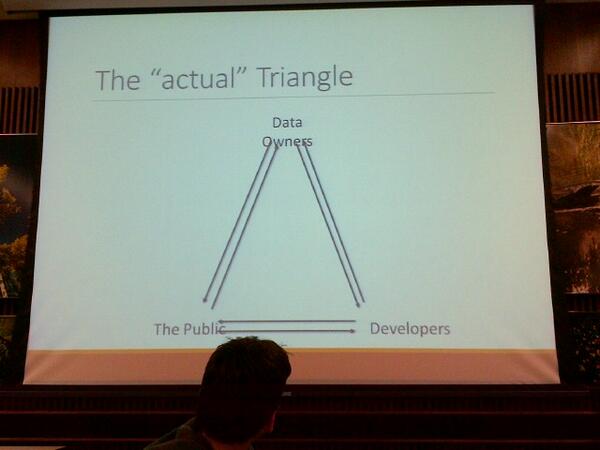
Funding and information flow one way.  The people at the top never get their feet wet.


There are a couple of problems with this model.  

One - how do the people at the top make their decisions on what and how to fund?  What informs the parameters they set?  Good question - it's not always clear.  When it's all about the money, though, it's not in everyone's best interests to ask.

Two - what if the parameters set are wrong?  What if the front-line has identified needs that aren't matched by any program, or are best matched through a shared-solution that fits into more than one funding bucket?  

This is where advocacy comes in.  It's possible to advocate for changes and promote differing interests; we see this happen all the time.  The problem is, again, that advocacy/government relations is a specialized and costly skill.  If you don't have the money, you not only can't get grants, but you can't promote your clients' best interests with decision makers.

Hence, Open Government and Open Data.  The goal is to open the decision making process so it's clear to everyone how and why certain choices are made - and, in theory, make it easier and more affordable to influence the process.  

The same applies to Open Data - if people on the front line see that the choices being made aren't going to work, they can formulate and pitch alternatives.

But all of this is moot until the internal culture changes.  So long as it's accepted practice for information to flow one way and the assumption is that the people at the top know better than the people at the bottom, we won't have Open Government.

Embedded image permalink
What government should start doing is co-designing funding streams with partners all along the chain. 


This way, the programs offered will be clearly designed to support the ground-level needs and realities of communities and the big-picture agendas of government.  There are good firms out there who do consultative co-designing this way, like Swerhun and Exhibit Change.  They're even local.

But to get there, government needs to do some co-designed structural changes to how they do business internally.  Break through the clay layer with some grassroots, as it were.

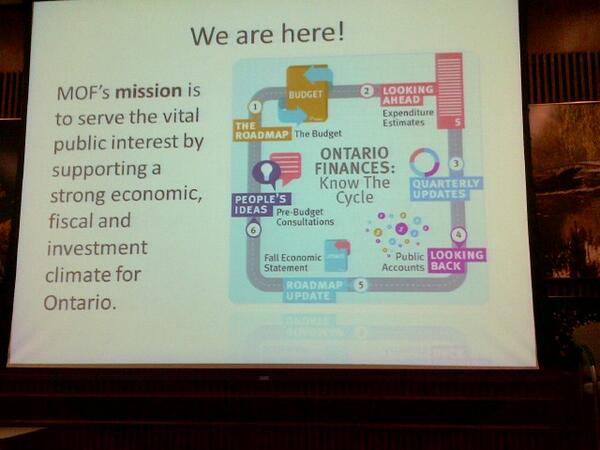
The fact that the federal and provincial governments are paying for a Human Resources cultural competency program suggests to me they might have twigged on to this need to change perspectives internally and that it's not just about top-down management.
Embedded image permalink
That's an excellent place to start.  If government were to fund an internal co-design process that seeks to address the structural problems of a strictly hierarchical and silo-based organizational structure, they could vastly improve the efficacy, impact and adaptability of their operations and planning.  


They'd also set a good example for non-governmental players, too, including those capital-hoarding companies that are missing the boat on catalyzing internal innovation and stemming the massive costs related to occupational mental health/presenteeism.

A focus on cuts reduces your bandwidth and flexibility. 

Systems, not silos, is the way to sustainability.  

And if they don't believe it coming from me, that's fine - I'd be more than happy to connect decision-makers with folk up and down the ranks and in every sector who feel the same way. 

But you'd want to start with these young folk who will inherit whatever system (or mess) we leave behind.  Believe me - they've got ideas you should be open to.

Embedded image permalink


Friday, 18 October 2013

Is Canada Settling?


The other day, I cam across a fantastic tool called The Little Black Book of Scams - a fraud awareness booklet designed in a user-friendly way, released by the Canadian government.  Fantastic idea, I thought - for all the feds' talk about being "tough on crime" there isn't much being done on prevention.  That they would take the trouble to innovate something new and proactive rather than preventative was a good sign.

Then I opened the cover.

"The Little Black Book of Scams was originally developed by the Australian Competition and Consumer Commission", wrote Melanie Aitken, Canada's Commissioner of Competition. 

It's hardly the first time the Canadian Government has borrowed from Australia.  In fact, we are constantly borrowing innovations from other jurisdictions; we've turned it into an art.  While countries like the US and Australia are pursuing new, risky, potentially amazing ideas, Canada is about incrementalism at best and at worst, stagnation.  "This too shall pass" has become our rallying cry in the face of diversity, be it economic or social tensions.  Government focuses on walling off troubles lapping at our shores rather than harnessing troubled waters to spin the wheels of inspiration.

Why should it be otherwise?  For much of our history, it's been true.  Canada hasn't seen real conflict on our home soil for generations.  We've had a grand total of one political assassination in our nation's history.  The FLQ crisis was a tame affair compared to, say, Northern Ireland.  As a nation we are blessed with abundant natural resources which less-blessed nations needs to build the things they innovate; if the approach ain't broken, why should we fix it? 


Peace, order and good government is our rationale - there's no need to be innovative, thank you very much - the boat's sailing just fine the way it is so please don't rock it.  Government and in general, the Private Sector have made an art out of justifying the status quo in the name of fiscal prudence.  

I have see this same theme play out from all sectors; structural change gets discussed in academic terms at conference with a demand for bold ideas and vision-oriented leadership but when people return to their boardrooms, the focus changes to "Do we really need to change" and "What proven models out there can we crib from so as not to assume any risk ourselves?"

Everyone talks about grabbing the low-hanging fruit; nobody talks about personally reaching higher.

The problem is, the folks in charge are deluding themselves, falling victim to their own scams.  The system we have is floundering; the boat has already sprung leaks.  Natural resource extraction isn't proving to be the panacea it was promised to be and what we do have is proving to have consequences beyond what was advertized.  

For all our talk of weathering economic storms, more and more Canadians are falling behind and becoming disengaged.  Instead of innovating new solutions, Canadian companies are instead focused on cutting corners, chipping away at whatever competitive advantage they had.


Faced with this reality, we have politicians boastfully presenting plans to lower our standard of living to make Canada more cost-competitive, with value-add being ignored entirely.  The general theme is that we don't need to adapt to a changed modern reality - if we can just step back in time and recreate what we had a half-century ago, everything will be fine.


I don't think so, Tim - you can never go back to before.  The times have changed and to stay competitive, to perhaps even lead the way, Canada must start thinking differently.  We must start acting creatively.

The good news is, this is already happening - just not where we expect it to.  While government tinkers at the margins of policy and far too many Private Sector players are  mired in their comfort zone, there are innovative, proactive firms doing things differently.  Their practices might not have long track records, but so far they seem to be doing pretty well.  The reason for this unprecedented success is hardly a surprise - these firms have done their homework and are using the latest understanding of what motivates cognitive labour (both productivity and innovation) developed in other fields to their advantage, creating new opportunities in the process.

Instead of employing the success-oriented, blinders-on focus that is supposed to be the determinant for success, they are embracing failure as learning opportunities and looking laterally for inspiration.

Therein lies the great irony - we have this expectation that money and power are the great motivators for success.  In a way, this is true - the most competitive people will generally rise to the top, often on the backs of others.  That doesn't mean they're creative, just forceful.  But competition isn't about creation - that's a different process requiring different incentives.  Some of the most creative people don't do sales well, as the emphasis on selling what they have would detract from their ability to push their ideas even further.

The people government is trying to motivate in the Private Sector (and the Private Sector is trying to motivate in government) are social laggards when it comes to innovation - they're too comfortable to be bothered.  Therefore, all the tax breaks, speeches and advocacy are being pointed in the wrong direction and in the wrong manner.

The most innovative people in this country (and there are a lot of them) aren't all about money and power; profit has become a means, not an end.  The truly revolutionary ideas on how to design things differently (everything from our education model to the way we design public spaces) are working with the people who don't have lots of money to pay for their services.


It's not that Canada as a whole has settled, only that our Established Class, the ones with the lion's share of the resources have.  It's why they're content to support tough-on-crime measures and tax breaks, because they're reactive against someone else rather than involving proactive action on their part.  The social entrepreneurs, on the other hand, seek out the marginalized communities in our midst and in working with them are innovating the structural solutions we so desperately need.


Canada is a rich country blessed with everything we need to succeed; financial resources and business acumen at the highest levels of society and a diverse, innovative group of social entrepreneurs working at the grassroots level.

The elite don't need to innovate themselves, nor must they continue to rely on imported ideas; truly, that's the approach that failed civilizations have employed throughout history.  All that is required is for someone to bridge the gap between the different elements of society so that there is a healthy exchange of funds at the top for ideas generated at ground-level.

This catalyst can come in the form of the burning platform effect, or it can be caused by someone putting a stone in the soup; one way or another, though, it will happen.


   - Business Quarterly 37 (4); 1972