Search This Blog

CCE in brief

My photo
Recovering backpacker, Cornwallite at heart, political enthusiast, catalyst, writer, husband, father, community volunteer, unabashedly proud Canadian. Every hyperlink connects to something related directly or thematically to that which is highlighted.
Showing posts with label Canadian Military. Show all posts

Wednesday, 28 August 2013

Fit For Conscription?


Thinking this morning about Syria - and the various alliances lining up on either side of the Syria equation - reminds me more than a bit of the state of Europe pre-World War I.  If supporters like the US, Great Britain and Germany are steadfast committed to siding against the Assad regime and Iran and Russia decide to support him in force things could get pretty nasty, pretty quick.  Add to that the volatility across the Middle East and in economically challenged countries with heightened ethnic tensions like Greece and Hungary and ongoing violence in hotspots ranging from Somalia to Western China, there's a potential scenario which sees the world on fire.


All worst-case scenario stuff, of course.  One would like to think we've learned from the past and won't repeat the mistakes of our forefathers.

If, though, countries like Canada find themselves further engaged in fighting for a new world of law where the strong are just, the weak secure and the peace preserved - would we have the military resources to do so?  Sure, there's lots of talk about procuring physical assets like f35s, but a story less told is how poorly we've been doing in supporting our troops, particularly where it comes to PTSD.  One must question whether we have the human resources required to sustain heavy combat in multiple theatres, simultaneously.

If we don't?  If the demands of world security (and our allies) grows more burdensome than our military can bear, would Canada ever re-introduce conscription, giving yet another generation of young men (and now, women) the opportunity to serve their country on the front lines?  Again, unlikely.  As Randian Objectivism has become today's Marxism, I don't see their being a lot of appetite for that against a backdrop of austerity, but not yet widespread desperation.

If we do, though - how prepared are Canadians to go to war?  How fit are we?  I know of a whole host of young Canadians, highly trained and extremely motivated who have spent months or years looking, unsuccessfully, for steady work.  They're becoming more psychologically fragile the longer uncertain futures loom over them.  Frankly, I wonder what sort of training supports they would need to develop the sort of emotional discipline required to run into opposing gunfire.

Then, there's the physical fitness.  Society-wide, we've gotten into a bad habit of off-loading our healthcare to healthcare providers; without the physiotherapy, the drugs and the personal trainers (if you can afford any of those things), how fit are we?  A generation of desk-workers could find themselves dying more of strain-induced heart attacks than actual combat.  

Of course, this is all speculative.  It's at the extreme end of strategic planning to consider such eventualities, but guaranteed that somewhere, military gamers are running scenarios, just as they are around water insecurity.
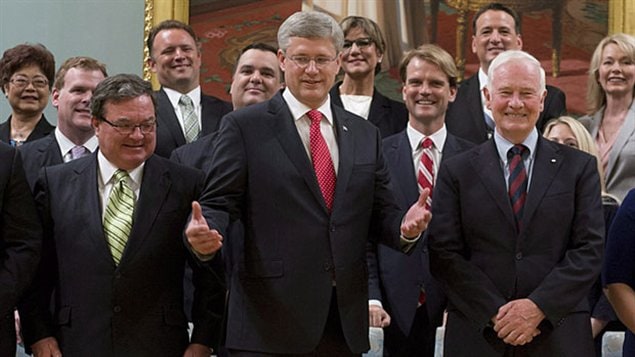
If it does happen though, I'd argue we aren't ready.  It would take several years of committed government intervention to get new soldiers fit and trained for combat.  More than that it would take a massive propaganda war (far more invasive than even the Economic Action Plan one) to get Canadians committed to the idea of putting skin in the game in the name of Harper's New Canada.


After a decade of "stop expecting government to hold your hand" leadership, it would be very interesting to see our current federal government turn around, commit sociology and ask Canadians to put their lives on the line for others in their name.  It'd be a bit rich for the political class to tell Canadians to ask what they can do for their country when they have visibly failed to set that standard.

I think our political leaders need to do some serious soul-searching about what they want Canada to be ready for down the road.  I think it's even more important for Canadians to have open conversations about these big questions.

War is the ultimate game-changer; Canada's identity was shaped by global conflicts past, as well as conflict solutions like peacekeeping.  War could very well change who we are and what we stand for again.

None of us can make informed choices that will impact the young feet that may fill tomorrow's boots on the ground if we don't take the time to get informed.

What's happening in Syria is a great place to start.

Wednesday, 5 September 2012

Rob Ford Was Right The Second Time


I wouldn't doubt that his foundation makes such a difference in the lives of participants.  Having a supportive tribe/social group, discipline and a common, achievable goal to strive towards can have a powerful impact on personal development.  The military is build on that very same model, or at least it was.  Conversely, being born into poverty and surrounded by violence gives youth the wrong message, the wrong incentives from day one.
 
 
On the one hand, Ford seems to get that - his programs, which are social programs, save lives and provide opportunity for their participants.  On the other hand, he can still say things like this:


There aren't many who are interested in investing in a retail shop in a hot zone.  But there are lots of people willing to invest in programs that give kids the support they need to nurture the tools of success.
 
 
Rob Ford's dedication and passion for the kids in his program is commendable; there's no question in my mind that he believes in what he does.  All I ask is that he broaden his horizons a bit - as Mayor, he has opportunity and responsibility to make that exact same commitment to all Toronto's youth.
 
 
As too many of our officials seem to be forgetting, true leadership leaves no one behind; it helps us move forward together.


Tuesday, 4 September 2012

Save Our Soldiers


And yet:


I'm sure that Team Harper is focused with free-market intensity on stopping the gravy train when they cut services like this.  They've probably thought very carefully about the bottom line and PR implications of forcing our veterans to individually prove they need psychological help, going against the grain of their training and "corporate culture" of Yes Sir, No Sir, No Excuses Sir.
 
 
But I ask this - have they spent much time thinking about what happens when they decide to move on Iran or any number of emerging conflicts with soldiers that are emotionally and psychologically frayed?  Do they assume they can just hire more troops, when the horrifying consequences of armed conflict are blasted onto every TV, Movie, Video Game and mobile device screen?  Have they thought out the implications of biting off more than Canada can handle militarily or public response to institution a draft?
 
 
No matter what they might try to tell themselves, it's not just about the money.  It's about the people.  I pray for our men and women in uniform - and for the rest of us - that Team Harper doesn't learn this lesson the hard way.

Monday, 7 May 2012

Stephen Harper’s Opportunity for Legacy: A Centralized, Proactive Mental Health Strategy


I have been critical of Stephen Harper; I think he often takes a short-sighted, cynical policy track that favours his Party’s interest over his country’s.  Like most politicians, these two things have bled into one in his mind.  I don’t, however, think he does this out of malice – Stephen Harper genuinely feels that might makes right, that people left to fend for themselves fare best and that ideologies other than his own are threatening.  Harper’s heart is in the right place – it’s his head that needs to follow suit by seeking out and acknowledging the facts and making a conscious effort to develop evidence-based policy. 

I believe PM Harper really does care about mental health issues; it’s not an abstract policy file to him but something that hits home.   Like most people, though, he doesn’t fully get mental health.  If you’re tough enough, common wisdom suggests, if you’re focused enough and willing to do whatever it takes, you can bend reality to your will.  You can win the race, become Prime Minister, even will away depression and anxiety.  It’s a wishful theory, but it’s just not true.

Society, the “body politic,” is just that – a system of interconnected parts where minute hits felt anywhere impact everywhere, whether we recognize this or not.  Take post-traumatic stress disorder – what the mind does to get the body through conflict has long-term repercussions.  Whether it’s a soldier coming back from war, a child who has been bullied or someone who has faced discrimination in the workplace for any reason, the accumulative impact of these experiences doesn’t build resiliency and social/emotional empathy – it attacks confidence, fosters aggression and depression and significantly impedes performance - especially innovative performance. 

Multiply that impact across communities, cities, provinces, the world – you end up with people who can’t function in society and live on the streets, aggressive drivers who aren't mindful of the traffic around them, bitter bosses and under-performing employees.  You end up with people who only know how to solve problems through aggression, rather than compromise.  In a nutshell, that’s the root of the challenges we are facing globally; it’s a crisis that simply turning people loose or micro-managing them cannot solve.


Stephen Harper’s Legacy

This, then, is Stephen Harper’s true leadership moment.  What happens on the mental health front will define his legacy; either he can be the Prime Minister that builds a national solution that will positively and proactively assist generations of Canadians (and potentially be copied by other nations), or he will be remembered as the Prime Minister who saw a slide in civility, social cohesion and general mental health on his watch. 

If Harper is willing to look past some of his own concerns about firewalls and collaboration, he can go down in history as the Conscious Nixon who went to the China of mental illness.  He can align his fiscally conservative sensibilities not to cut and isolate services, but blend them together into an efficient, cohesive, centrally-coordinated mental health system facilitated by the best modern technology – and Canadian technology companies – have to offer.

A centralized national health and mental health system is good policy.  It makes for good politics, too.  Being the architect of such a system would also define Stephen Harper as one of the most visionary leaders in Canadian, perhaps global history.  A powerful legacy to leave behind, but one that can only be reached by empowering and connecting others.


If you want to go fast, go alone.

If you want to go far – move forward together.


Thursday, 19 April 2012

Motivating Innovative Success


Occupy.  Davos.  Goldman Sachs.  ORNGE.  The Knowledge Economy.  Mental Health.  Public Health costs. 

Everyone I talk to is looking at individual, structural problems and wringing their hands in worry about what to do next.  Some of these folk are equally looking ahead at the emerging reality of the Knowledge Economy and wondering how we can get from here to there.

All these pieces are connected.  Like playing three-dimensional chess, we have to stop looking at individual social issues and see how they fit together into a holistic puzzle.  To do that, we need to revisit our understanding of how we can move our pieces and what strategies will help us get past our two-dimensional thought box.

The best place to start is with motivation.

“You eat what you kill” is a standard phrase in consulting land.  For employees in many a field, the rule tends to be that performance is rewarded by bonuses; if your colleagues get bonuses and you don’t, it’s because you’re a failure.  While financial reward might be good for pushing people to produce more, faster, or to be more aggressive in sales, it turns out financial reward is not the best motivator for innovative success. 

Many will say that statement flies in the phase of standard wisdom – money has always been success' reward.  For these people, I leave you two stories to consider; heliocentrism and evolution.  You can keep breaking down a pull door because you can’t push it open, but there might be an easier, more effective and less stressful way to get where you want to go – success in innovation, leadership in the Knowledge Economy.


     - Margaret Atwood


LEARNING

Nothing comes from nothing.  Creative ideas don’t magically pop into people’s heads, fully-formed.  If you want people to innovate, you have to provide them with raw material they can absorb and time to properly synthesize.  This can’t be a one-off affair; it has to be a life-long thing.

Fortunately, there are pretty good models out there to help make this happen in an affordable, accessible and efficient way.


MEANING

Bring meaning into work.  While we like to differentiate between what we think motivates people at different stages of their life and in different roles, that’s largely a social construction.  What really motivates, say, a volunteer to give 200% is the same thing that motivates employees.  You gotta give them some skin in the game.

Having done a lot of time recruiting and supporting volunteers in my time, there are three things that are proven to keep them coming back for more:

1)      Recognition.  They aren’t tools, they're people.  Engage them as such.  Get to know them, learn about why they're volunteering and what their other interests are.  You never know where a potential for cross-pollination will arise and you’ll surely never find it if you don’t ask.


2)      Food.  Volunteers should always have access to at least snacks and drinks, like juice, coffee and tea.  It’s not hard to add some crackers and fruit to the mix.  The less your team needs to think about what and when to eat, the more cognitive energy (and physical strength) they have to dedicate to your cause.  The same holds true for employees, and the best employers always have a coffee/tea machine, some snacks and definitely a microwave and fridge.


3)      Meaningful work.  People get frustrated when they feel they are digging and filling in holes for no purpose.  They need to understand what the point is.  Having said this, if you’re delivering something with meaning that every volunteer or employee can latch on to, people will spend hours stickering cards in support of that cause.  You still want to mix up the tasks a bit and allow people to be challenged; you also want to set the example by having the people at the top of the food chain sitting down and do the grunt-work with everyone else.


One of my favourite campaign memories involves a long, tired night of stickering U-Vote-Ats for a provincial by-election in the GTA.  The exhausted team was sitting around a table, beavering away when my boss of the time, the former MPP for Stormont, Dundas and South Glengarry came in and sat down to sticker with us.  Jim Brownell sat there for hours, making silly jokes with the rest of us and just stickered.  It’s no wonder that people would travel across the province to support him, too.


LEGACY

Why do we have sex?  To leave progeny behind.  The same holds true for ideas; consciously or unconsciously, people who get engaged want to be leave something behind or be a part of something bigger than themselves that they feel has a good chance of enduring.  It’s the human equivalent, I think, of lekking behaviour.

If we can grasp this concept, consciously, we can build in legacy and meaning into work design.

My dad, a retired research historian, told me about a talk he was asked to give to one group or another.  He was asked what his fee was; my dad suggested to me that he didn’t have a fee and that the idea hadn’t occurred to him.  He enjoyed sharing his expertise on the subject; that was his motivation.  I told him he was missing an opportunity.  Iif he doesn’t need the extra cash and believes in his cause, why not has his fee be a donation to a charity or organization of his choice?

At the recent THINK2012 conference hosted by the amazing ORION Network, guest facilitators were paid in donations to causes they believed in.  It’s a good motivator; there’s no reason you can’t apply this in the workplace, too.

I would suggest that you want to give employees what they need to live, comfortably, and make sure salary always fits within that comfortable quality-of-life range.  Particularly if you’re a creative industry, though, tie success to meaning and legacy; give your workers public credit for what they accomplish, plus an opportunity (through donations-as-bonus) to build legacy by giving back to their community.  Remember, quality-of-life isn't about cash, it's about access and interaction.

If we’re all doing this proactively and benefiting from the process, that means government will have to spend less and charities will be able to spend less on marketing.


There’s really nothing new to the idea of proactively motivating your team to do what’s in your/your company’s best interest.  It’s been around since the days of Sun-Tzu.  All we need do now is make sure this wisdom is applied to the 21st Century context:

The best victory is when the opponent surrenders of its own accord before there are any actual hostilities... It is best to win without fighting.


Friday, 30 March 2012

Stephen Harper: It’s Dangerous to Ignore Our Veterans


I have an active interest in how veterans are treated.  My grandfather, Ed Carter-Edwards, served as an Airman during World War II and actually ended up spending time incarcerated at Buchenwald Concentration Camp.  To survive, my grandpa built thick mental firewalls to disconnect from the horrors that surrounded him; when he returned to Canada, the damage was so great that he spent some time institutionalized.  Upon his release, the advice he was given by his military overseers was to keep his experience to himself; to talk about something like that would make people uncomfortable and essentially make him un-hirable. 


The more I have learned about my grandfather’s War experience, the greater an understanding I have of how it shaped him and, as a consequence, my father and myself.  It was the undying devotion of his wife and family that helped him re-adapt to civilian life, though the scars are never far from the surface.  I go to great pains to teach my son that it is not okay to absolve oneself of social responsibility; when we do that, everyone suffers.  We owe it to ourselves to be supportive of others.  It’s yet one more reason why I got into politics and why I’m such a staunch advocate for building strong, collaborative individuals for a strong, functioning society. 


If we owe ourselves a supportive society, we are indebted to our men and women in uniform who sacrifice so much, on so many levels, to give us the security we need to foster that society.  History teaches us what happens when we break that vow.


There’s World War II – there’s also Vietnam.  It was a tough war fought on questionable ground, but the men and women who put their lives on the line did so because that was the personal commitment they had made to their country; to keep it safe or die trying.  The expectation therein is that the country has an obligation back to their soldiers, not to offer a lump-sum of cash and move along, but to help those vets every step of the way.  The US didn’t post-Vietnam – a study in 2007 determined that 1 in 4 homeless people in America were vets.


We now have 40,000 Canadian veterans who served the will of government through deployments to Afghanistan.  Some of them have been horrendously, physically injured.  Every last one of them has lived, over there, in a constant state of anxiety for what might come next.  Every last soldier bears the psychological scars that are the inevitable wounds of war. 


Canada’s military puts more than their lives on the line when they don our uniform; they risk their sanity, the well-being of their families and their future, should they survive their deployments (tricky thing; if the government doesn't declare war, it impacts a soldier's benefits).  This is more than any employer has the right to ask of an employee, but like teachers, soldiers don’t serve for themselves, but out of their belief in something greater.  They also cannot speak out on their own behalf – that is the level of commitment they make by signing up to serve.  Our obligations to them, to their families and to our collective future must equally be more than contractual – it must be moral.


I had assumed Canada has learned the lesson that has played out, time and time again, globally – you need to support your vets.  If you don’t, a couple of things happen; one, they can develop longer-term illnesses, physical and psychological, that impede their ability to function in society.  On worst-case scenarios, you see violence, suicide, or great men found drunk under park benches.  Post-traumatic stress disorder is but a fraction of this.  Here in Ontario, the McGuinty government recognized that firefighters can develop work-related illnesses that can be debilitating and made the right move to provide them with the help they deserve for the job they do, protecting the rest of us.  Harper's such a big supporter of the military, right?  Surely he would proactively do right by our men and women in uniform?


Turns out I was wrong.  The Harper government has moved away from ongoing support for disabled veterans in favour of a one-time lump sum payment.  They also put the responsibility to justify disability assistance on disabled soldiers, which is a bit like telling someone who was hit by a car it's up to them to prove they were injured.  Sure, this fits within their general modus operandi of “leave people to fend for themselves” following meagre cheques in the mail for child care instead of a plan and the gutting of Canada’s census.  It’s the standard Hard Right, Hawkish approach – you need to build in a certain “moral toughness” into people by forcing them to survive on their own – selection of the fittest in a social context.  It’s also so wrong as to be dangerous.


It just goes to show how completely ignorant, willfully or not, these people are of history and biology.  It wasn’t a lack of “moral toughness” that helped scale us back from a nuclear Holocaust in 1963 – in fact, it was the ingrained need to be the last man standing that landed us on the brink over those thirteen days.  “Toughness” isn’t the ability to fight back against whatever – what we want to foster is resiliency.  Instead of pursuing an evidence-based approach that looks at physical and psychological kinetics, the Tories are just going with their gut.


So, here’s a little gut-fact for you; anger is strongly correlated with obesity and heart disease.  Look at the bulldogs in the Harper cabinet – Dean del Mastro is a good example.  Look at Toronto’s Rob Ford.  Look at Stephen Harper himself.  These are angry, bitter men that aren’t connecting the dots between their waistlines and their cognitive positioning.  What this means, ultimately, that they can’t fix their problems with a one-off diet regimen; there is an entire lifestyle change required, one that will take the support of their peers and, more broadly, the society in which they exist.


Which brings us back to our 40,000 Canadian veterans of Afghanistan.  If the government plans to absolve their broader responsibility to the long-term well-being of these men and women, they are going to have problems reacclimatizing to civilian life.  Full stop.  That means broken families (and impacted children), dysfunction at work and potential long-term unemployment and the acting out socially of the symptoms of their PTSD, etc.  None of this will be their fault but they, along with society, will have no choice but to bear the consequences of Team Harper’s un-front negligence.  This helps our broader internal and external security goals none at all. 


Another thing to consider; Canada’s military brass, like director-levels everywhere, is largely made up of baby boomers.  When they retire, who will replace them?  Those same vets whose PTSD did not get adequate short-term treatment.  Almost 1 in 4 Canadian veterans of Afghanistan suffer from mental illnessThink about what that could mean for the future of Canadian military decisions for a second.


What’s maddening about this is that Stephen Harper gets the impact of mental illness; his biological grandfather suffered depression and likely committed suicide as a result.  There is an unfortunate social stigma around mental illness and suicide; if I read Harper right, his internal fears about self-control, exacerbated by his frustration with some control-removing Liberal pollicies like the NEP, have largely shaped his Machiavellian, firewall, control-freak nature and policy development.  His anger management issues fit that context perfectly.


Caught in a cycle of recrimination, Harper is perpetuating the mistakes of the past – mistakes we can ill afford at a time when the global economy is crumpling and very real international threats, including the rise of ethnic violence in Europe, are building.  Now is the very worst time to hide behind walls – from the top down, Canadians must be open with and supportive of each other.  Stephen Harper needs to set a positive example by seeking help to conquer his internal demons; it will take a lot of courage on his part, but as Prime Minister, it’s his job to pave the way.  There are precedents to this; there’s a reason why Australia is a leader in mental health promotion.


It takes guts to make oneself so utterly vulnerable, particularly when one has worked so hard to foster a political culture of vicious personal attacks.  True strength doesn’t come from without, however, but from within.  Harper can internally justify taking such a brave risk by saying he’s not doing it for himself; he’s not even doing for his Party.  He would publicly own up to his insecurities and seek help in remedying them on behalf of our soldiers.  Harper would also have mountains of evidence-based reasoning in his favour (some of which can be found in the left-hand column of this blog).  In so doing, he would then empower himself and society to face the elephant in the room and start doing right by our veterans.


After all, they do the same for us each and every day.