Search This Blog

CCE in brief

My photo
Recovering backpacker, Cornwallite at heart, political enthusiast, catalyst, writer, husband, father, community volunteer, unabashedly proud Canadian. Every hyperlink connects to something related directly or thematically to that which is highlighted.

Sunday, 2 September 2012

The Political Fight For Your Limbic Brain


Both sides of the political spectrum are turning to research suggesting that they other guys are more emotional, less practical than they are.  The new political battleground is on the hustings of cognition.


Which is funny, because they're both right.  To me, that just proves that our social divides don't exist on the axis we think they do and, more to the point, to function as strong individuals in a strong society, we need them both.
 
Move forward together, etc.

The Conscious Revolution is Catching


Mental capacity, and the lack of it, was much discussed in and around Ottawa last week.

 
The word "crazy" gets bandied about with alarming regularity, considering how poorly defined it is.  You can use crazy in the sense of nonsensical, bold, aggressive, reluctant, petulant, ignorant, dumb or even as a descriptor for an actual condition of cognitive impairment.  Given its vagueness of meaning, crazy is really a poor term to use as anything other than an insult.  If you want to actually give a situation, a condition or a person meaning, you need to refine your terminology a bit.
 
 
Hence, Rob Ford's functional fixedness is being considered through the lens of a recognized cognitive behaviour suite, obsessive compulsive disorder.  There are plenty of other politicians who could be diagnosed as having a "mental illness" and indeed, many have come forward, admitting to battles with neurologically-originated conditions like depression or alcoholism.  In fact, the study of the political brain has become trendy in science and journalism  Now, we're still in that phase of the game where we look to use labelling of cognitive ability as a stick to beat opponents with; there has been a lot written of late tying social conservative beliefs to our "reptilian" brain, with the implication being that one end of the political spectrum is dumber or less open to new ideas than the other. 


But there are a couple other things happening at the same time that, whether we see it clearly are not, are wholly connected to this phenomena.  One, the mental health crisis that, while not prominent on the radar these days due to the focus on our economic doldrums, still lingers.  It is the economy, though, that reigns supreme - along with questions like "how do you motivate innovation to grow new economic activity?"  Innovation, artistic creation and that nebulous concept of crazy are rightly intertwined; innovation is equally a function of our grey matter.  Then, there's health care, specifically the unsustainable nature of our existing model.  There's a huge mental health component to that Gordian knot as well.
 
 
Who makes decisions about our health care, our economy, our services?  Those people who get it into their heads that the world needs their leadership to function properly - a delusional belief if ever there was one.  Just because it takes a bit of delusion or narcissism to think you're that important doesn't mean that it isn't true; exceptional individuals, for better or worse, do change the world.  It's these outliers who, given the right opportunities in life, will build the better light bulb, cure cancer or develop a health care model that is adjusted to the realities of modern society and demand.
 
 
There is a lot of crazy in politics, but we need that crazy to move the ball forward.  Even if you're a status-quo libertarian who thinks of progress as inconsequential, you can't deny the historical reality of manic, motivated people developing followings and nurturing change.  It's just the way things are, the way they've always been.
 
 
In service use, in labour but especially in politics, we are beginning to peel back the layers; instead of simply accepting "that's just the way it is" we're asking "what makes them that way?"  In the days of colonialism, anthropology was a tool used to help Western powers understand (and better manage) those that they colonized.  The corollary of that process was the absorption of bits and pieces of indigenous culture into Western society.  Today, there's almost a reversal of that process emerging; through the studies of organizations like Samara or the information exposure efforts of Wikileaks or 404SystemError, it's now the average citizen who's peeling back the layers of political motivation, reverse-engineering the behaviour of our pols to understand it better.
 
 
As the public becomes increasingly inquisitive about the cognitive capacities or our pols - and as we have ever-expanding access to every breath they take, every move they make - there is more and more thought being given to how we can read, choose and motivate our political class better.  This trend ties in to the notion of managing cognitive labour to greater results, reducing external service dependence, de-medicalizing mental health and of course, getting more out of life.
 
 
This notion of maximizing human potential and of creative destruction in our society at all levels through systematic change is not a new one, nor is the idea of sudden bursts of civic activity, demanding more of society's leaders.  In fact, you could say it happens with startling regularity, with each iteration allowing people at all levels to climb the pyramid a bit further.
 
 
We're in the bust part of one of these cycles now; there will be hard times for those at the lower echelons of society that will trickle up, in degrees, to those above them.  As the wheel turns, though, both sides will realize that to reach their end goals, middle ground needs to be found.  It's that balance between executive function and systematic reaction that at some level, we are constantly striving to achieve. 
 
 
What all this focus on mental capacity at all levels does is allows to pursue that goal more consciously.


Friday, 31 August 2012

What Happens When We Don't Think Before We React:


Responsibility is a conscious choice - one that few of us make instinctively.  How can we focus so exclusively on individual ownership when we still have so much work to do on ownership of individual action? 


Eyes on the Brain
A neurobiologist explores the amazing capacity of the brain to rewire itself at any age.

What the Brain Tells the Eye.

 
Do we see what we want to see?
 
 
Have you ever picked up a gallon milk bottle that you thought was full when it was empty instead? You realize your mistake as soon as you begin to lift the bottle because your hand and bottle fly over your head. Your brain assumed that the bottle was heavier than it was and thus instructed your muscles to exert more force than was necessary. Before we make any voluntary movement, a great deal of planning, which is largely unconscious, takes place in our brain.
 
The same is true for perception. Since our eyes sense what is around us, it’s easy to think that our visual system is quiescent unless stimulated by something from the outside. However, what we see is governed to a large extent by what we expect to see. As with our movements, our brain sets us up in advance for what we will see.
 
This idea came home to me one morning when I glanced out my kitchen window at the bird feeder outside. Small woodland birds, such as nuthatches, juncos , and chickadees, were the usual visitors to the feeder. But on this day, I happened to glance up from the kitchen sink and saw five enormous wild turkeys, one male and four females, looking in on me. The male was so tall, he practically looked me in the eye. Despite their large size and distinctive appearance, it took me a full second to figure out what I was seeing. Had I glanced outside and seen the usual juncos and chickadees, I would have recognized and distinguished these birds, despite their small size, in much less time.                  
 
So why did it take so long to see the big wild turkeys? Because I didn’t expect to see them. What we see depends to a large extent upon what we anticipate seeing. The first area of our visual cortex to receive input from our eyes is called the primary visual cortex. It was once thought that neurons in this area respond almost exclusively to stimuli coming from the eyes. But we now know that the activity of these neurons is affected by “higher” brain centers which are involved in prediction and planning.
 
 
When the brain can predict what will be seen, it can prime the appropriate circuits in the primary visual cortex and other regions, allowing us to interpret visual stimuli more quickly. So, when I looked out the kitchen window that morning, my brain may have readied the circuits in my visual cortex for what I expected to see – the usual small birds at the feeder. The image of turkeys threw my visual system into a momentary state of confusion. Some circuits had to be suppressed and others activated in order for me to make sense of the surprising view outside my kitchen window.

Thursday, 30 August 2012

Eastwood Owns Obama's Chair


Clint Eastwood vs. ObamaChair.


Gonna have to wait for a bit more personal context on this, but I agree with Stephanie.

Stephanie Cutter@stefcutter
Wow.
 

Wednesday, 29 August 2012

Introducing Guardly - A Look At the Future of Public Services?


Guardly is a brilliant, innovative application of social media and new technology to a societal need.  Not only does it allow for services to get to where they're required and fast - it brings the whole conversation to the intended user in a way that is accessible and intuitive for them.  This is the next iteration of the whole "get your health card like a pizza" theme redesigning social services to mesh with how people behave rather than trying to train them to behave in a way that works for services.


Now, how can this concept be expanded to broader applications, boosting the economy by creating new markets and improving service delivery, benefiting both users and providers?  If you read my blog, you know that I have proposed the creation of a map-based, user-friendly online service aggregate, something the US is now pursuing with their digital government strategy.  When Canada gets around to building its own model, we'll need an App that connects those services with users in their daily lives, via mobile device.  Guardly (or tools like it) can be the connective tissue between users and online service delivery.


That's big-picture; on a more immediate level, there's a ready-made opportunity that would allow Guardly to test out the broader application of their product in a related field (security and safety), helping to address a major social issue at the same time.  That field is the interaction between our police, mental health service providers and persons suffering from mental illness themselves.


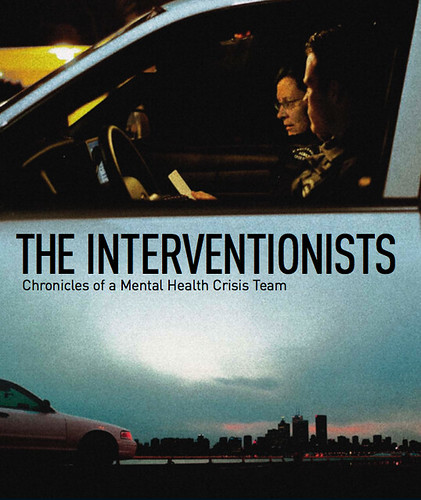
At Gerard Kennedy's recent Mental Health Matinee, I had the opportunity to view The Interventionists, a documentary that follows Toronto's Mobile Crisis Intervention Team (MCIT) as they dealt with calls involving Emotionally Disturbed People (EDPs).  It was pretty shocking stuff, though none of it unexpected.  We know what happens on our streets, even if we choose to ignore it.  After the screening, I had a chance to speak with one of the MCIT Officers, Mike Zawerbry, about the work (which he was very passionate about) and ask if he felt there were other tools he could use to enhance his services. 


Officer Zawerbry said that having one online portal that aggregates what mental health services are available in town by type and location would be incredibly useful.  If that portal could include tips on recognizing mental illness symptoms and suggested responses for de-escalation responses, that would also be helpful.  For it to be of real-time use, this portal would have to be accessible by mobile phone and intuitive to use.  You can't be fumbling over functions when there's someone trying to harm themselves or someone else in front of you.


Overdose at Occupy TorontoThe MCIT program is a partnership between the Toronto Police and St. Joseph's Health Centre.  Completely separate, the Schizophrenia Society of Ontario's Justice Mental Health Program (JMHP) provides support and training for people on both sides of the law (including families) related to mental health.  Same sort of deal; if the services JMHP and some self-guidance tools were available, would such a service help de-escalate problems or provide more rapid support access?  If individuals with diagnoses of mental illness had their own profile information on their personal devices, could they use that as a self-help and help-seeking tool when they have moments of distress?


An App like Guardly could be tweaked to help fill this gap.  Would such a service help keep people out of hospitals, the justice system and jail cells, reducing service cost?  If so, would that be worth funding?  On the other side of the equation, how much could be saved in terms of unnecessary service use/preserving human dignity/maintaining safety and security?


Ontario is looking for innovative ways to stimulate the economy; it's looking to improve service delivery and provide additional support for their front-line workers - they're also looking to improve quality of life outcomes in the province. 


Guardly might just have an App for that.

Systems, not Silos


There's a Hopi proverb that says "one finger cannot lift a pebble."  It takes the whole hand to grasp, the arm to move and of course, the brain to coordinate.  Each finger is it's own thing, yet each is part of something larger, too.  It takes a centrally coordinated executive function for those parts to do things together, but when they do - the results are are disproportionately greater.


The brain works like that, too.  We like to look at the separate pieces as serving distinct functions, but the reality is that we need every piece to reach our full potential.

 
Whatever we like to tell ourselves, the same holds true for society.  We're not a bunch of silos working in competition; we're part of the same societal system.  Together, we are more than the sum of our parts.  When we recognize this, consciously, we don't need hand outs or hands up - we become the force that moves pebbles and mountains ourselves.


It Never Starts Where You Think It Will


"Over the years, plenty have participated in legislative duties while drunk, or stoned, or incapacitated in some way. By maligning a much-loved figure like Fairbairn, the Tories risk a spotlight being shined on the conduct of their own members. They won’t be happy about the outcome. At all."

- Warren Kinsella


Everyone loves Game of Thrones.  Why?  Because it's so unpredictable and, as such, provides a great mirror for the times.  There aren't any villains, really, just people, their choices and the motivations behind those choices.  Sometimes, the consequences of those choices burn everyone.  Plus, there's the odd little throw-ins that build pressure and ignite existing, simmering tensions in new ways.
 
 
History is a lot like that.  It's never the thing you expect that triggers the fall.  The climate was ripe for World War I, but it took the assassination of a Duke in Sarajevo to get the pieces moving.  Al Capone was done in by tax evasion.  Commodore Perry's aggressive stance on Japan lit a fuse that would lead to, among other things, the Rape of Nanking and the bombing of Hiroshima and Nagasaki.  The lesson is, the more force you exert, the less certain you can be of unintended consequences. 
 
 
Here in Canada, we have a recognized mental health crisis.  Everyone wants to do something about it, nobody knows how.  We have social services that are sinking under the demands placed on them, but a populace that can't afford to pay more.  They could, perhaps, if they had jobs, but the job creators aren't complying - because they fear economic instability caused by government using tax dollars to pay for those very same services.  Then, there's the realization that the industrial economy is rapidly failing and needs to be replaced by something innovative. 
 
 
Will the story of Joyce Fairbairn and the repercussions that ensue ensnare enough people on a personal level that the powers that be will say "this has gotten out of hand?"  Will leaders start questioning the behaviours that have gotten them in trouble and look for alternative solutions?  If so, where will they be looking?
 
 
It's interesting times.  Who knows what will happen next?  We'll just have to stay tuned...