Search This Blog

CCE in brief

My photo
Recovering backpacker, Cornwallite at heart, political enthusiast, catalyst, writer, husband, father, community volunteer, unabashedly proud Canadian. Every hyperlink connects to something related directly or thematically to that which is highlighted.

Wednesday, 14 October 2015

Breaking Bread and Catalyzing Community


"If you really want to make a friend, go to someone's house and eat with him... the people who give you their food give you their heart."

Cesar Chavez


How does one build community?  

What's the secret sauce to building an organization, a party or a movement that's more than just transactions, but where the parts add up to a greater whole?
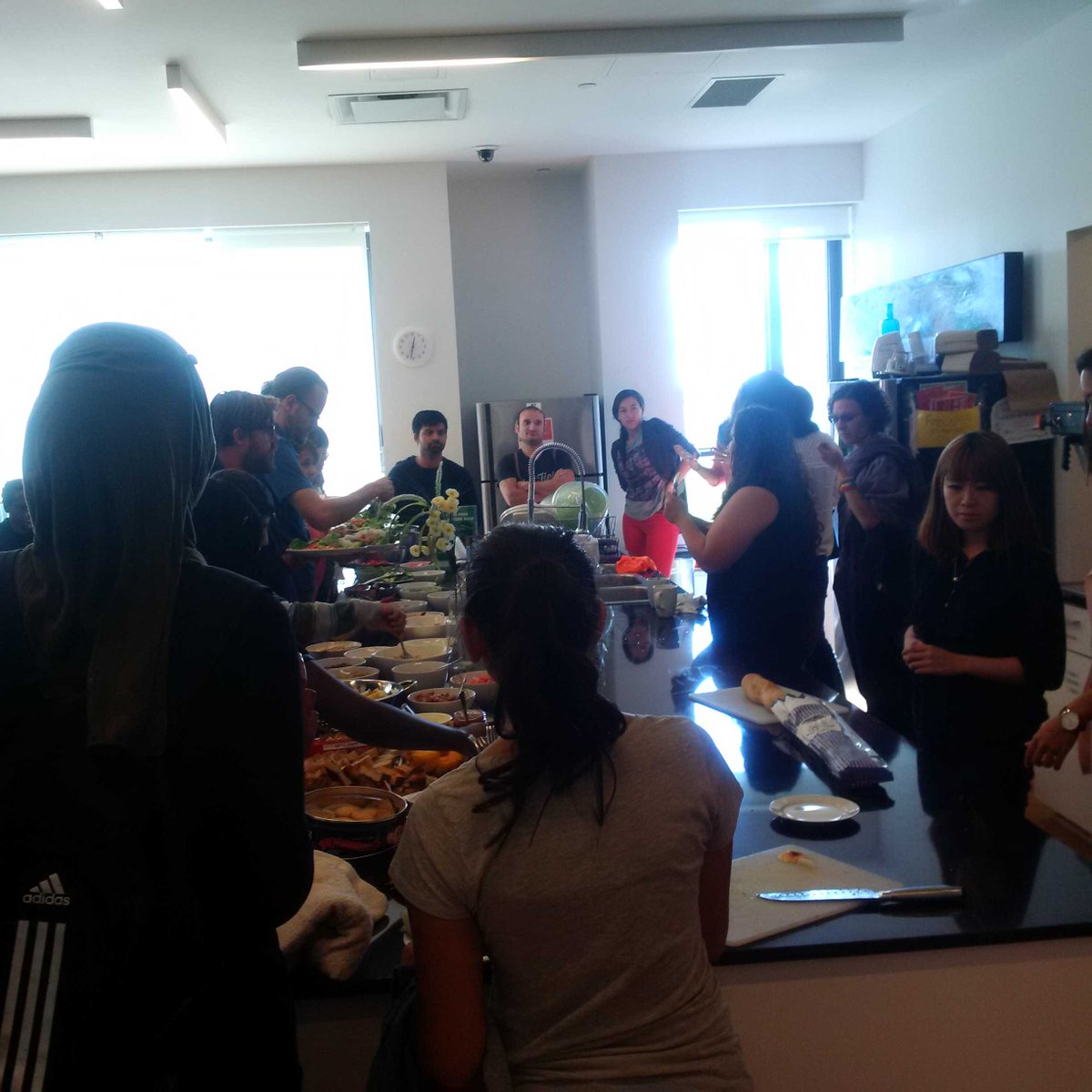
Embedded image permalink
This is Salad Club at the Centre for Social Innovation, Regent Park (located in the amazing Daniels Spectrum building run by Artscape).  

While each CSI has a salad club - on different days of the week, so you can attend all of them if you so desire - Regent Park is my favourite.

Apart from having a manager who is one of my favourite people in the world, the big reason for this is that CSI:RP also does this:
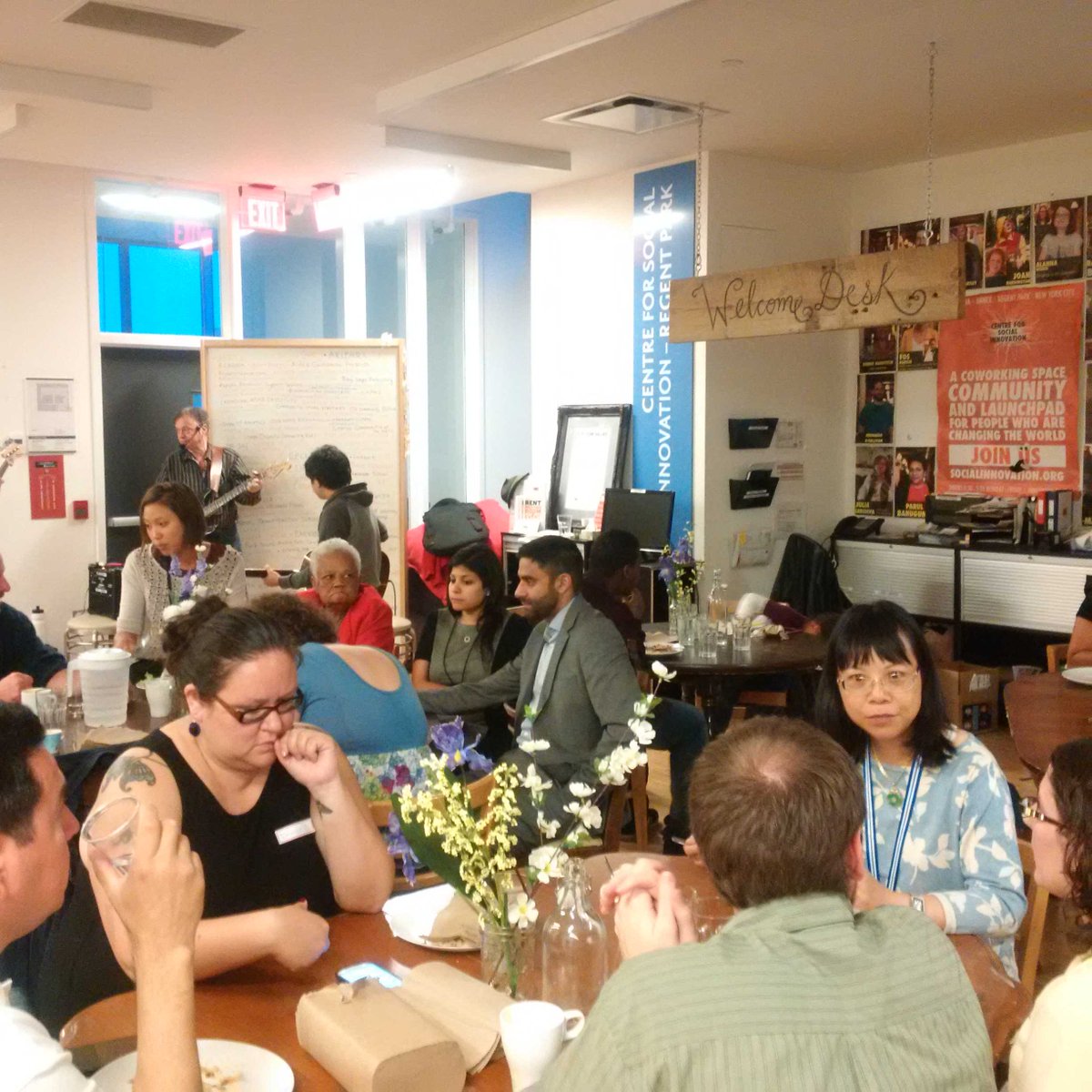
Embedded image permalink

"Food, in the end, in our own tradition, is something holy.  It's not about nutrients and calories.  It's about sharing.  It's about honesty.  It's about identity."

Louise Fresco


That's the CSI:RP Potluck.  Whereas the Salad Clubs are aimed towards CSI members, the potluck is designed for the community of Regent Park itself.  There's food, introductions, games, an opportunity for neighbours to learn more about each other, their hopes and talents and opportunities and concerns for the future over a meal they make together.


"What I've enjoyed most, though, is meeting people who have a real interest in food and sharing ideas with them.  Good food is a global thing and I find that there is always something new and amazing to learn - I love it!

Jamie Oliver


The Open Government Team at Queen's Park has started their own variant on this theme with the Cookie Club.  Idea is similar - the host provides some basics (in this case, cookies) with guests bringing their own coffee.  There's less "let's create a meal together" - but perhaps that's something they should explore.

As I've written previously, food is at the core of community - the breaking of bread, sharing of the basic essentials and collaboratively building a meal is exactly he same process as building a broader community.  It makes sense that these two things would be so closely intertwined.

There's a movement - or more accurately, the seeds of a movement - forming throughout our society in government, the public and private sectors and in communities of all kinds.  These nascent communities of engagement are collectively looking at the sorts of issues that, individually, we have a much harder time wrapping our heads around - Wicked Problems like poverty, climate change, mental health, etc.

These interactions happen in committees and hackathons, in conventions and coffee shops, at civic meet-ups like WSIC or online through forums like #SamaraChats.  As the different initiatives and groups begin to orbit each other, gravity is pulling them together around common purpose.  

At the centre of all this activity, you will increasingly find what you would expect to find: the sharing of food and the building of meals as a catalyst for the sharing of ideas and nurturing of community.


"Come with us, and become gardeners of community."


Friday, 9 October 2015

Political Irony in Canada


This man is Canada's Prime Minister.  He's supposed to be Unifier in Chief, the embodiment or at least the public-facing representative of Canadian society.

He's been pushing the "troubles at Canadians shores" narrative for quite some time.  It's ISIS, not CSIS, he tells us, that we should be afraid of.

Meanwhile, CSIS has been telling us the greatest threat Canadians face isn't ISIS, it's home-grown terrorists.

Not doing so hot in the polls, Harper calls in a foreign campaign fixer, this guy:


This foreigner, invited at the behest of the Prime Minister to do work that, frankly, could be done by a Canadian, takes a hard line against Mulisms in Canada, identifying them as the boogeyman Canadians fear most.

The niqab thing.  The niqab thing escalated to the civil service.  The tip-line thing.  The shenanigans around allowing refugees in.

There have been consequences to this, including niqab-wearing women being attacked in Montreal and Toronto and most recently, my friend Farah Mawani suffered a verbal onslaught of Islamophobic remarks.

Which kinda feeds into CSIS point, doesn't it?

In response to this attack @WiTOpoli creates a hashtag, #countrywewant, as a positive counter to the negative attacks and repercussions of the Team Harper strategy.

This grassroots-led move goes viral.  Media personalities, celebritives, community members, even party leaders like Mulcair and Trudeau get on board, sharing their visions of what Canada is rather than what it needs to be defended against.

And at the end of the day, this picture emerges:

Displaying _new_Tw_gallery_img.png

This woman is standing proudly in front of the Canadian flag, a new Citizen able to vote for the first time in this election.  She has won the support and admiration of countless Canadians, become a cause to rally behind.

This image should be something Harper and co can use to conjur up fear.  Instead, it becomes a symbolic moment for Canadians stepping up for their individual freedoms against a government who, once upon a time, was all about individual freedoms.

Poetic justice, indeed.


Wednesday, 7 October 2015

Nation Building


Why are the NDP bleeding support?  They've strayed from where they were in the quest to solidify centrists votes; their base feels uprooted and everyone else sees the NDP as a policy tumble weed.

Why have the Harper Conservatives been able to grow?  For starters, they have never abandoned their base, which means their floor has never lowered.  Their roots are deep and the party ain't shifting ground.  

More than a couple positions that keep their base rock-solid, however, are anathema to voters on the other end of the spectrum.  You can't be all things to all people, but you can't win majorities off of your base alone.

So Team Harper has perfected the art of the wedge-issue, essentially side-stepping substantial policy challenges and appealing to people's baser instincts.  You can be a left-leaning, pro-separation Quebecer but hey, if the niqab/scary Muslim things makes you skittish, you might just base your vote on that alone.

That's what modern politics is about, after all - adding just the right pieces to your narrative to expand your coalition into the small percent of non-locked voters to form a majority.

While Team Harper is mighty effective at this, the consequence of their wedge-issue mentality is an increasingly divided, embittered and angry country.   Anger is better than confusion for gaining support - it's so clear, so motivational! - but it's a dangerous state to keep a nation in for long periods of time.

If not anger and wedge-issues, though, how do you add enough support to  your coalition to win? More to the point - how do you not push the short-term effective, long-term destabilizing anger-button when the other guys are doing so and clearly benefiting?

Is it possible for a party to win a big enough coalition with aspiration instead of instigation?  How could you effectively communicate such a message to the niche groups you need to win?

There is a massive difference between winning power and nation-building and increasingly, it's hard for Canada's political parties to play that role - a role they were never intended to play, anyway.

Perhaps the question needs to change.  Instead of parties asking what does it take to win, we should all be asking where do we go from here?

#countrywewant ((#MyCanadaIs A Place to Belong)) UPDATED


Diversity is strength.

It's true of genetics and it's true of society; the more variety you have, the more opportunity you have. Diversity of tools, ideas, voices and perspectives brings more options to bear in problem-solving and increases capacity to adapt and resiliency in the face of change.

The Canada I know is not one that fears troubles at our shores, but embraces our ability to make a positive difference in the world.  Whether it's fighting for the rights of people to be different against Nazi Germany or in the Bosinan War, or providing medical and political solutions through groups like CISEPO, we're always ready to dive in and help as we can.

The Canada I know never shies away from a fight, but excels at crafting alternatives.  Whether we're nudging for the end of land mines or crafting new ways to keep the peace so that dialogue can occur with Peacekeeping, Canadians are a creative lot that prioritizes solving problems over ending people.

Why are we so ready to make sacrifices and share our resources and ideas with people who live across the world?

Canada is an idea, a vision of what the world can be.  

We are a nation of communities based not on an ancestral lineage or a culture carved in stone but on the idea that diversity is strength.  And when dream and share and build together, even the sky doesn't limit us.

What makes Canadians different is that their differences are celebrated as opportunities for understanding, not rejected as threats to a mythic stereotype.

Canadians recognize with pride and humility that ours is truly one of the best places to live in a world where far too many of our fellow human beings live in poverty, bereft of opportunity, bereft of security, bereft of hope.  We choose to help others out of a sense of human responsibility to help others achieve what we can too easily take for granted.

Canada is a country that is proud of its role as a safe-haven, whether to refugees from war-torn countries or to planes thrust into the chaos of 9/11.  I'll say this again - Canada is proud to open its doors and provide shelter, even a home to those in need.

Why?  Why are we not afraid of the wily schemes of Machiavellian foreigners?

Because we are so confident in what Canada stands for and how we, as Canadians, embody that belief in our daily lives that fear is unnecessary.  Canada was made by people of different cultures, languages, customs and world-views, and that diversity is what makes Canada great.  Canada is a celebration of the possible.

How can you be every day in a place like this and keep maliciousness in your heart?

Canada is a place of refuge.  It's a celebration of humanity at its best.

Canada is more than a place to live - it's a place to belong.


UPDATED 9/10/15

Illustration by Terra Loire GillespieBased on our growing concern, and spurred by my experience with Islamophobia on Tuesday, Women in Toronto Politics released this statement today, and launched a #countrywewant campaign. http://witopoli.com/2015/10/09/countrywewant/ 

Please read and share our statement and graphics (one included below), and join our discussion on Twitter and Facebook to share YOUR vision for our country!

Farah is a friend from the Centre for Social Innovation and someone that works actively for the betterment of our country and all people in it.

Her #countrywewant campaign with @WiTOpoli has taken off, and for good reason - Canadians are tired of division and a focus on the past and want to work together right now to ensure a brighter future for all.

Please support her campaign and share your thoughts on what the #countrywewant looks like now and down the road.

Tuesday, 6 October 2015

#MyCanadaIs


What bothered me the most when I read this today wasn't what you might expect.

Yes, the racist tone was troubling.  Of course, the very notion of diversity making someone feel uncomfortable.  Above all that, though, the darkened view of Canada it presented doesn't reflect the reality I know, at all.

That impression - a country full of fear and bitterness and closed doors - it's boring.  No one can be curious, or experimental, or innovative in that world.  There's no fusion of art and ideas and culture and genes in that world, which doesn't give it much room to grow.

That's not the Canada I know.

From my years growing up in Cornwall, Ontario through trips across the country and experiences living in places like Peterborough, Ottawa and Toronto, the Canada I know has always been one that embraces, celebrates and benefits from the sheer variety that Canada represents.

Everyone has their own unique take, and those takes are sometimes at odds, but fundamentally Canada is a place of the possible.

My Canada is richer in colour and texture than narrow biases and closed doors.  My Canada is a celebration of collaboration, fusion, diversity and play.

Which is why my Canada is so creative, so innovative, so world-leading on ways few notice, but everyone feels.

In taking with a couple folk (Derek Alton and Joanna Reynolds in particular) I felt that, as there was no real narrative to counter the emergent bigotry surfacing this election, it was important that someone do something to represent the view of Canada I know and so many Canadians celebrate with me.

It was important not to feed into the existing narrative - there's too much "stand against" out there and I didn't want to feed into it.  What I wanted was an opportunity for people to share what they love, what inspires them, not what they fear or are frustrated with.

Hence, #MyCanadaIs.

It's just a hashtag; there's no carefully-researched and focus group-tested narrative behind it, no organized team of promoters selling the concept or pushing people to jump on it.  There's nothing stopping people from twisting the intent into something more like the article linked to above.

A risk, maybe, but one I'm willing to take - because I believe that Canada at its best is the best of everywhere else, and because I believe in Canadians.

So have at it, folks.  Tell us what makes Canada special to you - a place, a face, a story, a community, a tree, even cat photos.  Canada is the story we tell together, and there's no pre-ordained formula for what the bigger narrative looks like.

Canada is what we build together.

With that, here's a tweet for you: 

#MyCanadaIs what we build together, which is why it's awesome.

There's room in that Canada for everyone - spend some time with us and I know you'll want to be part of that action.


When did the Right stop standing for freedom?


Understanding is the path to enlightenment:


Fear leads to the opposite.