Search This Blog

CCE in brief

My photo
Recovering backpacker, Cornwallite at heart, political enthusiast, catalyst, writer, husband, father, community volunteer, unabashedly proud Canadian. Every hyperlink connects to something related directly or thematically to that which is highlighted.

Monday, 8 June 2015

The Battle of Genosteros (only, happening in Essos)


Embedded image permalink


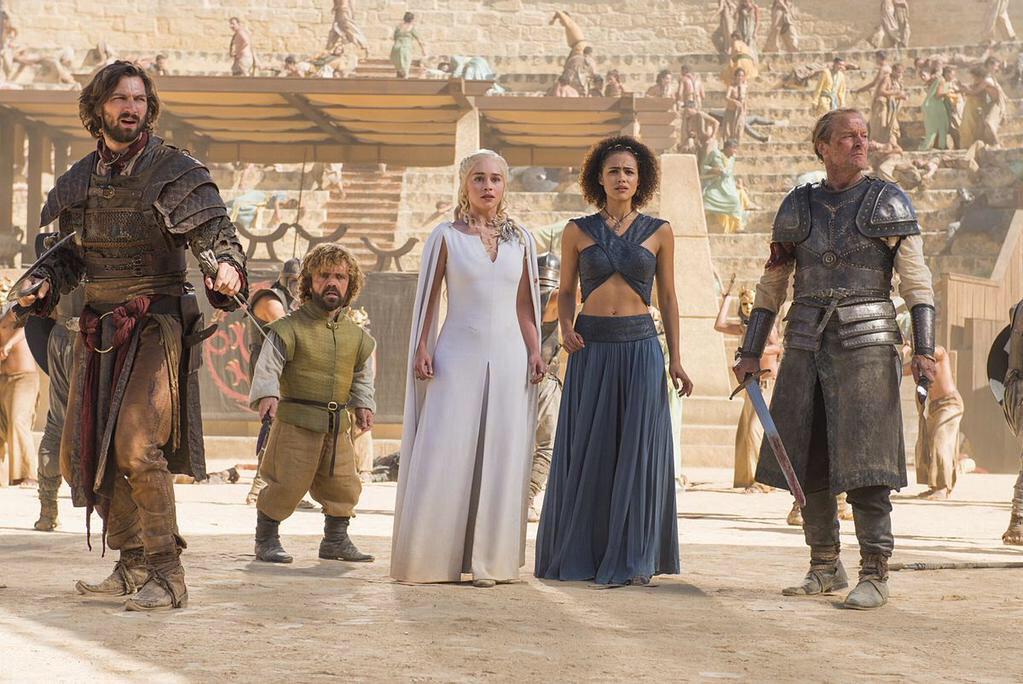
Is this what you call aggressive negotiations?  Dany's got the white, Missandei has the midriff.  Could use a couple lightsabers, though.


And then...


From the sky - Yogon!

Well, at least Yoda took his peeps with him.  Unlike some "leaders."

Monday, 1 June 2015

Cutbacks and the Burning Platform


Embedded image permalink


This is the basic premise of laissez-faire capitalism - that social safety nets encumber people, hold them back from developing the toughness, the hustle, the skills they need to become economically competitive.  When everyone is competing for jobs, contracts, resources and whatnot, what you get is the best of the best.  Period.

It's the social equivalent to natural selection - the weak or maladapted die off, leaving only successful specimens behind.  Except, of course, laissez-faire doesn't take that last into consideration.  For some reason, the most ardent capitalists don't talk about that part much.

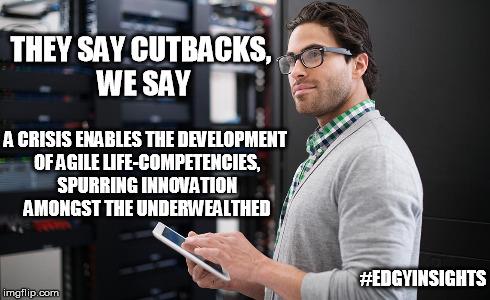
Their thinking (or their spin) is exactly what "edgy insights" says - those who are suffering a critical lack of work, food, security and basic infrastructure are blessed, really, with the opportunity to be innovative, to create new solutions and will be compelled to sell hard to make some coin and change their lot in life.

That's how it works, right?  Those with resources - massive corporations, VC, the collective consumer - don't have to design or innovate anything.  They do not sow.  They don't have to collaborate with or empower or even inform, unless compiled to by great marketing and pitches, to do anything other than decide where to put their dollars.

The haves only dole out jobs, or contracts, or funds to those who convince them to.  The have-nots have to fight, hustle and best competition to get access to resources.  Same for firms - you can buy the innovative ones, which is so much cheaper than innovating yourself.

It's an easy frame without any messy complications.  

Except that isn't how natural selection works; innovation isn't consciously developed and marketed, it happens organically and biologically.  If anything, the more resource-hungry a group is (whether it's political parties or private companies) the more combative they become.  

How do you get to the top of the resource ladder in any laissez-faire system, be it a tribe of gorillas or a political organization?  Not through innovation, but by taking out the guy above you.

Here's what history teaches us - a reduction in service and resource access doesn't result in innovation, it results in violence.  It's the shrinking waterhole scenario.

Some other things to consider:


If you're "ethnic" you have to struggle even harder to get ahead.  That's before you get into postal code stigma, racial carding, etc.


Successful people constantly promote the concept of the quick win, the low-hanging fruit/  Get something fast, demonstrate success, then get the next one, and the next one.

If something or someone doesn't look to offer a short-term Return on Investment (ROI), you don't bother with it.  Which is why the have-nots must provide massive value-add from the get-go if they want some of the resources held by the haves.

Or, you could create a quick-win scam that not only has a greater chance of ROI with less creative investment, but also makes you feel like someone's beneath you on the social ladder.  Or you could steal, smuggle, join a gang.  These are all quick-wins and often not that dissimilar from what the successful people do.

Is there much difference between a political fundraising campaign using scare tactics or empty promises in exchange for money vs. the guy promising to fix your heating ducts for a surprising low cost?

The other option, of course, is to loose everything, become homeless and sleep on the street.  

In both scenarios, the weak don't die off - they move onto the streets creating crime risks, spreading illness, etc.  In every place in the world I've been to where laissez-faire is truly practised, the wealthy live behind gated walls topped by iron spikes or crushed glass.  Heavily armed guards must be present wherever money is exchanged in quantity.  Street scams, pick-pocketing and muggings are common.  

That's before you get into organized crime.  

Places like Columbia have gotten out of their holes by increasing, not decreasing capacity for society's most marginalized.  So of course the champions of laissez-faire want to do the opposite, because they make their own reality, doncha know.

So by all means, people cutting resource access to those below them while maintaining or increasing their own, do your thing.  Grab for your low-hanging fruit and buy into your own messaging.

Just don't dare tell us no one ever warned you about the consequences.

After all, there's no room in this world for whiners.


Sunday, 31 May 2015

Kyber Crystals and Armageddon Weapons


This episode of The Clone Wars cartoon is an original story that fits perfectly within the Star Wars Universe.  It just happens to resemble the third act of the first screenplay I wrote for my own sci-fi epic (first draft, 1998, most recent in 2013).

More proof good ideas will keep coming up - and that an idea on paper is only worth the cost of the paper it's written on.


FADE IN:
EXT.  THE VAST EMPTINESS OF SPACE
Stars shine like a billion candles, flickering in the absolute darkness. 
                     NARRATOR (VO)
                      (a haunting, female voice)
At the edge of space lies a desolate galaxy,
only on the edge of which can life be found. 

                CUT TO:
EXT.  SPACE
We see a green planet, a fragile sanctuary in the inky depths.  A shooting star falls towards its surface. 
CUT TO:
EXT.  SURFACE OF PLANET – DAY
Gentle rain falls on a limestone plain, broken by time and flora.  A river cuts through the terrain, carrying the drops of rain towards a distant ocean.

We see primitive mammalian bipeds hunt a creature akin to an ankylosaurus.  The scene feels like our palaeolithic age, but is definitely happening on an alien world.

                     NARRATOR (VO – cont’d)
On many planets life thrived, adapted, and spread.  In turn,it gave birth to knowledge, civilization and the desire to control.

We overtake the hunting scene and pass over a grassy knoll, crossing 15 millennia into the future.

Before us lies a coastal metropolis, as New York may look centuries from now.  Small craft buzz around the city’s spires.  Beyond, a vast ocean stretches to the horizon.  Waves crash gently against the shore.

One shuttle heads towards the sky, and again into the future.  We continue upwards, past the shuttle and through gathering storm cloud

                     NARRATOR (VO – cont’d)
                      (over following scene)
Some life forms would reach the stars, and there encounter others; great kingdoms were formed.  All were conquered by the Grand Emperor Shushong’deh, and merged into one vast empire.

Beyond the clouds, beyond the penumbra of the atmosphere’s rim, the sky fades to indigo, then black.  Stars wink in one by one until the heavens are filled with the shimmer of distant light.
A long, bulky spaceship rumbles into view.

                        NARRATOR (VO – cont’d)
Upon Shushon’deh’s passing, his sons battled each other for control; the empire collapsed.

The ship passes close by; it is a warship, heavily armoured, with weapons bristling along its hull.

                     NARRATOR (VO – cont’d)
Factions were formed, alliances made and broken – the Era of the Warring States had begun.

We follow the war-craft into a terrible battle in the depths of space.
CUT TO:
EXT.  SPACE – MONTAGE OF BATTLE
Stretching into the distance, ships of widely different designs and sizes assault each other. 

Amidst the chaos, one massive Capital Ship fires on another.  Squadrons of small fighters swarm like bees, taking shots at their rivals, at the hulls of other warships.  Two massive battleships pass at close range, blast holes in each other’s hulls.  In this conflict, there are no winners.

All sound is muted by the vacuum of space. 

                     NARRATOR (VO – cont’d)
For two thousand years, the battles raged.

An ARMAGEDDON SHIP, more imposing and sinister than any we’ve seen, pierces frame.  The bow of the ship is dominated by the barrel of its terrible Weapon.

The vessel fires a powerful beam which tears through a Capital Ship like a pen through paper.  The whole ship explodes from the fissure outwards.  The blast dissipates quickly in the vacuum.

                     NARRATOR (VO – cont’d)
Terrible weapons of destruction were unleashed; whole worlds were laid to waste.  The factions realized that if they could not find peace, all they had fought for would be lost.

The detritus of battle floats in space.  In the background, the battle rages on.  The images freezes, flattens as we


DISSOLVE TO:

Friday, 29 May 2015

Humonion: Mapping the Layers of the Individual


Embedded image permalink


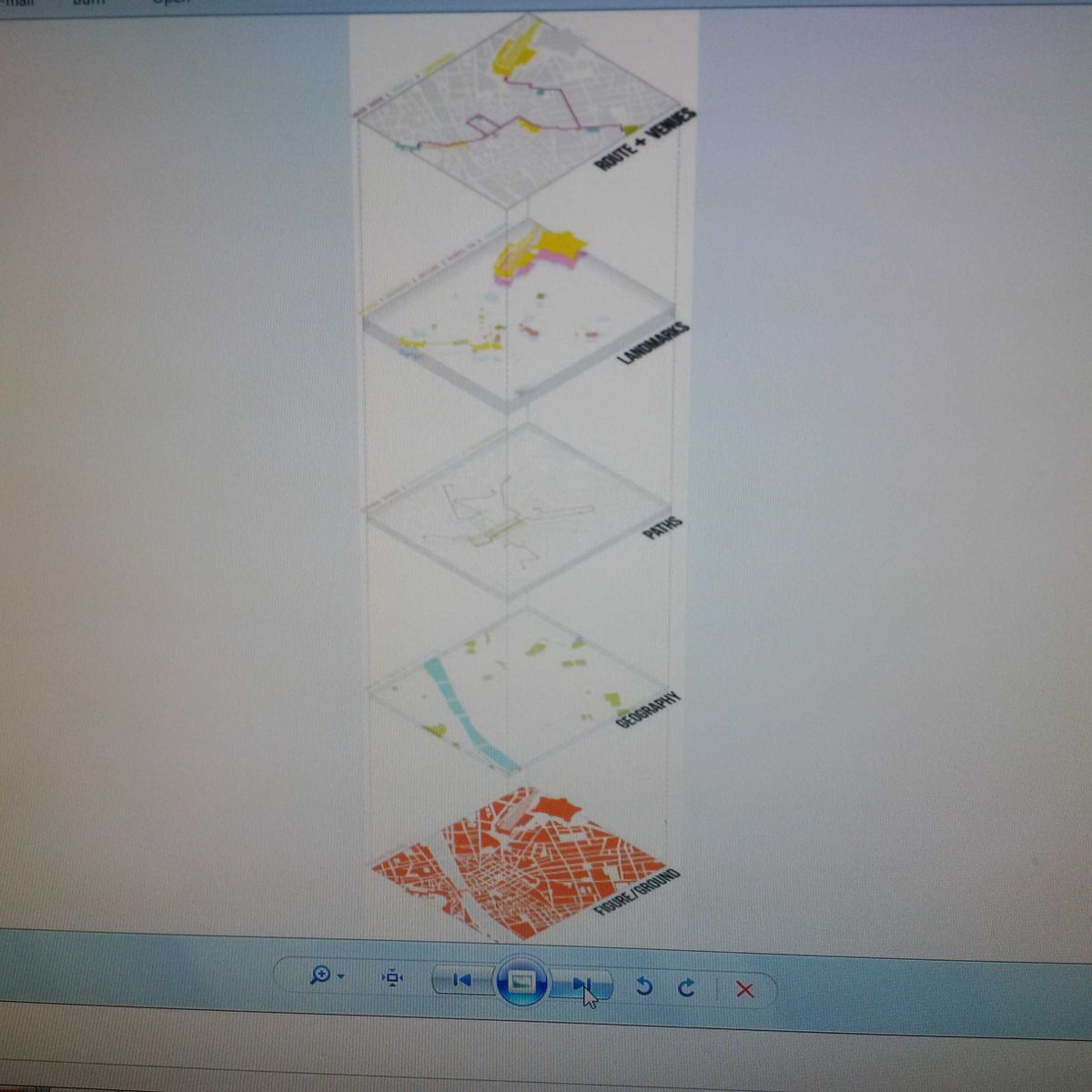
You might be familiar with the layered anatomy map - it's been around for ages in school text books, in posters, in science models.

The human body consists of a skeleton, muscles, a nervous system, organs, skin, etc.  Layers that can be isolated and defined, but that kinda work together, like a system.  Bones protect organs, but can't move without muscles, but the muscles need a nervous system to stimulate and coordinate movement.  Each layer matters - each layer is dependent on the other.

Like a system.

Increasingly people are starting to look at cities like systems, too - not just urban planners, but community groups, developers, you name it.  Transit systems, sewage systems, zones and service centres - all these are part of a complex, interactive system that relies on all parts to be functioning for the whole to be functioning.

Between the anatomy of people and the anatomy of a city, of course, there are other layers - the anatomy of the community and before that, the anatomy of a person.

A person can be many things all at once, though we tend to view them as one thing at a time.  We talk about keeping home and work separate, about compartmentalizing, about not "carrying over" what happens in one aspect of our lives to another.

It's accepted wisdom that this is the way the world needs to work - compartmentalization between our different lives, as though there are switches we can flick or outfits we can step into and out of at will, if we teach ourselves to do so.

Geocentrism used to be accepted wisdom, too, as was the notion that the earth was flat.  Just because it's convenient for us to believe, it doesn't make it so.

People are systems with layers that interact, just like any system does.  Just as weakened lungs or damaged lungs impact the entire organism, challenges to one layer of a person - parent, employee, resident, ethnicity, etc - inevitably impact the others.

A mother burned out at work might have less energy to be a mom with when she gets home, impacting the child.  A driver with relationship trouble has less focus to put on traffic-navigation than than one who's personal life is trucking along just fine.

As people don't think systems very easily, we have a habit of generalizing, minimizing, compartmentalizing.  We don't want complexity, we want simplicity.  Terrorists are evil, period - that's all that matters.  Homeless people are homeless, period - what else is relevant?  When you're at work, you shouldn't be a dad and when you're a parent, you should be solely focused on your kids.

That's how our system is set up, it's what we're comfortable with, but it's not working.  If anything, there's broad recognition that silo-based thinking is making a mess of out society from the top layer down to the very bottom.

Visual thinkers as we tend to be, we respond well to images.  It's easier to navigate with a map than with directions, whether you're travelling from point A to point B or making an IKEA table or a Lego set.

With that in mind - why not visualize our social system in a way that shows the layers and how they interact?  Why not do that with people, too?

Imagine an art project that breaks down people from different walks of life and social classes in all their complexity.  A Mayor might be a father, a board member, a diabetic; a criminal might be a father, a person with ADHD and a supportive community member.

People are systems, with our different facets all impacting each other - we all know it, to some degree, but often have trouble accepting or looking for this when we interact with other people.

We just need to see it.

Thursday, 28 May 2015

Banned by the Ombudsman


You are blocked from following @Ont_Ombudsman and viewing @Ont_Ombudsman's Tweets. 

So, I've been banned by the Office of th4 Ombudsman of Ontario.

Not by the person who occupies the position, mind you - the office account itself.  

For having the temerity to say this:

Rather disappointed to see Andre Marin campaigning + pitching for his job like a politician. Unbecoming of @Ont_Ombudsman post. #onpoli

Now, this is all just on Twitter - and it's not like "blocking" actually stops people from seeing content.  I can use one of the other accounts I manage, or look up the ombudsman account without being logged in (though whether that's known to the person managing the account, I don't know).

The issue here is that an officer of the Legislature - a position that is supposed to have an open ear to public concerns - is blocking people left, right and centre without just cause.  

What impression does that send?  How comfortable should we now feel, contacting that office with concerns?  How seriously should we feel our concerns will be taken by that office?

You can see where the problem lies.  There's enough public mistrust of government; the last thing we need is to feel even our ombudsmen are running their own agenda and dismissing complaints and people they don't like.

Worse, as I mentioned yesterday, Andre Marin has organized an active campaign to lobby for his job - an appointment by the Legislature.  He's not a lobby group, lobbying government; he's supposed to be a watchdog.  Yet now he's trying to demonstrate to the Legislature that he's got a constituency of his own and that therefore, has personal legitimacy in the way a politician might.

It's an uncomfortable precedent to set.  The ombudsman has a broad range of powers, a significant budget and easy access to the media; if the person who holds that office starts putting themselves and their interests above the neutrality of the office, we have a big problem.

It's what happens to governments at around the 10 year mark - they begin to think they are the office, rather than have the privilege and duty of occupying it for a time.

For the integrity of the office, out of respect for the public servants in that office who simply want to do their job, it's time for a change.

If Marin truly likes the idea of having a constituency to represent, there are actual elected offices he can run for.

Post Script:
  and 3 others retweeted a Tweet you were mentioned in
9h
well u are in the minority, facts don't enter ur equation, I'll stop trying to entertain educate u

"I'll stop trying to entertain /educate you" retweets the Ombudsman. The latter is his job, so perhaps not the smartest retweet on record.

Andre Marin and the Role of Ombudsman


Please, keep in your thoughts and prayers at this most difficult time.
12 retweets3 favorites


Choose language/Choisir langue
Most people have no clue who Andre Marin is, nor what the role of the Ombudsman is.  Of the public, those who recognize his name and his post view him as a hard-hitting government watchdog, protecting the realm from government misanthropes.  


Like them or not, under Marin's watch the Office of the Ombudsman has produced hard-hitting reports presented with the flair of an advocacy group; he knows how to work a headline, he knows how to get attention.  You can see some of these reports here.

Of course, his performance has not been without criticism.  Some of it has stemmed from the content of his reports; that's expected.  When people are attacked, especially if there's justification, the instinct tends to be "fight back"  Kill or be killed, etc.  No one wants to lose face, or privilege, or face consequences.

It makes sense that the Ombudsman has to be someone ready and willing to be tough - but also fair. Especially when the person filling that role is responsible for surfacing misconduct, their own actions must be beyond reproach.  


There have been a whole host of complaints over the years that put Marin well within the realm of reproach.  It's certainly possible to dismiss all the complaints filed and the high rates of staff turnover as sour grapes or team members who "didn't make the cut", but this raises questions about HR practice, expectations set, etc.  It's certainly not common for an office to develop a support group (CADOO Coalition Against Discrimination at Ombudsman Ontario).  

There are expense questions as well, though it must be said this is a bit of a political culture thing we're noticing at all levels rather than a story unique to one office.

Which is why the Open Movement is so promising - public servants working to put the public good first, promoting transparency in government, collaboration on policy with citizens (like the Open Data Directive), etc.  There's a slow culture shift away from the old-school frame of power broker or information gate keeper.  

It's a difficult transition, especially in a work culture where employees are often afraid of being "public servant zero" - the epicentre for a scandal, whether of their making or not.  Outreach is sometimes discouraged, innovation stifled - the silo effect is a big part of government's structural problem.  The Virtuous Schemers working quietly behind the scenes to open the silos of government are courageous and inspiring.

These Virtuous Schemers strike a careful balance between respecting the constraints of their position and their commitment to public, rather than partisan, service.  Not a one of them puts self before service.

Which, to me, is the most troubling part of Marin's active and aggressive campaign for the job.  That kind of hard-sell might be how sales works - it might be the kind of approach politicians take in "reapplying" for their job (seeking a new mandate from their constituents).

Yet the office of Ombudsman is an appointment.  More than that, it's one that comes with a great deal of power.  To be appointed is an honour that comes with a duty.  It's not, by design, a gig you mount public campaigns for.  

In so doing, Marin has created a constituency and seeded with information that takes liberties with the facts.

3/3 Yep. In less than 48 hours, u have no Ombudsman. Time to make ur voice heard. Unfortunately it's come to this. MAKE SOME NOISE PLEASE!
136 retweets42 favorites


Consider - should Marin be reappointed, he could very well point to his "Marin Nation" of constituent support as justification and validation for his business-as-usual.  He could continue to block out voices he doesn't care to hear from (happened to me tonight - not from Marin's personal account, but the office's account).  What impact will that have on his capacity to shed light where it's most needed?

Consider - he's been in the role for a decade; that's about a good time for anyone in positions of power to step down, before they confuse their position with themselves.  

The Office of the Ombudsman is not facing a "difficult time" - it's in the middle of a defined administrative process that will carry on long after Marin is gone.  I doubt Marin himself is facing a "difficult time;" he's a man with a long career and  list of accomplishments he can point to.  Plus, he's that bulldog, right?  That's the sort of ABC mentality that's doing well in sales these days.

I think that, after ten years and some questions raised over his tenure, now's a great opportunity for Andre Marin to try out some new opportunities and for Ontario to have a new, hard-hitting Ombudsman who brings new energy and is a little less comfortable with the massive leeway and power that comes with the role.

If anything, it was his partisan-esque Twitter campaign that solidified that.  A leadership quote to end with I hope Marin takes to heart:


Most people will never know who Marin is, but it would be a shame if they come to view the office of the ombudsman itself with suspicion or derision.  Let's avoid that.

Wednesday, 27 May 2015

Why Hacks Trump Debates


"Plus - no press, no trophy, just racing - the way I like it."
   - Lightening McQueen, Cars 2

In the evolving world of management practice, there's a saying that's gaining traction: "culture eats strategy for breakfast."  

Now, big business (like big politics) puts a premium on strategy - high-level, plan-centric, Machiavellian chess-playing.  Your resources - physical and human - are pieces on the board to be moved in tactical fashion to achieve strategic objectives.

Yet typically, strategic planning relies on certain assumptions which often are in correct.  It's as true in business as it is in war, and it's certainly the case with war room politics.  When the people at the top lay out their strategy and simply expect those they view as beneath them to follow orders, they're setting themselves up for trouble.

You could change the lives of millions and millions of Canadians – those who need the most help – for the better, Craig.
But we have to right act now – are you with us?

That little blurb is from a political party seeking funds (I think you can guess which one).  This party has a strategy in place and they're not deviating from it, yet what they don't have is a supporting culture to realize that strategy on the ground.


It's a lesson from the military that seems to be missed by the people doing strategic planning.  Politics refers to "the War Room" mentality, but they have never quite absorbed the concept of morale that is an integral part of successful martial planning and implementation.  

Is your plan transparent and clearly understood by your team?  Do your soldiers (and in politics, that means a lot of people who are volunteers, ie not paid or paid a pittance) feel like they have a skin in the game, or are do they feel like tools?  Do they believe the commanders understand front-line reality, or care about life on the ground?  Do the people have faith in their commanders?

Politics focuses on the win, to the exclusion of all else.  The theory is that you can work your troops to the ground, burn people out, whatever - they're all replaceable and everything is forgiven by a win. Winning - and the power forming government provides from that win - is all that matters.

Yet the purpose of government isn't to win, or to dictate - it's to govern.  In our country, in theory, the purpose of government and Parliament is to govern in democratic fashion, ensuring the needs of all people are met and opportunities abound for all.

This isn't happening, clearly.  The only people telling us otherwise are the people benefiting from the system as-is.  Canada's political culture is disaffected at bet; at the active partisan level, it's increasingly cut-throat and dictatorial.  The idea of culture is being ignored by most.

Not all, though.  Within the public service and even within some political offices, there is real recognition that the operations of government are not what they could be; civic engagement is low, resulting in less robust policy conversations; the public service is factionalized and in many cases demoralized - we're not where we could be and suffering for it.

As a result, the how might we question is creeping into the conversation; how might we change that culture?  How might we nurture innovation and cross-pollination within the public service, and across public services, and between the public service and the people? 

How might we foster a community of civic engagement that encourages inclusive solutions instead of stakeholder competition for slices of the funding/policy agenda pie?   What should a new Social Contract look like?

The government of Ontario has taken some interesting steps in this direction - there was Budget Talks, which solicited policy ideas from the public (and was massively popular, securing more contributions than the average by-election).  Now, the Ontario Open Data Directive is open for anyone to post their comments and contributions.  It's literally crowd-sourcing a government directive, which is a pretty cool way to give people skin in the game.

Which leads us into our title - Hacks vs. Debates.  Debates tend to be Socratic in nature; sides are supposed to presume they're right, the other guy is wrong, and argue to prove that such is the case.  A third party (in our case, voters) are supposed to weigh the pros and cons of the debate and decide which argument has the better case for it.  In politics, a big part of this has to do with leadership, character, personal traits that could be considered separate from the raw data each side presents.

Truth be told, though, when you have three main political parties, a hodge podge of stakeholder groups and various layers of pundits weighing in on strategy and tactics, the real purpose gets lost. 

Instead of trying to craft the best policy possible, we focus on who's the worst/least worst team and which plan hits more positive than negative points on a general scorecard.  We are voting for parties, or leaders, or specific policies, which is not much different than a three dollar donation.  

What we aren't doing is collectively understanding the challenges we case and co-designing solutions that reflect, as best as possible, the needs and opportunities of all.

Political parties put forth what they think are winning strategies and hammer them home. Stakeholder groups campaign for what they want/against what they don't want.  The big picture - the public interest, collectively - is lost.

Many are just fine with that, because they don't believe in the idea of public interest (they're more of the Jedem das Seine mentality).  The reality on the ground suggest their approach might not be the best one.

Whereas debates are competitive, hackathons (or Solutions Labs) are collaborative, inclusive; there's no pre-determined end, no winners and losers.  The goal is to find solutions that have legs, or that at least have iterative potential, then give them a try.  If the people are always engaged, then iteration happens much more rapidly, avoiding the four-year bounce-around that happens with our current system (and is in no small part why so many programs start then stop, wasting money, frustrating people and weakening structural integrity).

Which is why the smart policy people are stepping away from "are you with us" or "this is the plan" and taking on the role of facilitators.