Search This Blog

CCE in brief

My photo
Recovering backpacker, Cornwallite at heart, political enthusiast, catalyst, writer, husband, father, community volunteer, unabashedly proud Canadian. Every hyperlink connects to something related directly or thematically to that which is highlighted.

Tuesday, 9 December 2014

Will You Drink to This?


Nowhere mentioned in this article are donations of booze to events - fundraisers, for instance, or Party parties at related venues.  No matter.
 
If we're to get to the heart of the matter of this, we need to identify the core problem.
 
People with money donate to politicians and, as a result get their ear.  Those ears are then talked into by former political staffers turned GR agents because, again, that's where the money is.
 
Money isn't the objective of politicians - political wins are.  Money is simply a tool required to achieve victory.  You need to pay for polls, expensive ad campaigns, a whole lot of pizza and car rentals and whatnot. 
 
It's the job of partisans to get elected, and that means votes.  How do you get people to vote for you?  Not by thoughtful discussion of the issues nor carefully balanced policy proposals.  Nope - it's messaging and framing that matters.  Ballot questions pull at emotions - they're not about solutions.
 
People fundamentally don't care about the doings or Parliament - or at the very least they aren't interested.  Or informed.  Or engaged. 
 
So outreach needs to be done.  That costs money.  Money that comes from folk like those behind The Beer Store.
 
What's the problem?  Politics is a sales business and voters are apparently lazy consumers. 
 
What's the solution?  Open Government.  Responsible society.
 
We can keep whining about the problem, but until we agree to be part of the solution, nothing's gonna change.


Free Market Irrationality


Of course, this is just smart planning, right?  Make healthcare expensive and people will work extra hard not to get sick.  It's simple economics.
 
Except for where other financial interests - say, tobacco or fatty food sellers - actually benefit from people engaging in unhealthy lifestyles.  But that's just a supply-and-demand thing, right?  If people didn't want it, they wouldn't buy it.
 
Rational actors aren't persuaded by slick campaigns or suggestive advertisements designed to trigger emotional responses. 
 
And that's what people are - independent, rational actors.  To do the sociology thing is to impede individual success.
 
Really, what else matters?  To discuss cyclical poverty, workplace culture or anything education-related is to chatter on about non-fundamental stuff.  So too communicable diseases, crime, emergency preparedness and so forth.
 
Stick to the low-hanging fruit and quit wasting time on frills.  Everything else just magically takes care of itself that way, doesn't it?
 

Domesticating Capitalism

 
Eat what you kill.  Focus on low-hanging fruit.  Maximum return, minimal investment.
 
That's the framing of laissez-faire capitalism and competitive politics.  It mirrors exactly the framing of hunting and gathering.
 
Imagine if the hunters of the world had final say on the value of gardening.  They'd have laughed at the idea and belittled those who came up with it.  Dumb, wasteful, takes away from the core business of life, they'd say.
 
Until the fruits of other people's labour materialized.  Then, the aggressive hunters or laissez-faire foragers would pat the innovative gardeners on the back for their tenacity and persistence.  Said innovators may even be celebrated for their foresight.
 
Which is how things stand right now with social innovators or pioneers in social finance, or civic engagement, or info tech.
 
That's the challenge we face.  It's not the first time we've faced it, nor will it be the last.
 
The only way forward is not to waver.

#WeCantBreathe - What Social Murmuration Looks Like


Political advertising is a powerful tool for swaying minds.  The infamous Daisy ad is a famous example of this.  Thing is, political advertising costs a lot - there's the ad buys themselves, but also the talent that goes into designing the things, and pollinating them across mediums.
 
As Daisy Consulting founder Warren Kinsella has said, though, "the most important campaigns are the ones that don't cost a thing."  These are campaigns that can be nudged by people with narrow agendas but are largely driven by public engagement.
 
Today, this concept of the public carrying a message forward that benefits an organization in some shape or form is called "user generated content" - UGC for short, because acronyms are cool that way.
 
UGC campaigns have the potential to reach massive audiences and change the narrative in ways political ad campaigns don't.
 
You may be dismissive of the impacts #beenrapedneverreported had, but you can't deny the penetration our broader discussion around harassment and, as a consequence, male/female employer/employee has blossomed. 
 
Maybe the chatter will die down - clearly, there are executives who are banking on this - but all it will take is another high-profile incident, of which there will always be some in the offings, to bring the conversation back to the fore in earnest.
 
The same holds true of #ICantBreathe, which builds on #Ferguson, #MichaelBrown and other publicly-generated narratives that emphasize the racial divide in the US and how the justice system largely lands on one side of it (meaning, it's not actually justice).
 
This is all online stuff, though.  Not everyone is on a computer and what happens online doesn't necessarily translate into real-world practice, does it?  You can play Sim City for days and never have that life touch your real life, right?
 
What happens when a hashtag or a meme becomes the focal point of civil protest?  The die ins we've seen as a response to #ICantBreathe are an example.  There have been talks and presentations and probably revitalized funding for women's rights and anti-harassment activities as a result of #beenrapedneverreported.
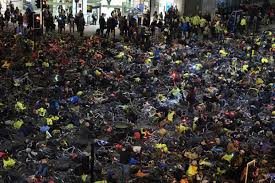
 
Online activity can and does translate into real-world engagement.  And what that engagement looks like is pretty amazing.

Here's a die-in:


What does it remind me of?  The same thing any protest reminds me of:
 
 
This is a murmuration of starlings.  To the right, you see a predator that would take out the weak links in the starling formation, if it could find one.  As it stands, however, the hawk doesn't know where to begin and certainly doesn't have the tools to break up the formation, if they stick together. 
 
Which they do.  It's a survival instinct, really - the ability to group together in the face of external threats.  The very notion of stepping out from the crowd is to risk predation.
 
Back to politics for a second.  "With us or against us" is a tried-and-true narrative; you're with Party X, or Party Y will destroy your way of life.  You're with us or with child pornographers.  There's no middle ground to stand on, no room to move independently, even if there's elements of the overall package you disagree with.  We win or they win - which side are you on?
 
The State, of course, is supposed to be on the side of citizens.  The Justice System is supposed to be beyond sides - justice, blind, etc.  Yet increasingly, the UGC narratives - the social murmurations - we're seeing are presenting a growing community beyond the usual suspects standing on the side of those they are officially told are the problem.
 
Men have gotten behind #beenrapedneverreported.  White icy league kids are getting behind #ICantBreathe.  People in the financial sector are speaking out against the failings of capitalism.  Even elected officials are suggesting our current model of democracy isn't doing its job.
 
There's a bigger picture taking shape, here, if you want to look for it.  Doing so requires a bit of sociology, mind you, but it's worth doing so - for self interest.
 
After all, altruism is selfishness that plans ahead.
 
And the only sides that matter in the long run are "that which adapts and survives" vs that which does not.
 
Inevitably, history's actors are relegated to the past. 
 
Take a deep breathe, folks, and strap in - we're in for quite a ride.  At least we're taking it together.


Monday, 8 December 2014

Investment and Social Impact: The Garden of Innovation


"Founder Henry Chong started the company Revelo Electric which specializes in electric bikes for urban settings. His idea, which started as an undergraduate thesis project has come a long way."

Technically speaking, an undergraduate thesis isn't R&D.  It isn't market research. Yet how many start-ups are emerging from ideas or needs first explored in academic settings?

Then there's Figure 1, which is a brilliant idea that bridges the gap between professional peers communicating relevant information and end-user privacy/info security.  I won't go into the massive growth potential of this App here.

How many innovative, problem-solving and potentially massively profitable enterprises have emerged from non-product oriented processes?  A ton.  Meanwhile, the money governments are pouring into financial incentives to nudge traditional private-sector players to be innovative isn't having much impact.

Also, the increased pressure on what used to be Not-For-Profits to be financially stable on their own (through sales, not grants) isn't making organizations more lean, it's denigrating services.  Pure science as a profit-focused tool?  All we're ending up with is less science and fewer idea opportunities.

 This is a good thing for the survival-of-the-fittest mentality of our current government - they feel that this shrinking of the pool increases the financial viability of what actually emerges.  But where beyond talking-points is the evidence to support this?  Where are the metrics?

There are none.  It's an ideological perspective as removed from reality as the idea of communism.

You can't motivate innovation with financial pressure.  It doesn't work; neurobiology and evidence from countless studies prove it doesn't work.  Instead, what financial carrots and sticks do is encourage more "fake it 'til you make" it hustlers who talk the talk, but tend not to provide metrics of distance covered for it.

So why do we have a government with access to massive amounts of data and professional support actually impeding the sort of innovative success that any economy should want?  Why, instead of heeding the data, is this government stifling its collection and undermining it's presentation?

It's not particularly rational, is it?

And that's the point.  When you know you're right and endlessly confident in your righteousness, anything that disagrees with you feels wrong.   When you're impatient for wins, the objective becomes the removal from your path of that which feels like an impediment to victory.

Even knowledge.

There is a world of difference between wanting economic success and wanting power.   If you see money and wealth as the conduit to personal power, then getting lots of money fast becomes the objective.  Iterative development, learning, exploration, etc. become frills, time wasters.  All that matters is the low-hanging fruit.

Innovation isn't about the low-hanging fruit; it's about figuring out how to reach the higher-up fruit.  Or teaching yourself to garden.

We're trying to solve the wrong problem.  And so long as we KEEP trying to solve the wrong problem, we're going to keep falling short of the mark.

But not the guys like Henry Chong.  They're not in it for them; they're in it for what they can do.  What we can do.
 
See, you don't buy innovation, you nurture it.  Supporting innovation is more like growing a garden than building a tower.

 And the people really interested in strengthening our economy are ignoring the Stephen Harpers of the world and spending time with the Henry Chongs.  Some are even funding them, turning Corporate Social Responsibility into R&D, merging social innovation and user-generate content.

 Something to think about.


#OpenWorld: Dance Like Everyone is Watching


      - Rian Malan, My Traitor's Heart

If you haven't seen the death of Eric Garner yet, watch it.  In particular, note the end where the officials start to get really defensive and are pushing people back.
 
It's like they realized they'd gone over the top and now wanted to be sure to avoid scrutiny. 
 
Which, in our day and age, is silly.  The worst thing you can do is try to shut down the signal - that only encourages people to sneak pics even more.
 
Think Ferguson.  Think Trayvon Martin.  Think Sammy Yatim.  The list goes on and on.  Whatever the context is, people are getting a big picture that isn't pretty.  More to the point, any extremist with a hate-on for the West gains immediate fodder for their "the West is evil" message, plus more justification for their own misdeeds.
 
Yet it comes down to individuals doing what they feel they need or want to do in a given moment.  It's Objectivisim.  And it doesn't work.
 
Today, there is no action that exists in a silo.  The walls have come down, except within our perception.
 
The world is watching what we do, as individuals, and making generalizations about all of us based on what they see.
 
Something to be conscious of.


Sunday, 7 December 2014

Less Calling than Justification


Let's go with this a bit.  When "al-Canadi" (ie, John Maguire) sais "it's your own people turning against you at home," he may kinda have a loose thread similar to a point.  "Our own people" assumedly meaning Canadians, and "turning on" meaning a rejection in part or whole of something we see as part of our Canadian fabric, there's lots of that - look at voter turnout rates as an example. 
 
Or the calls for an overhaul of our structure of governance (like Open Data) or economic model (shared economy).  There are a lot of beefs out there with things that aren't working, ranging from education to infrastructure repair.  Hell, I recently heard a finance guy calling for revolution.
 
None of these folk are rushing to the Middle East to oppress locals in the name of Islam, though, are they?  Much less attacking domestic targets.  If anything, we're trying to increase political transparency, not help catalyze a police state in response to terrorism.
 
Which, naturally, is the goal of ISIL and any other terrorist organization.  They'd love to see Canada become a hermit state, and love it even more if we collapsed into a civil war.
 
But that's not what Maguire is pitching as his motivation.  No, he's heard "the call" and is inviting Canadians (through petulant videos) to convert to Islam, or at least the version he's twigged on to.
 
What Islam has to do with trying to invade Turkey and oppressing locals is beyond me, but then I know that what ISIL is doing isn't really Islam.  It's barbarism, given name to justify it as something else.
 
And that's the rub, right there.  Whether it's ISIL seeking to destabilize others with violence or Maguire calling on other people to become like him, both approaches have zero-sum, apocalyptic end-games.
 
ISIL wants legitimacy, they've got the faux-Islam thing, but they're also expansionist.  Whatever the rhetoric, it's less a matter of their elite thinking about the end of days, so much as feeling like they're bringing the kingdom of heaven themselves, setting themselves up with the divine right to rule by force.
 
Recruits like Maguire are pushing for conversion; they want the world to take on their world-view.
 
What the common thread?
 
It's justification.  It's absolution through elimination of the Other.
 
If I, say, use a homophobic slur, or slap a child, or shoot an unarmed black youth, and I'm the only one who does the mean thing, then I'm a bad person.  If more and more people do it as well, though, then I was just ahead of the curve, wasn't I?
 
This is the truth that probably goes unnoticed by the Maguires of the world as much as it does by any people or organizations that justify inhuman acts of oppression in any form by saying "that's the way the world works."
 
The world might be a greedy, violent, short-sighted place, but it's also dynamic.  Extinction is written into the mainframe of our ecosystem. 
 
We like to think we're better than that, don't we?  In some way superior to the rest of the animal kingdom out there?  Civilized, rational actors, etc.?  Are we not therefore able of being more than our genetic blueprints?  Of being more than the selection of the fittest?
 
Maybe.  A lot of folk don't bother thinking that far ahead; they stop at the justification bit, declare themselves "histories actors" and whittle away their humanity, delving into the heart of darkness within. 
 
Canada has, at least in our popular myth, always tried to be more than this, the dominance game.  Instead of justifying bad behaviour through destroying or converting others, we've tried to build a state of plurality where diversity of opinion is seen as a strength, not a weakness.  By empowering different points of view, we're that much closer to the truth, to more sustainable solutions, etc. 
 
We're not trying to convert others; we're trying to grow something greater than the sum of its parts. 
 
We can make the conscious choice to own our actions and reactions rather than justify them.  It's a harder road than putting self-interest first and dehumanizing others or insisting they have to be like us to be human. 
 
To do so is to submit to something greater than oneself, or one's tribe.  It's to think of open-endings and of growth rather than of Armageddon and ends justifying means.
 
Not that there's anything new in this.  We might just be due for a reminder.