Search This Blog

CCE in brief

My photo
Recovering backpacker, Cornwallite at heart, political enthusiast, catalyst, writer, husband, father, community volunteer, unabashedly proud Canadian. Every hyperlink connects to something related directly or thematically to that which is highlighted.

Saturday, 4 October 2014

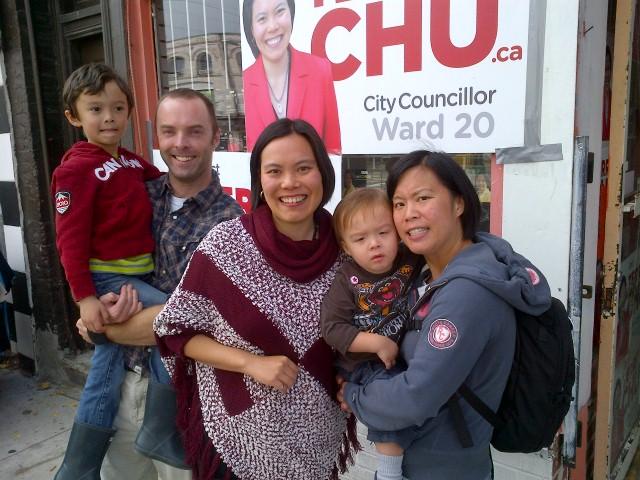
Terri Chu: The Fearless Tax Fighter


I believe we've established that Terri Chu, Councilor candidate in Ward 20, is an engineer, a civic leader, a pilot, scuba-diver, community organizer and baker of amazing peach pies.  Oh, and she founded Why Should I Care and has been a committed bicycle commuter.
 
But I'm gonna guess you didn't know what a tenacious fighter against wasted dollars and inequity she is.
 
Let us set the scene a bit.  It's 2008 and Terri's husband is a professor working at University of Cape Coast in Ghana.  Terri is there for the duration, doing what Terri does; getting involved in the community, identifying structural problems and suggesting solutions on a blog clearly labeled (Author: Terri, Thoughts and Ideas). 
 
Here's an excerpt from her blogpost:


 To summarize - Terri saw what felt to her like a misuse of public funds; she did her homework on the issue and then had the temerity to call the public official abusing dollars, including Canadian donations, to account.
 
It was Ghana, and she was there as spouse of an temporary foreign worker; they couldn't get to Terri, but the university had no problems taking out their revenge on Stephen.
 
Stephen was hauled into the President's office and fired on the spot.  They then asked if he had any questions.  Stephen asked one: "I thought Ghana had Freedom of Speech." 
 
The answer yelled back at him was "Yes, but you used your freedom of speech wrong.  You have the freedom to say good things about the university.  What you did was not appropriate."
 
This is why I love these two - they stand together, no matter what.  Terri had written a post that clearly troubled the University enough for them to take action against Terri's husband.  He had her back the whole way, as she has is.
 
And they both have the backs of those on the team.
 
It's been an amazing experience working with Terri on Why Should I Care - she is the most respectful, yet mission-oriented leader I know.  She'll let you know where you've messed up, but with the intention of getting things back on track.
 
When it comes to misinterpretations or blatant abuses of rights and responsibilities, however, she has zero patience. 
 
Of course, Terri's arsenal doesn't consist of attack ads or bullying comments - she brings her technical expertise, wit and way with words to the table.   Terri will be fearless in going toe-to-toe with developers, public servants and fellow Councilors alike and win her case on the facts and the conviction with she presents them.
 
Terri Chu had no qualms standing up for citizens and respect for public dollars in Ghana - she's successfully managed some massive infrastructure projects in town; just imagine what she can achieve at City Hall.
 
This it a woman you want in your corner, Ward 20. 


Embedded image permalink

Friday, 3 October 2014

The Collective Conscious: Design-Thinking Democracy


“You change the structure, and the way things operate is going to change. But at the moment, the incentives are all there to do things at a base level.”
 
Or, to put in a more familiar narrative - we human beings are flawed, imperfect.  It's only through committing ourselves to something greater than ourselves can the promised land be achieved.
 
Rumi would have loved the concept of Networked Intelligence - he'd probably laugh and say something about schools of fishes contemplating the existence of the ocean.
 
The story isn't new.  The context isn't new.  The objectives aren't new. 
 
What changes is the frame.


The ReCreation Myth


Thumbnail


There are universal stories that resurface with each generation, slightly modified to meet the times.  These stories will emerge, almost as if there is a social need for them, at certain moments in history.
 
We count these moments - moments when we dare to aim higher, to break barriers, to reach for the stars or to make the unknown known - we count these moments as our highest achievements.
 
The epic tales we tale are meant to inspire greatness, to remind us of what can be done or what can be lost when man goes astray.
 
But the way those stories get told give us a bit of focus on the temper of our times.
 
If you look closely enough, you'll see certain personality traits emerging in our heroes or being retconned into our legends. 
 
Just an observation.

The Protocol of War


Exactly.  Militaries fight wars.  They have hands-on experience of the risks and consequences of war from the personal up to the political level.  Which is why they have developed standards and protocols for combat
 
Politicians like to play at war, but for all their War Rooms and Campaigns and Boots on the Ground, they have no idea what actual combat looks or feels like.  They cause wars - it's always the military's job to get us out of them.
 
ISIL isn't a military - they're a gang.  They're terrorists.  They don't care about the long-term consequences of their actions; like a hormonal teenage boy, they're strictly focused on their now.  They go with the frame of "the Apocalypse will take care of the future" but that's really just an excuse not to plan ahead (though, funny enough, the politicians within ISIL are developing complex governance structures - shouldn't that be God's job in their perspective, or are they assuming they're his proxy?)
 
Being tough is not the same as being organized.  Aggression cannot succeed in the face of discipline.
 
There are meta-lessons in this, if anyone in position of authority can get it through their heads they aren't "history's actors" and learn from them.
 

Calling a War a War


I'm fine with Canada play an active role against the non-state of ISIL. 
 
I think that role needs to be clearly thought through and that any military action needs to be one component of more all-encompassing efforts that address the hearts and minds and growth capacity for civilians on the ground in the Middle East, but also looking at some of the conditions here at home which are leading disgruntled Canadians to choose terrorism over citizenship in a democracy.
 
If we are going to war, though, Team Harper should have the decency to call it such.  Afghanistan wasn't technically labeled as a war, which impacted the compensation available to our soldiers.  If you're going to send them into a war zone, have the dignity to honour them for going through that.
 
There are political reasons not to want to call a war a war - we like war on video games or watching it play out overseas, but with an increasingly laissez-faire culture (which has been championed by our Prime Minister himself), we are less fond of the notion of sacrifice.  There's no ROI in it.
 
ISIL, like Nazisim, isn't a state - it's an ideology built on hate.  It cannot be beaten from a distance with technology only - a more concerted effort of boots on the ground, behavioural economics and the provision of better alternatives is necessary.  We have to be clearly seen as placing the lives and livelihoods of ISIL's victims above our own if we are to convince them our way of life is better.
 
That means going all in.
 
It's war, people - one that has to be won, and therefore has to be fought.  Sacrifices will be made, including of political capital.
 
If Harper is really committed to stopping ISIL - and he should be - he needs to put that mission ahead of his own personal electoral successes. 


Thursday, 2 October 2014

Poor Rob Ford


Rob Ford isn't concerned about his health.  He knows he should be - at some level, he feels pangs of concern about the consequences of his health - but he doesn't have a deep-down emotional connection between his behaviour and his health, which is why he was out pounding in signs at midnight.
 
It's foolish, this obstinate, pig-headed behaviour; he put himself at risk, as he has always done.  But he doesn't quit, does he?  There's something admirable in that.  For most people quitting is a default setting.
 
What upsets us the most about Rob Ford is the same fundamental behaviour that we admire the most.
 
Something to think about in that.

ReThinking War


Two notions enter my head as I read this.  One - the Fall of the Roman Empire.  Two - the Clone Wars.
 
Can we get used to war in perpetuity?  Of course we can - it's been the norm for people in various parts of the world for ages.  There's a massive impact on education, productivity, infrastructure, social cohesion, healthcare, etc. but hey, that's all sociology stuff.
 
Unaccounted in this narrative is the other emerging threat - climate change.  Military minds the world over are pondering the grave risks that worsening storms, changing landscape and access to arable land and fresh water will have geopolitically.
 
So where do we go from here?