Search This Blog

CCE in brief

My photo
Recovering backpacker, Cornwallite at heart, political enthusiast, catalyst, writer, husband, father, community volunteer, unabashedly proud Canadian. Every hyperlink connects to something related directly or thematically to that which is highlighted.
Showing posts with label religion. Show all posts

Monday, 21 October 2013

Wealth, Faith, Isms and the Pursuit of Happiness


What is happiness?

Not religion, thought both Marx and Rand.  Religious institutions have oft been decried as systems of oppression.  They can exclude women, undermine opposing perspectives as sinful and cast "The Other" as infidels deprived of human rights.  Of course, Religious institutions are also insatiable beasts requiring vast wealth to keep The Word of God in tangible form, or at least to open to door for access and indulgences.

Friends on the political left will tell me that religions are designed to create haves and have nots and therefore are naught but systems crafted by the elite to enforce compliance and extraction from everyone else.  Religions have certainly been used for such exploits in the past (and present), but that's the institution and the people within the institution - not the religion itself.


It is worth noting that most of the founders of the world's great religions lived lives of poverty.

Ecstatic practitioners of all faiths equally eschew the trappings of wealth and live simply, close to the earth.  As implied by the term - ecstatic - these mystics also live lives dipped in rapture.  Is there joy illusory?

What defines happiness, if happiness is the goal?  Marx tells us religion is an opiate, an externally applied substance that creates the illusion of contentment.  If the wealthy are tricking the poor with cheap bobbles to keep real happiness to themselves, is the implication here that wealth is contentment?  
One would think, then, that the wealthy are deliriously happy and without a care in the world.  But if they feel an urge to trick the people so as to hold on to their own vast fortunes, the implication isn't happiness, it's fear of loss by competition.

Capitalism is theoretically all about competition; work hard, work smart and you too can be wealthy.  God isn't a network, so go forth and create your own, kind of thing.  If it's the ability to compete that drives people to succeed, gain wealth and buy happiness, you'd think we have a population that is hard-nosed driven to build their own success and, as a consequence, buy happiness.  But happiness through goods isn't all that different from the supposed opiate of God - it's an external substance consumed to create an artificial sense of contentment.


External substances.  Manufactured highs.  It's known that certain drugs, including narcotics like opiates, can be highly addictive; the highs one reach under the influence cannot be matched in normal life, meaning the drug becomes an escape from one's existing circumstances - it's the escape more than the substance that is addictive, which is now being demonstrated through scientific study.  Are luxury cars, expensive meals or trips to exotic locations any different?  Are mansions and vast lawns with high walls any different?  


All are variants on the same theme; escaping a heartless world.  One would think Marx would have concluded that both the rich and the poor worship false idols in pursuit of happiness, seeking a Final Solution to remove the source of their misery from the world to create a better one.

But why are the poor mystics so damned happy then?  Why would folk like, say, the Dalai Lama continuously dive back into worlds of hardship and emerge even more content, almost childlike as a result?

Let's go back to happiness.  What is it?

If you believe happiness is a feeling - light on your feet, a sense of optimism, an opposite to sadness, then what you are describing is a nothing more than a neurochemical state.  Hormones like serotoin, endorphin and oxytocin create states that can be described as happy ones.  Neurochemicals like dopamine are stimulated by the consumption of narcotics, which is why they are addictive.

So, if true happiness is the stimulation of happy hormones within the body without external stimulation, either in the form of religion, goods or drugs, how can it be achieved in a heartless world?

A world without a heart is a body without a circulatory system, like a jellyfish or a flatworm.  Our world is infinitely more complex than that, as is our civilization.  The heart is a selfless muscle, constantly beating, feeding the rest of the body, keeping the system flowing.


We humans couldn't live without it; in fact, we never have.  There's been some form of heart throughout our evolutionary process, slowly growing more complex as our own internal systems have grown more complex.  It's not often we think about our heart and its simple but essential role, until it or our body comes under duress.

Which brings us back to those happy ecstatics like the Dalai Lama, trying to keep dialogue between conflicting systems, trying to breathe life and hope into the abysmally poor and somehow, finding sustenance for their souls through the process.  

There's a funny connection between states of religious ecstasy and mania - which, in turn, is a neurochemical state that has a lot in common with a narcotic high, only produced without the need of external stimulation.  

Marx had it wrong.

The world isn't heartless.  Despite it's role as a tool for circulation, a full heart is a concept synonymous with happiness; there's a reason for this.  

Folk like the Dalai Lama are happy because they have beaten us to the punch, so to speak, and have realized something the rest of us haven't; religion isn't the sigh of an oppressed creature so much as it is a pulse, keeping the system pumping as it evolves, ever slowly, towards something more complex that requires not just a complex circulatory system, but a nervous system as well.

As they say - The Kingdom of Heaven is a Kingdom of Consciousness.

Knowing others is intelligence; knowing yourself is true wisdom. Mastering others is strength; mastering yourself is true power.  If you realize that you have enough, you are truly rich.

Sunday, 2 June 2013

The Digital Temple


- Judas, Jesus Christ Superstar
 
Business, Politics, even Charity spends oodles of money every year selling brands.  The goal is to ensure their message is read in every newspaper, heard on every radio, seen on every television; the PR folk want the message to resound throughout the entire Internet.
 
But what is the message?  Whatever the service, product or position, it almost invariably boils down to reminding or convincing people of why they need us.
 
Almost.  Not always. 
 
I'm pretty sure the founders of religions (like Christ or Mohamed), philosophies (like Lao-tzu or Rumi) or movements (Gandhi) didn't hold a lot of fundraisers.  As such, they weren't beholden to sponsors - just their visions.  This helped keep barriers from forming between those visions and the people who would follow them.


  - Cobb, Inception
 
A couple of things about ideas. 
 
The best ones tend to start free.  They inspire proactive action rather than incite reaction.  They also don't require a lot of PR.  The Golden Rule has popped up in every major religion, regardless of its origin not because of promotion, but because of its inherent power.
 
 
The same does not apply to manufactured coalitions of concepts slapped together with the hopes of appealing to manufactured constituencies.  Built on fabricated foundations, these policy packages are employed by Parties and rely heavily on extrinsic promotion. 


As is the case with genetics, while the packages spend time and energy selling themselves, ultimately it's the best ideas that carry on in the long-term.  This is why Political Parties, whatever their name brand, shift along the political spectrum depending on when and where they find themselves.  Their constituencies must adapt to modern contexts and therefore politics is ultimately the dog being wagged by the tail, whatever its practitioners convince themselves.
 
Inflexible brands are like flower pots; they either kill that which they attempt to contain through excessive restraint or break under the natural inclination to grow further.  This is why we eventually transplant individual flowers to collective gardens.  We don't leave gardens to grow wild - that just begs for cleansing brushfires that clean everything away, strong and weak.  Instead we ensure the health of each plant by also maintaining the well-being of the whole.
 
"Strength through unity" is a box, implying unity under one roof - something impossible with an expanding constituency.  Any variation on "us vs. them", to maintain a stable constituency of some kind, will inevitably exclude a majority to retain a minority.  The flower outgrows the pot.
 
Strength through diversity, on the other hand, isn't about borders - it's about adaptation.  The idea is to provide space and opportunity for each individual to reach their maximum potential in a collaborative setting, creating an evolving whole that is more than the sum of its constituent parts.
 
The church, after all, isn't a building - it's wherever godspeople are praying, sharing, collaborating.  That can be a patch of arable land in the Middle East or the Far East, along the Andean coast of South America or in Sub-Saharan Africa.  Increasingly, it's starting everywhere and connecting via the Internet.
 
Society has always had community hubs; these could be a home, a church, a market, a legislature.  Now we're finding these taking root online. 
 
And there's the rub; the best ideas don't sell themselves to grow their constituencies; it's growing constituencies that need adaptive ideas to make them whole.  Understanding is the place where diversity meets and innovation happens; when we all turn our individual strengthens in one direction, we can move mountains.


Thursday, 23 May 2013

What Religion and Innovation Have in Common


"Envision things ahead of what is physically possible."
 
The paleomammalian part of our brain stores information and pulls it up as necessary, like a matching game filtered through emotions.  So far as we know, we're the only species that innovates expansively; there's really no need to proactively create new stuff or explain the world.  Or at least, there wasn't; with all the sociology we've been committing over the past several thousands of years, that has changed.
 
The "new" or "neo" part of our brain makes connections between ideas and plans ahead.  This bridging process happens through a neurochemical process involving neurotransmitters like dopamine. Dopamine, like all chemicals, has an effect on the human body; it creates a euphoric feeling, a sense of expansiveness and deep connectivity with a bigger world of which we're but a part.
 
Civilization - complex social hierarchies, agriculture, manufacturing, healthcare, philosophy, language and the rest of it - are human innovations.  We have literally taken materials that had no connection (like wood, tree sap and minerals) and developed wholly original creations out of them.
 
Worth noting; history is replete with religious figures who served as the catalysts of progress, not stalwarts of conservatism.  Religious practices around "clean" food and social rules (the Golden one comes to mind, as does charity) help foster cohesive societies and point people in a shared direction.  The whole becomes more than the sum of its parts.
 
Whether chicken or egg, religion has always been the synapse that creates societies out of individuals.
 
With that in mind, check out these two events that just happen to be planned for the same two days:
 
 
and
                                                                                                                    
Discovery: Ontario Centres of Excellence                                                    @OCEInnovation
 
Thanks to Social Media platforms like Twitter, you can even follow and contribute to the conversations of both at the same time from anywhere in the world.  Pretty clever stuff.
 
Are you seeing the same connections I'm seeing?

Monday, 13 May 2013

A Quantum of Divinity


Yes, I love this kind of stuff - seeking the points of intersection between points of view gets me thinking.  After all, it's in the centre that innovation gets sparked...


If space exploded out of nothingness to create the universe we inhabit now, this begs the question–Did the universe create God? –Gail S.
 
This is a completely unanswerable question, so forgive me for attempting anyway.
 
If you believe in a personal God—the kind of God who answers prayers, performs miracles, and speaks directly to people—then science has nothing to say on the matter. Such a God exists out of space and time and does not live within the laws of physics, so cosmological discoveries are irrelevant.
 
Einstein had a different view of God, one that is widely shared in one form or another by many other scientists who study the universe. “I believe in Spinoza’s God who reveals himself in the orderly harmony of what exists, not in a God who concerns himself with fates and actions of human beings,” Einstein told Rabbi Herbert Goldstein in 1921. When George Smoot called his map of the cosmic microwave background “the face of God,” or when Leon Lederman refers to the “God particle,” they are speaking roughly in this context. Insofar as the laws of physics emerged at the time of the Big Bang, you could say that the God we know appeared then too. Then the question of “what came before the Big Bang?” becomes equivalent to the question of whether there is a deeper, more timeless form of God.
 
Recent theories about multiple universes that exist in infinite time (also described in my previous post) provide a place for God to exist before our universe—and after, if there is an after–if you choose to interpret them that way. Those theories could also explain how our universe began, and what came before the Big Bang. As yet these theories are untestable, though, so they still live in the realm of metaphysics as much as physics.

Sunday, 31 March 2013

Show Me Your Calves: Slaves to Fashion


There is a whole science around manipulating people's drives to get them to behave in a certain way; cast their vote for or against, buy a product, ignore the man behind the curtain.  It used to just be an art - marketing, manipulation, a slight of hand. 
 
Now, with the crystallization of NLP, neuromarketing and such, it's a science.  Other people are learning how to make you think their desires are your original inception. 
 
But who pulls the puppet-masters' strings?  When they feel they're smart and everyone else is dumb, their confidence blinds them to their own motivations.

There's only one way to illuminate the shadow-world of the semi-conscious mind.  The answer's a variation on a theme we've come across time and again -

Recognize that we are imperfect, accept that we're part of something larger than ourselves and come to terms with the fundamental premise that no man nor woman is an island - together, we're a system.

Sounding a little too pseudo-religious for your liking?  You can interpret it that way, if you like - really, though, it's just science.

Friday, 15 February 2013

Thoughtful Sex


Then, consider Matt Ridley's notion of Ideas Having Sex - innovation as social procreation, as it were.
 
 
Does desire bring people together in an equitable way?  Not really.  Desire, be it for power, for resources, for sexual gratification brings with it the need for domination.  It's why a balanced "free market", otherwise known as "selection of the fittest", doesn't work in an interdependent social context, which we undeniably are (unless you are able to make your own clothes, grow your own food and sustain your own public infrastructure, which would be quite a feat).
 
Conversely, responsibility - the apparent opposite of desire - is about what you give back, not what you receive.  When people collaborate in an understanding, trustful way (this can be a married couple, a company of soldiers or an office team) they create something that has greater reach through space and time than can an individual. 
 
Who do we choose to surround ourselves with?  Most of the time, those choices are out of our hands; we can mistrust the Other and live in desirous suspicion, or we can love our neighbours - a theme repeated throughout world religions.
 
Which makes me think of the Sufi maxim - "God is great, there is nothing but God, therefore I am God."  Which is an ecstatic thought that can occur to people having dopamanic manias, pushing their pre-frontal cortexes beyond normal, beyond even individual safety.
 
But society isn't about the individual - it's about the social whole, a new system that's greater than the sum of its parts.  You can't sustain a system if its components aren't properly maintained or pushed too far past their limits, which is what's happening in our society.  At a point of increased tension, polarization and social friction, we're beginning to turn towards leaders who know how to serve as bridges, not battering rams, looking to see what places they can bring us to.
 
It's all fun stuff to think about - and share.

Thursday, 18 October 2012

Bread, Candles and Community – The New Sabbath Project


-       Ralph Benmergui

It's easy to say that religion causes war. Ayn Rand, Karl Marx and Richard Dawkins have all done so. There's plenty of evidence to back that thesis, too - historical horrors ranging from the Crusades to 9/11 all had religious motives. But what of the wars that didn't? The Rwandan genocide was tribal. World Wars I and II were about power and conquest. Conquistadors might have told themselves their goal was to bring God to the heathens, but they sure squeezed in a lot of rape, pillage and plunder along the way, didn't they? 

Beyond this lies the fact that war is not a uniquely human enterprise; other species ranging from ants to lions and hyenas engage in mortal combat, too.  In all cases, war is always about the same things – dominance and resource access.  While religion makes for a pretty unassailable justification for conflict (mortals can’t argue with the will of God), it’s one not suitable to that application.

The sad irony is that the core teachings of all great religions try to steer people in the opposite direction.  The Golden Rule pops up in faiths across the spectrum of time and geography.  In fact, there’s an argument to be made that religion played a role in nurturing civilization, lighting the candle of humanity in our dark paleomammalian hearts. Is it possible that religion, in its purest sense, is about bringing people together rather than setting them against each other?

Last Friday, I had the great pleasure of partaking in The New Sabbath Project hosted by two wonderful human beings, Ralph Benmergui and Cortney Pasternak.  They invited a diverse group of people with different lineages and differing trajectories into their home for the lighting of candles and the breaking of bread.  It was a cold, dark autumn evening, but within those walls was a space filled with warmth and light.  Ralph and Cortney billed the dinner as a night of food and prayer; for me, what they created was community.

As an ice-breaker, Ralph had everyone explain the origin of their family name.  Through the process, we got to understand each other not just as faces and titles, but as threads of the experiences of generations, woven into the fabric of each individual.  By adding dimension to each name, we all became a bit more humanized to each other.  This became critical, later on.

After appetizers, we moved to the table, where Ralph explained the rituals of Shabbat.  As he unspooled the rules, though, Ralph explained the why – what the bread symbolized, what the salt symbolized, what the candles represented.  By the time he began the incantation (given in Hebrew), we had already, through our opening up to each other and under the roof of our hosts, created a shared space. 

Judaism is an ancient religion that has preserved the same traditions for thousands of years, from the days before empires.  Through the symbolism of the Shabbat ritual, but especially through the concept of shared food and light an image was invoked for me of people at the dawn of civilization huddling together around a campfire, safe from a dark and threatening world.

Then, in another ancient tradition, Ralph kicked off the act of giving blessings – to or for people, in commemoration of places or events, an evocation of empathy for the world beyond our created space.  It dawned on me as we went around the room that the act of giving blessings was a way of engendering empathy for others and gratitude for the things we have (instead of fueling resentment over the things we don’t).  These are fundamental concepts to Positive Psychology, a newish field that seeks to build social/emotional skills and emotional resiliency in people. 

Militaries use Positive Psychology as way of empowering their soldiers, just as a growing number of workplaces are employing its principles to foster healthier and more productive employees.  A religious ritual that predated history had already mastered a key concept of psychological well-being millennia before science had even begun to explore how the mind works.

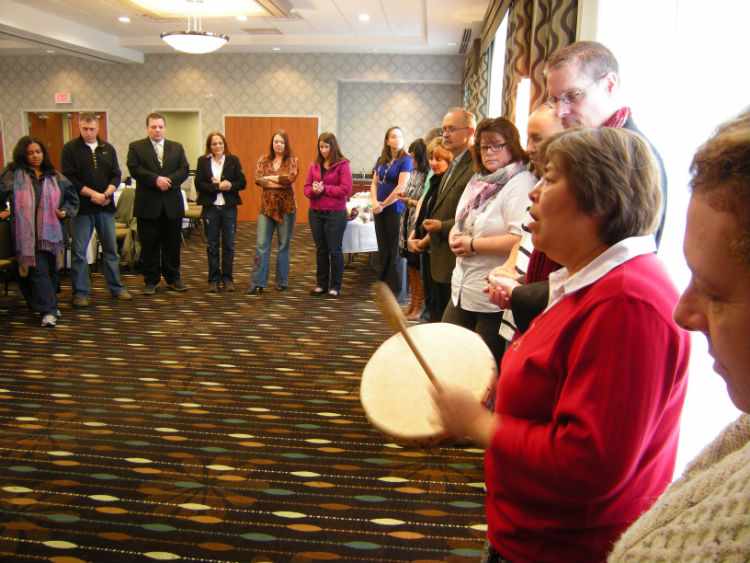
In the discussion that followed one of the guests, Sylvia, talked about a new job working with Native women.  Each work day, she explained, began with a “circle” – the creation of a space of comfort in which people could talk about their feelings.  For the first few days Sylvia didn’t get the point – they were there to work, not to have a hug-in.  By mid-week however, it made sense; when you understood the emotional state of a person at the start of the day, it informed all your interactions going forward.  There were less awkward communication problems and more appropriate supports, leading to improved outcomes. 

The notion of the shared space and even many of the rituals involved in creating that space mirrored the traditions of Shabbat.  It wasn’t just one religious faith that had landed on these practices; they seemed to be attached to religions from around the world.  This was appropriate – around the table were lineages representing Europe, Asia, Africa and pre-conquest North America.  The experience of the New Sabbath Project knitted together each of these histories into one shared community that transcended any one of our narratives.

At Ralph and Cortney’s table there were laughs and tears; deeply personal stories, tentative aspirations and questions of all kinds were shared.  Because of the nature of the space we had created, together, there was no judgment.  There was food (including Cortney’s amazing bread), there was light and above all, there was community.  Because of this, we all felt open to be ourselves, to speak plainly and honestly, as well as to listen.  It was surprising to many of us just what a fresh experience that was.

When the evening was done and the candles extinguished, we all parted and headed back into the darkness alone, yet filled in many ways.  The threads of our shared experience, however, weren’t cut – they will continue to accompany each of us on our journeys, encouraging us to seek out and weave even more lineages into our communal tapestry.

As the Rands, Marxes and Dawkinses of the world focus on a clinically pragmatic view of the world, they are neglecting a key component of the human experience – the connective tissue of community that gives us cause to come together and create a whole that’s more than the sum of its parts.

At its root, then, perhaps religion isn’t a thing designed to justify conflict and dominance; maybe it’s the thing that’s meant to bring us together.  So long as we keep a candle burning somewhere out there, that hope remains.


Tuesday, 11 September 2012

Stephen Harper's Bad Example Don't Mix Confusion With Fear


Some folk used to say the same thing about learning multiple languages at the same time - it would muddle the brain, they said, and result in children learning neither.  Look at households, at classrooms around the world and especially here in Toronto and you'll hear that's clearly not the case.  The brain's a much more flexible machine than we give it credit for.
 
 
Of course, that's not the main issue here.  The reason why some parents have created a checklist of issues they consider uncomfortable for their children to learn is because of just that - certain subject matters make them uncomfortable.  I could be wrong in this, but I'm pretty sure that no religious text promotes xenophobia.  What else could be the purpose of excluding children from the broader education that will benefit their peers?  Is there some magical line down the road where these children will have enough entrenchment in their parents' beliefs that exposure to other viewpoints and opinions in this polycultural society of ours won't offend their sensibilities?
 
 
Canada is not a collection of cultural silos, ethnic and religious groups existing "equal but separate" from each other.  We have a long, proud, envious history of finding collaborative solutions to common problems, of finding strength in diversity.  This has been a key part of our national identity, this desire to work together.  We might never have been a military superpower but in times of challenge, our friends and neighbours always knew they could depend on us.
 
 
That's how it used to be.  Today, Canada is becoming a more insular place.  It is the politics of division, not exclusion, that define us and this traces right back to the very top.  Stephen Harper, Prime Minister of Canada, doesn't believe in the things people can accomplish when they work together.  He stiles dissenting voices in the bureaucracy, in Parliament, in critical groups of every stripe.  He doesn't believe in collaboration, in debating ideas, in reaching a hand out to those in need rather than simply targeting those who might be threats.
 
 
In his own way, Harper is as socially influential a Prime Minister as Pierre Trudeau was, leaving an undeniable imprint on our country.  Harper seems to feel things like facts might confuse us, that any foe left standing provides a threat to his vision of the country.  In his view, transparency really equates with opacity; accountability is anything but accountable.
 
 
And so we see a growing number of Canadians deciding it's not worth trying to make things work, to have open debates about points of contention.  Why learn to disagree when you don't need to engage with The Other at all?  A lack of exposure to the why behind the differences around us lead to the rise of conjecture, suspicion and fear.  We naturally fill in the dark spaces of our understanding with bogeymen.
 
 
True leaders bring their people together with a powerful vision based on shared beliefs.  The people find themselves reaching out in collaboration and wonder at what they have accomplished, together.  We've seen this before.  But in Harper's Canada, it's Jedem das Seine - we've seen how that's worked out in the past, too.

Thursday, 5 July 2012

Are Faith and Reason Incompatible?


Watched this video (warning, it's long) which is a conversation about "helping people overcome their faith."  Socratic method.  The "faith virus." 

I find this stuff fascinating, because it always seems to me there is a fundamental approach problem in these discussions.  At many levels, science and reason are not at odds with the basics of faith.  There are natural laws, just as there are imposed laws in religion.  There is a direction in evolution (not towards superiority, but towards specialized collaboration) just as there's a "plan" in religion. If you strip away the language of both spheres and get down to the intent, there's a common, almost intuitive starting point that loses it's rapture the more clearly it's understood.

To me, faith isn't an illogical belief in something that does not exist; it's a trigger that helps us connect with a reality that is beyond simple comprehension and empowers us to become a whole that's more than the sum of its parts.  It's not a claim, it's a sensation.  As such, religion as a structural manifestation of that sensation can't fall - because it's biological.

What Dr Peter Boghossian is describing in his "lose faith through the Socratic method" approach is actually about cognitive behavioural therapy - which, in itself, has a lot in common with prayer.

Boghossian and Molyneux might want to dig a bit deeper into the concept of "know yourself to know the world" - if they really explore the neuroscience behind why there is faith, they'd see why it's not such a bad thing after all.  

Thursday, 21 June 2012

The Secret Story of Women, Religion and Civilization


While couched in the perspective of Christianity, this article (and the editor’s response) speaks to a much broader theme that we see reflected across religions, politics and culture.


The lines drawn here are between:


- individual freedom (without responsibility) vs. mutual respect


- staunch traditionalism in the face of social change (people in the centre/left might associate progress with moving forward, but for the right it’s synonymous with an erosion of traditional values) against progress


- the all-too-human ability to interpret phrases or edicts through our own preferential lenses vs. the way things truly are beneath perception


Christ, of course, was a progressive (as depicted in the New Testament); he’d have been pretty pissed off with much of what was done in his name (I intentionally avoid caps for “he” and “him” – don’t think he’d have approved of that, either).  Just as Islamism cherry-picks from the Koran to justify spousal abuse and violence that are rooted in cultures that predate Islam, Christ gets used as an excuse in a way that would be pretty hard to justify at the Pearly Gates, if you believe in heaven.

On the other hand, when you strip away the dogma of religion, culture and tradition, there is another interesting connection that materializes.


In “traditional” societies where males are dominant, women do much of the labour.  The men conserve energy, look tough, mate and compete with other males.  The goal is to be the guy the women want to mate with, put on a display and have those women come to you.  Responsibility isn’t the issue – only carrying on one’s genes is.

This is quite a common theme throughout the natural world, with lions being a nice, visual example.  Lion males don’t hunt, don’t rear – they can’t afford to expend the energy.  All that energy needs to be saved for strenuous competition with other males and the maintenance of displays of threat or prominence, like the peacock’s tail or a pretty car.

In “traditional” societies – human and otherwise – women/females are responsible for food, child-rearing, etc.  They don’t have time for much else.  It’s also not uncommon for women to collaborate on these inherited chores in collectives.  One has to wonder if the Taliban could have been born anywhere other than a heavily mountainous terrain that discourages broader social development and reinforces tribal organization.

Now, go back to humans for a bit.  What happens in marginalized communities where there are mothers with kids of dead-beat dads?  What do those dads do with their time?  I’ve been around the world and have seen a common theme in slums and ghettos from Morocco to Bolivia to Toronto – mothers with multiple children, sometimes from multiple males, living in squalor conjointly and trying to work together to bring their kids up well while the dads are at coffee shops or popping caps into each other.  A generalization, to be sure, but one I’ve seen enough to feel comfortable in making.

Now, take a look at broader demographics trends – where women are denied access to education and opportunity, society remains “traditional” or rather, tribal; male-dominated, violent, greater populations but less quality-of-life and shorter life spans. 


On the other hand, where women have a greater role in society, we see progress – greater education for all, greater development, more collective security, opportunity and above all else, shared responsibility that surpasses gender barriers.


With that in mind, take a fresh look at fundamentalist Christians who want women to be in the home, espouse “traditional” values and look disparagingly on equality and opportunity as “godless” and divergent traditions as pagan.  Look at al Qadea, aiming to feudalize society and marginalize women.  None of that really has anything to do with religion – in fact, religion as a concept has been a key development allowing us to embrace progress.  These behaviours, these trends are really about biology, a kind of social evolutionary laziness.


It’s a laziness that’s in vein, too – the larger populations get, the more pressure gets put on those populations to have order and structure to avoid epidemics and systematic violence.  It’s marginalized groups, particularly women, that see emerging problems and fight for the right to be part of the solution.  Which brings up another interesting phenomenon – the role of female figures in religion.  The concept of an earth-mother is not an uncommon one.  Archaeological evidence supports the notion that even Yahweh was originally depicted as having a consort, Asherah.  There’s a whole untold story behind faith, religion and the evolution of society just itching to be told.    


Religions allow people to collect behind an idea that is bigger than themselves.  That feeling of “being connected” actually triggers a neuro-chemical response – if you’ve ever had a “eureka” moment, you’ve felt those neurotransmitters at work. These interpersonal (and inter-synaptic) collaborations allow people to develop solutions to the problems that emerge from cohabitation; solutions like shared infrastructure, waste disposal and health care – all things that are pretty complex and therefore require specialization.    Technology allows us to scale up the Maslow hierarchy, as does aesthetics, music, etc.


Far from being a threat to social cohesion, the empowerment of women is what allows society to flourish.  But we already knew that, didn’t we?

Friday, 15 June 2012

Time To Renew


Politics is about more than just governance - it's about competition, being oneself at the expense of someone else.  This is as true between political Parties vying for dominance and control as it is between nations fighting over land, resources or economic supremacy.  

Partisanship is as much about tribalism as it is ideology.  In fact, when all ideologies are taken to extremes, they tend to bleed in to each other.

Brand is the flag we veil our tribalism in (my country right or wrong, etc.) that allows us to identify competitors as Other, thereby skirting around the Golden Rule.

Policy, on the other hand, must be inclusive and balanced to be effective.  This cannot be achieved if policy makers - partisan politicians - are putting tribal interests ahead of the common good. 

There is not a single political institution in history that has continuously overcome the temptation to skew the public good here or there for partisan gain.  Of course, no government in history has been held to the mass scrutiny that is possible today.  The politics of the present is projected in HD; every blemish is magnified a hundred fold.  Increasingly, we don't like what we're seeing reflected - and increasingly, there's no where to hide from the truth.

There is an undeniable reality emerging.  I'm going to one-up Andrew Coyne and say it's not just Political Parties or even our political system that needs a revamp to meet the needs of the time.  The changes happening out there are too vast for that; society as a whole is chafing under the skin of outdated institutions. 

It's us that needs to change. 

Identity is about the trickiest form of governance - over oneself and the face one presents to the world.  Our selves don't exist in isolation; we are surrounded by id.  Of course, we have always been more than islands; human beings have a deep yearning to belong, to be part of something greater than ourselves, to know and be known. Which is why we became tribal, or partisan, in the first place.

To make space for ourselves in an increasingly interwoven social landscape, we must become conscious of who we are, as individuals, and where we fit in the broader social organism.  The process of doing so will redefine how we see ourselves and, frighentingly, remove some of the barriers of perception that have made us feel safe, like a garden wall.  It's as those walls come down and we are forced to define ourselves as individuals whose actions have broader, social  consequences that we will begin to experience true freedom - not of body in space, but of mind in body.

For some, this process will be too much and seem too cataclysmic, almost sinful.  Those who cling to the comforts of tradition in the face of progression will fight against change, as they do every generation.  That is their choice, but they will inevitably get washed away in the tide of social transformation. 

After all, there are some laws that transcend short-term societal conventions: first among them, adapt to survive.


Wednesday, 6 June 2012

Humanity's Riddle


It's long and complex, with references out the wazoo, but this piece ties together themes and trends that transcend time, culture and language.

But it's definitely worth reading.

Many of the beliefs we take for granted as established and ours in fact have roots in unexpected places.

Symbols like the snake (knowledge), the tree (the circle of life) and fire (understanding or innovation) are repeated throughout history and tradition.  Just as is the idea of a power greater than ourselves.

All these strands are threading through time to a common juncture, like roots to a tree, only we can't see where they connect.  

This, then, is the ultimate riddle we face - what lies behind the curtain? 


Wednesday, 16 May 2012

GSAs, Catholic Schools and Education Reform


Having the advantage of being on the political periphery, I have no qualms going near this.

I think there is a real opportunity here to make a more cohesive, efficient system that provides our kids with more opportunities (in a cost-effective manner) and makes it easier for harder-working parents to know their kids are safe and exposed to valuable learning lessons in after-school settings.  We could potentially even reduce gridlock by putting after-school programs in schools.


That's my idea.  If you've thought of something different, I'd love to hear it!