Search This Blog

CCE in brief

My photo
Recovering backpacker, Cornwallite at heart, political enthusiast, catalyst, writer, husband, father, community volunteer, unabashedly proud Canadian. Every hyperlink connects to something related directly or thematically to that which is highlighted.

Wednesday, 24 February 2016

Hope and Anger


Rob Ford tapped into an unseemly vein of anger in Toronto, and that anger propelled him to success. 

As Rob Ford didn't have any sort of verbal filters, he comfortably told things as he saw them (which is not to be confused with "telling things as they are.")  There were not-so-subtle undertones of racism in his comments and approach.  It's more than fair to say that he had a huge amount of support from some of the demographic communities he disparaged, a reality that can't be understood without a deep understanding of the social context within which those communities exist.

At the same time, Ford uncorked and gave voice/license to a swell of resentment, anger and bigotry which has been bubbling just beneath the surface in Toronto for quite some time.  In some instances, things got ugly.  

It could have been much worse, though - Ford could have had a bit more self-discipline and held keys to a higher office.  When he said things like "run 'em out of town" he could have had the legislative clout to actually make that happen - or the will, experience and resources to intimidate even the law makers and enforcers to stay out of his way.

If Trump wins, he will be Rob Ford maginfied.  How would Donald Trump have responded to Ferguson?  How would he respond to the next one?  It's not too much of a stretch to apply his "we have to be much tougher" logic and think of Daraa.  Remember - Assad still has his supporters.

Shit could get very real and very ugly in a hurry with a "no deals" President with a fondness for divisiveness and gut punches in charge.  

That is the model we used to see a lot more of in the days of empires and kingdoms, which far too many modern leaders see themselves as rulers of.

This is only part of the story, thank god.

The other part is more hopeful.  Increasingly, there are governments and leaders recognizing not only that they can't do it all alone or have all the best ideas, but that their role as leaders is actually to empower and support the communities that form their constituencies.  This is where Open Government is emerging.

Tied to Open Government is a renewed level of civic activism - not the oppositional, protest kind that seeks to challenge unliked policies and practices, but that hacks, designs, facilitates, etc. solutions that come from and work for the people.  It's a very messy process right now, with egos and misunderstandings and good intentions without sufficient information doing as much harm as good, but it's a starting point.

We've seen recently in Canada, both under Ford and former Prime Minister Stephen Harper how other levels of government, public servants and communities at large have managed to make things work despite the wrong kind of leadership.  Funding cuts were worked around; some federal laws simply weren't enforced provincially; new partnerships were made to develop and implement community solutions from the ground ip, rather than simply fight against top-down impositions.

Increasingly, we're seeing a reinforcement and return to quasi-dictatorial top-down leadership and divisive politics being countered by the emerging concepts of open government and responsible society.  This is significant; this represents a massive change in the way governance works, communities are engaged, what communities are about.

My gut tells me we will see (probably over a longer term basis) a realignment of political power, with politicians becoming facilitators more than representatives or neo-feudalists.  I also think that there will be a lot of friction and conflict, potentially on a massive scale, before we get there.

At least things won't be dull.


Wednesday, 10 February 2016

Why Corporations Have It Wrong


Sit with that for a second.  It's a lesson that extends beyond corporations; the more women are empowered, educated and in positions of authority, the better nations do.  Less wars, less illness, higher quality-of-life, greater economic stability.  That's what the evidence tells us.

Except there aren't that many women in executive positions - not in the private sector, not in government.  If you listen to the arguments of a John Tory (pulling from a past quote, so his position might have changed - he's a business guy, after all) the reason for this is that women aren't as pushy and "hungry" as men are.


Exactly.  Men are more likely to shove their way to the front of the line and say "I deserve more. I'm better than these other people."  Clearly, if they're able to compete so fiercely for themselves, then they'll do the same for a company from C-suite positions, right?

In this light, the job of funders, or employers, or boards is to sit back and wait for the most aggressive, persuasive person to come to them.  If it happens to be that those people are male, that's just life right?

That's the approach that's being taken, a laissez-faire approach to awarding positions that thinks from the individual out or occasionally from the market up, without really looking at the bottom line.  

If profitability really matters, then the smart executives will recognize that they need to change their methods and culture and start committing a bit of sociology.  

Leaders don't wait for alphas to come to them - they grow leaders.

Consider it like talent scouting.  There may be kids who are amazing at coding or basketball or whatever who live in marginalized communities and are basically told from day one of life that they have no value and don't belong in the professional world.  If they show up at a professional fair, they will be dismissed out of hand, without their skills ever really being harnessed.  Smart leaders go out into the world, look in unusual places and seek talent  The probe for talent, they give people opportunities, the grow leaders.

If corporations really want to be profitable, and successful, and have impact and all the rest of it, they need to rethink their culture.  


.

Thursday, 4 February 2016

#NewWay2Govern: Tech, Refugees, OpenGov and Responsible Society


There is a lot to chew on in this article.  The quote above, though, gets right to the heart of the matter.

Government's standard operating procedures are falling out of sync with technological development.

Our Westminster model of Parliament pre-dates computers, tv, even cars.  It dates back to a time where government was the Monarch and their inner circle, or Privy Council.  Government reluctantly agreed to consult with wealthy landowners on matters of law and taxation, but generally did their own thing.  As it evolved, Parliament became a mechanism whereby every day people whose lives were impacted by government operations could have some skin in the game, by representation.

What other way was there for communities to voice there concerns to some far-off government?  You couldn't visit your MP's office, or tweet with a Minister, or pick up the phone and call someone.  The only way to have a regular airing of local concerns to government was through the one person who communities elected to be their voice in far-off Parliament. 

In this model, the public service was essentially the workforce of the crown.  Technically, they still are.  The public service answers to the crown, and the crown - government - is held accountable by Parliament.  Only since Magna Carta, we've gotten to a place where the largest political party in Parliament - the body meant to hold government to account - becomes government.  This gives the parties a lot of power over members of Parliament from their nomination all the way through who gets to have a seat at the cabinet table, plus what local projects get funded.

The public does't elect government - they elect Parliament.  The biggest party in Parliament forms government - which means that card-carrying partisans and back-room political decisions ultimately decide who leads government. Much of the function of Parliament under this scenario is to either prop up or shoot down the government of the day, which is a different function than truly holding government to account.  

The Public Service doesn't answer to Parliament - it answers to the crown.  The crown is represented by the Governor General, and the Ministers of the Crown, from the PM down, are all technically functionaries of the crown.  They're also creatures of their political party, with the agendas and mentality that goes along with that.

So what's really happening with this Open Gov stuff is that partisans are directing the public service to serve another master, the public, without embarrassing them as partisans.  Meanwhile, Opposition parties are looking for weak links in the government's - ie, Public Service's - armour through which to take shots at the political party in power.

Meanwhile, the culture of the electorate is still essentially based on the Westminster model, a reality which is reinforced by partisan messaging of "only we can make/keep Canada strong."  In this model, Civil Society is a passive player, a backseat driver at best in the functioning of government.

Which all made sense in the 1200s, because there was no other way the public could engage with government.

Yes, Canada's outdated privacy and FOI information acts are out of sync with modern technology. Almost everything about Canada's model of government and civil engagement is out of date.  

You don't change a system by targeting one component of that system; you can't fix wicked problems by picking low-hanging fruit.  Everything needs to change; public service culture, political culture, how the media covers and engages with politics, how the public sees its role in policy making, how partisans engage with each other and with everyone else.

Herein lies the real challenge; we have had great advances in technology that permit a change in the dynamics of engagement - cars, tv, telephones, the Internet, social media, etc.  The use of new tech is being encouraged, in some cases, but by top-down directive - an outdated model of engagement in itself.

You can't order someone to be open; you need to foster a culture that allows for open.  

That means adjustments inside government, within partisan politics and throughout civil society.  It's a big, big change.  Ultimately, what we're talking about is a complete reordering of the dynamic of governance and accountability.  

This is the right thing to do and the right time to do it.  Our current model of governance and implementation is woefully inadequate for the size and complexity of modern society. 

We're seeing this play out in real-time with the Syrian refugee crisis, which provides a great many lessons for anyone willing to pay attention.

Government-funded settlement agencies are being overwhelmed with more work than they were designed to cope with.  Modern tech and social media are finding these agencies fielding asks that have nothing to do with their core business, adding to the stress and time constraints to do the essential work they do.  And all of this is happening in a climate where funding taps are turning off and groups that could and should be collaborating are competing for the limited funding that's available.

Strategies are being planned after the fact, where there's time to strategize at all.  People are falling through the cracks, hard workers are being burned out as the work shifts from doing things well to putting out brushfires or playing defence.

Meanwhile, civil society has stepped up in ways that simply weren't possible before modern tech and all the tools of social media.  What's happening out there is nothing short of revolutionary - civic groups are proactively taking on the role of service provider in a way that used to be the exclusive property of government agencies or government-funded/supported charities and not-for-profits.  The work being done is amazing, but it's not coordinated, which means there is a lot of duplication, gaps and overlaps that could be avoided.  

The problem is that there's no real mechanism in place for this kind of coordination.  Government has struggled to coordinate activity between Ministries and various funded agencies, and really have no mandate to coordinate activity between civic groups and everyone else.  There are trust issues, especially when it comes down to government (partisan) holding to account service agencies (serving the public) who's funding relies on the Crown.

If culture change is the goal (and it should be, because without it nothing will change), how do we get there?  Whose culture needs to change, and what does responsibility and coordination look like in this space?

You don't generally hear design thinking, UX/UI or journey mapping as part of government's lexicon; that tend to be more the methodology of the social innovation space.

Which is exactly the point.

Public service culture needs to change, but that change needs to happen in conjunction with changes in political and civil society culture, as well as media engagement.  All this is happening in a messy world of falling revenues, reduced funding and the uncomfortable realization that there are a lot of skeletons in the closest that will come tumbling out when the door is opened.

How is this wicked problem to be tackled?  What provides enough of a common impetus for change that allows for the kind of uncomfortable conversations necessary?  What shared challenge/opportunity can be the stone in the soup that allows people who don't generally play nice to do so in a way that focuses on solutions rather than blame?

I used to think severe weather events were going to be the catalyst.  Now, it seems like something else is fitting that bill.

Either way, there are encouraging, iterative, still tentative and still small-scale things going on in the Zeitgeist that may be a model for how we can do all this stuff better, using modern tech and engagement frameworks but above all, putting individuals at the centre and making collective impact the goal.

Culture change facilitated by technology.  Open Government, Responsible society - a society consciously recognizing itself as such and collaborating to make the whole function to the maximum of its potential with an emphasis on empowering individual agency and engagement through equitable service, communication, trust.

Fun times indeed.


Monday, 1 February 2016

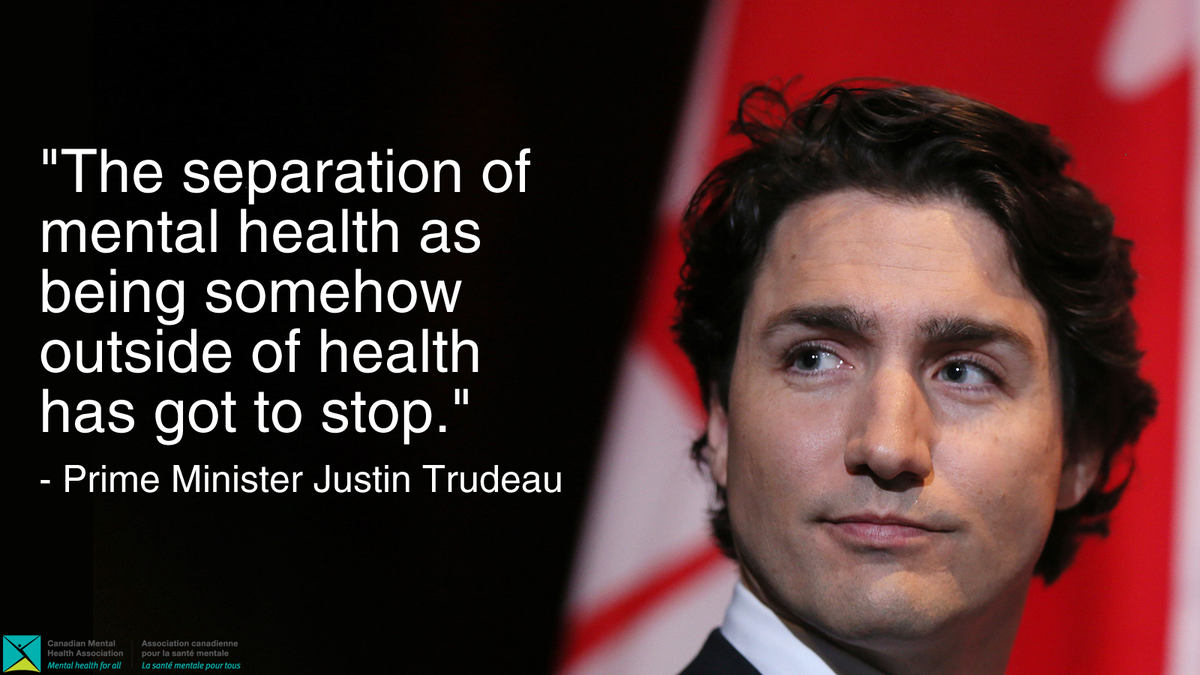
Mental Health at the Centre


Embedded image permalink

I remember having a good chat about this with a certain Chief of Staff some years ago.

It's as true for health as it is for other sectors - like employment, immigration, justice.

We have no problem looking at every file through an economic lens, but for some reason we are challenged to put the human at the centre of the equation.  Which of course begs the question about how smart our priorities are, and how clever our engagement strategy is.

Unless we decide to let robots do everything (and that's a definite discussion point), people are still at the centre of economic everything, and are supposed to be the end-beneficiaries.  

To deny that basic reality is just plain crazy talk.

Brainstorming Vs Design Thinking:Solving the Right Problem


The first thing that came to mind while reading this article was that you truly can find studies to back anything. Of course, the way you frame the question matters quite a bit; the same data can prove exact opposite theses, based on how it is used.  

Data is neutral. People are not. They have biases, preferences, previous experiences to pull from, etc.  

I absolutely agree with the article in terms of coming up with ideas being a different thing than implementing ideas. Lots of people think it would be cool if X or Y without any intent to do anything to make X or Y happen. They throw the idea out into the ether and if it gets picked up so be it. Others will get excited and start, but move on to something else before getting started. Still others will pursue an idea without the right understanding of how to implement it, meaning it goes nowhere.  

As someone who spends a lot of time ideating and a decent amount of time creating, I totally get the concept of ideation in isolation. Sometimes you need space to play with an idea, flesh it out, do doodles and speak to the air in ways that is would be incomprehensible to anyone else. Sometimes, you need just one person as a sounding board.  

This is ideation as a selfish activity, with the goal being to make sense of one's own idea, not solicit ideas from others.  

Of course ideas don't come from the ether, nor to them spring fully-formed from the head of the innovator, like Athenea from Zeus' noggin. Everything comes from everything - the more exposure one has to ideas, images, past innovations, people, etc the more fodder they will have for ideation.  

All of this supposes that ideas are what matters. Or, to follow the article more closely, that ideas turned into action are what matters. Is this true?

This notion is based on a very Western, very Survival of the Fittest conceptualization that posits ideas or innovations as babies that their creator parents nurture. Whatever is the best idea will be adopted by the market and survive because it was the one best fitted to societal demand.  Ideas that aren't best-suited will die out.  

It's a very inwards-out process, this‎; it suggests a whole much of individuals throwing stuff against the wall to see what sticks.

Lots of things will sick that may be shiny and fun but actually aren't all that useful.  

Let's say the issue at hand was stopping diabetes type II, a preventable illness that takes a massive economic and social toll, especially on North American society. Is the best way to find solutions to diabetes Type II to get a bunch of people to sit by themselves and brainstorm?

That's not far from how the existing policy process works, with a bit of information -gathering done to provide substance for ideation.

Not that the problem of diabetes type II still persists. Note that it has been exacerbated by all kinds of implemented ideas - everything from fast food to TVs and cars and the modern work day have had an impact ‎on occurrence of diabetes type II.

Ideation is fun. Creation is fun. In the frame described here, though, it's an isolated act removed from context. 

Who's to say that the independent judge is best arbiter on what a good idea is? Lots of really smart and successful people have ideated and developed policy, programs, even polling that fails to achieve it's goals. Are all these ideas as good as they were sold to be? I'd argue not.  In fact, I'd say there are plenty of studies that say otherwise. In fact, I'd say that Western culture is steeped in the notion of the blind innovator pushing their idea forward to the greater detriment, because they were selfishly about the idea, not the context.

What if we reframe the outcome from being "come up with a good idea" to "addressing a problem?"

Design Thinking is a increasingly popular (not to be confused with good) process that looks to tackle solution-making from a different angle. Instead of focusing on innovators and ideas, it begins with people and their problems. The process here isn't about the lone innovator coming up with brilliant ideas, but a careful study of the context, culture and people involved in a problem set - lets say diabetes type II - and understanding the underlying patterns and behaviour. Once you know what the landscape looks like, it becomes a lot easier to identify a path to success.

Through this process, the more information you get, the more journey-mapping you do, the more robust your understanding of the landscape looks like. Also, since the idea isn't the fixation point, iteration is a lot easier. No one has to sell their pitch, because everyone is focused on the problem, not their ownership of the solution.

It might be the case that individuals are better at coming up with ideas and aggressive visionaries are better at turning their ideas into action, but the truth is that people exist in a social context and proper solutions aren't necessarily the same thing as individual wins.

When it comes to solutions, or even products, it's not the creator who matters most - it's the end user.

And the end user, almost invariably, is a crowd.


Tuesday, 26 January 2016

Reporting Change


- Warren Kinsella

Kinsella makes a valid point about the world we know.  News isn't just information - it's information that gets presented.  From Parliament down to service providers and over to everything from accountants to yoga instructors, we outsource the substance of our lives so that we can focus on more specific things more intently.

To a degree - and especially where it comes to big decisions and the news that informs them - we have given agency to others on our behalf.  

I've written at length about why this has been necessary; Parliament was created in an age cars and the internet, so we needed someone to carry collective voices to places of decision making.  Every day citizens didn't have the tools, or skills, or the time to do investigative journalism.  It was someone else's job, just as farming or keeping the trains running or the sidewalks paved was someone else's job.

There's a big change afoot, however, that is revisiting this dynamic.

It's early days, and the future is far from clear, but there's been a whiff of investigative reporting and real-world reportage happening out their in the social Zeitgeist.  Even when the media was shut out in Ferguson, we got real-time stories and images via social media.  At a recent Civic Tech TO, there's a project that essentially is doing what reporters do - it has recognized that some Orders in Council went missing and is exploring why, and developing mechanisms to flag future such absences for the general public.

Not to say that everyone in the general public will care, much less be interested in engaging directly, but that was the case before, too.

Beyond just reportage, we have civic groups popping up to do things like collect clothes for refugees, source and provide blankets for the homeless and even tackle wicked policy programs.  These aren't funded groups with defined roles, so their sustainability is in question, not do they have agency in that someone has given them permission to do what they're doing.

But it's all happening anyway.

The emerging picture isn't clear, but there are definitely big changes in our social dynamic under way.