Search This Blog

CCE in brief

My photo
Recovering backpacker, Cornwallite at heart, political enthusiast, catalyst, writer, husband, father, community volunteer, unabashedly proud Canadian. Every hyperlink connects to something related directly or thematically to that which is highlighted.
Showing posts with label Civic Engagement. Show all posts

Wednesday, 9 December 2015

Horses, Bayonets and Toronto's Taxi Barons


If ever a case was to be made of the desperate need for taxi companies to get with the times, this is it.

Uber is increasingly popular, especially among younger travellers.  Individuals and companies have started to play with Uber's potential value-add - everything from pizza delivery and mail service to increasing mobility for people with mobility issues.  Yes, it's a new model and yes, it requires new regulatory frameworks to support it - but with initiatives like Tim Hudak's Private Member's Bill aim to do just that.

Apart from providing supplementary income, part of the big reason Uber is so increasingly popular is because it is the anti-taxi.  The taxi racket has a bad name in town; drivers rushing corners or cutting off pedestrians, taxi barons gouging their own drivers, etc.  

In the free market, customers are the evolutionary forces that determines what survives, and they tend to favour what is seen to work in their best interests.  Increasingly, the traditional taxi model is becoming the horse and bayonet of commuting options.  It represents a bygone era of service dictators who fought government with the assumption that the public was really a passive third party.
Uber, on the other hand, represents where society is at now - civic engagement, expansion of option, governments looking to support entrepreneurship and co-design services and regulatory environments with the public as well as the usual organizational suspects.  They've hired some smart young policy minds and communicators from Queen's Park (the amazing Susie Heath comes to mind) who know how to engage, not just message, and who better reflect Uber's end-user than old-school taxi company owners.


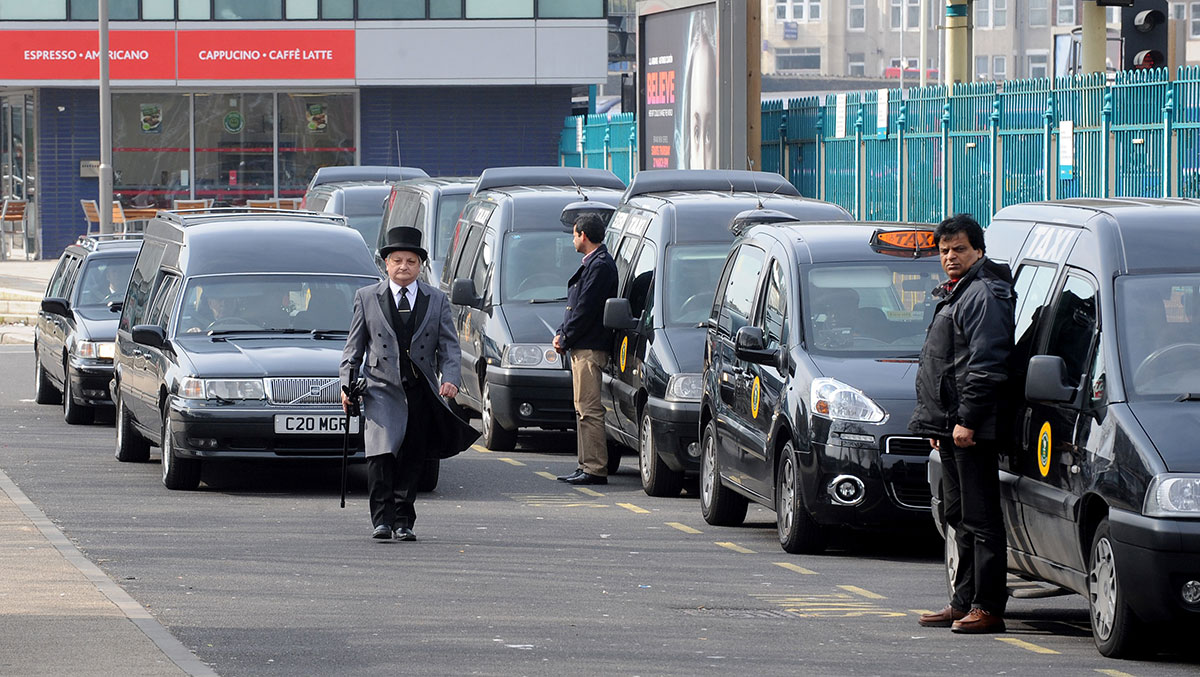
Which brings us to this inane protest which will disrupt traffic, piss off commuters and reinforce all the things people dislike about taxis and the entire taxi industry.  

Why on earth would taxis schedule their own funeral procession?  What can they possibly hope to gain by frustrating the people who ultimately pay their bills - citizens?

Simply, because the taxi industry lives in the past and haven't figured out why they need to change their tactics from what worked a century ago.

The theory here is dominance - flex your muscle, remind people what power you have and then force the powers that be to turn their backs on your competition, leaving you with a non-competitive market.  It's what Steven Harper tried to do as a politician, which ultimately led to his downfall.

Sorry, Taxi barons, but that just isn't the way it works any more.  

Moves like this don't strengthen your cause - they alienate your "base."  And the more young commuters have their experience of taxis tainted with negatives, the less likely they will be to use them - especially when they can turn to friends or try new experiences through organizations like Uber.

By all means, proceed as you feel is right - get your horses and bayonets out and show those politicians who's boss.

It's your funeral.  I just hope you can afford the fare.


Thursday, 24 September 2015

Polls: The Entrails of an Election


This poll is telling us that the Tories are way in the lead, with a majority within reach.  I say again, for emphasis: this poll.  Call it a snapshot of a percentage of one moment in time, if you will; it's one of many polls we've seen this election.  One or two of them are bound to be predictive in much the same way as a stopped clock is right twice a day.

Personally, I think the Conservatives are likely to land on top - not because a majority of Canadians think they have the best plan or see Stephen Harper as the embodiment of #CPCJesus.  Rather, they have more angry people in their base than discouraged ones, meaning they are more likely to vote, and donate, etc.  They will invest heavily of their time, money and speaking points to support the only party they feel will meddle less in their lives, cut their taxes, secure their freedom of speech.

That, plus the Conservatives have always had a more effective GOTV than its opponents.  And I feel comfortable in arguing, they have demonstrated more of a systematic willingness to do whatever it takes to win (whereas for the other parties, it's some individuals rather than the culture).

All that aside, though, political people are still following the polls, responding to the polls, trumping what bolsters their team and poo-pooing what doesn't.  It's a Pavolovian thing, I think - political people get the same sort of dopamine hit from a poll that other people get from checking their social media feeds.

If you collate all the polls after the dust settles, I'm sure you will find all kinds of interesting patterns. The entrails of #elxn42 will no doubt be carefully poured over by the sorts of people who do that, looking for lessons or trends and whatnot.

How reflective will those stories be of what actually happened on the ground, though?  On any given day, we've had polls that have placed each party on top and lagging behind, simultaneously.  They're all the result of surveys and such, so they're all true for a certain slice of society at a certain point in time... to a degree.  What's not revealed by these polls is how reflective respondents answers are of their actual opinions.  

When a server in a restaurant asks you "do you want white or red with that?" they're trying to nudge you to an answer; the hope is you will just choose from the options before you.  When a poll asks you which leader you like best, then who next when you remove your first choice, or which policy area concerns you the most, it is doing the same thing.

How many polls have the optional answer of None of the Above or I'm worried about them all equally, because they all affect me equally?  Or I don't know and don't care?

One of the biggest challenges for service providers, politicians, etc. in working in marginalized communities is trust, openness and authenticity.  This is for good reason; programs will run for short durations, promises won't be followed up on, or the external leader wading in will come across as White Saviour rather than community supporter.  It is very hard to earn trust when you're seen as part of the problem, and that with just cause.

When people don't trust you, they aren't open with you.  They aren't authentic with you; more than anything, they probably just want you to go away.

To an increasing degree, Canadians on the whole are feeling marginalized in our political process. Their elected representatives represent parties first, constituents second.  Engagement takes the form of donation asks or as backdrops for announcements rather than serious conversations.  Question Period has become insider baseball - more about scoring points and hits than properly debating the pros and cons of policy.

Polls are snapshots of a much larger story, much like touching the tail and pronouncing that the elephant is like a snake.  Elections are won or lost by parties, which is a much different beast than being the process by which the populace chooses the best governance for the country.

While I'm sure the entrails of this election will provide hours of joy for many backroomers, I really hope the parties and pollsters pay real attention to the mood of the nation after the election. 

Ultimately, this process isn't about the parties and who wins; it's about Canadians and the effectiveness of our democratic process.  That's not something determined by seeing how many people picked the white over the red.

Sad part is, it's going to be harder than ever to match voting patterns with demographics due to the death of the long-form census.  If millennial turnout is low, if new Canadian turnout is low, then we have a numbers challenge our polls aren't even hinting at.

When the majority of Canadians are neither represented by nor invested in a "majority" government, we've got a problem.


Wednesday, 28 January 2015

Man, does Warmington Miss the Point!


Here's Warmington's frame: Wynne, that dastardly woman Premier, is manipulating children (little non-sentient creatures who are supposed to be protected from the world by their parents until a ritualistic coming-of-age) as political pawns.  Shameful.

Here's Vety's frame: this ungodly lesbian woman is trying to teach children to accept sex, because to even talk about sex is to suggest getting to yes is the objective.  Sex, after all, is sinful, unless it's procreative and within the context of holy matrimony.

There are audiences who will jump on such frames.  Clearly, their are politicians who will seek advantage in pushing those frames, possibly including Monte McNaughton.  He can differentiate himself from Christine Elliot by owning the issue and set himself up as the only one who can protect youth from evil Liberal attempts to sexualize children.

That's their frame.  Now here are a couple of factoids reflective of actual reality.

Millenials are a growing force to be contended with - they make up a full half of the workforce and, as baby boomers fade off into a retirement sunset many Millenials fear will be denied them, they recognize that the 20th Century social model is failing them.

Still on Millenials - they aren't motivated by the same aspirations that drove their parents; they're more interested in social ownership than just property.  They want to engage grow, build communities, put people and the planet before profit, etc.  This can be interpreted as lefty socialism or more right-leaning entrepreneurialism and direct participation in the nation-builder sense.

Now, on to religion.  Believe it or not, religious inclinations and the buying-in to complete religious ideologies is decreasing.  Youth don't see organized religion as representative of their reality or embodying of their values any more than they feel government has their long-term interests at heart.  If anything, youth feel that traditional institutions have played a massive role in mucking up the world previous generations borrowed from them.

This applies equally to second-gen Canadians as to those whose families have been here for ages.  "We're not married to your past," they say. "We have to protect our future by building a world that can sustain it."

Then, there's the reality of Gomeshi, the Parliament Hill assault scandals and the overarchinig and incredibly uncomfortable public conversation around unspoken sexual abuse that largely involves powerful older men targeting younger women.

Now let's add this all up:

On the one hand, you have the Warmingtons and Vetys of the world, aghast at the idea of kids learning about sex, being indoctrinated into an adult world before their time and in a way that subverts traditional sexual enculturation (talk birds and bees, ignore sex entirely until the kids get married).  They see youth as pawns, ie without ownership, without will, without any ability or right to speak for themselves or make decisions about their own self-interest.

On the other hand, there are youth who see the Warmingtons and Vetys of the world as poster-boys for everything that's wrong with the world; chauvinist, borderline imperialist with their sense of cultural superiority, instigators of social disorder and apologists for every male who has abused power so they can abuse young women.  

Remember - Tessa Hill and Lia Valente started a petition; they did indeed lobby the government and were successful at it, too.  If the tables were turned and it was Warmington and Vety at the podium, talking with the Premier about the need to keep kids in the dark about rules of engagement around sex and just hoping predators would leave them alone, the Warmingtons and Vetys of the world would be congratulating themselves on their win.  It's patronizing, hypocritical, domineering.

That a Conservative leadership hopeful would miss the demographic reality behind this scenario suggests they're either super short-sighted or hopelessly cynical.

Meanwhile, there's Kathleen Wynne, right in the middle.  She's not using the youth as pawns - they came to her.  The Premier is serving as a conduit for their message, their initiative and their taking ownership of their own future.

Hill and Valente are stepping up in the same vein as Morgan Baskin and Munira Abukar; don't judge us by our age or our gender, they're telling us:

- this is our time, folks; we hope you'll be with us, but we're moving forward regardless

That's their frame.  They feel that the educational status-quo is putting them at risk.  They feel the institutional status quo is impeding their opportunities.  They feel that the old boys' network is intentionally keeping them down so that the Warmingtons and Vetys can continue to reap more than their fair share of society's benefits.

With Premier Kathleen Wynne, however, they see someone who listens, who treats them seriously and understands their perspective.  They see Wynne as their advocate.

Wynne knows exactly what she's doing.  The game is changing, and she's adapting in ways that are both strategically beneficial and better for Ontario in the long term.

If there is a fight brewing, it isn't between the left and right; it's between the past and the future. 

Wynne knows which side she's on.  Her opponents are making it pretty clear which side they're on, too.


Monday, 26 January 2015

I Disagree with @stphnmaher


If the objective is to replace Harper, then yes - cut him off at the knees. 
 
In kindly, paternalistic fashion, lay out all his psychological foibles for public airing.  What leaving Toronto meant to him and why he wants so damned much to be seen as a Westerner.  Why he left the Liberals (which is why he hates the Liberals) and the things leaders he wanted to admire did that disappointed him that he himself is doing now.  The quiet things that torment him even now, driving him further and further away from the values and principles he thinks he holds dear.
 
If your sole focus is to destroy Stephen Harper, that's completely doable.  However, that shouldn't be the goal.
 
Canadians are cynical of their politicians in the same way young Stephen Harper was.  Any politician that focuses on destroying their opposition and portraying their own leader as an faultless demi-god aren't going to address our emerging democratic deficit and all the structural ills that come with it - they'll merely become the next party presiding over the demise.
 
Attacks of opposition and "framing" of your leader are all about messaging, attempting to build confidence through repetition.  Neither are about trust.
 
Our collective goal shouldn't be to get rid of Harper.  Harper is a symptom of broader societal malaise and civic rust.
 
When was the last time we had a leader that worked tirelessly to make us believe out democratic system was what mattered most?  That our voices mattered, when we raised them, and that policy was better when we engaged?
 
What we need now isn't a leader who can defeat the other guy.  What we need is leadership that brings us together with common cause and shows us that democracy works.
 
That's an even harder job - it means eschewing the quick wins and the low-hanging fruit and doing the more complex business of actually leading, and leading by example.
 
Whenever that happens, though, we'll all win.  And wouldn't that be a refreshing change?

Wednesday, 29 October 2014

Patronizing Citizen Richard


There really isn't anyone that I know of on the Canadian (or any) landscape quite like Richard.
 
He's pretense-free, which is rare.  He's thoroughly committed to his ideals, of which he's not at the centre - we are.  Richard has a code of ethics that he follows, religiously, because be believes integrity matters.  Richard is open, a natural communicator, great at breaking down complex issues and ridiculously committed to making a difference.
 
Best part is, Richard does what he does because he believes in it.  He's not after profit, even to his own detriment sometimes.  This doesn't mean he's got trouble securing funding or donations for projects - #OGT14 is proof of that.  It means that you never need worry about him being inefficient with resources.
 
What that means is he's the kind of public servant we'd love to have more of.
 
It's kinda hard to save the world on an empty stomach, though, so Richard is looking for support to do what he does.  To be clear - his services aren't for sale; he believes that they're valuable enough that someone out there will surely be willing to pay for them.
 
Richard isn't looking for an employer, an investor or a sponsor - he wants a patron.  Consider him a civic engagement artist.
 
I'm going to invest in Richard - he's earned it and besides, I can't wait to see what he comes up with next.  Whatever it may be, it's something Canada will benefit from.
 
Check him out, folks - this is community art like you've never seen before.  We need more like him.
 

Sunday, 19 October 2014

Conserving Progress - Leadership Advice for the PCPO


This isn't the first time I offer some leadership and engagement advice to the PCPO.  Unfortunately, I expect these words of suggestion to be ignored in similar fashion.
 
Here goes anyway.
 
There are two things happening within the PC Party right now; a leadership race, in which contenders want to portray themselves as the best bet to lead the Party to victory and a broader bit of soul-searching as, if they're wise, PC partisans are asking why they've lost traction and what exactly it is they stand for.
If they study the failings of their past two leaders (which I'm sure they're doing) they may have noted that both John Tory and Tim Hudak had a particular fixation with winning.  With winning being the primary objective, everything else was stacked up to deliver a win.
 
Theoretically, this makes sense - it's about the system is supposed to work, right?  Give the people what they want, with a bit of strategically picking fights to mobilize action - that's how winning is done, n'est ce pas?
 
John Tory tried the shiny baubles and put slightly new quotes of paint on old ideas (coal plants).  Tim Hudak picked fights and positioned himself as the voice of righteous anger.  We know how well these approaches worked out, don't we?
 
On the other hand, I imagine they'll be taking a gander at Kathleen Wynne's massive victory, even if secretively, and trying to reverse-engineer her success.
Kathleen Wynne's greatest strength is that she is a facilitator.  She's incredibly engaging - not just charming, but when you speak with her, she listens.  She takes notes.  She follows up - and when she acts, the people know that their ideas and concerns were part of what fed that process.
 
I'd argue Wynne and the Liberals need to do more of this in rural Ontario; I'd argue the reverse for the PCs in urban Ontario.
 
With the process in place right now, contenders for the PC leadership need to sell memberships and have more people to vote them in as leader.  As always, it's a race to the finish line - no time to engage, the rush is to close the deal, period.  When winning is done, consequences can be dealt with later.
 
The problem is, filling bums in leadership convention doesn't necessarily translate into seats in the Legislature.  If the ranks of the PC Party are filled with angry landowners who dislike the notion of culture change, will the Party and leader be beholden to their ideology?  How well will that sort of message resonate in increasingly diverse urban Ontario, especially must-win places like the 905?
 
On Monday, Why Should I Care is having a discussion about Healing Ontario's Rural/Urban divide.  It's a topic that should be incredibly relevant to the PCPO, given that they desperately need inroads into the GTA.  It was in recognition of this twinning of culture challenges (the renewal of the PC Party and the need for renewal in Ontario) that we decided to invite PCPO leadership candidates to attend.
 
WSIC is a well-respected forum that continual draws "top-drawer" speakers while staying true to its purpose of helping everyone, regardless of rank or wealth, to get informed, get engaged and make a difference.  The likes of Art Aggleton and Alan Fotheringham have been known to pop by and listen to the insightful conversations that happen at WSIC.
 
It's also worth noting that WSIC's founder, Terri Chu, is running for Toronto Council in Ward 20, and has a serious chance of winning.  Terri has a strong reputation as a balanced, non-partisan voice that puts evidence over ideology.  From a political positioning angle, it makes good sense to be seen engaging with her.
 
I can only assume the teams of the PC leadership candidates either didn't do their homework or simply couldn't connect why being WSIC speakers would be beneficial for them.
 
One never bothered to answer.  Two agreed to participate quite some time ago, but backed out at the last second (yesterday, in fact) because of concerns they might appear as "lesser-thans" if the star candidate wasn't there.  This may have been the strategic reason why the star's team never made any efforts to participate, either.
While efforts are being made even now to find replacements for the backed-out speakers, the message provided is clear: the Party is saying "civic engagement in the GTA isn't a priority for us" as individual leaders and their teams are saying "our commitments are only so valid as we see their value to our strategic branding, which is focused on headline-status, not grassroots engagement."
 
So here's my word of advice - don't do that.  Don't play the game that has caused so many Ontarians to disengage from politics and with the PCPO in particular.  Things have changed, and this "control the message" model is no longer viable. 
 
Leaders engage; they go among the people, listen to the people and then bring them and their ideas together into a broader framework.  They recognize diversity of ideas and of people as a strength, and nurture them.
 
Going back to the same well of depleted soil that has been homeground for the PCs since the days of Mike Harris is not a great strategy for growth.
 
There may be no immediate wins to be had at urban engagement forums like WSIC, but as with all gardening, you've got to nurture the soil before you can plant seeds, and seeds need to be tended to with care over time.
 
Forget the focus on own land, folks.  It's time to be gardeners.


Thursday, 16 October 2014

Thinking Outside the Partisan Box with @GHoakz + @ZPaikin

Zach Paikin and Greta Hoaken.


Full confession - I consider both Zach and Greta to be friends (though one of them still owes me a non-coffee). 
 
The first time I had a serious chat with Zach, we ended up talking philosophy, politics and occupational mental health - in about four different languages.  I consider myself a polyglot, but Zach's facility with language (right down to regional accents) is awesome to behold.
 
I've got a particular soft spot for Greta.  I first met her on the last Ontario Liberal Leadership race, where we both were part of Team GK.  17 at the time, she first walked into the campaign office with wide eyes and a bright smile, dressed in a school uniform.  It didn't take me long to realize that behind those bright eyes was a burning intellect, a passion for positive change and a wicked organizational mind.  It wasn't 'til later that I learned she'd been an entrepreneur since she was 13.
 
Both Zach and Greta are part of a growing movement that doesn't see gaining power through the existing system as the only means to effect change; they see the as-is system as part of the problem to be addressed.  You can see this movement reflected in organizations like Samara, civic engagement groups like Why Should I Care and of course, all things Open Government.
 
I love the fact that they're willing to challenge the status quo and present an idea that transcends partisan politics.  I would argue, however, that they need to dig a bit deeper to discern the core problem and then work out from there towards a viable solution.
 
A couple of key quotes that stood out to me:
 
- centralization around party leaders has made it less evident to the public what potential prime ministers wish to do with power.
 
- a theoretical Liberal prime minister would have a tough time explaining to his caucus why he was putting a handful of Tories and New Democrats in cabinet in place of some of his fellow Grits.
 
- A theoretical Liberal prime minister would have a tough time explaining to his caucus why he was putting a handful of Tories and New Democrats in cabinet in place of some of his fellow Grits.
 
- establishing a coalition-government norm would reaffirm the fact that we elect Parliaments, and not governments, in this country.
The role of Parliament is to hold government to account on the people's behalf - such has been the case since Magna Carta.  Government is the Crown and the Crown's Ministers.  It's not part of our constitution that Ministers need to be selected from among elected Members of Parliament; that's convention, not law.  The Party system evolved as a way to ensure broader interest groups had sufficient voice for their collective concerns to impact policy.
 
Understanding where we came from helps in seeing why things have gone so screwy.
 
When politicians elected to represent specific, geographic constituencies become subservient to the interests of political parties as a means to ensure support in their riding, but also to build the brand necessary to get "promoted" from the Parliamentarian side to the Crown's side - who is serving who?
 
As Samara's MP exit interviews demonstrated, Parliamentarians don't know who they're supposed to answer to or even have a clear sense of what their role is.
 
While I commend the idea of increasing the plurality of voices and views at the decision-making top, I wonder if opening up all Parliamentarians to compete for higher position would make them more, not less subjective to centralized power (the PM and the PMO).  From a real-world perspective, if I'm the guy/gal making choices about who's in cabinet from a broader range of players and I know that "getting the promotion" is a key motivator for MPs, I'm playing them off one another to get more of what I want across the board.
 
That's the opposite direction of where we need Parliament to be heading. 
Knowing how clever and committed Greta and Zach are to strengthening our system of democracy, I would encourage them to turn their energies towards Open Government, participatory budgeting, etc.  Also, the emerging field of workplace culture change is worth considering; the House of Commons is all-too-often a toxic environment that hinders rather than supports the development of shared solutions as we focus on stopping what we don't like rather than collaboratively creating things we do like.
 
That, and civic engagement.  Perhaps the best thing that bright, engaged and thoughtful leaders like Greta and Zach can do is share their passion, networks and understanding of the system with other Canadians of all rank and file.
 
The kind of structural change we need isn't going to be flowed from top to bottom; it's got to be grown from the bottom up.


Tuesday, 7 October 2014

Politics Done Different: Why We Should Care


If you live in Toronto, you may be aware that there is a municipal election going on.
 
As candidates for Mayor, Council and Trustee all jockey for position, endorsements and votes, we're being bombarded with soundbites and potshots on the airwaves and via social media.
 
This one stood out for me this morning:
 
Doug Ford Campaign @DougFord2014  ·  12 hours ago
Tonight Mr. Tory said he doesn't support tolls, but in 2013 apologized for fighting against them

While I appreciate Doug Ford's team giving some free promotion for Why Should I Care, the civic engagement group founded by Ward 20 council candidate Terri Chu, I would suggest they missed the point.
 
If you actually listen to the clip, what you hear isn't John Tory talking about road tolls, but rather John Tory talking about the silliness of gotcha-politics and the corners it backs politicians into (which is exactly the stunt Team Ford attempted with their tweet).
 
I was there that night in January, 2012 in my role as a WSIC board member.  I was very impressed with what I was hearing from Tory - a kind of self-reflection that's unfortunately not that common in politics.
 
John Tory took a strong stance against the kind of simplistic populism Doug Ford tends to champion.  Tory admitted to having played the game earlier in his political career, but as he has matured as a public person, he has recognized the destructive and demoralizing nature of crass partisanship.
 
The reason he was there to speak at Why Should I Care wasn't for political gain - he wasn't running for anything at the time - but because he believed in the principle of civic engagement.  Tory candidly recognized that people have lost faith in the political process and suggested that less messaging and more engagement is required.
 
Which, of course, is why Terri Chu founded Why Should I Care, and why it's become such a popular event.  We bring in speakers from across the political divide, from the public service and from the grassroots to discuss the issues rather than pick apart personalities.
 
Turns out there's a healthy appetite for conversation.
 
Busy as we are, as bombarded by data and advertisements and political soundbites as we are, people get that the issues facing society are complex and require complex answers.  A frequent reason given for why people don't vote is because they recognize they aren't as knowledge on issues as they could be and don't want to make ill-informed decisions.
 
The role of leaders isn't to stoke populist emotions and polarize society, but to empower people to get informed, get engaged and be part of the democratic process every day, not just once every four years.
 
I give John Tory props for having the guts to chat directly with people about issues and for bringing an open mind to the table.  He takes the time to understand and communicate context, which shows a level of respect for us "folks" lacking in certain other candidates.  That's the kind of engagement we, as citizens, should be encouraging.
 
We can't solve our current structural problems with the same gotcha politics that landed us here in the first place.  We all need to care enough to get informed, get engaged and make a difference.

"Respect for taxpayers" is a bumper sticker.  Respect for citizens involves engagement.
 
If we want politicians to take their job seriously and move beyond sound-bites, we have to be willing to do the same.
 
"We far too often reject things before we open our minds to consider them."
 
       - John Tory, Toronto mayoralty candidate