Search This Blog

CCE in brief

My photo
Recovering backpacker, Cornwallite at heart, political enthusiast, catalyst, writer, husband, father, community volunteer, unabashedly proud Canadian. Every hyperlink connects to something related directly or thematically to that which is highlighted.
Showing posts with label autism. Show all posts

Monday, 26 May 2014

Autism Genes and IDIC


I suppose we could go the GATACA route with this information, but hopefully we take the other route.  
When we recognize cognitive conditions like bipolar disorder or autism or even ADHD as genetics, not some sort of infection, maybe we'll realize we're trying to solve the wrong problem.

The goal isn't to "normalize" the sinistra out there by making them dextra - it's to empower everyone to be the best unique contributors they can be in collaboration.

Just imagine the possibilities.

Saturday, 24 May 2014

Preventing Elliot Rodger


The haughty tone, the forced laughter, the cheesy-dialogue; if this was the sort of approach Rodger took in his quest for sex and affection, it's no wonder he was a virgin at 22.
 
Let's be clear - Rodger may have a diagnosis of being on the autism spectrum, but there is no correlation between the narcissism and God delusions manifested in that video.
 
Autism is a cognitive condition that relates to expression, understanding of social etiquette, and ability to interact in a pro-social way.  Demanding sex, bad villain laughs and the pulling out a gun and shooting people are activities with no connection to autism.
 
No, I'd be more interested in looking into those narcissistic traits and expressions misogyny over the course of this guy's life. 

Instead of focusing what or who or how to blame, what can be learned from this experience to prevent the next one?
 
Rodger would have interacted in certain ways in person, had his videos and all his stuff on Facebook.  There were plenty of triggers there to suggest a person with a morale compass that pointed in the wrong direction.
 
What process is in place for students to pass information of concern on to authorities?  Does the school maintain ties with local police?
 
How could Elliot Rodger have been flagged as someone in need of intervention before it was too late? 
 
Elliot Rodger wanted to be better than others, so he got himself a gun and opened fire.  The gun, you see, was the tool of his power.  Something in that the NRA doesn't want you thinking about.
 

Tuesday, 20 May 2014

Warren Kinsella, Autism and the Art of Nudge


This, from the always-insightful Warren Kinsella - a guy who gets the irrational nature of politics if anyone does.  

Partisan politics isn't designed to appeal to logic, create debate or develop shared solutions - it's about winning, period.  By it's competitive nature, partisan politics is tribal.  The focus almost inevitably shifts from what one side can do (proactive) to preventing what the other side would take away (reactive).

The problem is, even the informed get swept up in this.  More person-hours and sweat get put into things like lawn signs when there's no real evidence that they have any impact.  The same can be said for any GOTV initiative.  Yet these are the sorts of activities that get picked apart by analysts as indicative of a winning campaign.

For the pols, it's about keeping up with the Joneses - you don't want to be the one guy who doesn't play the game; it just feels too much like falling behind.  What if it really does make a difference and you cause your side to fail by dropping the ball?  That's an uncomfortable feeling to have.

The salesmen are just as good at selling themselves - often, even better.

People, whatever their knowledge base, are simply not rational creatures.  In fact, the more informed they are, the better they tend to get at justifying their existing positions.  

Where this varies in politics is when a partisan, for whatever reason, switches teams.  A floor-crosser can confabulate changes to emotional positions in ways dug-in tribal partisans can't, rebranding old friends as untrustworthy foes - which is fascinating.  It's almost like a conversion process.

What does this have to do with autism?


Do you believe this?  If you already feel autism has no correlation to inoculations, the answer is probably yes.  If, however, you're suspicious of inoculations already, the answer is probably no - instead, you'll be questioning the research.

Climate change, the effectiveness of social intervention on crime reduction, even homophobia are all similar examples - if we feel something, or if our feelings can be poked and inflamed, the facts against our position (or lack of facts for it) don't matter.

9 times out of 10 we'll go with our gut, which really means we respond to the drives of neurochemistry over external information.  This makes sense, from an evolutionary perspective - our ability to react quickly to potential threats is a big part of why our species hasn't died out.

At the same time, though, we don't live on the African plain in small herds anymore - we're socialized, specialized, technology-dependent creatures that rely on knowledge to survive in our current context. We might not feel like taking out the trash, or following the rules of the road, but we know there are consequences if we don't.  

This is the perpetual problem of public policy - how do you design systems and processes that appeal to how people actually make choices rather than how we'd like to think we make choices?

In an age where some governments are starving the public (and themselves) of facts so as to not confuse their ideological leanings, this is a huge problem the public service is trying to grapple with.

Herein, to me, lies an interesting problem - what determines success in our current political culture is to appeal to the limbic brain of the public; troubles at shores, illegal coalitions, dangerous schemes, common sense, etc.  You can win this way, but you can't effectively govern this way.

The elements of society seeking more effective governance and policy have to find a different approach; inoculations carry some risk, but far less than not getting them.  More to the point, not inoculating your own children puts other children at risk.

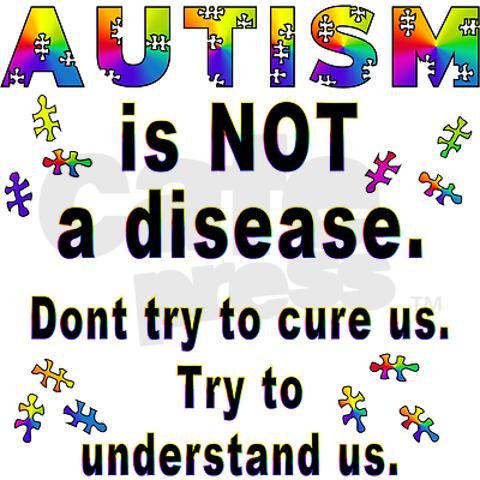
Autism, on the other hand, isn't leprosy or a zombie curse - it's a variation on cognitive wiring in the same way skin tones are variations on pigment.  The right understanding allows for the right accommodations.

While not every autistic person (because autism is part of the person, not some kind of virus) will become a Jacob Barnett or Temple Grandin, how many world-changers are we losing out on due to our own emphasis on avoiding a potential negative instead of supporting a potential positive? 

How might we shift gears between the growing trend towards instinctively-appealing presentation in politics, marketing and beyond and the need to promote debate, critical thinking and emotional self-regulation?  

I suspect the confabulations of floor-crossers or team-leavers will offer some insight into how this might be accomplished, but I don't have the definitive answer.  Neither do you.  

Between us, though, I know we could come up with something amazing and effective.

Your neighbours are getting on board the Open Movement - can we count on you, too?

=o)

Sunday, 18 May 2014

Doug Ford the Sociopath Gets Challenged


You might think Doug Ford would take counsel before opening his mouth about issues of mental health and cognition given that his brother is, among other things, a drug addict.  I wouldn't - like many others in Toronto, I have suspicions that Doug Ford is a sociopath.


 - superficial and portray themselves as smarter than others
- delusional
- figure they can get away with anything (like blatant cash bribes)
- they lie, all the time, with ease and confidence
- feel neither guilt or shame
- don't learn from mistakes; they double-down
- their heart "goes out" to no one - not even their own brothers


Does that sound at all like Doug Ford, the Worst Brother Ever?  You see where I'm coming from then.


So, back to Ford's comments about autism.  He mentions "violent behaviours" like screaming.  How does he feel about punching your own friend, beating a friend, barrelling through an elected official to go join a fight or saying things like "get her a shot right now or I'll fucking break her..."?


Autism is not a cause of violence.  That's a facile, ignorant comment made by simpletons looking for a quick answer.  Violence is not a product of mental illness, the way we tend to view it.  If that were the case, we'd have to label a lot of hockey players and fans as mentally ill, wouldn't we?  They engage in violence and calls for violence all the time. 


Violent behaviour is a response to that which makes us uncomfortable, which we feel threatens us.  We respond to threats reactively, the same way we pull our hand back from a hot stove or feel an urge to lie down while in high places; this threat-response behavior manifests as stomping on a bug, smacking a child who talks back, promising consequences to employees to question us or screaming at a world that feels threatening, seems not to make sense.  Like Rob Ford does, or like some autistic kids do - depending on their circumstances.


There's really no difference - the reactive behaviour is the same whether you're flipping out at Pride or screaming because nobody's communicating the way you do.


Which is what happened to Jacob Barnett for ages.  Haven't heard of him?  You will - he's the autistic kid who many think will be the next Einstein/Newton.


Temple Grandin was misunderstood by many - now she does TED Talks.


Winston Churchill had mental health issues.  Abraham Lincoln had mental health issues.  It's quite likely that Stephen Harper could be diagnosed with a "mental illness" - as Bob Rae was.  These aren't weak men - they're dynamos, catalysts, outliers.  You'd be surprised how many "mentally ill" people have shaped the course of human history.


What we don't get - what people like Doug Ford, pathologically incapable of understanding others as they are don't get - is that different isn't bad.  It's different.  It's the interaction that defines good and evil.  The more empathy you have, the less sinful you become.


Being black, or gay, or tall, or autistic doesn't make you good or bad.  These are all aspects of the elephant, one trait amongst the many combinations that make us all unique. 


When we focus on the negative, we become angry, fearful, reactive (and violent) to. 


When we seek comprehension, we are inquisitive, patient, engaging and, ultimately, powerful in that special Ender Wiggin way.


Rob Ford has, through his illness, shaken a status quo that was desperately in need of being shaken.  He is a parody of all the norms we have come to accept of politicians.


Doug Ford is something even more extreme - a glimmer of what we could become, as a society, if we choose to focus on what irritates us instead of seeking common ground.


We can opt to stand against that which we disdain or makes us uncomfortable, as the Fords do - but that's a path that history teaches us has a dead end.


The alternative is to get beyond our own stigmas and learn how to understand, rather than react to.

When we learn to look beyond ourselves, that's when community truly begins.


Doug Ford sees himself as tough, better-than, shiny, independent.  There's nobody better than him - certainly not some autistic upstart.  Why, Dougie could wipe the floor with an autistic nobody, physically or verbally.


Hey Doug - I've been diagnosed as on the autism spectrum; that makes me your inferior, right?  But I'll bet you're not brave enough to go toe-to-toe with me in the arena of ideas.  You've got nothing but bluster; I've got everything, including the facts.


I've called you a sociopath, Dougie - I'm telling you that you're a lesser-than.  Are you going to take that?  Want to prove you're smarter than I am by disproving everything I've written here?


I'm betting you aren't.  Shows how weak your position is, doesn't it?


Wednesday, 2 April 2014

Autism Speaks For All


Meet Jacob Barnett.  Jacob is a 16 year-old genius touted as a successor to the likes of Isaac Newton and Albert Einstein.  Jacob is also a disruptive leader, challenging our educational model (and he's hardly the only one).  Plus, he's the star of a popular Ted Talk and has been on the Glenn Beck show.
 
Oh, yeah - and he's autistic.  Didn't learn to speak for ages, but when he did, spoke in multiple languages, including physics.
 
If Jacob had been forced to learn in a traditional manner, apply for jobs in a traditional manner and compete with more "normal" communicators for those positions, he'd likely be a failure, costing the healthcare system and/or impeding his family from their own economic contribution.  Whole families have been brought down this way.
 
But because his mom, Kristine Barnett, paid attention to the cues she got from her son and worked to support his growth and development in a way that worked for him, Jacob is now poised to change the world.
 
There's a lesson in here about how we identify and manage "mental illness" and "developmental disorders" that we are painfully slow in learning. 
 
Where it comes to all things cognition, we're still tying left hands behind backs and trying to force people to right strictly with their right.
 
We want people to think and act in one way - laissez-faire, competitive, sales-oriented and succeed through one frame.  We expect outliers to sell themselves to us without any effort on our part. 
 
It doesn't work.
 
Right now, there are cognitive outliers out there working in mail rooms or living on the street, struggling to come to terms with a cognitive gift they can't see as anything other than a curse as work opportunities and relationships pass them by.  Some of these people, given the right tools and support, could cure cancer, remodel government or develop an eco-friendly, completely sustainable energy source.  Who knows?  We never will, because we're not prepared to listen to them.
 
At the same time, we have "normal" people becoming less productive, less social and more likely to suffer from illness because we're designing work and work places wrong.  A bit of design thinking could fix all this, but that's too much like committing sociology, isn't it? 
 
There's nothing more frustrating than watching people flail in the dark when there's light available.
 
But try explaining that to the overconfident people in The Cave.
 

Monday, 30 September 2013

Jacob's Ladder: Maximizing Our Human Potential


Let's be honest - Jacob Barnett is an exceptionality.  Not everyone's kid is going to change the world, nor are they blessed (or cursed) with gifts so incredible as to remove them from normal human communication.  Nor is every person destined to reach self-actualization.

But we aren't really trying to seek out the exceptional, are we?  If anything, we're pretty set on standardization.  Sure, we think we want creativity, but in practice, it makes us uncomfortable.  There's a rationale behind this that is explained by the fact that so many of us (perhaps especially those aggressive, competitive folk who reach the top of the food chain) don't see the value in reaching for something greater than personal success.  For them, personal fulfillment is simply a marketing term for selling self-help books.

If we're honest, Kristine Barnett is an exceptional person, too.  She risked personal stigma and the perceived risk of ruining her son's life by rejecting the standard methodology society wanted her to follow.  She did, overcoming even her own self-doubt in the process.  Because she loved her son too much not to try, the status quo was never an option.  

There's a valuable lesson in this, one that will only grow in resonance as issues like youth unemployment, democratic malaise, innovation deficits and mental health in the work place start to connect for us consciously.

We keep trying to force round people to fit the square civic holes designed to keep the economy chugging along, causing friction for the individual and for society as a whole.  It's the way we've done things thus far.  Fortunately, the next iteration is always present at the ends of the old one.  Design thinking for products, spaces and services is going to provide imagined solutions - and with them, new challenges to be solved.

After all, that's how evolution works - the exceptions eventually become the rule.

Tuesday, 20 August 2013

The Social Advantage of Loving Your Neighbour


As offensive as this letter is, the author does have a point - of sorts.  In a survival-of-the-fittest, individually-competitive world with no assistive technology, no social services, no civilization of any kind, this autistic boy wouldn't have a chance.  Nor, of course, would anyone with a host of conditions ranging from blindness to asthma to schizophrenia to albinism.

That's the way biological evolution works - that which is fit (or lucky) survives to pass on its genes. There's a whole world view dedicated to this kind of approach; people should come with skills in place, no training required.  If you can't fend for yourself, you're not meant to survive.  If you're different (i.e. difficult) in any way, you don't belong.  The traditional ways are best and aggressive competition is the only way to produce solid results.  This system buys in to the myth of humanity on a downward spiral from a fictitious past where we were free of disease, illness and the ravages of nature. 

Of course, that's not how our world works.  We don't grow our own food, manage our own health, fix our own cars, etc, etc; we are a system, not a series of silos, entirely dependent on the health of the whole to maintain the well-being of the individual.  

Every human society (and many other species, as well) includes empathetic, altruistic institutions.  Society relies on The Golden Rule, which is why it's universal.  You literally cannot have a dense concentration of people without an imperative to love your neighbour; otherwise you'd be removing anyone who got on your nerves - including those hyper-sensitive, anxious folk who present as bigots.

It's a good thing, too - without those "special needs" folk, our society wouldn't be possible.  Despite what free-market purists like to tell us, innovation isn't about making money - it's about solving problems.  Often enough, it's those so-called "problem people" who think outside the box (sometimes on scales incomprehensible to "normal people") or connect the dots in ways that elude the majority.  

In fact, despite what the anonymous neighbour tried to tell Karla Begley, there's a growing market for innovation and new approaches - as a result, the sorts of people who come up with them could do quite well.

People like Jacob Barnett.


Whether it's a hate crime or not, the Anonymous Neighbour's letter is absolutely a crime of reactive ignorance.  Social evolution is rapidly replacing biological evolution - collaboration, acceptance and education are more valuable skills than self-reliance, aggressiveness and the like.  You can dislike the trend, but it's a well-established one.

My suggestion would be this - if the Anonymous Neighbour is so set against committing sociology, a hermit's life might be a better fit for them.  I would, however, certainly not advocate suicide - to deny the rest of us of their problem to solve would be a crime against society.

After all:


autism hate letter oshawa

What Genius and Autism Have in Common (Maia Szalavitz)


What Genius and Autism Have in Common

A study of eight child prodigies finds that share some striking characteristics, most notably high levels of autistic traits and an overrepresentation of autism in their close family members


Child prodigies evoke awe, wonder and sometimes jealousy: how can such young children display the kinds of musical or mathematical talents that most adults will never master, even with years of dedicated practice? Lucky for these despairing types, the prevailing wisdom suggests that such comparisons are unfair — prodigies are born, not made (mostly). Practice alone isn’t going to turn out the next 6-year-old Mozart.
So finds a recent study of eight young prodigies, which sought to shed some light on the roots of their talent. The prodigies included in the study [PDF] are all famous (but remain unidentified in the paper), having achieved acclaim and professional status in their fields by the ripe age of 10. Most are musical prodigies; one is an artist and another a math whiz, who developed a new discipline in mathematics and, by age 13, had had a paper accepted for publication in a mathematics journal. Two of the youngsters showed extraordinary skill in two separate fields: one child in music and art (his work now hangs in prestigious galleries the world over), and the other in music and molecular gastronomy (the science behind food preparation — why mayonnaise becomes firm or why a soufflé swells, for example). He became interested in food at age 10 and, by 11, had carried out his first catering event.
All of the prodigies had stories of remarkable early abilities: one infant began speaking at 3 months old and was reading by age 1; two others were reading at age 2. The gastronomist was programming computers at 3. Several children could reproduce complex pieces of music after hearing them just once, at the age most kids are finishing preschool. Many had toured internationally or played Lincoln Center or Carnegie Hall well before age 10.
Six of the prodigies were still children at the time of the study, which is slated for publication in the journal Intelligence. The other two participants were grown, aged 19 and 32.
The study found a few key characteristics these youngsters had in common. For one, they all had exceptional working memories — the system that holds information active in the mind, keeping it available for further processing. The capacity of working memory is limited: for numbers, for example, most people can hold seven digits at a time on average; hence, the seven-digit phone number. But prodigies can hold much more, and not only can they remember extraordinarily large numbers, they can also manipulate them and carry out calculations that you or I might have trouble managing with pencil and paper.
Working memory isn’t just the ability to remember long strings of numbers. It is the ability to hold and process quantities of information, both verbal and non-verbal — such as, say, memorizing a musical score and rewriting it in your head. All the children in the study scored off the charts when tested on measures of working memory: they placed in at least the 99th percentile, with most in the 99.9th percentile.
Surprisingly, however, the study found that not all of the prodigies had high IQs. Indeed, while they had higher-than-average intelligence, some didn’t have IQs that were as elevated as their performance and early achievements would suggest. One child had an IQ of just 108, at the high end of normal.
There was something else striking too. The authors found that prodigies scored high in autistic traits, most notably in their ferocious attention to detail. They scored even higher on this trait than did people diagnosed with Asperger’s syndrome, a high-functioning form of autism that typically includes obsession with details.
Three of the eight prodigies had a diagnosed autism spectrum disorder themselves. The child who had spoken his first words at 3 months, stopped speaking altogether at 18 months, then started again when he was just over two-and-a-half years old; he was diagnosed with autism at 3. What’s more, four of the eight families included in the study reported autism diagnoses in first- or second-degree relatives, and three of these families reported a total of 11 close relatives with autism. In the general population, by contrast, about 1 in 88 people have either autism or Asperger’s.
Other unusual parallels between prodigies and those with autism: they’re both more likely to be male (though that finding may be due in part to the failure to recognize either girls on the autism spectrum or, perhaps, girls’ hidden talents) and both are associated with difficult pregnancies, suggesting that uterine environment may play a role in their development. In the math whiz’s case, for example, his mother “started labor nine times between the 29th and 37th weeks of her pregnancy and required medication to stop the labor. During the 35th week of her pregnancy, her water broke and she had a 105-degree fever from an infection in her uterus. The child prodigy did not have a soft spot at delivery,” the authors write.
When Asperger’s was first described in 1944 by Austrian pediatrician Hans Asperger, he referred to children with the syndrome as “little professors” because of their prodigious vocabularies and precocious expertise, and because they tended to lecture others endlessly without being aware of their own tediousness. Poor social skills and obsessive interests characterize the condition.
Yet, despite the obvious similarities, very little research has been done on the connection between autism and extreme talent. One previous study, published in 2007, did find that close relatives of prodigies — like close relatives of people with autism — tended to score higher on autistic traits, particularly in problems with social skills, difficulty switching attention and intense attention to detail. Other than that, however, the issue hasn’t been studied systematically, beyond the observation that autism is often seen in savants, or people with exceptional abilities who have other simultaneous impairments.
Prodigies, in contrast, appear to benefit from certain autistic tendencies while avoiding the shortfalls of others. On a standard assessment of traits associated with autism, the prodigies in the current study scored higher than a control group on all measures, including attention to detail and problems with social skills or communication (though this result was not statistically significant, probably because the sample was so small). But they also scored significantly lower than a separate comparison group of people who had Asperger’s — except on the attention-to-detail measure, in which they outshone everyone.
“One possible explanation for the child prodigies’ lack of deficits is that, while the child prodigies may have a form of autism, a biological modifier suppresses many of the typical signs of autism, but leaves attention to detail — a quality that actually enhances their prodigiousness — undiminished or even enhanced,” the authors write.
In other words, these children may have some genetic trait or learned skill that allows them to maintain intense focus, without compromising their social skills or suffering from other disabilities that typically accompany autism spectrum disorders. Comparing these children with those who have full-blown autism or Asperger’s could therefore potentially help pinpoint what goes wrong in those who develop disabling forms of autism and what goes right in others with similar traits who simply benefit from enhanced abilities.
The current study doesn’t tread that ground, but its findings do fit in with the intense world theory of autism, which posits how the disorder may arise. The theory holds that certain patterns of brain circuitry cause autistic symptoms, including excessive connectivity in local brain regions, which can heighten attention and perception, and diminished wiring between distant regions, which can lead to a sort of system overload. In both animal and human studies, this type of brain wiring has been associated with enhanced memory and also with amplified fear and sensory overstimulation. The former is usually a good thing; the latter may cause disability.
The intense world theory propounds that all autism carries the potential for exceptional talent and social deficits. The social problems, the theory suggests, may ensue from the autistic person’s dysfunctional attempts — social withdrawal and repetitive behaviors, for instance — to deal with his heightened senses and memory.
It’s possible, then, that the wiring in prodigies’ brains resembles that of an autistic person’s, with tight local connections, except without the reduction in long-distance links. Or, their brains may function just like those with autism, but their high intelligence allows them to develop socially acceptable ways of coping with the sensory overload.
Although some researchers — and much of the public, influenced by popular books like journalist Malcolm Gladwell’s Outliers — argue that prodigious expertise can be acquired with sheer effort, 10,000 hours of practice to be exact, the current findings suggest that natural talents can blossom in far less time. “[Many prodigies] displayed their extreme talent before reaching 10 years of age, undercutting the nurture-based theories that credit contemporary training techniques and upwards of 10 years of deliberate practice as the root of all exceptional achievement,” the authors write.
That doesn’t mean all is lost for everyone else, notes Scott Barry Kaufman, a cognitive psychologist at New York University. “There is research showing the positive benefits of working memory training,” he wrote on his blog on Psychology Today‘s website, suggesting that practice could take us closer to perfect.
The current study is a small one, and much more research needs to be done to elucidate the connections between highly gifted children and those with autism spectrum conditions. But the findings strongly suggest that such connections exist. They also caution against characterizing the genetic roots of conditions like autism — or other potentially disabling problems like mood disorders, which have been linked with exceptional creativity — as wholly negative. If the same “risk” genes may lead to both debilitating autism and great intellectual gifts, we need to understand them far better before we label them as unwanted.
Maia Szalavitz is a health writer at TIME.com. Find her on Twitter at @maiasz. You can also continue the discussion on TIME Healthland’s Facebook page and on Twitter at @TIMEHealthland.