Search This Blog

CCE in brief

My photo
Recovering backpacker, Cornwallite at heart, political enthusiast, catalyst, writer, husband, father, community volunteer, unabashedly proud Canadian. Every hyperlink connects to something related directly or thematically to that which is highlighted.
Showing posts with label Wakata. Show all posts

Friday, 25 July 2014

Why You Want to Be Where Worlds Collide


Open Government.  Open Data.  Open Communication.  It all leads to an Open Community of the willing who are informed, engaged and collaboratively making a difference.

That's what it's all about.  That's what we're gunning for next Tuesday, July 29th starting at 7pm at 67 Yonge Street, 16th Floor.

In collaboration with the brand-new ThinkData Works, Wakata Inc (that's me and the amazing Jen Li) is hosting the second Where Worlds Collide, this time with a twist.

The first outing was to see who would come out and what they were interested in.  It was an amazing turnout of public servants, community catalysts, private sector players and a whole lot of big ideas.  My favourite two were Jabullah Murray's Basketball/Leadership program, PUSH Elite and the My SoJo platform.

Where Worlds Collide even attracted a couple of Mayor candidates in David Soknacki and Morgan Baskin.

The conversations were amazing - new connections were formed, new ideas raised; the energy was palpable.

And now we're upping the game.

Embedded image permalink
As Open Government continues to build like the falling of small stones that start an avalanche, initiatives like #OGAP2 and #OGT14 are changing the way we engage and, hopefully, the way we do both government and civil society.  We want to build on and add to that.


Where Worlds Collide is just that - a collision of events, of styles, of people.  It's going to be part concert, part consulting session, part networking, part reality show (with Richard Pietro updating us on his OpenGov on the Open Road adventures.

Here's what's in the works:


Embedded image permalink
First - what says open more than a rooftop patio?  Thanks to Bryan Smith and the ThinkData Works team, that's where we're going to be.  Space is limited, so if you wanna come - sign up now, here.


Keith McDonald will bring the music, his own compositions about Open Gov and Open Data.  Picture a perfect fusion of data geekness and head-bopping tunes and you get the idea.

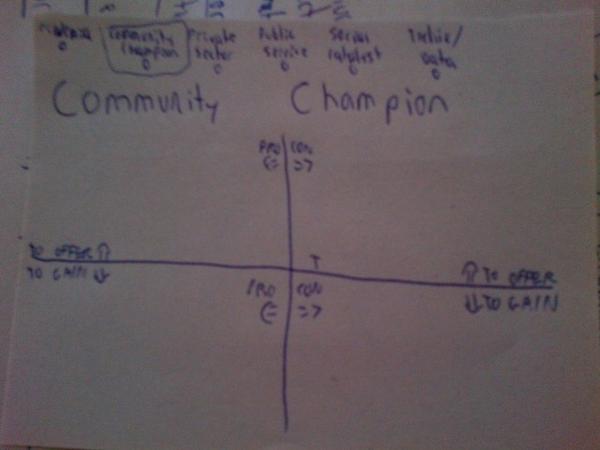
We'll also have some chart paper scattered about the place that'll look like a prettier version of this:
Embedded image permalink

The point is to encourage people from different sectors to comment on what they think the pros and cons are for peers from other fields.  What does, say, the Private Sector have to offer Open Government?  What will they get out of it?

As I've learned from the Design Thinkers at Exhibit Change, the perspectives we hold about ourselves and each other are hardly universal.  Exploring these points of view is key to determining where both our communication challenges lie and where open ground can be found.

Of course, there'll be networking - a chance to pitch your idea, suss out new talent, find the partner you've been looking for but unable to find anywhere else.  Courtesy of ThinkData Works, there'll be some snacks and beverages, too.


We'll get a LIVE FROM SOMEWHERE IN CANADA update from Richard on his discovery of Canada and chats about Open Gov.  You can get a bit of a teaser here.

Lastly, we'll have a panel discussion about what Open Government is and what it means for Canada.  Who'll be on the panel is a bit of a surprise, as will be the direction of the conversation.  The goal is to start somewhere and see where we go from there.

It's gonna be different, it's going to be helpful and I have no doubt it'll be fun.

Hope to see you there.

Tuesday, 12 November 2013

My Phone Will Start Ringing Any Minute Now!


Two narratives I'm contemplating today as I dive further into defining what a truly networked society would look like, how it would work and why partners from across multiple spectrums will work together to catalyze it.
 
The public service Integration Imperative:


The evolving nature of PR:


The real challenge for PR is that it's a sales business; a focus on marketing existing value over creating new content is hard-wired into the industry.
 
The biggest challenge of government is that service delivery models are silo-focused; everyone knows they need to integrate, but A) don't know quite what that looks like and B) see integration as a threat to their turf.
 
How on earth do we bridge the gap between what we're comfortable doing and where we need to be going?
 
Sorry, phone's ringing, gotta sign off.  You know where to find me when you're ready to have a conversation!

Sunday, 14 April 2013

Logic, Or the Semblance of It


Do you think the sun orbits the sun?  Likely not, but there was a time that was a common perspective. 
 
Racism (or any stigma, really) is a variant on the same theme - them Other folk aren't as human as you are and as such, not deserving of the rights and freedoms that are the sole property of mankind.  It's universal, this - we matter, you don't.  We have the moral authority to impose upon you, but the reverse would be a travesty.
 
Might makes right in business, in politics, in bullying, in rape.  At least, many of us feel that way.
 
In truth, though, there is one massively complex system that includes the furthest-flung galaxies and the most microcosmic of organisms.  We sentient humans are somewhere in the middle, unremarkable to anyone but ourselves except for one thing - we have the capacity to be conscious of the big picture. 
 
We don't always - often enough, we settle for shadows or cheap facsimiles.
 
At our best, though, we know that we're part of a whole that is infinitely more than the sum of its parts - and aim to offer a meaningful contribution, maybe leave a bit of a mark behind.
 
Call it social genetics.


Wednesday, 20 March 2013

Collaborate by burning the midnight oil, like Edison (Harvey Schachter)


I would have to agree with this.  After all, understanding is the place where diversity meets and innovation develops; understanding, of course, is a cognitive function.
WAKATA isn't just a concept - it's intended to be a solution.


By Sarah Miller Caldicott
(John Wiley, 284 pages, $25.95)
It was common for the scientists hired by Thomas Edison for his innovation factory in Menlo Park, N.J., to toil into the late evening or early morning hours, their boss alongside them. He often ordered a midnight lunch of meat, bread, cheese and beverages for the entire crew, to fuel their overnight discussions and theorizing. Gathered together over food they were – take your pick – innovating, collaborating, or both.
 
Innovation is a hot item these days. Mr. Edison’s great-grandniece, Sarah Miller Caldicott, found that in the first five months of 2012, 250 books were published with the word innovation in the title. But she wonders if in seeking the Holy Grail of innovation, companies (and authors) are actually looking in the wrong direction.
 
After studying her famous relative, she believes the secret to success is in the collaboration that those midnight lunches reflected. “Perhaps it is a culture of collaboration that we should be seeking as the Holy Grail,” she writes in Midnight Lunch.
 
Obviously, one doesn’t preclude the other; innovation and collaboration can go hand in hand. The problem is that most people think of innovation as solitary, stunning breakthroughs that emerge through the power of a singular mind, a Newton lying under the apple tree, Archimedes in his bathtub, or Mr. Edison in his laboratory. But Ms. Caldicott reminds us that the inventor of the light bulb, the phonograph and the motion picture camera (among many other devices), was not a solitary creator.
 
“He viewed collaboration as the beating heart of his laboratories, a sustained resource that fuelled the knowledge assets of his sprawling innovation empire,” she writes. “From his earliest days renting space in workshops and small laboratories, Edison collaborated with others. Realizing the value of sharing his inspiration with people who held different skills than he did, Edison felt a unique bond with those who laboured with him.”
 
She stresses that the modern fascination with teams does not necessarily mean we are collaborating. Teams too often operate as individuals working alongside but separate from each other. Collaboration involves interweaving a group of people’s work so the talents of everyone are leveraged for a significantly greater gain.
 
Ms. Caldicott pieces together four phases of collaboration, each containing two elements, so eight factors in all to consider:


Phase 1: Capacity

It starts by creating the foundations for collaboration to thrive. For Mr. Edison, the first element was creating a “collaboration soup,” formulating a diverse group that represented a cross-section of experience, thought styles and creative potential. He relished, and sought, diversity. “It is not always necessary, perhaps not always desirable, to be a specialist in a subject in order to make suggestions to it which starts useful angles of research,” he noted. “We specialists are likely to get into ruts of our specialties out of which it is difficult to progress.” The second element is to assemble small teams of two to eight people who, through collegiality and the nimble search for discovery, can make a breakthrough in understanding.


Phase 2: Context

The team must then focus on developing a new context to frame the problem. That happens through a combination of individual learning plus hands-on collaborative working, which Ms. Caldicott dubs “solo meld” and “group meld.” First, the individual team members pursue their own learning process, questioning their assumptions, reading widely, and considering analogies that might broaden their thinking about the issue at hand. “Individuals prepare insights without locking down on any specific idea or direction,” she says. Then they come together as a group, discussing their insights developed in that solo meld, and pushing each other to new ideas, through methods that include experimenting with prototypes and developing stories to explain possible solutions.


Phase 3: Coherence

The team needs a central, binding force to integrate the collaborators. “Like a kind of gravity that permeates the entire group, coherence connects team members with an invisible grasp that allows the team to keep functioning even if there are disruptions,” she observes. That collaborative momentum comes as the members emerge at various points to inspire each other to move ahead and, secondly, through communication of the progress they are making toward their collective goal.


Phase 4: Complexity

In complex projects, teams must jettison the hierarchical mentality and organize in more fluid patterns that allow them to adapt to shifting conditions – what she calls “smart layers” that can connect the actors in different ways. Keep procedures, structures and other entanglements to a minimum. Document what the group is doing so you can track what has been accomplished (Mr. Edison constantly wrote about his ideas and progress in notebooks).
 
Midnight Lunch comes at innovation from a useful, different perspective. It’s not always easy reading, and readers can get lost in the details of the eight elements of collaboration. But Ms. Caldicott provides a nice blend of storytelling about Mr. Edison and other creative thinkers that can add to your knowledge about collaborative innovation.
 
 
Special to The Globe and Mail
Harvey Schachter is a Battersea, Ont.-based writer specializing in management issues. He writes Monday Morning Manager and management book reviews for the print edition of Report on Business and an online work-life column Balance. E-mail Harvey Schachter

Thursday, 24 January 2013

The Tragedy of Ashley Smith


And repeated, and repeated, in all kinds of contexts to various degrees of severity.  It's cyclical.
 
Why?  Because we aren't psychologists; we don't understand the behaviour of others any more than we understand the behaviour of ourselves.  If we ever hope to fill in these social fissures, we need to work harder to understand.
 
No one can force us to do so - we have to want to, for ourselves.  We have to believe understanding matters; we have to have faith that understanding is possible.