Search This Blog

CCE in brief

My photo
Recovering backpacker, Cornwallite at heart, political enthusiast, catalyst, writer, husband, father, community volunteer, unabashedly proud Canadian. Every hyperlink connects to something related directly or thematically to that which is highlighted.
Showing posts with label Guardly. Show all posts

Monday, 30 December 2013

NotifEYE For Missing Persons


Problem solving is a curse.  It doesn't turn off.
 
So, while there are those to turn to hope, or hate, or combatting hate in the light of Christopher Peloso's disappearance, I'm automatically thinking about who can help locate him now and what can be done to provide more rapid, less public assistance for everyone down the road.
 
Here's where I'm at now.
 
The Crime Prevention Association of Toronto (CPAT) has partnered with Guardly, a smart start-up with a Security App that's first in class globally (they're based here in the city, I might ad).  Guardly's basic App helps people in situations of distress (being chased, for instance) to send their geolocation to a set list of friends and security providers, up to but not necessarily including 911.  It's a lot easier to hit a button discrectely then to have to place a dead-giveaway call.
 
CPAT's contribution ups the game significantly.  One of the additions in their NotifEYE App is a push function; say you're a senior in Toronto Public Housing, have health issues but no family or friends who will come and check on you.  Instead of falling, breaking a leg and being found dead a week later because someone complains about the smell, let's say you miss hitting a pop-up you get daily on your phone asking if you're okay.  This sends a warning to a service provider who will place a call and, if there's no answer, ensure someone physically goes to check on you.  Your life could be saved.
 
Could this sort of application be used for people at greater risk of going missing?
 
There are all kinds of privacy and freedom issues that will surely be raised at this point, but read on. 
 
Some seniors have dementia issues.  Some people with depression issues, or schizophrenia or other conditions are more likely to feel the need to extricate themselves from a normal environments.  You could include some youth in this list, too.
 
If the person at risk and their family/caregivers/friends were to discuss such a NotifEYE system at a point where the at-risk individual was in a good headspace, parameters could be set with the goal of creating a clearly understood system, a safety valve that works for everyone.  In the case of pre-established period of time without contact, family/friends/caregivers could send out a simple message that says "are you okay" or something equally innocuous just to know the at-risk individual is okay.  The content and features of the push could be discussed and tailored by everyone concerned; the number of pushes allowed in a day or month could be established in advance.
 
The goal of such a tool wouldn't be supervision, but emergency.  Like any emergency preparedness tool, it ideally would never be used, but you'd be ready when and if the need arises.
 
Thoughts?

Thursday, 28 November 2013

Open Doors Catching Fire


That's true.  Now, skip down the article a bit...


Everyone is moving in the same direction - we'll all get there, eventually, but the question is who are the trailblazers?  Who are the ones history (and electorates) will remember as first to the top of the mountain?  

Governments (both the elected and civil service sides) can play catch-up to where others are already going, or they can take a bit of risk, think a little different and lead the way forward.

With initiatives like OpenGov, OpenData and even workplace psychological health and safety, jurisdictions in Canada are on the right track.  With super innovative, proactive and user-friendly digital support tools and services like Guardly, RealTimeCrisis and WalkAlong, we're creating value that other jurisdictions are looking to learn from.

We can get there; we just need to pull together and keep moving forward.

Tuesday, 3 September 2013

Online Police Supports – A Solution Dying to Happen


The death of Sammy Yatim has brought back into focus the nature of police training and supports, especially where it comes to their interaction with Emotionally Disturbed People (EDPs).  A big question raised is the suitability of police as first-responders to EDP calls, although that’s a difficult nut to crack.  Programs like MCIT help some, but the reality is that police, by the nature of policing, will continue to be first responders; until such time as every citizen can identify the neurochemical causes of erratic behaviour, a 911 call involving aggressive or irrational individuals is going to find its way into police dispatches.
Another big concern that has been raised – this isn’t the first time the way police interact with EDPs has come to light.  It’s not even the first time a study has been called for.  In fact, multiple studies have been commissioned and they all tend to present the same findings – yet nothing really changes.  Struggling to find solutions that have public appeal and actually tackle the problem puts governments in a corner; the general public isn’t interested in complex solutions, they want clear deliverables they can understand and read about in action-oriented headlines.
The Government of Ontario, trying to demonstrated proactive action in some manner, has decided to expand police access to tasers.  The theory is that putting more varied tools into the hands of front-line police officers will give them greater on-the-spot choice, reducing their likelihood of unnecessarily turning to lethal force as a problem-solver.
I’d be interested to see the psychological studies that back up that assessment.  I’m gonna go out on a limb and guess that there aren’t many.
There’s probably some hope in policing, justice and government circles that the problem will just blow over as new stories grab the headlines and capture public attention; that’s what generally happens with stories like this.  It’s why we have a series of not-acted on reports in the first place. 
What if there was another way?  What if the solution wasn’t to put more offensive weapons in the hands of isolate front-line officers but instead give them tools that connect them together and provide better access to supportive information? 
It’s being done elsewhere, in a number of different ways.  Social media is playing a key role in this perception shift of what’s best for both front-line officers and the people they interact with.
Without giving away spoilers, there are some cool applications of smartphone Apps being applied to security-related uses.  Then, there are tools like Blueline and PoliceOne that are expanding on the capacity of social media platforms like Facebook and LinkedIn to create safe spaces for law enforcement personnel to share information, best practices and to provide peer support.
There are good models in here that I hope the people looking into Sammy Yatim’s death are looking into.  The solutions we’re looking for are literally being written, now.
It just takes someone to connect the dots, sell the story – and decision makers willing to implement change.

Tuesday, 13 August 2013

Justice For Mental Health (and homework for Matt Gurney) UPDATED


Having a Twitter back-and-forth with Matt Gurney about police and identifying mentally ill individuals.

Gurney makes a good point that no matter what, officers will have to handle the person in front of them, regardless of what the backstory is - and they won't necessarily have oodles of time to decide what's motivating behaviour (illness, drugs, a stressful day).

Here are a couple of ideas I put down that eventually morphed into a slide deck that isn't so postable to a blog:


JUSTICE FOR MENTAL HEALTH

THE REALITY

       Front line police officers are often first and last responders to Emotionally Disturbed Person (EDP) calls

       Without appropriate supports and education for police, these calls carry an unnecessary risk for both officers and EDPs

      Post-Traumatic Stress (PTSD) for officers with impact on their work, health and families

      Avoidable incarceration, injury and fatalities for EDPs

       Toronto officers receive annual mental health training as part of a two-day “use of force” program.  Training includes role-play but no exposure to persons with lived mental illness experience or education about the biology or behaviour of mental illnesses

THE OPPORTUNITY

Expand existing Police training and provide additional online support tools

Training:

·         Resiliency and stress management


o   Basic training regarding brain function and abnormal psychology (CANC + JMHA)

·         Exposure to EDPs in safe environments (eg. Rounds at CAMH)

Online Support Tools:

·         Modularized online training (including videos presenting behaviour of psychological conditions for exposure)

o   Modular E-Learning programs would reduce manpower lost to training time issues

·         Online map-based portal aggregating all Toronto mental health, health and related justice service providers

·         Smart-phone App that provides an easy-to-navigate chart of mental illnesses, symptoms, conditions, triggers and suggested responses (developed in conjunction with E-Learning program)


ACTION ITEMS

-          Develop a pilot program (including model web portal/App) for  Toronto Police Divisions 51 + 52 (build on existing Mobile Crisis Intervention Team program)

o   Partners; Toronto Police, City of Toronto, additional mental health service providers


UPDATE - Look at this, there is already solid material out there that could be followed up on:

HALLUCINATIONS:

My hallucinations are not always there but when I see and hear imaginary things, it is very frightening and painful to me. I know some people think I can just control myself and tell myself they are not real. But I can’t will them away. They are real to me when I am experiencing them.
– CLIENT

Definition:
Person senses perceptions that do not exist in the real world such as:
- feel such as bugs crawling under the skin
- smell such as smoke or gas
- taste such as poison in food
- sight such as visions of God, other persons, etc.
- hearing such as voices telling the person to do something auditory the most frequently encountered hallucination involves the auditory sense, i.e. hearing


Recognition:
• has faulty sensory perceptions, i.e., hears, sees, smells, feels things that do not exist
• talks to self
• appears preoccupied and unaware of surroundings
• has difficulty following conversations and instructions 
• momentary or extended lapses in attention, as if listening to something
• misinterprets words and actions of others
• may isolate self 

• may use radio or other sounds to tune out voices

Police Response Strategies:
• isolate and contain
• do not invade personal space 
• do not touch without permission or stand too close
• speak slowly and quietly using simple concrete language
• avoid verbal confrontation
• remember it may take the individual longer to process information
• instruct to “listen to my voice, do not listen to the other voices”
• explain your actions
• ask questions:
    – “Are you hearing voices other than mine?” 
    – “What are they telling you?” 
    – “What do you see, feel, taste?”
• reduce confusion, i.e., bright lights, television, radio
• be aware that stress may increase hallucinations
• address the person by name/if do not know it, ask how they would wish to be addressed

• do not pretend that you are experiencing the hallucination along with the person

Remember – you are the grounding in reality. Respond by saying, “I don’t hear the voices, but
understand that you do.” It is critical to ask questions regarding the content of the message in that it may be a directive to hurt someone including you. Try to get a sense of how they feel and how you could help. 

Remember – the person may not be able to adequately process the information or may have recent memory problems making it difficult to follow instructions.


UPDATED:  “Real life in the police services is not a television drama,” wrote Blair near the end of the ruling. “What took place here sullies the reputations of the many good officers in our country, whose work is integral to the safety and security of our society.”

Thursday, 28 March 2013

Stephen Harper Reads WAKATA


Creating an online service hub that makes it easier and more intuitive for users to determine and access the services that they want is actually a really good idea - one I've discussed before:


That's okay - I'm totally fine with the Prime Minister cribbing my ideas.  A bit of recognition, though, would go a long way towards encouraging other engaged citizens to share their innovative ideas for streamlining service or improving productivity or fostering innovation.
 
But yeah, there's a chance Harper isn't cribbing from me; he could be cribbing from the US.  Or Australia.
 
Either way, it just goes to show that innovation doesn't happen in a vacuum - progressive ideas happen through collaboration and sharing.
 
Of course, the concerns raised in the article above are valid; the Harper government has a history of shrinking public access to information; they've curtailed the Census, they've denied bureaucrats the right to speak, defunded NGOs they don't like, built up cones of silence around Parliamentary activity and are even stifling their Caucus.
 
Canadians should be very concerned that Harper and co will continue to starve knowledge in their drive to develop The Master Switch.  The trick isn't to get mad and fight against the very idea of improving online service access, though - that would defeat the underlying progressive purpose.  Instead, the goal should be to get creative.
 
People do have trouble accessing public services in their present format.  They do spend tons of time online.  And they like online stuff that is both informative, fun and rewarding.  Better service presentation would reduce duplication, gaps and overlaps (and related costs) and making engagement rewarding will encourage people to be proactive.
 
How do you get the public engaged in service reform using modern technology and use a bit of charm offensive to build political traction at the same time?
 
Smart political operatives will be seeking partners to answer those questions and have a plan in place for the next election


Photo: Heh.

Wednesday, 29 August 2012

Introducing Guardly - A Look At the Future of Public Services?


Guardly is a brilliant, innovative application of social media and new technology to a societal need.  Not only does it allow for services to get to where they're required and fast - it brings the whole conversation to the intended user in a way that is accessible and intuitive for them.  This is the next iteration of the whole "get your health card like a pizza" theme redesigning social services to mesh with how people behave rather than trying to train them to behave in a way that works for services.


Now, how can this concept be expanded to broader applications, boosting the economy by creating new markets and improving service delivery, benefiting both users and providers?  If you read my blog, you know that I have proposed the creation of a map-based, user-friendly online service aggregate, something the US is now pursuing with their digital government strategy.  When Canada gets around to building its own model, we'll need an App that connects those services with users in their daily lives, via mobile device.  Guardly (or tools like it) can be the connective tissue between users and online service delivery.


That's big-picture; on a more immediate level, there's a ready-made opportunity that would allow Guardly to test out the broader application of their product in a related field (security and safety), helping to address a major social issue at the same time.  That field is the interaction between our police, mental health service providers and persons suffering from mental illness themselves.


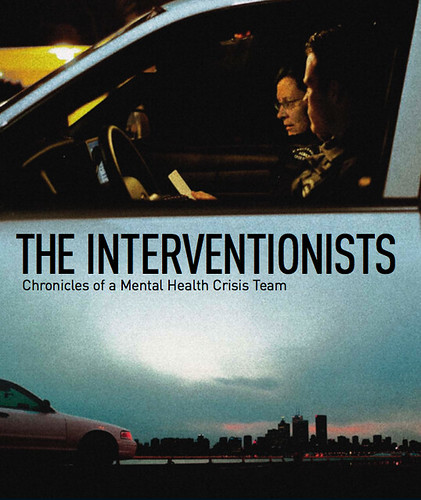
At Gerard Kennedy's recent Mental Health Matinee, I had the opportunity to view The Interventionists, a documentary that follows Toronto's Mobile Crisis Intervention Team (MCIT) as they dealt with calls involving Emotionally Disturbed People (EDPs).  It was pretty shocking stuff, though none of it unexpected.  We know what happens on our streets, even if we choose to ignore it.  After the screening, I had a chance to speak with one of the MCIT Officers, Mike Zawerbry, about the work (which he was very passionate about) and ask if he felt there were other tools he could use to enhance his services. 


Officer Zawerbry said that having one online portal that aggregates what mental health services are available in town by type and location would be incredibly useful.  If that portal could include tips on recognizing mental illness symptoms and suggested responses for de-escalation responses, that would also be helpful.  For it to be of real-time use, this portal would have to be accessible by mobile phone and intuitive to use.  You can't be fumbling over functions when there's someone trying to harm themselves or someone else in front of you.


Overdose at Occupy TorontoThe MCIT program is a partnership between the Toronto Police and St. Joseph's Health Centre.  Completely separate, the Schizophrenia Society of Ontario's Justice Mental Health Program (JMHP) provides support and training for people on both sides of the law (including families) related to mental health.  Same sort of deal; if the services JMHP and some self-guidance tools were available, would such a service help de-escalate problems or provide more rapid support access?  If individuals with diagnoses of mental illness had their own profile information on their personal devices, could they use that as a self-help and help-seeking tool when they have moments of distress?


An App like Guardly could be tweaked to help fill this gap.  Would such a service help keep people out of hospitals, the justice system and jail cells, reducing service cost?  If so, would that be worth funding?  On the other side of the equation, how much could be saved in terms of unnecessary service use/preserving human dignity/maintaining safety and security?


Ontario is looking for innovative ways to stimulate the economy; it's looking to improve service delivery and provide additional support for their front-line workers - they're also looking to improve quality of life outcomes in the province. 


Guardly might just have an App for that.