Search This Blog

CCE in brief

My photo
Recovering backpacker, Cornwallite at heart, political enthusiast, catalyst, writer, husband, father, community volunteer, unabashedly proud Canadian. Every hyperlink connects to something related directly or thematically to that which is highlighted.
Showing posts with label control. Show all posts

Tuesday, 16 April 2013

Suconscious Motivators to be Mindful Of:

 
To answer the author's question at the bottom, I was aware of all ten.  There's nothing particularly special about that fact - I have simply been motivated to understand how this mind stuff works.  You can do the same, if that's a choice you make.
 

The center that I cannot find is known to my unconscious mind. ~ Auden

What if I told you that your unconscious mind actually controls your conscious mind?
 
Not exactly what you had in mind, now is it?
 
In my studies of neuroscience and neuro-practices, I've learned truths about our unconscious minds that literally blew me away. Many of the beliefs I'd been taught for decades became little more than urban myth.
 
I want to share some of these powerful truths with you. The more we understand about our minds, the easier it becomes to step into our full potential. Our minds are designed for each and every one of us to create BIG potential!
 
Today I'm sharing a list of 10 truths that IMO we all should know. Over the next few weeks, I'll post more about each truth and how it impacts our business and personal worlds. So here goes!

Your Unconscious Mind(UM):

1) Processes all of the data inputs from our five senses.

That's now around 11M bits/second, which is a lot of info to handle. More than any supercomputer out there can manage. Your UM uses deletion, distortion and generalization to manage all that data. We'll talk more about this process on Wednesday.

2) Is the master of your conscious mind.

In fact, your conscious mind only gets involved in data processing and responses when the unconscious mind calls upon it. That's when the UM decides it needs logical input to analyze something that's new and different, that doesn't fit the known patterns. Until then, your unconscious rules.

3) Is symbolic.

Your UM stores all of your memories in symbols and images - not in text or paragraph form. That's one reason why visual is a stronger communication/memory system than simple text.

4) Enjoys serving you, but needs clear direction.

Your UM is programmed to serve you. It runs all of your body's systems, instinctually responds to danger and more. It's designed to serve you but it also needs very clear direction. That's where we humans sometimes get in trouble.

5) Does not process negatives.

That's right - your UM does not hear that negation or negative. When you talk or think about what you do not want to happen, it's the same as telling your UM to go out and get that very thing. That's why it's so important to say what you want.

6) Takes everything personally.

Since perception is all about our own unique meta programs and processes that are used to analyze, store and respond to information - everything is personal to your UM. Each of us has to consciously strive for objectivity, stepping beyond our unique programs and perspectives to see various viewpoints.

7) Controls and maintains all perceptions.

Our initial perceptions are formed in early childhood. Between the ages of 0-7, every single thing that happens in our world becomes a truth to our UM. We then build on those initial perceptions and they become like fly paper - attracting more experiences that match the perception to make it true.

8) Works on the principle of least effort.

Our minds want to use the least resources possible to manage inputs, run our bodies and more. The smaller the effort, the more mental capacity we have for emergency processing - like when that woolly mammoth charges us or when all heck breaks loose in our business.

9) Maintains instincts and generates habits.

The more we can respond out of habit or instinct, the less energy our UM has to use. We create habit after habit to allow our minds to have excess capacity for those all important moments. The challenge is that those instincts and habits often get in the way of our own best path.

10) Is programmed to constantly seek more and more.

This is why there is always more and more to discover, why we never stop learning and expanding. It's the function of our UM to expand and as such, so does mankind.
___
I'd love to know how many of the above truths you knew before you read this post. I had inklings of a few but didn't really know the reality! How about you?
 
Check back over the next few weeks. I'll be sharing about individual truths on Mondays, Wednesdays and Fridays.

Tuesday, 19 March 2013

Jobs and the Economy: What Jason Kenney Can Learn From Teachers


Stephen Harper never had a real job prior to politics - he never put his fabled economics degree to the test prior to entering politics.  Jason Kenney served as a lobbyist - a role he has essentially carried over to the Immigration file, as he pretty much spends all his time lobbying ethnic communities to vote Conservative.
 
 
BUT - the Tories have done a pretty good job of stifling opposition, scaring bureaucrats into silence and demonizing those who disagree with their narrow ideology, haven't they?  Power is theirs and they aren't prepared to share it.  Alas, by choking the Census, clamping down on inconvenient evidence and knee-capping conversation, Team Harper is forcing everyone to rely on gut instinct rather than fact.  Instinct in the absence of fact, particularly in tough economic times, will always, always encourage a bunker mentality - the exact opposite of what we need to get out of our worsening economic slump.  It's a limbic thing.
 
 
What I will do is suggest the CPC folk look at some different models to find out how motivation really works and how to foster the independence, critical thinking and comfort with risk they seek.  Of course, first they must unlearn what they have learned.  What's required for them to do that?
 
 
It's not about controlling the flow of fish, folks - it's about teaching people to fish. 
 

Thursday, 7 March 2013

Communist Libertarianism: The North Korean Paradox


With China on the slippery slope towards pseudo-capitalism, North Korea is really the last Cold War Communist State left.  The more isolated they become, the more frightened they get, shoring up their firewalls and threatening any trouble that might even possibly think about lapping at their shores.  Alas, North Korea reflects all that went wrong with the Stalinist Experiment - corrupt leaders that feel entitled to their frills, poorly-informed decisions, resource inefficiency, a suffering populace and the thing that irks me the most - waste.  Waste of materials.  Waste of talent.  Waste of opportunity.
 
Opportunity, of course, lies in change, adaptation, growth.  You can't have progress without change, which requires a certain personal flexibility and a willingness to listen to and work with others. 
 
Progressives, as we know, get branded as pinko lefties by the political right; trying to force social contracts and new ideologies on the people who are just fine as they are, thank you very much.  Libertarians in particular are anathema to centrally-generated, centrally-imposed policy, particularly where it comes to their right to do whatever they please with their resources on their land.  "Back off, government," say the landowers - this is our land."  Libertarians can get pretty belligerent when they feel their personal and territorial liberties are being threatened. 
 
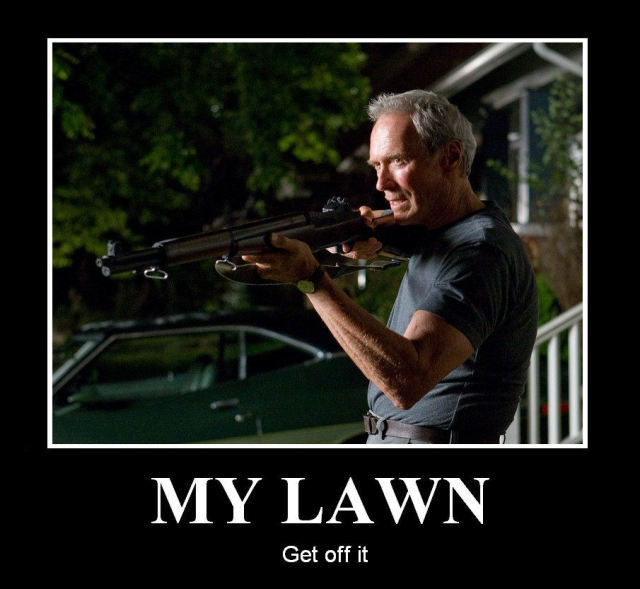
One of those personal liberties they cherish, of course, is the ability to protect their territory.  While the Second Amendment was about having a populace armed to protect against external threats, the political right, led by the NRA, have reinterpreted it to be about the right to bear arms and protect personal property, including self.  There are lots of threats lapping at the castle walls, a man's got to be able to defend his family, or something to that effect.  The NRA spends a whole lotta money fighting for the individua's right to bear arms
 
When innocent people die because of those arms, the NRA is quick to point out it's not their ideology, but external threats that are the problem.  Their Spokesman Wayne Lapierre issued a statement that was carried by Fox News to every corner of the US:  "In a race to the bottom, media conglomerates compete with one another to shock, violate and offend every standard of civilized society by bringing an ever-more-toxic mix of reckless behavior and criminal cruelty into our homes—every minute of every day of every month of every year.”
 
But wait a minute. 
 
Anti-change, anti-external imposition, the desire to keep people off your land, protect it with guns and thump your chest at anyone who comes near your territory?  That sounds awfully familiar.  It sounds something like North Korea.
 
Ah, but I'm only saying that because I'm a lefty, pinko progressive.  I'm either incapable of understanding how things really work or am choosing to ignore the facts.  True libertarian/politically right people aren't interested in ruling over big territories or other people, they just want to be left alone to their own space.  You don't interfere in their business, they won't interfere in yours. 
 
It just so happens that because we have a corrupt, socialist system in place, the world isn't working the way it's supposed to.  Which is why people like Randy Hillier proactively work to get out the non-freedom lovers like Norm Sterling to make room for properly anti-government libertarians like Jack MacLaren.
 
Ditto Rob Ford - the Lord Mayor was so upset with the corruption and entitlement of leftist Mayors that he had no choice but to do whatever it took to win office and set things to right.  We're very lucky he's there - he's all that stands between us and the leftists on City Council.  He's also the only hope the kids of Don Bosco have of getting ahead in life.  Mayor Ford, you see, knows the right way to motivate people to be independent, so long as they listen to him.  Those he can't help, he can shout down - or incarcerate, or run out of town
 
The checks and balances of a democratically elected government and an impartial bureaucracy have helped to filter out some of Mayor Ford's policy approaches.  One wonders what he'd be up to, as leader, if those checks and balances that infuriate him so didn't exist.  Then again, he does have the undying love and support of Ford Nation in his corner.
 
Power is about getting and maintaining control.  Libertarians want control of their own lives, but in a social context, that absolute freedom has to come at the expense of someone else's freedom.  Totalitarianism is basically libertarianism at the state level.  Both libertarians and totalitarians want the freedom to exercise their control in their territory however they please and think that they're the ones who have all the answers. 
 
Despite what they tell themselves, freedom from others isn't the goal - control of territory and resources is.  People, after all, are territorial animals.
 
Like all animals, people maintain territorial control through threats and, where necessary, strength.  Handguns are to people what horns are to bulls or rhinos - and nuclear deterrents are the same thing at the state level.  Costly and expensive propaganda is the state-level equivalent to the peacock's tail.  Control is about preventing external incentive to change, which is what progress is all about.
 
Knowledge is progress.  The handgun and the nuke are the products of progress, as are all weapons and fences that help protect one's territory.  All aspects of society, in fact, have been engineered not by isolationist individuals or regimes, but by collaborative people.
 
Progress isn't about forcing change, so much as libertarianism is about stopping it.  Just like the North Korean regime keeps trying to do.  Fortunately for both, progress is like time - you can't stop the inevitable.


Sunday, 30 December 2012

Some Mental Health Myths to Forget About in 2013 (Liza Finlay and Alyson Schafer)


Without a doubt the most astute piece I've read in a while.  Everyone can benefit from the points laid out below:


They're trite. They're tired. They're untrue. We may not even be aware of it, but most of us live by a set of aphorisms that are, quite frankly, made up. Fictions. Fallacies.
In our psychotherapy practice, we call these myth-conceptions pop-culture poppycock that stubbornly persists despite having no scientific basis or benefit. These bull-crap beliefs become entrenched at an early age and are handed down from generation to generation with the same alacrity of grandma's cookie recipe changing hands. We gobble them up, swallowing them whole and without question.
But we need to question. By challenging faulty beliefs we're free to set a new course, to create a mental map that is consciously chosen. Here are a few of the most pervasive myth-understandings to leave behind as you head into a new year. Leave these mental albatrosses buried in 2012 where they belong.
1. People don't change. Yes, they do. All the time. In fact, change isn't only possible, it's necessary. Darwin helped us figure that out over a century ago when he observed some species flourishing where others floundered. He called this finding "survival of the fittest" -- and by fittest he didn't mean strongest, he meant most adaptable. In our practice, we see magnificent examples of adaptation all the time. But you have to want it; it's not so much that people don't change, it's that they won't change.
2. If it's worth doing, it's worth doing right. Wrong. If it's worth doing, it's worth doing poorly. Worthiness and mastery are not intertwined concepts. Indeed, if perfection was the only barometer of merit, most of us would never get out of the starting gate. Talk about performance anxiety! The bottom line is this: if we only dwell in those endeavours that come with a guarantee of success, we live a shallow life. For 2013, each of us needs to develop the courage to be imperfect. Good enough is good enough.
3. You don't make the same mistake twice. Sure you do. Mistake-making is murky, and muddy, and wonderfully nuanced. The journey to enlightenment is a journey of a thousand steps. Psychological theorist Alfred Adler called life "the great becoming" -- we are in a constant state of 'bettering'. And if we want to be a part of that beautiful bettering, we need to risk, to make mistakes. Life is long. Get dirty.
4. It isn't fair! Yikes. Stop moping! On the BS-scale, that one's right up there. It's a cop-out, a handy way of sidestepping personal responsibility when we feel unable to face the challenges of life. Listen, the dog actually does wag the tail. We are not simply victims of life's happenstances. In actuality, we not only create our own realities, but we have the opportunity to recreate them, too. If you feel that life isn't fair, instead of waiting for someone to hand you a Kleenex, why not ask the question "what am I willing to do about it?"
5. There are two sides to every story. While that's a great start, in fact there are many more than two sides to every story. This is an example of dichotomous, or black and white, thinking. Sorry, but life is lived in the grey areas. No two of us interpret events the same way, meaning that there are as many "sides" to a story as there are humans on the planet. The world would be a better place if we attempted to wrap our minds around all of them. It's messy, but it's just. So, instead of "I'm right, you're wrong," consider what another person must believe in order for them to perceive this as their "truth."
6. All you need is love -- la la la la la. We love The Beatles too, but it's time to put down the hookah pipe and think seriously about the love-is-all-there-is mantra. We don't actually love everybody -- and nor should we. (Let's face it, we may even find some a challenge to like.) The commandment to love thy neighbour is a metaphor. What we are really charged with is the task of respect. We follow a philosophical tenant that requires us to treat all fellow beings with equanimity -- including the cranky neighbour and the obnoxious in-law. So, yes, love is great, but we should all aspire to a far less lofty (and far more achievable) goal -- respect and its offspring, civility. "All you need is respect, la la la la la." (Not nearly as catchy is it? Well, guess that's why The Beatles are the songwriters and we're the therapists.)

Thursday, 23 February 2012

Strategy, Creativity and Discipline


      - Sun-tzu

They say all is fair in love, war and politics, yet in each field there are certain rules that apply, almost like social gravity.  The history of military (or political) strategy is the attempt to determine and understand these rules.  Students of strategy study the lessons of successful predecessors; they also seek to learn from the failures of others. 

A good recent example of this is Rob Ford’s winning mayoralty campaign; it has been reverse-engineered by governments across the country, looking to capitalize on Ford Nation’s best practices and avoid his pitfalls.  This isn’t a stand-alone process; Ford’s success at the polls has not translated into broader political success with council.  Why is that?  The answer to this question is relevant to strategists, too. 

A standard weakness in strategic development, particularly in light of success, is a singular focus on control.  You want to duplicate what worked previously, which means managing all the variables as closely as possible to ensure repeatable outcomes.  In politics in particular, message control is key; campaign communications are worked out far in advance, with one message-of-the-day building on the next, all timed to inflict maximum damage on one’s opponent and draw maximum focus to your own platform, vision, leader, etc.

The problem is, realities change; what worked previously isn’t guaranteed to work the next time around.  Tight control leaves little room for innovation or seizing-the-moment; look at Tim Hudak’s messaging-fatigue during the recent Ontario election as evidence of this.

On another previous Ontario campaign – the by-election that saw Rick Johnson defeat John Tory in Haliburton-Kawartha Lakes-Brock – a great campaign slogan (vote local) was the product of an innovative staffer who, seeing a “buy local” sign at a grocery store, put two-and-two together and created a winner.  It wasn’t part of the plan, but that bit of proactive creativity made a difference.

For campaign strategists, then, a rewording of Sun-tzu’s famous advice might read like this:

What’s worse:

-          To have members of your team who are unpredictable

-          To be unable to predict the actions of your opponents

-          To be predictable to your opponents

Conversely, what’s better:

-          To have members of your team be entirely scripted

-          To understand the actions and motivations of your opponents

-          To be unpredictable to your opponents

The best deployment provides troops (be they soldiers or campaign teams and candidates) with defined parameters, a definition of success and as many resources as possible.  The best resource in any campaign is creativity; how to do more with less, out-of-the-box solutions, etc. 

Every campaign I have ever been involved with, someone somewhere has said “be creative” when faced with some dilemma or opportunity.  Good campaign managers will seek out creative individuals for their teams; generally these are known or referenced commodities, though, people you can count on to be quick to respond and capable of independent idea generation, but not to the point of risking the general trajectory of the campaign.

If creativity is desired, how do you nurture it?  If self-discipline is beneficial (allowing for creativity to happen within comfortable parameters), how do you foster it?

The answer isn’t as complicated as we might think.