
| In the 16 peer-reviewed scientific studies summarized below, researchers found that liberals and conservatives have different brain structures, different physiological responses to stimuli, and activate different neural mechanisms when confronted with similar situations. Each entry below references the source document and a PDF of each study has been included. The studies are arranged from most recent to oldest. We included all the peer-reviewed studies on this subject which we could find. If you know about others, please contact us with details. |
1. Conservatives spend more time looking at unpleasant images, and liberals spend more time looking at pleasant images.
|
 "We report evidence that individual-level variation in people's physiological and attentional responses to aversive and appetitive stimuli are correlated with broad political orientations. Specifically, we find that greater orientation to aversive stimuli tends to be associated with right-of-centre and greater orientation to appetitive (pleasing) stimuli with left-of-centre political inclinations."
 Philosophical Transactions of the Royal Society B: Biological Sciences, Mar. 5, 2012
2. Reliance on quick, efficient, and "low effort" thought processes yields conservative ideologies, while effortful and deliberate reasoning yields liberal ideologies.
|
 "...[P]olitical conservatism is promoted when people rely on low-effort thinking. When effortful, deliberate responding is disrupted or disengaged, thought processes become quick and efficient; these conditions promote conservative ideology… low-effort thought might promote political conservatism because its concepts are easier to process, and processing fluency increases attitude endorsement.
3. Conservatives react more strongly than liberals to disgusting images, such as a picture of someone eating worms.
|
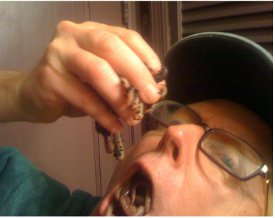 "
"4. Liberals have more tolerance to uncertainty (bigger anterior cingulate cortex), and conservatives have more sensitivity to fear (bigger right amygdala).
|
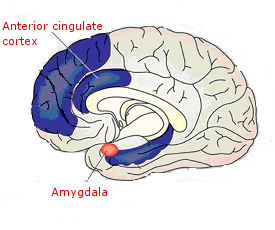 "In a large sample of young adults, we related self-reported political attitudes to gray matter volume using structural MRI [magnetic resonance imaging]. We found that greater liberalism was associated with increased gray matter volume in the anterior cingulate cortex, whereas greater conservatism was associated with increased volume of the right amygdala...
5. Conservatives have stronger motivations than liberals to preserve purity and cleanliness.
|
 "...[R]eminders of physical purity influence specific moral judgments regarding behaviors in the sexual domain as well as broad political attitudes...
6. Liberals follow the direction of eye movements better than conservatives.
|
 "In the present study, we examine whether gaze cue effects [the ability to follow the direction of another individual’s eye movements or gaze] are moderated by political temperament, given that those on the political right tend to be more supportive of individualism—and less likely to be influenced by others—than those on the left. We find standard gaze cuing effects across all subjects, but systematic differences in these effects by political temperament. Liberals exhibit a very large gaze cuing effect while conservatives show no such effect at various SOAs [stimulus onset asynchrony]...
7. Republicans are more likely than Democrats to interpret faces as threatening and expressing dominant emotions, while Democrats show greater emotional distress and lower life satisfaction.
|
 "Independent sample t-tests revealed group differences in the averaged threat interpretation scores of the 10 facial stimuli. Republican sympathizers were more likely to interpret the faces as signaling a threatening expression as compared to Democrat sympathizers. Group differences were also found for dominance perceptions, whereby Republican sympathizers were more likely to perceive the faces as expressing dominant emotions than were Democrat sympathizers...
8. Conservatives and liberals react similarly to positive incentives, but conservatives have greater sensitivity to negative stimuli.
|
 "Our findings suggest that conservatives are sensitive to avoidance motivation [motivation through negative stimuli], which produces 'inhibition' responses manifested in greater rigidity... Based on the studies' findings, we would not expect differences between liberals and conservatives in responding to positive stimuli or incentives (i.e., approach cues), but we would expect greater inhibitory reactions by conservatives in response to negative, avoidant cues. Self-regulation appears to provide a useful perspective for understanding how one's political views may affect categorization processes and, more broadly, the association between political conservatism and rigidity."
9. Conservatives have more activity in their dorsolateral prefrontal cortices, the part of the brain that activates for complex social evaluations.
|
 "The conservatism dimension, which corresponds to the liberal-to-conservative criterion, was associated with activity in the right DLPFC [dorsolateral prefrontal cortex]... In this study, we speculate that activity in the DLPFC may reflect a role of this region in deliberative decision-making in complex social evaluations... The observation that this region was increasingly activated by conservative beliefs could be explained by claiming that conservative statements require more complex social judgments marked by greater cognitive dissonance between self-interest and sense of fairness...
10. Conservatism is focused on preventing negative outcomes, while liberalism is focused on advancing positive outcomes.
|
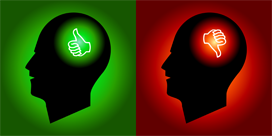 "Political liberalism and conservatism differ in provide versus protect orientations, specifically providing for group members' welfare (political Left) and protecting the group from harm (political Right). These reflect the fundamental psychological distinction between approach and avoidance motivation. Conservatism is avoidance based; it is focused on preventing negative outcomes (e.g., societal losses) and seeks to regulate society via inhibition (restraints) in the interests of social order. Liberalism is approach based; it is focused on advancing positive outcomes (e.g., societal gains) and seeks to regulate society via activation (interventions) in the interests of social justice."
11. Genetics influence political attitudes during early adulthood and beyond.
|
 "The present research attempts to characterize how the transmission of political orientations develops over the life course... [G]enetic influences on political attitudes are absent prior to young adulthood. During childhood and adolescence, individual differences in political attitudes are accounted for by a variety of environmental influences... However, at the point of early adulthood (in the early 20s), for those who left their parental home, there is evidence of a sizeable genetic influence on political attitudes which remains stable throughout adult life."
12. Compared to liberals, conservatives are less open to new experiences and learn better from negative stimuli than positive stimuli.
|
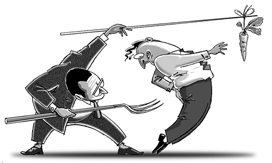 "In this study, the relations among political ideology, exploratory behavior, and the formation of attitudes toward novel stimuli were explored. Participants played a computer game that required learning whether these stimuli produced positive or negative outcomes. Learning was dependent on participants’ decisions to sample novel stimuli... Political ideology correlated with exploration during the game, with conservatives sampling fewer targets than liberals. Moreover, more conservative individuals exhibited a stronger learning asymmetry, such that they learned negative stimuli better than positive... Relative to liberals, politically conservative individuals pursued a more avoidant strategy to the game…
13. Conservatives tend to have a stronger reaction to threatening noises and images than liberals.
|
 "In a group of 46 adult participants with strong political beliefs, individuals with measurably lower physical sensitivities to sudden noises and threatening visual images were more likely to support foreign aid, liberal immigration policies, pacifism, and gun control, whereas individuals displaying measurably higher physiological reactions to those same stimuli were more likely to favor defense spending, capital punishment, patriotism, and the Iraq War. Thus, the degree to which individuals are physiologically responsive to threat appears to indicate the degree to which they advocate policies that protect the existing social structure from both external (outgroup) and internal (norm-violator) threats."
 14. Liberals are more open-minded and creative whereas conservatives are more orderly and better organized.
|
 "We obtained consistent and converging evidence that personality differences between liberals and conservatives are robust, replicable, and behaviorally significant, especially with respect to social (vs. economic) dimensions of ideology. In general, liberals are more open-minded, creative, curious, and novelty seeking, whereas conservatives are more orderly, conventional, and better organized... A special advantage of our final two studies is that they show personality differences between liberals and conservatives not only on self-report trait measures but also on unobtrusive, nonverbal measures of interaction style and behavioral residue.”
15. When faced with a conflict, liberals are more likely than conservatives to alter their habitual response when cues indicate it is necessary.
|
 "Our results are consistent with the view that political orientation, in part, reflects individual differences in the functioning of a general mechanism related to cognitive control and self-regulation. Stronger conservatism (versus liberalism) was associated with less neurocognitive sensitivity to response conflicts. At the behavioral level, conservatives were also more likely to make errors of commission. Although a liberal orientation was associated with better performance on the response-inhibition task examined here, conservatives would presumably perform better on tasks in which a more fixed response style is optimal."
 16. Conservatives sleep more soundly and have more mundane dreams, while liberals sleep more restlessly and have a more bizarre, active dream life.
|
 "Conservatives slept somewhat more soundly, with fewer remembered dreams. Liberals were more restless in their sleep and had a more active and varied dream life. In contrast to a previous study, liberals reported a somewhat greater proportion of bad dreams and nightmares. Consistent with earlier research, the dreams of conservatives were more mundane, whereas the dreams of liberals were more bizarre...

No comments:
Post a Comment