
You can find anything you want on the internet these days - equally, you can find lots of material that reinforces what you already believe in/stand against. The access isn't the issue - it's shaping how that access gets used.
To strengthen their brand, reinforce their base and in an attempt to engineer a national community of experience that is more conservative in nature, the Conservative Party of Canada has spent a great deal of time hammering home simple messages, denigrating their opponents and stifling facts that don't back their arguments.
Some progressive communicators have tried to copy this approach, hitting the fear button and relying on attacks to denigrate their opponents while relying on simple messaging and a low public profile to shore up their own defenses. In doing so, these progressives are becoming pale shadows of their opponents. In this tug-of war, it's ultimately the Conservatives who win by putting the breaks on progressive dialogue.
So what's a progressive to do? If you can't beat 'em at their own game and aren't willing to join them, you change the rules of the game.
Whereas traditional conservative thought presents the unknown as dangerous and The Other as untrustworthy, progressives see new territory as laden with opportunity and disregard the concept of The Other entirely.
It's been easier for the Political Right to channel the current mediums of public preference (video) to their advantage, theoretically, because video is an emotional medium. Progressives have this bad habit of seeing themselves as less emotional and more evidence-based; as we all know, facts tell, but stories sell. When you present a fact, it sits on the table like a plastic toy; it has no resonance for the audience, because we understand the world through the lens of emotion. Literally - we're hard-wired that way.
To assume that all emotions favour conservative thinking is to close the door on some pretty essential tools of communication. Hope is an emotion, too, as are wonder, a sense of belonging and optimism. In the same way media (not just visual but all sensory mediums) can be manipulated to favour negative, reactive responses, it can be channeled to trigger positive, proactive responses.
This is why context matters. Meaning is derived from association - without context, a thing in and of itself has no value. Art is like this - the content of a painting, a chorus in a song or a payoff built up to in a movie can all trigger emotional responses, positive or negative.
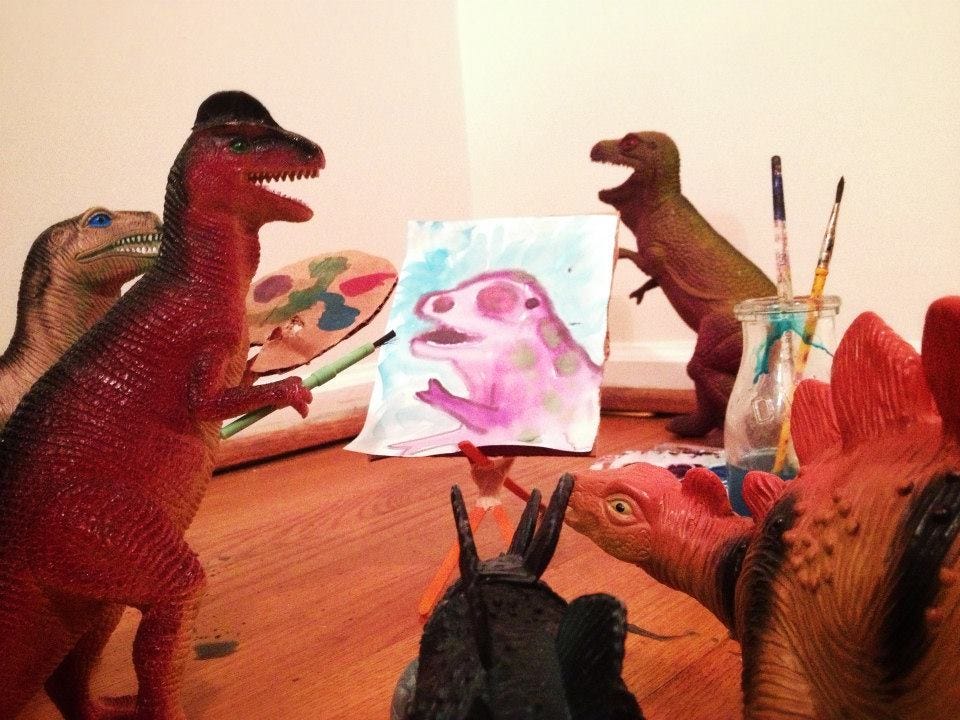
Here's where Dinovember comes in. By creating a mystery that has a touch of the taboo (they made a mess), a pinch of whimsy (interrogating a Teenage Mutant Turtle? This is about the new Bay movie, isn't it?) and an ongoing sense of wonder (could it be true? Do they come to life at night?), these folks have created something magical and engaging for their kids. Is it hard to imagine those youth entering each day of November with the same sense of anticipation kids get leading in to Christmas?
But there's more. By creating something creative and clever, by giving it a brand but not a fixed set of parameters and by inviting others to participate, these parents have built a movement that other parents (and their kids) are going to want to be part of, like a meme.
You can't communicate the complex in one soundbite, but if you can keep your audience coming back for more, you can roll out complexity one frame at a time. This is how TV shows like LOST (about finding community through acceptance of self) and BATTLESTAR GALACTICA (we're on a repetitive cycle of failure - can we become more than we have been before?) built and sustained audiences that debate their finales to this day. Besides, if you want to expand your market, you need to offer broader sets of value that appeal to them.
Progress need not be seen as perilous, nor the Undiscovered Country feared as the end of the familiar. With a bit of sustained hope, hard work and creative thought towards content and context, it can be something to look forward to.
Which is the whole point, isn't it?


