Search This Blog

CCE in brief

My photo
Recovering backpacker, Cornwallite at heart, political enthusiast, catalyst, writer, husband, father, community volunteer, unabashedly proud Canadian. Every hyperlink connects to something related directly or thematically to that which is highlighted.
Showing posts with label State of Fear. Show all posts

Tuesday, 2 September 2014

IGN on ISIS: Fear the Mind Killer


Watch this video wherein IGN staff are asked why it it that we love to fear zombies.  The answers, I think, are pretty bang-on:

- Fear of the loss of self
- They are the Heart of Darkness manifest
- There's a little part of us that fears Armageddon, the end of the world we know
- There's a little part of us that craves Armageddon, the end of the world we know
- Zombies are kinda human, but not really human - meaning it's okay to cut their heads off
- There's something terrifying about the perceived natural process of things (sociology to some, societal decay to others?)
- Fear that we're the rational actors we like to tell ourselves we are and could become zombies ourselves
- That mindlessness is infectious (ie Rome is the mob)

I love the concept of zombies, because they're such an apt metaphor for the human condition.

Which brings us to ISIS.  The people who flock to ISIS, whatever they might tell you, aren't all born-again Islamists or whatever.  Like those who join any aggressive cult, there is a drive to belong, to have power, to be safe against the zombie hoard and to survive the apoclypse.

It should come as no surprise that the US Joint Chiefs of Staff have warned us that "This is an organization that has an apocalyptic end-of-days strategic vision that will eventually have to be defeated."
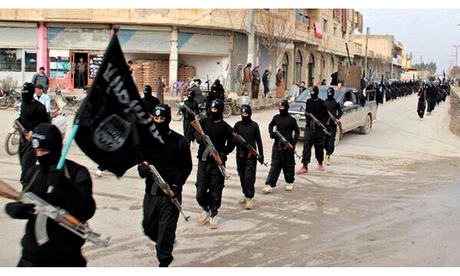

ISIS is essentially a bunker for the apocalypse who fear the zombie masses of the Other.  The Other, oddly enough, that they have no issues beheading, because you know - if you're not us, you're a zombie.

Funny how, if you look to the left, you can't pick out any particular individuals, can you?

What happened as the walls went up around Ferguson?  The police started to get aggressive and call protesters fucking animals.  The use of force went up and the threats to kill escalated.

What response does the West have for terrorism, or society have for Ferguson?  Lines get drawn, sides are chosen and the other begins to look suspiciously like a person impersonation, not a neighbour.

Fear your neighbours, suggests ISIS - they could be one of us.

Fear outsiders, say North Korea, libertarians and Canada's Prime Minister - they mean to take away your individuality and even your life.

What's the consistent thread through each of these scenarios?

The more we fear the Other, the more distance we put between them and us.  They are a threat, inhuman.  It's okay to hate them - our hatred of what they could do to our individuality is, in fact, a purifying force.

Don't feel guilt.  Don't feel shame.  If you don't cut their heads off, they will destroy or worse, convert you. It's our tribe against the zombie hoard; you're either with us, or you're one of them.

Now, go back and read IGN's list.  Notice anything?

The more we dehumanize the Other, the more we feel compelled to band together, circle the wagons, stay on-message.  The more we identify them as an inhuman threat, the more justified we feel in treating them inhumanely.  As we feel increasingly outnumbered, the count-down clock ticks ever more loudly; no time to think, act now!!  Always be closing!


Fear is the mind killer.  It's as simple as that.


Wednesday, 19 February 2014

A State of Fear: When Citizens Become Terrorists


The Global War on Terror has been used as an excuse by dictators to clamp down hard on dissidents since it was declared by George Bush thirteen years ago.  Over the same time period, our general understanding of what a terrorist is has changed.
 
Technically speaking, a terrorist is someone who uses terror - fear - as a tool to achieve political aims.  This fear can be induced through violence, threats, intimidation or coercion.
 
The blowing up of the Twin Towers was undeniably an example of terrorism - al Qaeda wanted to ignite fear among Americans, cause panic and disrupt their and the rest of the West's ability to function internally and engage externally.
 
Of course, technically speaking, much of how politics is conducted in Western countries like the US and Canada these days counts as terrorism, too - attack ads, bullying, voter suppression, so on and so forth.  These tactics are absolutely intended to achieve political aims.
 
Despite the common-place nature of the Political War Room, however, political parties don't declare war on each other; States declare war on States.  Terrorism isn't a state.  It's the collective actions of an individual or individuals that seek to terrorize citizens of a state.
 
Or is it?  We've seen a shift in political rhetoric that seems to redefine terrorists as people who seek to disrupt the best interests of the State, not the people.  Of course, those best interests are determined by the State itself - or at least, the elected representatives of the people who form government.
 
What happens when the interests of the state as defined by government differ with those of groups of citizens?  What happens when the state stops listening to concerns, starts stifling information and starts identifying those groups as enemies of the state's best interests?
 
This is the nature of escalation.  The state makes decisions without consultation; parts of the public resist.  Those who resist get marginalized - and in response, they protest.  Frustrated with protests and displeased with the potential of bad press, the state may want to provoke legitimate protesters into becoming violent protesters.  It's easier to declare them terrorists that way.
 
If anyone else interjects, the state can accuse them of trying to undermine the legitimate state and support a coup.  Instead of it being a matter of policy for the people, it becomes about power and control of the state.
 
Both sides will have friends who will probably support their horse in the race, meaning the tools and tactics grow beyond the power of the state alone.
 
At what point does a line get crossed - when does the state become the terrorist?
 
It's a slippery slope, this - one to be conscious of.